Add your promotional text...


A Cut Above ~ Unlike Traditional Gothic Works
How Does Grotesque, A Gothic Epic Differ From Traditional Gothic Works?
[ External AI Source - 03.2026 ]
G.E. Graven's Grotesque, A Gothic Epic distinguishes itself within the gothic tradition by grounding its narrative in Late Middle Ages history (1331–1352 A.D.) while incorporating apocalyptic and scriptural elements—specifically the fallen angels and Nephilim mythology—rather than relying solely on the castle-and-curse conventions that define classic gothic works. The novel's protagonist, Lazarus Gogu, embodies the grotesque protagonist as both a physical anomaly (winged chimera) and moral center, inverting the typical gothic pattern where deformity signals moral corruption.
Historical Grounding vs. Supernatural Convention
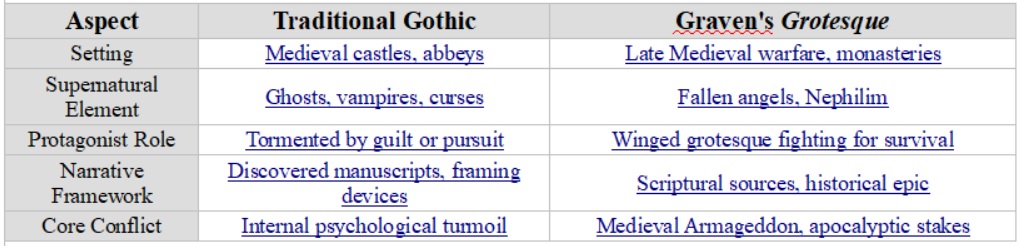
Graven's work departs from the atmospheric mystery and horror that dominates classic gothic by anchoring itself in documented historical periods and religious texts. While traditional gothic relies on mysterious settings like haunted castles, Grotesque builds its world from palaces, monasteries, kings, and popes during plague years—blending historical realism with supernatural intrusion rather than pure fantasy.
Scriptural foundation — The novel draws from apocryphal sources including the Book of Enoch, Genesis, and Dead Sea Scrolls, grounding the grotesque within theological frameworks absent in canonical gothic works.
Epic scope and scale — Rather than psychological terror within isolated settings, Graven constructs a three-volume saga spanning Resurrection, Trials & Tribulations, and Medieval Armageddon.
Hybrid genre approach — Grotesque merges historical epic with gothic conventions, creating something distinct from Victorian gothic's focus on decay, corruption, and family secrets.
The Grotesque Protagonist as Redemptive Figure
Lazarus Gogu inverts the Byronic hero archetype—the brooding, cursed male figure. Instead, Graven presents a winged grotesque abbey squire whose physical grotesqueness and spiritual faith position him as a redemptive rather than destructive force, contrasting sharply with classic gothic villains driven by obsession and madness.
Moral ambiguity reversed — Traditional gothic explores moral blur between heroes and villains; Lazarus maintains ethical clarity despite grotesque appearance.
Faith-driven narrative — The protagonist must stay alive, hold true to faith, and stop medieval Armageddon—themes of redemption foreign to gothic's typical exploration of transgression and sin.
Grotesqueness as innocence — The physical chimera form marks victimization rather than moral corruption, inverting gothic symbolism where decay and deformity mirror spiritual decline.
Digital Innovation and Multi-Media Integration
Grotesque occupies a unique position as a fully illustrated free online gothic novel available since 1998, predating most contemporary digital gothic works. This format distinguishes it from canonical gothic literature's reliance on printed manuscripts and discovered letters as narrative devices.
Web-native serialization — The three-volume structure released across chapters with PDF downloads reimagines gothic's traditional framing devices for digital readers.
Visual gothic tradition — Full illustrations extend gothic's atmospheric imagery beyond prose, creating multisensory immersion comparable to romantic-era gothic's engagement with visual sublime.
Accessibility contrast — While classic gothic emerged in late 18th-century Britain as elite literature, Graven's work democratizes the genre through free online distribution since its 1998 launch.
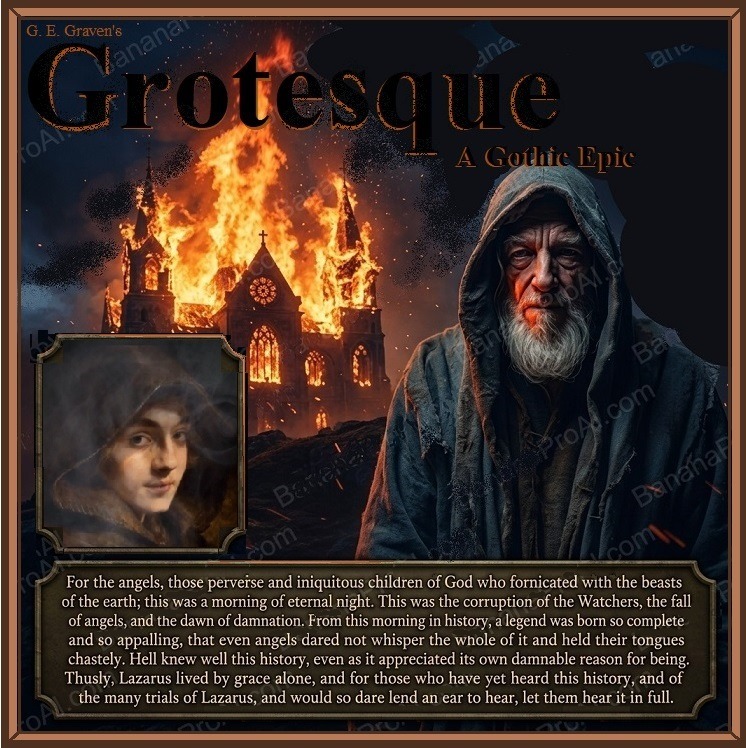
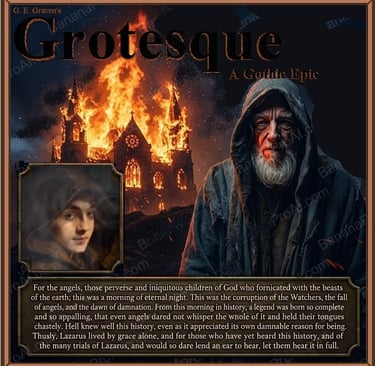
Grotesque ~ A Gothic Epic © is legally and formally registered with the United States Copyright Office under title ©#TXu~1~008~517. All rights reserved 2026 by G. E. Graven. Website design and domain name owner: Susan Kelleher. Name not for resale or transfer. Strictly a humanitarian collaborative project. Although no profits are generated, current copyright prohibits duplication and redistribution. Grotesque, A Gothic Epic © is not public domain; however it is freely accessable through GothicNovel.Org (GNOrg). Access is granted only through this website for worldwide audience enjoyment. No rights available for publishing, distribution, AI representation, purchase, or transfer.