Add your promotional text...


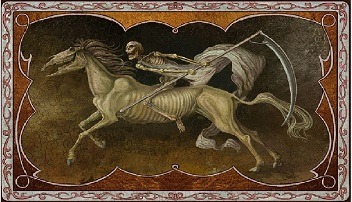

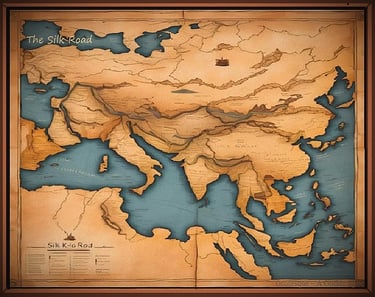
Hell and History were now as intertwined, as were the sins that once plagued a mighty Babylon. As it happened in 1331, a secluded temple in Central China exploded, and from its most guarded secret, a dead bird carried Lucifael’s message across the lands. For seventeen sickening years, the rancid odor of putrefaction rolled over the Kingdom of Mongolia like a divine and malignant breeze ~ the Black Death was the Devil’s Disease. Radiating from out of the heart of the continent, Lucifael's lethal concoction continued its corruption of the vast Asian Kingdom, and by 1347, the wave of mortality and malady had spread to its furthest southern shores, reaching the Black Sea and its fledgling Genoese port city of Kaffa.
The Black Sea ~ Kaffa ~ October 1347
After the Genoese discovery of an all~water trade route to the Far East and Crimea, the Asian seaport of Kaffa had evolved into a thriving gateway for Genoese merchants that gathered rare and priceless goods from Mongolia’s Silk Road and shipped them to the various kingdoms throughout Europe. However, in the later days of 1347, the Silk Road delivered a rather different gift to its eager Genoese tradesmen: The Bubonic Plague.
The walled city of Kaffa immediately closed its gates, shielding itself from further infection as, elsewhere, Mongolians rotted, unabated and by the thousands. Ill word of the Genoese tradesmen spread as quickly as did the disease ~ word that the foreigners of the West had drawn upon their ‘evil Christian magic’ to cast the Mother of All Curses over Mongolia. Hence, surviving warlords banded together to form an army of Mongolian Tartars who charged against the fortified city in attempts to drive the colonial beast, back into the sea, from whence it came. Yet, with defending rows of capable crossbowmen, spearmen, and superior strategies, Kaffa held claim to its Crimean ground.
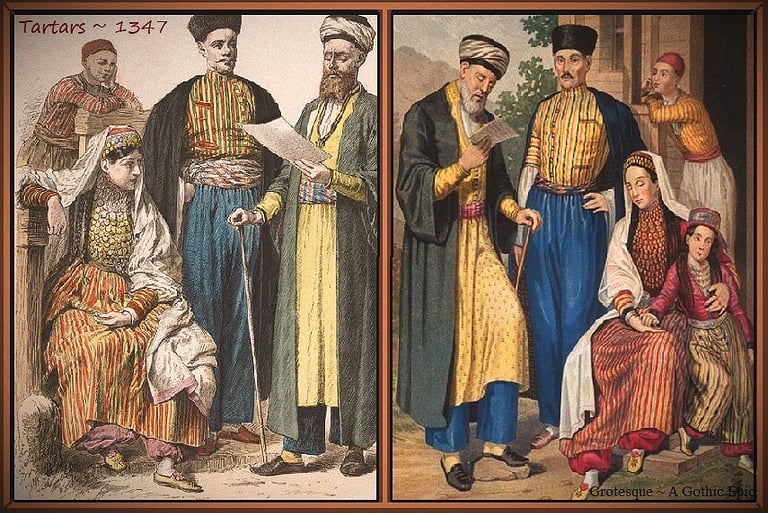
Initially sporadic, the attacks on the city grew more organized and fierce as the campaign evolved. Still, the Genoese kept the Mongols at bay for three grueling months; that is, until the Tartars eroded Kaffa’s ramparts with wave upon wave of vengeful, charging, screaming, and most~honorable Mongolians. In the spring of 1347, when the weather warmed and the cherry blossoms bloomed, Genoese blood began to seep from its own city walls. Low on provisions and able bodies, the stranded inhabitants had come to terms with the outwardly inevitable ~ that the Tartars were on the verge of taking the city. However, in a rather unusual but divinely intentional twist of fate, the tide of battle changed. The winds turned and the heated breath of Lucifael blew over the pressing armies as the plague had finally infiltrated the ranks of the Tartar hoards. In only days, the entire countryside reeked with the heaping decay of a rotting Mongols, and, for leagues in every direction, the fumes of festering human flesh ruined the air. Mortified, the Tartar Lords could only watch their vast numbers crumble, as whole legions fell; bloated, blackened, and decimated by disease.
It was no wonder that the Tartars were equally appalled and ashamed by their stricken condition, as they held their cultural and religious preoccupations in highest esteem; revered with an honor greater than any fear of life lost. All but blind by such strict social notions, of which were underscored by centuries of unwavering indoctrination, the Mongol warriors appreciated only one way of life and accepted only one manner of death. For the Mongols, life and death were black and white, with no confusion in matters regarding dignity and dishonor. For them, death in battle was honorable, unlike death by disease, which shamed their entire family and forever marked their survivors with the social stigma of impure lineage.
As many of the Mongols fell mad with fever, plagued to demonstrate a most~honorable death, they charged Kaffa’s walls in massive suicide raids. Stragglers, who were too weak to fight, stumbled forth and stood before the ramparts like ceremonial wretches and beggars of dignity, longing for a kind Genoese crossbow to still their suffering and rescue their families from otherwise inevitable and dishonorable distinction. Perhaps, by means of implied redemption, the Tartar warriors threw themselves against the base of the city’s fortifications, sacrificing their superior numbers to an ever~growing staircase of fly~infested flesh, allowing their Mongol comrades to climb their most~distinguished remains and scale the walls.
As the days wore on; when the sun retreated behind evening skies and the coastal breezes turned seaward, the Genoese colonists drowned in the acrid stench of a thousand souring Tartars. Still, they held their city, praying that the plague would eventually kill the will of the Mongol masses. Numbers and fortifications aside, Time was no ally for either army, since the Genoese were depleting their provisions as quickly as the plague slew newly recruited Tartar warriors. Thus, it might have seemed as though both armies had altogether fallen into a stalemate.
However, as History knew well; with every application of the Art of War, Man was merely a disposable pawn. After all, the Art of War was not of earthly design ~ ‘twas strictly a divine invention, conceived even before the construction of Hell, when legions of heavenly angels armed themselves against their earthly brothers and sisters: the Watchers, with their Chiefs of Tens. And one angelic sister, in particular, knew of the design of war. As God’s foremost angel, Lucifael was indeed privy to most of His Grand Design. Immediately following her fall from Grace, she employed her acute knowledge of creation and destruction to influence Man, providing Him with new tools and strategies to wage evermore~effective wars upon His brethren ~ the canon, the longbow, and the armor~piercing bodkin arrow were only the latest devices of destruction designed via the intimate whisperings of her evil advice. Now, she whispered fresh secrets and, once again, the art of war had evolved to include a deadly new concept. When she infected the auricles of the dying Tartar Lords with her wicked whisperings, they learned of a rather vile strategy of human annihilation: germ warfare.
Determined to oust the Genoese, the Lords summoned a fleet of thirteen of their largest catapults and commanded its armies to hurl the contaminated corpses of its comrades into the heart of the city. Evenly spread over Kaffa’s walls, the death machines never rested. Night and day, for time on end, an inexhaustible supply of diseased Mongols rained down upon the Genoese city, crashing through rooftops and crushing unsuspecting passersby. At such an ungodly rate of delivery, the colonists could not burn the bodies as quickly as the Tartars hurled them over the walls. And the ghastly odor of burning hair and skin mingled with the existing smell of rotting flesh, filling the enclosed settlement with a suffocating stench. Hell had overwhelmed Kaffa as a lone crow cawed twice and again from the upper boughs of a cherry tree.
Surrounded, and with nearly all of its provisions depleted, Kaffa readied a fleet of thirteen of their largest ocean~faring ships, rigging them for swift departure. Genoese sailors, soldiers, and merchants stripped the city of its possessions, filling the vessel holds with all that was priceless: gold and silver; Asian jade and crafted stoneware; tanned hides and bundled furs; rough gems and rare jewels; and barrels of spices and perfumes. And when they had thoroughly packed the fleet’s hulls, they stripped the planking from the city’s wooden structures, enclosing the ships’ decks with even higher walls to accommodate the additional cargo that remained. With the city gutted of its most precious holdings, twelve ships stole out of port under cloak of darkness. The crew of the thirteenth remained behind. Thoroughly torching the city, they left a roaring inferno of blazing buildings in its wake as they caught up with the retreating armada.
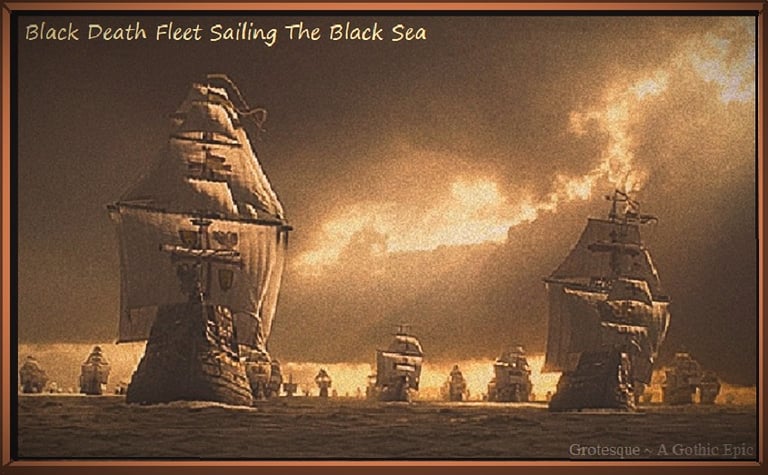
The Santa Godeberta was the largest and most seaworthy of the thirteen cog ships. Her massive columnar crossbeams spanned a doubly reinforced hull of clinker planks, and, with a towering mast, yard, and sail, she escorted her heavy flotilla toward Genoa. Her crew had since modified her deck to include borrowed planks from Kaffa buildings that formed a raised wall above her gunnels. In preparation for high seas, metal clasps anchored a web of ropes that secured her overly copious topside cargo.
Larger than most ocean~faring merchant vessels, she was the latest construction and the pride of Genoese shipbuilders. A U~shaped quarterdeck stood over her cargo~covered aft deck and, above her fore deck, an accommodating prow~deck extended over a straight~stemmed bow. Even without her tens of tons of Kaffa cargo, she displaced nearly one hundred and forty~four tons of water. She was indeed a sea beast, if ever one existed. However, she was not empty, but packed to the gills, her belly sitting heavily in the water and her twelve oar ports hugging the ocean swells. ‘Twas only her eighth haul from Kaffa to Genoa and would yet prove to be her most burdensome. Well over her designed capacity, the slightest misfortune or miscalculation could clearly send her and her twenty~four seamen screaming toward the bottom of the ocean. Beneath a blanket of early morning stars and in the steady breeze of a seaward wind, the Santa Godeberta led her heavily laden fleet across the placid face of the Black Sea and into the dark horizon of home’s direction.
Indeed, the Genoese colonists had escaped the flying Tartar corpses with all of their treasures and left their envious Asian enemies to inherit only scorched earth. However, as clean and easy as their escape might have seemed, they did not account for angelic intervention ~ when Lucifael had a stake in History, she seeded the roots of it, often sewing the future with bittersweet hindsight. The Genoese were safely away from Kaffa; yet they failed to escape their dire destiny, of which Lucifael had cunningly prearranged. Only days into their voyage, members of the fleet fell, deathly ill. Surviving seamen rolled their fatalities overboard whilst quarantining the growing sick below quarterdecks and near the rear of their vessels. They bought themselves time enough to keep the deadly contagion at bay, sloshing the deck with buckets of brine to wash away the expelled waste and fluids of the infected. Even with such precautions aptly applied, they had no idea that that their comrades were less of a source of infection than from the stowaways that hid beneath the decks of their vessels. And when the armada rounded the southernmost tip of Italy, the dying outnumbered the living by nearly two to one. En route, the trailing ship of seamen who burned Kaffa to the ground had fallen away from the fleet, drifting aimlessly as it waned into a flat ocean horizon. The twelve ships pressed forward like persistent floating coffins, crossing a barren sea and driven only by the desire to see their Genoese port. Yet, desperation finally carved the seaward course of the Santa Godeberta. With failing seamen running her rigging and Genoa still too far to sail, she swung her bow and fleet toward the nearest seaport of Messina, Sicily.
With only twelve creeping trade ships, manned with a handful of dying men, the Black Death Fleet would survive History and be remembered as the deadliest ill~equipped armada ever to sail European waters. And from the waters beneath the earth, Lucifael sneered.
Mountain Mouth ~ November
The setting sun faded behind drab late~Autumn clouds, leaving a black and unseasonably cold eve to linger over the heartland of France. A tree limb cracked; a dog barked; yet, no other noise troubled the hushed and windless night. Below ground, the sound of a boy’s labored breathing carried through the darkness as, deep within the bowels of Mountain Mouth, a robed figure struggled up a steep passage and toward the grotto, a refilled water bladder draped over its shoulder. The silhouette dropped the bladder near the cave wall and turned a quick attention to a dwindling fire. Fresh wood and a new flame revealed Lazarus, his hood now tucked into his rope belt. Long black hair framed the boy’s dirty and somber face, his eyes flickering like glowing sapphires in the firelight. Aside from the steady fog of his breath, only the movement of his pupils marked the otherwise motionless moment, swelling and contracting in the light of a struggling blaze.
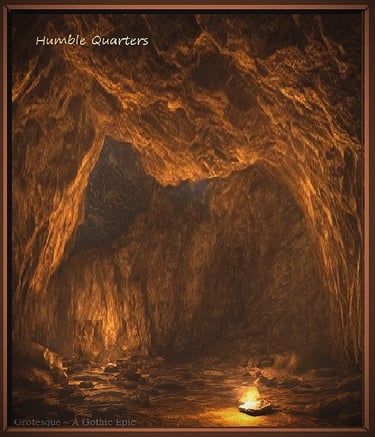
Lazarus sat on a stone. In effort to exorcise the perpetual chill that had since settled within his extremities, he pulled the hood of his robe over him, propped his feet against glowing coals, and warmed his hands against the new radiance. Yet, the flames climbed, the fire roared, and Lazarus’ pupils were but pinholes against blue circles. He stepped away from the infernal heat that now consumed every trace of chill from the grotto. High overhead, orange hues and shifting shadows danced across the clinging mass of a thousand bats; altogether, their vast numbers of eyes reflecting in the firelight to mimic a dark sky of twinkling stars. Smoke spiraled upward, pooling against the grotto ceiling. A handful of bats took flight and circled the cave. Lazarus slipped the hood from his head and checked for the fog of his breath, which had since disappeared. More bats stirred in the quickly warming cavern.
The boy fixed his eye on the bats as he left the fire and scaled irregular rows of the terraced ledges, making his way toward the upper regions of the cave, occasionally turning about to inspect them from an even higher vantage point before continuing his climb. A sea of beady black eyes scrutinized his steady upward advance; however, the bats did not flee as he initially gathered they might. Instead, they remained steadfast against the ceiling, seemingly as curious of Lazarus as was he, of them. The boy pulled himself atop the highest ledge. He stood and straightened his robe whilst inspecting the roof of the grotto, with its many staring eyes.
“Are you warm?” he asked aloud. “Will you teach me?” The boy’s sudden call carried through the hollow and several bats dropped from their roosts to join others already circling the cavern. More followed suit and the grotto churned with a flurry of fluttering wings.
Altogether, it might have seemed as though they took turns demonstrating their worthiness to the colony while the masses hung fast as heavenly judges for to keep score of the latest demonstrator’s aerial abilities. And even if they weren’t being judged, Lazarus certainly kept a close eye on those of them that chose to fly.
At length, the boy disrobed. Steadfast on the ledge he perched in nothing but loincloth and foot mittens. His own magnificent bat~like wings unfurled and splayed, with them he mimicked the wing movements of his tiny teachers. Though each bat was different, Lazarus discerned from it that, in flight, its wing movements were identical to all the others ~ wings cupped and beating in an ascent, wings hard and open with a sudden slowing, and wings tucked for a quick dive. His eyes flashed about; his wings popped the air; his brain burned as he contemplated the methodology ~ the many forms and necessary methods outwardly exhibited in the art of bat flight. So it happened, that throughout most of the eve, he learned from his cave companions.
In the hour before dawn, the bats had since closed their beady black eyes, surrendering themselves to the realm of upside~down daydreams, and Lazarus retired from his evening lessons. Fatigued, hungry, cold, and with aching wings, Lazarus slipped back into his robes and climbed back down onto the grotto floor. He stoked the fire and gathered food from his sack of provisions. Finally, he sat on a stone before fresh flames, a water bladder beside him, and he feasted hungrily on flatbread and strips of salt~cured meat. A shift in the shadows stole his attention.
Yellow eyes glowed!
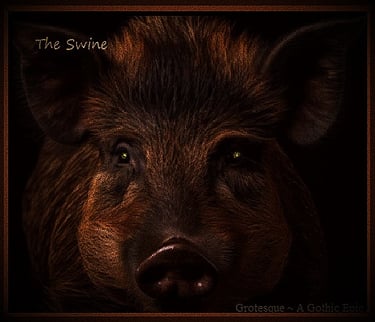
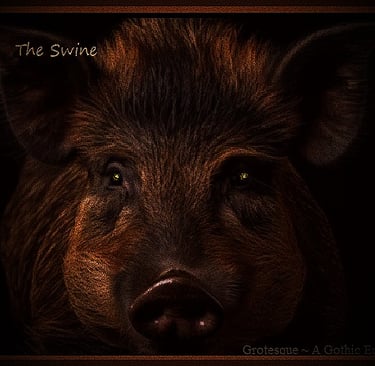
“HISS!” Lazarus spat his food, fell off the stone, and scrambled backward as, within the grotto entrance, a pair of gleaming unattached eyes seemed to float in the blackness. Like twin moons, hovering near the cave floor, the orbs burned through Lazarus with reflecting firelight.
“Who goes there?” Lazarus managed the question, ears back and pupils wide. The eyes never blinked. Lazarus sniffed the air and raised his ears to discover the faint odor and irregular breathing of an animal that likewise smelled out the air.
Then a black boar snorted and stepped out from the passage shadows. Lazarus huffed with a sigh of relief. He stood and brushed the dust from his robe, chuckling as he did. “Why, you are a swine! I’ve seen the likes of your kind ~ in books!” The spooked boar spun away for the grotto entrance but then stopped and looked back at Lazarus.
“Oh, don’t leave! I mean you no harm. I shall sit now.” Lazarus eased himself to the stone and sat silently. The boar turned to Lazarus and took a few small steps, smelling the air as he stopped.
“You are hungry, yes?” Lazarus asked. He lifted a strip of meat from beside his foot and presented it in good light. “Come. Eat.” The boar kept his distance.
“Have it.” Lazarus threw the meat only a few feet from the animal. It cast nervous eyes between Lazarus and the food scrap but eventually stepped forth, sniffed, and devoured the meat. Then it stared at Lazarus, seemingly as if waiting for more.
“Do you also like bread? I don’t care for it ~ too dry.” Lazarus tossed a large chunk of flatbread. The boar scooped it up and scrambled out of the grotto.
“Wait! Don’t go!” Lazarus gave chase. In the outer cave, he rounded the corner to the cave entrance to spot the boar clambering over the rocky ridge. Above the hill, crimson clouds stretched across the sky ~ early sunrise. Lazarus quickly retreated into darkness. Only then did he realize how truly exhausted he was. He shuffled back to the grotto.
Over the course of the following week, Lazarus continued his lessons, building strength enough in his wings to lift himself off the floor. But with wings still too weak to support his weight, Lazarus could only muster short low~level flights between the tops of cave floor stones.
With time turning, Lazarus fell into the same schedule as the bats, sleeping during the day such that he could study them when they were most active. The nights grew colder with recurring frosts and when the firewood heap dwindled, he left the cave to collect wood from the backside of Mountain Mouth. As the smoke continued to rise from his fires, growing numbers of bats left the cave to seek undisturbed roosts elsewhere. With nearly a quarter of them gone, Lazarus began to notice barren spots in the ceiling that they once covered. However, these days, Lazarus’ attention was not strictly devoted to the bats, since, after his lessons and precisely at sunrise, the boar now frequented Mountain Mouth to join him for dinner. And dine, they did.
Sicily ~ Port of Messina
A well~dressed Sicilian boy stood upon the sand of the sea as a whirlwind of gulls swarmed over him for bits of broken bread. His long black hair and bright clothes whipped in a steady breeze. He held the last morsel of manna toward the heavens, eyes closed on a grimacing face. A sea gull snapped it from out of his fingers and he yanked his arm down, giggling. The boy shaded his eyes from the glaring sun, interlocking his fingers over his brow whilst staring toward the southwestern ocean horizon. Two specs appeared ~ then a third.
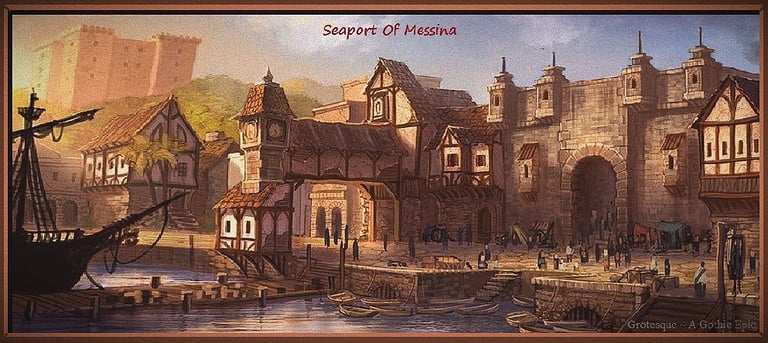
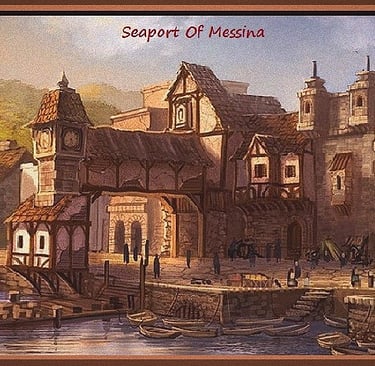
“Mama! Ships,” the boy called from over his shoulder as he pointed seaward, “Four! Five ships! More!”
The Santa Godeberta led her heavy armada of merchant vessels into the port of Messina. With a low stern and a high bow, she sliced a path through the rolling sea, overloaded with the considerable and costly remains of a fallen city. As a ghost ship, her abandoned deck glistened from a steady sea~spray; still, without a visible crew governing her course or sail, she did not yaw or bow in the ocean swells. As deeply as she sat in the water, even with her many tons of cumbersome cargo, only a handful of fleas and a basket of rats would truly demonstrate the gravity of her haul. No heavier than a sack of rice, the insignificant burden of these insects and rodents would prove quite capable of breaking the backs of millions; crushing the pillars and flagstones of every European kingdom; and flattening the face of the entire continent.
A crowd of pedestrians and passersby gathered at the docks to witness a rare spectacle of its time: a fleet of massive ships, seemingly capable of sailing even the widest and most treacherous oceans. Hundreds of eager boys and scruffy peasants lined the docks of the port, seeking to lay claim to more of the sparse dock space nearest the rope pilings. They jockeyed for position as hired hands for unloading cargo. With such a heavy fleet, they were quite certain that, of those chosen to unload, a generous pay of several days’ labor was in order. Men grumbled and shoved one another as wrestling boys churned the dust. People packed the port as the congested crowd swelled into the streets. The bustling city stalled to a standstill, stopping to watch the approaching armada. Increasingly apparent to all of its bystanders, the docks were incapable of safely securing such a monstrous flotilla. Still, the fleet pressed forward, obstructing the horizon with its ever~growing presence.
A burly Port Captain and two of his port~smiths stood atop a highly elevated landing of timbers that overlooked the congested dock. The frustrated captain waved a red banner toward the approaching ships, signaling them to break and hold fast. Beside him, one of the port~smiths voiced agreement to the captain’s former claim. “Right, you are, sir. They are no ships of ours ~ Portuguese? Genoese, perhaps?”
The other porter tapped the back of the captain’s hairy shoulder. “They’ve arrived, sir.”
The man lowered his banner and peered down over his shoulder to discover ranks of armed soldiers penetrating the crowd. Altogether, the glaring sunlight of their helmets and the forward movement of their elongated formation could have projected the likeness of a glowing fire~worm, parting a sea of heads as it snaked toward the dock. He nodded and turned his attention back to the unyielding fleet, waving his banner in a desperate attempt to hail ~ yet, to no avail, as the Santa Godeberta broke the outer perimeter of Messina’s harbor.
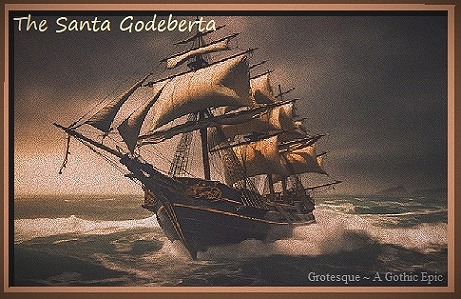
The captain’s concerns were clearly apparent to his port smiths, who likewise stood in awe over the fleet, which now bore down upon them as if sailing hard and strong in the high seas. As was both custom and rule for the safe docking of larger vessels such as these, their sails were to be fast to their yards and oars drawn and used whilst navigating through the harbor. However, only half of the Santa Godeberta’s sail lay fastened to the yard ~ the rest of it remained unfurled and catching the wind. The tangled ropes of her main rigging dangled about her mast and yard. With only three of her oars churning weakly, they did little to stifle her speed.
“They’re standing hard on us, Captain,” one of the port~smiths exclaimed. “There’s a long sea behind them!” He pointed toward the ship that followed closely behind the Santa Godeberta, having a full sail and no oars. “And the next ~ she’s like a barrel rolling down a plank ~ her sail is wide open! Look at her, Captain, she is barreling wide open! Shall I make the call?”
The Captain cupped his mouth with a hand, waving the banner as he yelled toward the approaching fleet, which now began to fill the bay. “Avast! Muster the yard rigs! Swing stem to stern! Turn your~”
One of the nearer ships crushed a small fishing craft, dragging part of its remains by its own net, which hung entangled on its bow. The Captain dropped his banner and ordered his port smiths to proceed with the call.
They leapt to his command. One of them turned about, grabbed a suspended metal mallet, and rang a large tubular bell. The other man screamed over the deafening tolls, waving his arms, ordering the crowd to clear the wharfs. Panic ensued as the throng trampled itself in its haste to flee the harbor’s edge. Screaming soldiers fanned out in a desperate attempt to form a barrier.
The many eyes of Mesina’s masses lay fixed on the Santa Godeberta as she sliced her way through white~capped waves, belching a steady spray of ocean from beneath her massive bow ~ she was as a raving sea monster intent on beaching herself. The port captain and his two men leapt from the observation tower even as rows of wharf planks and pilings exploded beneath the crushing weight of the over~stowed ship. The entire harbor reeled from the force of her impact. The shattered tower collapsed atop the crowd as the ship ran aground, heaving itself over the line of soldiers and crushing them into the coastline. No sooner than did the Santa Godeberta plant herself atop the soldiers, the second ship blazed into port, narrowly skirting her backside and scouring the starboard corner of her stern before turning sharply, slamming its larboard side against the harbor, and disintegrating a vast stretch of the wooden dock. Again, the seaport tolled, roaring to the crash and the screams of its stupefied populous. Ten more heavy vessels rolled into port, presenting of themselves a massive wall of wood, ropes, and sails that seemed to swallow up the bay; and with no sign of crew on their masts, yardarms, or decks, the seaport of Messina appeared under siege by an invading armada of ghost ships.
And what, if not by apparent divine intervention, the two ships' hulls remained intact even as a large section of the port dock lay destroyed, pressed against the shoreline as a heaping row of splinters. Close behind them, ten more ships crept into the bay, eventually slowing to a still. Against the bulk of uninvited vessels, men scurried openly as frantic insects; the harbor was a rolling chaos. With the Santa Godeberta's bow landlocked, the Port Captain and his guards clambered over her foredeck.
A shirtless and sweating sickly man stumbled out of the hold. He fell back against the near wall, and slid down on the deck. He slouched over, bobbing his head like a drunken sailor. The hollows of his eyes lay dark and seemingly bruised, as were the tips of his fingers. Port guards swarmed around him while others poured into the ship’s hold.
The port captain pointed over his head. “Cut loose her sail! This ship stays!” Several portsmiths climbed the rigging. He approached the sweaty man and screamed; “Where is the Captain of this vessel?” He turned to the ship’s hold entrance and bellowed, “I want all of the crew on deck! Bring them up!” He turned back to the dirty man. “Who commands this fleet?”
The man responded in a manner, delirious with fever, “No captain ~ no fleet ~ only ocean. Ocean claims the dead ~ all dead.”
A portsmith whispered in the captain’s ear, “He’s drunk, no doubt.”
The port captain continued his interrogation. “What is the name of this ship? This fleet sails for Genoa, yes?” He scanned the heaping cargo. He glanced over the decks of the other vessels. “Your ships are loaded beyond capacity. How you kept them afloat, only God knows. Where did you get all this cargo?”
The man managed a reply, “Ship is ~ Santa Godeberta ~ from Kaffa, to Genoa.”
The Captain commanded two of his men, “Get him on his feet. Give him some air.” He spoke to another who stood beside him, “Draw a pail of water. Sober him.” The captain shook his head and mumbled, “Kaffa ~ with this load?” He looked over the tied goods covering nearly every section of deck and spotted a black rat darting between barrels. He crossed his arms. “Not in a thousand years.”
“Capt’n!” A voice called up from inside the ship’s hold. “There are only five men on the oars.” The port captain stared at the hold entrance as man stepped out and wiped the sweat from his brow. He continued, “Capt’n, these men are ill ~ quite so, even. We shall have to carry them.”
Two guards reached beneath the dirty sailor’s arms and hoisted him to his feet.
“Argh!” The man cried and crumbled limply. The startled guards dropped him onto the deck and the unconscious man lay sprawled, with his arms over his head and exposing a pair of black swollen masses, like rotten apples, which protruded from out of his armpits. The ruptured swells leaked as a mix of puss and black blood pooled over the deck. The guards wiped their arms against their pant legs. A rancid odor boiled up from sleeping sailor. The captain cupped his nose and mouth and backed away. “In God's Name!”
Then he turned and bellowed, “Leave the ship! Touch nothing! A pestilence is aboard!” Guards flew toward the ship’s bow as portsmiths scampered down the rigging, some jumping headlong into the water.
In the short space that followed, all twelve ships were secured to port, guarded by hundreds of armed soldiers assigned with orders to stop, even by deadly force, anyone that attempted to board or leave the ships. And in only a day, rumors of the contaminated ships spread throughout Messina.
On the second day, the fleet crews requested physicians to come aboard and tend to the sick. The city officials agreed only on the condition that once the physician climbs aboard the vessel, he must remain. None of the city's physicians agreed. Port officials sent food and water over by buckets on ropes. Once emptied, the buckets remained on the vessels. In this way, every precaution was made to quarantine the ships.
On the third day, the stench of death drifted over the dock; carried inland by sea breeze. By physicians’ warnings, the guards were ordered to fall back for fear that the wind carried the ships' contagion. With the guards further away from the ships, dusk fell quietly over the dock and rats, driven by thirst, mustered the courage to crawl down the ship’s hawsers, down the tie ropes, and onto the dock only to scurry off and join their wharf rat cousins.
On the sixth day, many guards fell ill. An angry mob gathered at the port and the city officials had no recourse but to order the twelve ships out of port, cargo and all, lest they be set ablaze. Seeing quick profit and free passage to other European ports, stationed sailors from Genoa, Marseilles, Corsica and Sardinia agreed to split shares of the fleet’s precious cargo in turn for manning the vessels out of port and to various coastal cities.
And on the seventh day, the harbor flushed the ships out to sea. Immediately, the Black Death Fleet disbanded, with most of its ships setting their sails for ports other than Genoa. Inconspicuous on the surface, Messinia already lay condemned since, although its port was purged of the Genoese vessels, the gatestone disease remained lurking in the shadows beneath her docks. Riding the backs of infected wharf rats were equally infected fleas, gestational with disease. Their stomachs were infinitesimal wombs of Hell ~ in full labor ~ ready to deliver their devilish concoctions. And the Devil’s evil evolved. Within weeks, Lazarus' wicked mother transformed the entire Messina populous into a fruitful orchard of pestilent black apples ~ ripe with death and plump for her plucking.
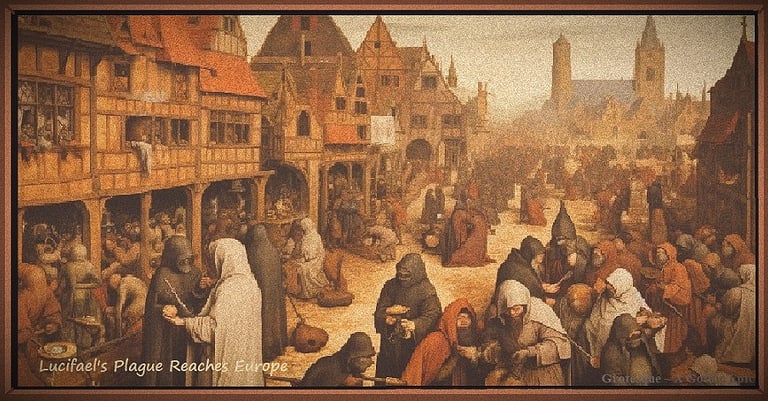
Thus, it happened that the Great Pestilence arose from the docks and swarmed inland, leaving in its wake only a gutted shell of a city. The plague blazed into a full~blown wildfire as Europe’s final hour had come.
Mountain Mouth ~ December
More than three weeks had elapsed since Lazarus first arrived at Mountain Mouth. In that span, his body hardened with muscular definition and the weight he since lost in his arms and legs was only transferred to his now heavier muscle~toned wings. Short flights between floor stones had evolved to longer flights at higher altitudes. He no longer climbed the wall to the stone ledge near the roof, but flew to and from it. He collected firewood not by walking around the backside of Mountain Mouth, but by flying over its crest and back again. Still, even with these new abilities, he was in no condition to make the journey to the Italian monastery. Even short flights requiring any degree of effort, like that of collecting wood, stole his breath. And he knew that in order to cross the Gulf of Leon to the Isle of Corsica, or from the Isle to the Italian mainland, he had to prove himself capable of remaining airborne for at least half a night.
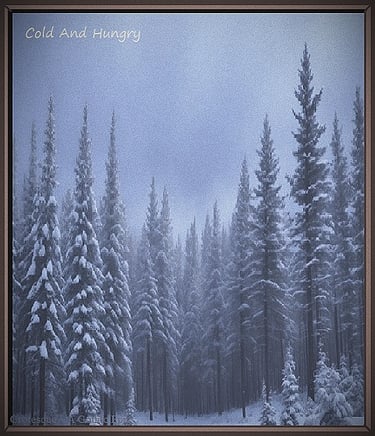

A bitter cold blew steadily out of the north. The valley of stones stood glazed over with a thin sheet of ice left by the previous night’s sleeting rain. Inside the grotto, Lazarus lay asleep, curled beside a dying fire, his steady exhales forming fog in the frigid air. Above him, half the ceiling lay barren, with the bats huddled against the higher rear roof of the cavern.
Lazarus groaned and pulled himself tighter into a ball. Asleep still, his ears perked and they searched the cave for a fresh sound that echoed within its walls. He cracked open his eyes; his over~sized pupils shrank to black dots on blue.
“Swine?” he called out, easing himself into a seated position. He yawned with fangs and rubbed his face. “Is that you?” A snort answered in reply. “Not now, swine. I’m tired.” Lazarus searched the darkness only to discover the boar rummaging through his sack of provisions. “Swine! No!” Lazarus leapt to his feet and ran toward the boar. “Get out of there!” The animal raised its head out of the sack, a plump squash in its teeth. It squealed and darted out of the cave with the morsel.
“Don’t let it be,” Lazarus sputtered, frantically searching through the contents of the sack. He pulled out the flask of blood and examined it. Save a thin fracture running the length of its side, the vessel remained sealed and unbroken. Relieved, now another notion struck him and he flipped through the sack to discover that the boar had robbed him of every crumb of food.
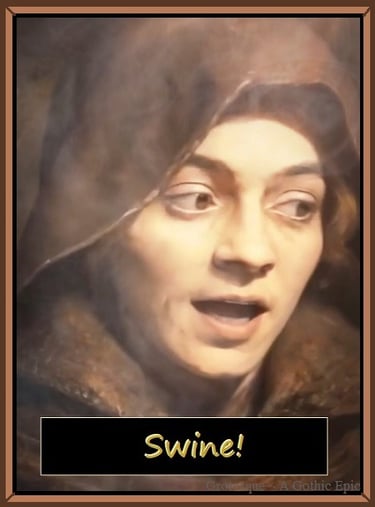
“Swine!” he yelled. Lazarus retrieved a small leather satchel from the sack and placed inside it the flask and other items that he deemed important enough to keep near him. Then he stormed back to the dying fire with it. “Why?” He set the purse down beside him and stoked the fire with fresh wood. “I shared my food with you!” He threw more logs atop glowing embers. Lazarus screamed at the grotto entrance, “Thou shalt not steal!” Several bats took flight, circling the cave, as smoldering logs burst into flames. Lazarus glared through the fire.
Another week crept by as a fresh snowfall blanketed Mountain Mouth. During such time, Lazarus slit the back of his robes such that his wings hung outside of them. He also returned to wearing his mask. These changes were necessary if he was to circle the crest of Mountain Mouth for any great length without freezing. And with them, he managed to stay aloft for nearly three hours. However, even three hours was not enough to cross the seas. With winter fast approaching and him without food, Lazarus finally collapsed from hunger, fatigue, and bitter cold. The culmination of these unbearable conditions drove him back into the grotto ~ to reconsider his promise.
Early morning had arrived with a sea of stars drowning ~ dying in a crimson sky. Within the grotto, a lethargic Lazarus stoked the fire once more and lay down his head. He peered over the nearly deserted ceiling ~ only a quarter of the bats remained. And there he lay, considering whether to fly back to the Abbey; stealing into the night and returning to the cave, replenished with kitchen provisions.
He sniffed the air as a familiar smell lingered in it. His stomach rolled into knots. Lazarus scrambled across the floor, hoisted a hefty boulder, popped open his wings, and tore into the air. He circled inside the grotto with his eye fixed on the passage entrance. Unaware of Lazarus, the boar stepped inside, moving quietly, easing its way toward Lazarus’ empty sack of provisions. Then the animal worked its head inside the opening. Lazarus dove with the stone and struck its head. The boar squealed and bats erupted from the ceiling.
The boar staggered out of the grotto. Consumed by hunger, he lifted the stone and gave chase. Together, they raced out of the cave and across the valley of stones. Lazarus gained ground on the squealing pig as both cleared the ridge crest, clambering down its east slope. Disoriented, the boar stopped and turned on him, thrashing tusks. In that moment, Lazarus’ stone found its mark ~ the boar was no more.
Breathless and exhausted, Lazarus grabbed the pig by its hindquarter hoofs and dragged it up the ridge, toward the cave. Only when he neared its crest did he realize his predicament. He raised his face, squinting at the burning red dawn, and now fully aware that he stood outside the cave as the sun rose. Frantically, he pulled the boar over the crest and back down its shadowed side. Heave after heave, Lazarus dragged the pig across the dry riverbed, swathing a path through the snow and toward the cave. The snow heaped over the pig and melted into the fur of the still~warm animal. Moments flew passed him like a string of bees. The sun climbed further still, the stars now drowned in its fire. A sunburn itch crept over his exposed skin yet with his every remaining strength, Lazarus pressed on ~ foot by foot, yard by yard, all the while ignoring the pain.
At last, he reached the cave mouth, dragging the boar into its depths. The first rays of searching sunlight peered over the horizon. Lazarus heaved the wet pig still further into the darkness. Yet, a thin red line of light and a thread no wider than a spider’s web, pierced through a crack of stones atop the crest of the eastern ridge, shot across the valley of stones, and fell inside the cave. It struck the head of the boar and bounced off glistening melted snow. And as would a looking glass cast reflection, the water deflected the beam ~ dead into Lazarus’ eye!
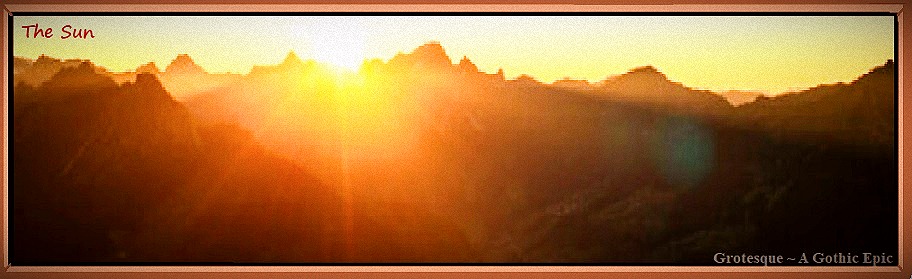
Lazarus released the boar, leapt into the shadows, and writhed across the floor as if slapping away clouds of stinging wasps. “Oh God! Ah! Ah!”
Smoke burst forth from every part of his body, with a dusty cloud spilling over the cavern floor. Blind and with arms flailing, he scrambled to his feet and stumbled deeper into the cave in as much the same manner as did the disoriented swine stumble out of it. An ashy trail boiled behind him as Lazarus darted through the passage, tore into the grotto, and ran to where he normally slept.
“Oh GOD! No~No~NO~~~HISS!” He stumbled and rolled about atop his sack of empty provisions.
“Ah~Uh~UH~~~SCREECH!”
Startled bats erupted from the ceiling and swarmed the cave. Rolling and clawing at the floor, Lazarus found his leather satchel and, in his delirium, clung to it as if life depended upon his doing so. Yet the satchel could not save him ~ no purse, prayer, or promise could reverse the death of a grotesque once burned by the sun. He rolled and propped himself up on one arm. Tremors rippled through ever~hardening flesh.
“FA~THER!” He screamed once last. Then his skin crackled, color draining, turning gray as granite. The last of his choking breaths turning silent as he tumbled stiffly on his side, a petrified arm still thrust out toward the heavens. Within the roiling smoke, the dying continued as, completely to his core, Lazarus transformed into such a horrible state that even his bones became stone. And when the ash settled, the grotto fell still as a crypt, save for the fluttering of bats above a fresh fire and a newly created granite statue, oddly draped in a dirty squire's robe.
Lazarus was dead.
Vol. I: Chap. X ~ finis.
Next Chapter~
~11: Fall From Grace
“Take them, O great Eternity!
Our little life is but a gust
That bends the branches of thy tree,
And trails its blossoms in the dust!”
~H.W. Longfellow
Grotesque ~ A Gothic Epic © is legally and formally registered with the United States Copyright Office under title ©#TXu~1~008~517. All rights reserved 2026 by G. E. Graven. Website design and domain name owner: Susan Kelleher. Name not for resale or transfer. Strictly a humanitarian collaborative project. Although no profits are generated, current copyright prohibits duplication and redistribution. Grotesque, A Gothic Epic © is not public domain; however it is freely accessable through GothicNovel.Org (GNOrg). Access is granted only through this website for worldwide audience enjoyment. No rights available for publishing, distribution, AI representation, purchase, or transfer.