Add your promotional text...

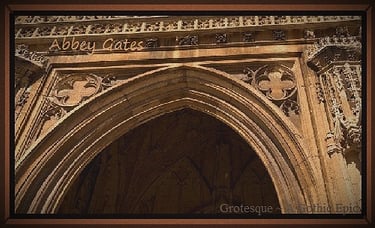
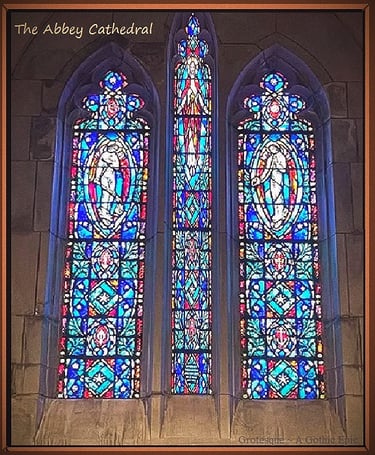
The crisp night air lay silent, save the fading screech of a distant owl. Stars illuminated the dim abbey grounds and the faint glimmer of several oil lamps shone from two stories of dormitory windows. Across the courtyard, a row of stained glass windows also glowed, but brilliantly ~ the cathedral was alive.
Within the gleaming church and looming high overhead, an intricate, soot~stained fresco adorned its vaulted ceiling. The painting sprawled over most all of the upper regions of the cathedral. Beneath it, two rows of massive stone pillars lined themselves near the outer walls and ran the full length of the main wing. Together, they supported flying buttresses that soared skyward and disappeared into the ceiling. The same sturdy design existed in all four wings of the cathedral and, where the wings joined ~ in the shared, open space of them ~ stood a raised hooded altar. Dangling tapestries and draperies ornamented the carved wooden canopy of the altar, and the sacred centerpiece sat atop a solid rock slab that centered the floor. On either side of the altar slab, thick leather tethers lay tied to closed iron loops that protruded from out of the stone foundation.
Cardinal Blasi stood before the raised altar, with a pair of tall floor candelabras casting a flickering light over his shoulders. Thoroughly engrossed in the text of a stack of brittle pages that he now shuffled, he mumbled to himself. His eyes poured over Latin passages of the Naramsin Translations, with which he since absconded from the Apocrypha’s archives. Nearby, friars Clodius and Greville quietly awaited command. Aside from the three of them, and Friar Grate, who busied himself with tying the last of several long leather ropes to the eight metal rings of the altar slab, the cathedral stood empty.
At length, Friar Grate approached Blasi. “The tethers are secure, Abbot; longest to shortest ~ outside to inside.”
Blasi briefly tore his gaze from the worn pages. “What does that mean?”
Greville stepped forward in an attempt to explain Grate’s statement. “On either side of the stone base of the altar, there are four hooks. Each of them calls for an attached rope. All of the ropes must be ~
Clodius sighed; he interrupted Greville and provided Blasi with a more concise explanation; “The altar slab rests in two floor groves. If the slab is not evenly pulled back, it shall catch.”
Blasi raised a brow, yet never looked up from his papers. “And if it does catch?”
Clodius answered, “Well, if it catches, then the tethers must be rearranged in opposing order ~ shortest to longest, with their loose ends crossed to the other side of the altar. Then, the slab must be pulled completely closed before reversing the tethers again and reopening it.”
“Is it difficult? Involved?”
Clodius shrugged. “Only lengthy ~ in the moment required to close and reopen the floor pit.”
Blasi informed him; “Then I now charge you with the task of seeing to it that the slab does not catch.” Clodius stiffened as Blasi continued, “And, of course, I shall hold the both of you in account for any miscarriage.”
Clodius’ jaw dropped and he glanced at Greville, who was frowning at Grate’s subtle smirk. He squirmed before clearing his throat. “If I may, Your Eminence; we can offer no assurance that the slab shan’t catch.”
Blasi slowly lowered the pages and turned to him with narrowing eyes. And both Clodius and Greville found, beneath the Cardinal’s steely brow, what appeared to be the very cold, washed, and determined stare of the Devil, himself. Blasi’s blind eye burned through them, as if to see all of them at once.
Clodius quickly averted his gaze, instead, looking toward the altar as he further pleaded with Blasi, “The altar has never been moved. We know only of the method of moving it through ancient abbey records. To presume that we shall succeed ~
Blasi cut him off; his words laced with growing impatience; “You are now before me ~ not in the dormitory ~ because you remain in my good graces. The both of you do wish to be the new overseers of the catacombs, yes?”
“Oh, indeed!” Greville exclaimed, “And we are humbly in your service.”
Clodius glared at Greville before responding, “Yes; however, if it pleases you, Your Eminence ~
“Then, you shall see to it that the slab does not catch, yes!” Blasi barked.
Clodius sighed, yet complied. “We shall, Your Eminence.”
Abruptly, the outer, double doors of the oratory wing flung open as Captain Bourne led two columns of his strongest soldiers into the church ~ and up the center aisle that divided long rows of terraced seats. The drumming steps of a hundred marching boots thundered through the oritorium. At length, the Captain shouted for them to halt and the soldiers froze into position. And as his voice carried off, echoing through the vast enclosures of the church wings, a new silence fell over the cathedral.
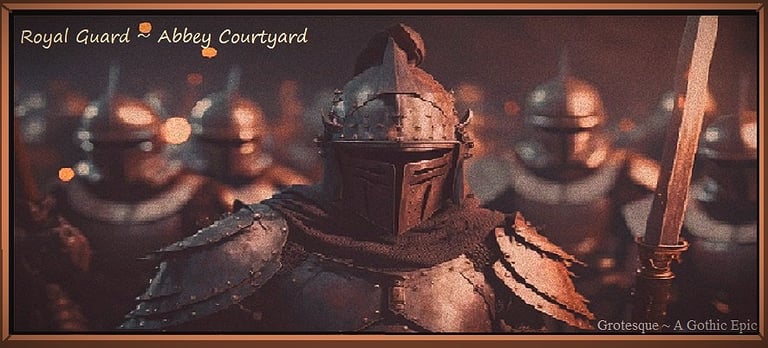
Cardinal Blasi and the three abbey friars watched as Captain Bourne approached. The Captain stopped short of them, scratched his cheek, and threw his hands on his hips. He passed a pair of green, probing eyes over the cathedral, mostly inspecting the altar with its attached ropes. Then, he exchanged glances with each of the friars before turning to Blasi. “Shall we begin?”
Blasi turned his attention back to the Naramsin pages as he replied, “Soon enough, Captain. However, there are several pertinent and quite significant details concerning the altar. Friar Clodius shall now make you aware of them.”
Clodius took his queue and stepped forward. “Ah, yes, Captain,” he said. The monk explained to Bourne of the importance of pulling the altar slab evenly, such that it did not lock itself into place. Together they paced around the altar for nearly three minutes as Clodius informed Bourne of what was required of him. The monk continued, “Thus, the positioning of your men is of utmost importance, as they shall be opposed for space once we begin.” Bourne eyed the eight long tethers lying on the floor, in a precise dovetailed arrangement, extending outward from the slab. “As you now know,” Clodius added, “The task of moving the altar is somewhat involved ~ truly, more than one might gather from mere appearances. Nevertheless, I require ninety~eight of your men ~ no more and no less. Now, how many do you have at your ready?”
“Enough.” Bourne curtly stated.
“Indeed.” Clodius frowned and raised a high chin. “I see.” He scrutinized the disfiguring scar on Bourne’s cheek.
Bourne leaned forward and whispered, “Careful with your righteous eye, friar; lest you force me to save face in front of my men.” Clodius glanced over Bourne’s shoulder to find two steadfast columns of the Royal Guard staring at him.
“Well, then.” The monk huffed and turned away, deflated. “Shall we arrange ~ your men?”
“Position them as you see fit, priest,” Captain Bourne stated, pointing toward his soldiers with a slow swing of his extended hand.
Clodius looked to Cardinal Blasi, who approved with only a confirming nod.
Thus, Clodius busied himself, positioning eight rows of soldiers on the leather ropes. Altogether, forty men secured the two outermost tethers, twenty~four gripped next outermost pair, twenty grasped the next innermost, and fourteen held the very, innermost tethers. Bourne posted the last of his men ~ those not assigned positions on the tethers ~ outside the cathedral, to guard each of its three entrances. All were in position; all were ready. And in the ensuing silence that enveloped the church, Clodius stepped behind the eight rows of soldiers, inspecting the alignment of each rank with respect to the position of the altar. Finally, he stepped away, looked to Friar Grate from afar, and nodded. Grate whispered to Cardinal Blasi, who looked up from his papers and signaled Bourne with a gesturing of his hand. In response, Borne turned back to his men and bellowed commands as he circled their ranks. “Every man pulls! Every row heaves as one! All rows keep pace together ~ a three~count pull; a three~count rest!” He stopped behind them and clasped his hands in the small of his back. “On my mark!” Taut ropes tensed. “Heave!”
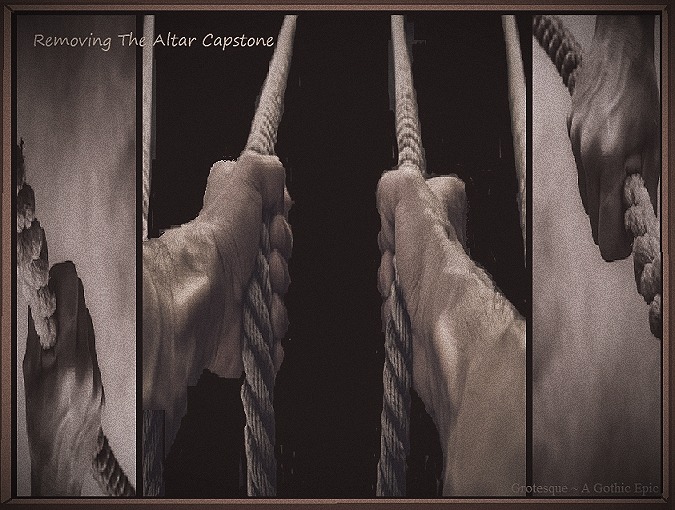
Ninety~eight soldiers strained. Eight tethers creaked. Yet, the altar held its hallowed ground. Blasi scowled at Clodius. Greville squirmed.
“Heave!” Again, the soldiers leaned back on the ropes as the grinding noise of six tons of sliding rock reverberated through the cathedral floor.
“Heave!” ~ and a few inches more.
“Heave!” ~ and still more.
“Heave!” ~ more.
“Heave!”
Primed, and like a ship’s drummer over heaving oarsmen, Bourne held his rhythm. His soldiers were a choir of hisses and groans. And with Bourne’s every new call, the slab surrendered more of a dirty floor. On the opposite side of the altar from Bourne, Blasi saw a rectangular hole gradually fall into view, exhaling decades of vented mustiness. At length, with a deep pit thoroughly exposed, a resounding thump echoed through the church.
“’Tis done,” Clodius informed Blasi, “The slab goes no further.” Blasi motioned to Borne as he stepped toward the opened pit.
“Release!” Bourne shouted. Soldiers dropped tethers; sweat glistened over drained arms; several men collapsed to the floor whilst others bent over, panting heavily. Yet, most of the men stood tall, with heads thrown back and mouth agape, wheezing at a ceiling of painted angels.
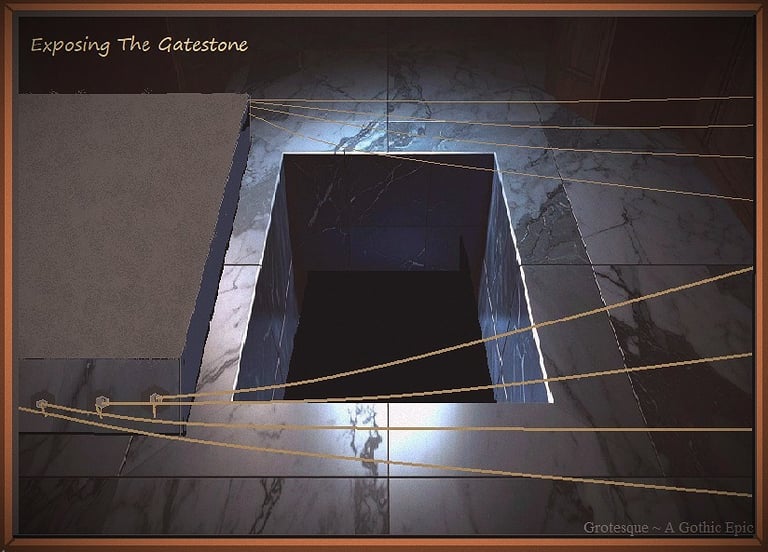
Friars, Grate and Greville, lined the grimy outer edge of the hole with several tall floor candelabras. Blasi inspected the now lit hollow. At twelve feet deep, the pit spanned sixteen feet by twelve feet. All four of its walls stood caked with a black resin, which resembled a thin film of coal ash deposited on the interior surface of a well~used hearth flue. Still, even beneath the filth, Blasi spotted a similar feature engraved on the centers of every wall: etchings of crosses, each with three concentric circles enclosing the heart of it. Yet, what captivated him ~ what quickened his heart and his breath nearly enough to send him into a fainting spell, was that which stood apart from outwardly charred pit.
A black and glossy, rectangular stone with well~defined edges and sharp corners rose from out of the center floor of the cavity. The glassy sides of the stone reflected beneath the candelabra firelight ~ the stone appeared as a standing block of highly polished onyx, seven feet tall, five feet wide, and three feet deep. Yet, otherwise solid, the monolith possessed a single, flawless, unobstructed, two~foot hole, which cleaved the heart of the stone’s broadest face. Completely, row upon row of engraved geometric inscriptions covered its exterior surfaces, even to include the curved interior of its gaping hole.
In his mind’s eye, Blasi considered the likenesses of the Apocrypha sketches with the genuine artifact, which now stood before him. Thoroughly captivated, he paced around the pit, a glistening gleam in his one working eye. His stare was a blank one ~ perhaps, even to reveal an expression of a gradual dawning of a staggering truth that quelled all doubt or disbelief that, indeed, Hell was real, with its tall stone door standing before him.
From afar, Captain Bourne called out to Blasi; “And what more should be done?”
“Ah, yes. We shall,” the Cardinal mumbled, ostensibly hypnotized by the image of the gatestone, whilst memories of his dead brothers captured his thoughts, quickened his heart, and spurred in him an intense loathing of the King Edward, of England. And in that moment of memory and bitterness, he recalled the lasting voice of the spirit of Jean Jacques Blasi, saying to him; ‘They hide secrets, a weapon of a kind to destroy the English king. You must take charge of this weapon, Francois. You must release it against him.’
“Well?” Bourne asked with growing impatience.
Blasi broke his entrancement and barked instructions, “Friar Grate, once within, I shall require light enough to see. And you shall accompany me.” He turned to Bourne; “I require a tether and several of your men, to lower me over the side.” Monks and soldiers busied themselves.
Shortly, Clodius and Greville convened beside Blasi, who now stood looking over the Naramsin pages. The Cardinal turned and addressed Clodius before entrusting the stack of papers to him, “You know the importance of these parchments. Now, be careful with them; they are delicate. And do NOT drop them, as I have them in precise arrangement.”
“Indeed, Your Eminence,” Clodius took them from him. His hungry eyes rolled over the fragile pages, astounded that he held the ancient text in his very hands.
Blasi added with instruction, “You shall hand them down to me when I call for them.”
Borne strode alongside a soldier who dragged a tether toward the pit. Three soldiers followed with him. At the edge of the hole, soldiers lowered the rope over its side and helped to lower Blasi below the floor. Behind them, Friar Grate hurried forth with a small candelabrum of seven flames. Stopping short, his sandal slipped across the grime that lined the hole and he nearly plunged into the pit. There he stood, holding the light and dangling over the edge, with Bourne’s fist clenched firmly into the back of his robe. The Captain yanked him to safety and hissed over his shoulder, “For a lively priest, you do taunt death.”
Within the pit, Blasi planted his sandals on the floor and released the tether. The Cardinal wiped at stains on the front of his robe, yet the stubborn soot remained. He searched his dim surroundings before calling from below, “Friar Grate! Bring a torch!” The soldiers helped to lower Friar Grate into the hole. Blasi stepped nearer the wall and, with an upwardly reaching hand, waved to Clodius. “My parchments; give them to me.”
Clodius compared the dirty floor to his clean robe. Instead, he gave the stack of papers to Greville. “Give them to him.” Greville glared at Clodius and took the papers. Greville lay flat on his chest, over the edge of the grimy hole, and passed the pages down to Blasi. Taking them, Blasi called up to Clodius “You wish to oversee the abbey catacombs; yet, they are every bit as filthy as this pit. Perhaps I may reconsider your appointment to them.” Clodius only pursed his lips and looked elsewhere.
Once within the hole, Friar Grate raised his arm and took the candelabrum from one of the soldiers, wincing as beads of hot wax rolled down the underside of his forearm.
“Bring the light,” Blasi called to Grate, approaching the gatestone.
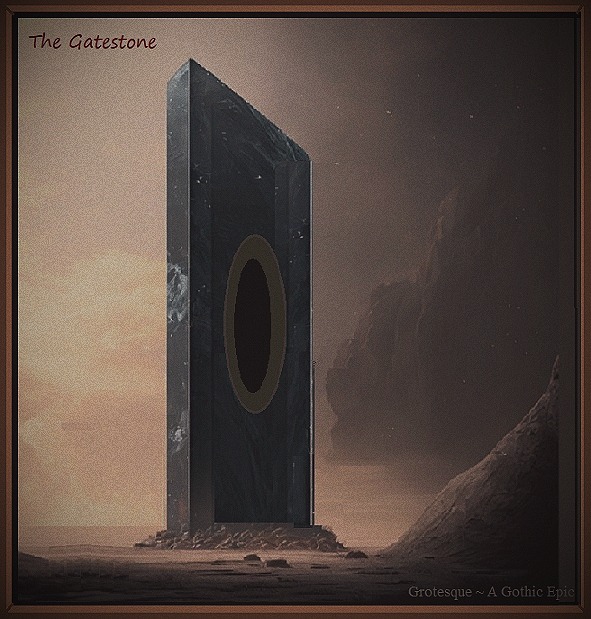
As the friar illuminated the polished face of the gatestone, the Cardinal inspected its many rows of distinct but indecipherable etchings, of which were neither French nor Latin in origin, yet altogether arranged in flowing presentation as a scribed language unbeknownst to even the most literate scholars of the age. Notably, the etchings were not hieroglyphic pictures, but rather, geometric figures that Cardinal Blasi had since recognized from collections of texts once hidden within the Apocrypha’s archive. Blasi gestured for Grate to remain where he stood. The Cardinal stepped further away from the face of the gatestone and centered himself before the engravings. Squarely in his eye, the flow of symbols seemed to form a pattern ~ rows of circles and lines that might suggest an ordering of inscriptions that begged instant pronunciation of them. Yet, like the many times that Blasi studied the identical symbols in the Apocrypha’s books, even to the degree that he felt near to mouthing the apparent sound of them, all that surfaced was the recurring frustration that he could not. He dropped his gaze to the pages in hand, wondering of the method by which a mere abbey cleric by the name of Naramsin had successfully translated such cryptic inscriptions into Latin.
Blasi’s papers fluttered and Grate’s flame flickered in a cool breeze, which abruptly spilled over their sandaled feet. Together, they cast an upward glance to find Clodius, Greville, and Bourne staring down at them. Blasi dismissed them and strode toward the gatestone. He cocked his head, peered through its hole, and saw only the dim, far wall of the pit. He placed his fingertips against the gatestone face to find it unexpectedly frigid. Again, he retreated to his former distance and stared at the monolith, rubbing his chin, lost in thought.
Bourne cleared his throat noisily, as if to convey a growing impatience. Blasi replied to the noise, not even acknowledging it with a glance, “This is not an amusement, Captain. Some endeavors require delicacy.”
Bourne huffed, threw his hands on his hips, and paced near the edge of the hole. “A damned fool rock, it is,” he grumbled.
Only then, did Blasi casually turn his head up at Bourne and narrow his eyes. “A rock? Is that what you gather it to be?”
Bourne affirmed his claim, “A rock.”
Blasi gave Grate the stack of parchment and approached the part of the pit floor directly beneath where Bourne stood and called up to him, “Perhaps you might loan me your dagger, if but for a moment?”
Bourne clutched a sheathed bone~handled blade, which hung on his hip. “And why?”
“Since I wish to share with you, a thing about this ‘mere rock’ ~ as you so easily call it.”
Standing a short distance from the Captain, Greville leaned into Clodius’ ear and hissed, “He carries a weapon into the House of God!”
Bourne unsheathed his blade. With his thumb, he wiped away a faint smear of Ivan’s blood from its polished surface. Clodius, upon seeing a knife within the sacred confines of the church, narrowed his eyes and set his jaw, but said nothing. Bourne nodded his head to Blasi. “Very well,” he agreed, tossing it into the pit. The dagger clattered on the floor beside the Cardinal. “Scratch your blessed stone and show me the magic of it.”
Blasi shook his head as he retrieved the knife. “Oh, I shan’t scratch it. Still, I might command your full attention with this blade.” He stepped away and neared the gatestone. Then, he bowed slightly and cast the knife through its center hole.
Bourne listened for the dagger to fall out of the other side of the hole. Nothing ~ as if, it had vanished. He circled the side of the pit, yet saw no knife on the pit floor. Clodius and Greville followed, both perplexed. Finally, Bourne informed Blasi, “I have seen better feats of magic in His Majesty’s Royal Court.” Now, if you would; kindly return my blade.”
Instantly, a flash of light bathed the cathedral ceiling as Bourne’s dagger plunged toward him, slicing through the left sleeve of his shirt, and piercing the toe of his boot before sticking solidly into the stone floor. Bourne fell backward on his rump, his boot still anchored in place. He looked at the dagger, now lodged between his toes, its handle coated with a thin layer of frost. He inspected his torn sleeve to find a thin red line that beaded up on his forearm. Then he searched the ceiling of the church to find only its mural of warring angels and demons, and weeping kings.
With brows raised and mouths agape, Clodius and Greville stared at the fallen blade.
Blasi stood in the shadows of the pit, oblivious to that which occurred outside the pit. He replied to Bourne, “Unfortunately, it cannot be returned, Captain. The blade is no more.”
Bourne broke the dagger off at the tip and pulled it out of his boot, grumbling beneath his breath; “Try that again and I shall forget your being a Cardinal.” A soldier rushed forward and extended an assisting hand. Bourne grabbed it, and the man hoisted him quickly to his feet. Then, the Captain whispered to the soldier whilst returning his blunt dagger to its sheath, “Sergeant Armond, ’tis a time to encourage the men. You know what I expect. Now, see to it. Make haste.” Armond snapped a bow and darted toward the cathedral doors when Bourne passed a probing eye over the ceiling as he called after him, “And fetch my helmet! Armond halted and gave another quick bow before dashing away.
Greville informed Blasi, “The blade has fallen up here!”
Bourne warily approached the edge of the pit to find Blasi looking up at him, arms crossed. “Is it still a rock, Captain?” Yet, Bourne gave him only a disquieted stare. Blasi turned and instructed Clodius. “See to it that the tethers on the altar are reversed, and position the Captain’s soldiers opposite side of the slab for to reseal the pit. Clodius nodded and stepped away, but stopped and looked to Bourne for approval. Bourne nodded and dismissed him with a petulant wave of his hand. Thus, Greville repositioned the tethers as Clodius realigned the soldiers.
Within the pit, Cardinal Blasi had since turned his attention to the gatestone. And when Clodius had positioned the last of Bourne’s men on the tethers Greville had reversed, the Cardinal retrieved the Naramsin Translations from Grate and instructed the monk to hold the candelabrum just so ~ high enough for him to read the written verses without blinding him from seeing all of the gatestone’s face. The sudden sound of a soldier’s sneeze carried through the cathedral’s interior and Blasi cast an upward glance at Bourne. “I require silence, Captain.”
Bourne instructed his men. “Not a sound!”
An unsettling silence followed, broken only by Blasi’s clear and measured voice, as he began reciting from pages in hand. “Et erit fugerit a voce formidinis cadet in faveam et qui se explicuerit de fovea tenebitur laqeuo ~”
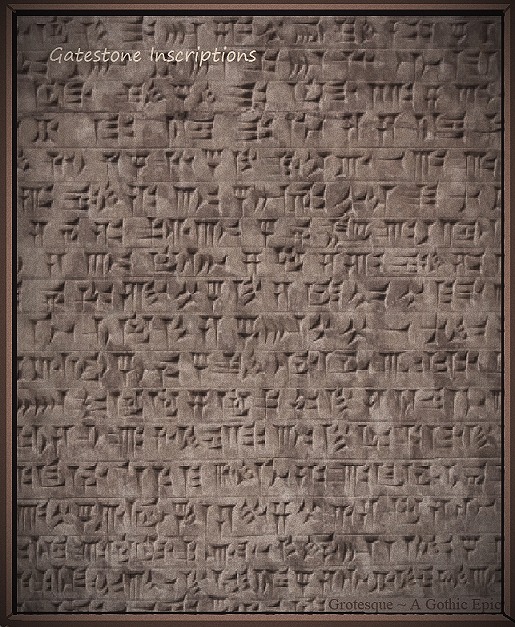
Time turned whilst Blasi circled the gatestone, reading aloud the Latin verses of Naramsin. Friar Grate hung on his sleeve, with the candelabra on high. At length, Blasi stopped pacing and faced the monolith. He then recited the last of the selected verses. “~formido et fovea et laqueus super et qui habitator es terrae.” Then he lowered the pages and studied the stone. A minute elapsed ~ then two. Finally, Blasi and Grate stepped forward to examine the unchanged face of the statue.
Well into the third minute of silence, Bourne called down to Blasi, “Shall we now pretend to see an army of ghosts, Your Eminence? Or might your stone be drained of its magic, after the jester’s trick with my blade?”
Blasi looked up and addressed Bourne’s subtle smirk. “Captain, the whole of your life is but a moment to this stone.”
Bourne crossed his arms and replied with a scoff, “As is your life, the same, even to a pebble.” Soldiers chuckled. “Silence!” he scolded them.
Clodius and Greville stood apart from Bourne and his men as the two friars conversed quietly betwixt themselves.
I must confess,” Greville whispered to Clodius, “In all my years as an Upper Council Priest, and with all I read of the records and depictions of the stone; never once could I bring myself to believe that such a thing truly existed beneath this altar. I only feigned to hold a faith to it. And I am certain that most of the Upper Council Friars felt and did the same as I, only out of fear of harsh reprimand.”
“Now, we know,” Clodius replied, nodding in the direction of the pit.
“But did you truly believe it to exist ~ that our abbey protected such a stone?”
Clodius raised a high chin. “Indeed, I did.” He cleared his throat before admission; “However, I gathered the stone to appear differently than the scriptorium sketches.”
“How so?” Greville asked.
Clodius folded his arms and deliberated, stroking a chin with fingers before answering, “Well, the stone seemed too perfect in its depictions. Only Heaven knows, but I gathered it to appear more common ~ even as a rudimentary relic of another age.” He held a pointing finger on Greville as he stared into the distance. “More so, I saw it to resemble a likeness of those large standing stones in England ~ those ancient rocks, arranged in a circle; if you might recall”
“Ah, those; yes, I do recollect them,” Greville responded, nodding toward the floor. Then he turned to Clodius. “And what of the woman spirit of the stone, with her black eyes and red hair? Do you believe that she exists, as Abbot Vonig and others claim ~ that she is the mother of the grotesques?”
Clodius winced, as if Greville’s line of questioning suddenly pained him. “How could you doubt her? Not only does she exist, but she presents herself in the flesh; cold and pale, yet as alive as you or I.” Heed my words, Greville ~ the mother of the grotesques is real.”
Greville shook his head; “I know not a single sign of her in all my many years at the abbey. I have never dreamt of her as others have claimed.” He turned to Clodius, brow raised. “Have you seen her?”
Clodius nearly choked as he gasped; “You shall never call my faith into question, Greville! Mind your tongue with me!”
“Oh, no; I never presumed that you ~ well, never that,” Greville exclaimed. “I wondered only if you may have laid eyes upon her. Forgive me.” Clodius rolled his eyes and looked to the darker regions of the cathedral ~ perhaps searching for the spirit that he so perfectly recalled. Greville cleared his throat and turned his attention to Bourne, as the Captain quickly circled the pit.
Bourne approached two soldiers who knelt near the edge of the hole; a loose end of a coiled leather rope lay between them. He tapped one of them on the shoulder. “Withdraw the tether from the hole and fix a loop on the end of it ~ wide enough for the Cardinal to fit his foot, when he calls for to be lifted out.” The growing sounds of footfalls drew the Captain’s attention to the oratory wing of the cathedral, where his sergeant, Armond, and a group of soldiers, hurried toward him. Along with a spare helmet, the sergeant carried a pair of ready crossbows in each hand. The four men who followed with him carried only a single crossbow. All were equipped with a flat, leather quiver of bolts strapped against their thighs.
When the ninety~eight soldiers, who stood on the altar’s tethers, spotted Sergeant Armond and his small company of armed men, they grumbled amongst themselves, rolling eyes of dissatisfaction. Altogether, they knew what not to do ~ abandoning posts or defying orders would be an unforgivable and irreversible act. Consequently, the overall tone of the soldiers changed, as it always did when the Captain found grounds for exercising greater caution and employing greater sentences for disobedience.
Clodius approached Bourne as he scolded him; “Captain, your blade can be forgiven; however, these men carry crossbows! This is the House of God! You cannot allow ~
Bourne spun around and snapped his fingers at both Clodius and Greville, who stopped in mid~stride. “The two of you!” He pointed toward a far wall of the cathedral, to a pair of massive stone columns. “Assume your places over there, behind those pillars and against the wall, lest you catch a stray arrow ~ by chance, of course.” Bourne glared at them.
Clodius scowled as he considered the Captain’s veiled threat. The two monks quickly stormed away, stepping passed the row of columns and finding their place beneath a large stone~carved crucifix of Jesus, which hung against the wall. And there they stood, with arms crossed, brooding.
Bourne turned to Armond and retrieved the spare helmet. As he fitted his headgear, he whispered to the crossbowmen, “You know what I expect ~ no exceptions. Yet, no harm comes to the priests. And if one of you should happen to injure the Cardinal and his parchments, then I shall see to it that your feet are loped off and fed to the dogs.” Bourne searched their eyes and the bowmen fidgeted; but the sergeant remained steadfast. The Captain addressed him as he pointed to an unobstructed area near the opening of the oratory wing; “Position your men precisely, there.”
“Aye, Captain.” Armond snapped a bow and addressed the men; “Follow me.” Bourne watched Armond lead the soldiers away; and in a flash of his mind’s eye, the Captain mused over the young, seasoned sergeant, who seemed to resemble a version of his former, ambitious self.
However, the ninety~eight soldiers, at the altar tethers, saw Armond and his lone squad of crossbowmen in quite a different light. They watched the sergeant position his small rank on bended knees, weapons at the ready, and aimed squarely at them. They looked on as he gave instruction to his crossbowmen, all the while, passing a pointing finger over the lot of the ninety~eight soldiers. They saw him gesture in the direction of each of the three cathedral entrances. They eyed him as he rounded the backside of his newly positioned squad and leveled a pair of crossbows at the backs of the kneeling bowmen before nodding to Captain Bourne. Likewise, they found their Captain replying to his trusted sergeant with a similar nod. Still, they knew the routine; and the ninety~eight men were now thoroughly encouraged to obey every command, given them.
“It moves!” The voice of Grate shouted from within the pit. Bourne approached the hole for better inspection.
Within the hollow, Blasi stepped closer to Grate, who held the candelabrum near the etched face of the gatestone. In the deathly quiet of a lingering moment, the friar whispered, “There.” Grate pointed to the glassy, black surface ~ to the cast reflection of the tall, still flames of the candelabrum he held high. “Can you see the image of the fires’ reflections; how they bend?” And although no breeze fell over him, Grate shivered from a sudden chill that seemed to fill the empty space of the pit. He glanced over his shoulder to discover that the pit walls now glistened completely with water droplets, which suddenly condensed against its dirty surface.
Remain still,” Blasi barked. He passed his fingertips over the cold face of the gatestone; it stood firm ~ quite solid. Yet, even so, the cast image of the candelabrum’s firelight swayed, as if the mirror image of the flames was passing through rippling water. “Indeed, it does,” Blasi mumbled, inspecting the surface more carefully. Then, he leaned away and quickly retreated several steps away from the gatestone. “What is this?”
At a safer distance, Blasi and Grate bore witness to an unnatural unfolding of events as, row after row of the gatestone’s etched inscriptions, vanished. From right to left, and from top to bottom, line after line of inscribed symbols appeared to wash away, leaving in their place, simply a smooth surface of sable and shimmering stone. And after every inscription had faded from view ~ when all of the gatestone faces fell smooth as black glass, creeping sheets of iridescent ice crystals fanned out to envelop the now frosty statue. The lingering chill in the air abruptly turned into a bitter cold as the priests noticed a fog on each other’s breath. Quickly, they withdrew to the wall of the pit and watched the once rigid surfaces of the gatestone begin to heave and roll, swelling and contracting, as if the entire ice~coated block breathed in many places as once. A deep rumbling noise accompanied a steadily rising vibration beneath their sandals, and the two of them briefly exchanged flush and drawn expressions before searching the trembling floor.
Outside the pit, against the far cathedral wall, Friar Clodius stood beside one of many massive columns; and with folded arms and a highbrow demeanor, he complained secretively to Friar Greville. “In the privacy of the Abbot’s study, the Cardinal personally selected you and me to assist him. This very moment, we should be in that pit, with His Eminence.” Clodius shook his head. “If truth be told, I should be down there, in Friar Grate’s stead; I am much more versed about the stone than him!” He huffed. “Yet, we stand here, against the wall, apart from all meaningful goings on, like a pair of meager squire boys.” He winced in apparent disgust. “And that Captain tries my patience like no other.” Clodius sighed and leaned his shoulder against the column. “Hear me now, Greville; if I were not so attentive and considerate ~
Clodius set his jaw and looked at the column upon which he leaned. He gently placed his hand against it ~ then both hands ~ then his ear ~ and with his head pressed against it, he remarked, “Greville; Rest your hand on this pillar. Greville?” Clodius looked over his shoulder to discover Greville standing much further away from him than he had initially gathered. Greville leaned against the church wall with his one hand raised and lightly touching the base of the wall~mounted crucifix.
“Come, quickly!” Clodius waved to Greville.
But Greville did not leave the wall. “It moves!” he called out, lowering his arm and pointing to the carving. Clodius left the pillar and approached him. Greville cupped his ear in the direction of the crucifix, gesturing for Clodius to listen more closely. “Hear how it trembles!” Clodius leaned forward, tilted his head, and heard a faint but quick and persistent tapping of the statue as it vibrated against the wall stones.
“The pillar trembles as well,” Clodius replied, looking over his shoulder, at the column that he had just left. At once, both priests cast an inspecting eye over the floor.
Greville spoke. “The wall ~ the pillar ~ now the floor ~ perhaps the entire church trembles?”
Clodius raised his gaze toward the ceiling’s fresco. He commented beneath a crumpled brow, “’Tis not good ~ for the mural.”
Clodius examined the sprawling, elevated painting. At its center, high above the cathedral altar, the full portraits of three kings lay enclosed by a ring of bluish flames. Further outside the ring, and completely encircling it, were images of warring angels with swords, shields, breastplates, and helmets. Like an aerial army, these angels appeared to defend the three kings from a gathering of winged demons, all of which possessed grotesque features similar to those of the various stone statues that lined the upper terraces of the outer cathedral roof.
Greville whispered to Clodius, “Pray tell; what should happen if he is not the man that he claims to be ~ if, instead, he is in league with Evil?”
Clodius winced and turned slowly. “And, to whom do you refer?”
“The Cardinal,” Greville exclaimed. “What if he intends more than to summon spirits against the English? What if he is the Devil, himself ~ and has come to the abbey only to open the stone?”
Clodius backed away. “Have you lost your balances? You speak heresy! In heaven’s name, he is an Avignon Cardinal!”
Greville continued, “And I am a Lower Council Friar, yet I am not familiar with those passages of which he recited. Can you recall them?”
Clodius leaned into Greville’s face and scolded him. “He is not a Council Friar, but a Council Cardinal ~ with the full translations of the stone in his very hand! Would he not be more versed than either of us, with regard to the stone?”
“Still,” Greville pressed him; “Are you familiar with any of the passages that he recited?”
Clodius grabbed his arm and growled in his ear of the reason for the vibration in the floor of the cathedral ~ that it was the result of galloping horses outside the church. Then he released Greville and threatened him. “Do not try my patience! I shall hear no more of your heretical accusations concerning our new Abbot. Now, collect your wits or you shall cost the both of us our rightful places as overseers of the catacombs!”
Greville dismissed Clodius with a petulant sigh before he looked away. The rebuked friar crossed his arms and glared at the soldiers at the altar tethers, who now stared down at the trembling floor. Some of them whispered with expressed concern and all ranks wavered slightly with fidgeting soldiers.
Bourne stood with three soldiers near the edge of the pit and cut a stern gaze over his nervous ranks before shouting to them, “Still yourselves! Silence your tongues, or the next man shall make lovely passion to my lashing post!” He turned. “Armond, be at the ready; weapons trained!” He spun back around. “All of you shall keep your attention on me ~ not one another; not the floor; not the priests ~ only, me!” Nearly a hundred soldiers froze, like poised statues, their eyes fixed on the Captain. The only obvious movement, at the time, occurred directly below Bourne’s boots, on the floor the pit.
Within the hole, Cardinal Blasi retreated to the wall and groped for a dangling rope, yet found only a slippery, cold surface that now stood covered with condensation. Friar Grate passed the candelabrum over the wall’s glistening sheen as he searched for the tether. Instantly, the flames of his candelabrum leaned away from the wall and in the direction of the gatestone. Grate raised his head, searched the upper edges of the hole, and noticed that, like the light that he held, all of the candle flames of the surrounding floor candelabrums also leaned toward the center of the pit.
Captain! The tether!” Blasi shouted, wiping a handful of black grime onto his robe and complaining beneath his breath. Then he stole a quick glimpse over his shoulder, at the bulging gatestone. “Now, if you would!”
A soldier quickly lowered the rope as Bourne instructed Blasi; “Slide your foot inside the loop of the tether.” Blasi grabbed the rope, when ~
“PHSSS!”
The sudden sound of a deafening blast of air ushered forth an unrelenting hiss that resembled the rupturing of a volcanic vent. The two priests threw themselves against the wall. Grate’s candelabrum struck the pit floor and its flame extinguished. Blasi lost the Naramsin Translations; the stack of pages scattered. Quickly, he scrambled across the floor, even on hands and knees, to retrieve the fallen pages; yet, keeping a wary eye on the gatestone and the hole at its center, which now filled itself with a roiling black fog. The churning darkness billowed and fumed before spilling out of the gatestone as a dense cloud. Blasi grabbed the last stray page and lunged for the wall when the heavy mist crept over the pit floor and concealed his feet with its absolute darkness. It appeared as if the entire pit floor had vanished, wholly consumed by the blackest of shadows.
Blasi grabbed the tether as sheets of ice, dark with soot, slid down the wall. He raised his sandal and fought with the loop at the end of the rope, frantically searching for a foothold. The black mist rose level with his hips. “Pull ~ dear God! Lift me out!” He stuffed the Naramsin pages in his teeth and clutched the rope.
Grate screamed as he high~stepped through the caustic cloud. “It burns! ‘Tis fire!”
Bourne’s voice commanded from above, “You two ~ pull the tether! You ~ fetch another! Move!”
“Now!” Blasi screamed through clenched teeth. The soldiers began to hoist him out of the hole even as blood blisters surfaced on his legs. Grate leapt atop Blasi and the instant tug of additional weight sent one of the two soldiers screaming headlong into the pit, penetrating the mist with a disgusting thump. The remaining soldier cried out as the quick~slipping tether scorched the insides of his hands. Together, the priests slid back into the waist~high cloud.
“Damn you, Cardinal!” Bourne screamed as he grabbed the tether to replace his fallen soldier. He summoned another six men. “On this tether! Now!” Feet scrambled and the rope tightened at the same moment that Blasi shoved Grate away from him. The priest stumbled backward and disappeared beneath the heaving mist. Alone, on the rope, Blasi slid up the pit wall. Soldiers pulled him to safety even as they threw a second tether into the hole. Blasi rolled on his back and clutched his thighs. Dark stains seeped through the pressed parts of his clothes. He stiffened from pain and gasped for breaths, the pages still in his clenched teeth. A soldier knelt over him and reached for the hem of his robe.
“Do not ~ touch me!” Blasi cried, grimacing.
Clodius yelled from afar, “What is the matter with you, Captain? Get Friar Grate out of there! He shall die!”
Bourne spun about and bellowed to Armond , as he pointed to Clodius, “If that man moves or speaks, drop him!”
Still within the pit, Grate scrambled to his feet. He stumbled about, groping, coughing, and blind by the corrosive mist that now rose evenly to his chest.
Bourne bellowed, “Inept bastards! He cannot see! Move that tether closer to ~ give it to me!” He yanked the rope from his soldiers, circled the side of the pit, and threw it down the hole as he called to Grate. “This way; yes: walk to the tether; yes; keep coming; I am here!”
Grate found the rope and latched himself to it, still choking on the burning mist.
“Pull!” Bourne shouted to the line of men behind him. All of them leaned back on the rope and Grate slid up the pit wall. Only half way to safety, Grate’s skin peeled off his arms, sticking to the wall of the pit like wet tissue. Flesh rolled out of his clenched fists and he slid down the rope, tumbling back into the mist. Bourne saw the end of the rope, with no loop and barked, “Bring me the other tether!”
Once more, Grate leapt to his feet, with only his chin above the mist. Yet, like the skin on his arms, now gone, his ears were also missing. Now deaf and blind, he ran frantically around the pit, strafing its walls in search of a rope. He fell. Again, he stood. Bourne readied himself to throw the other tether, yet stopped. He did not call after the priest; he could not. He did not even recognize the moving red globe as a man’s head. Yet, Grate cried out in terror, the tone of his voice now dreadfully changed by the acrid mist.
And if ever there was a succession of screams, of which could be seared into the lasting memory of even seasoned soldiers ~
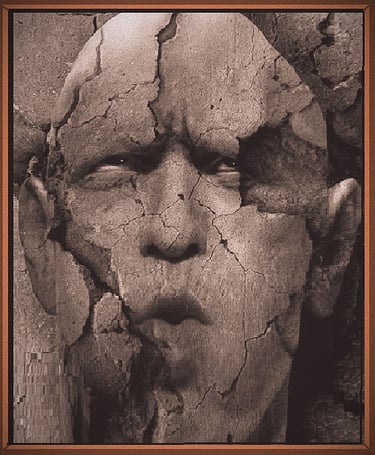
From their vantage point, the ninety~two soldiers at the altar tethers were unable to see the ghastly occurrence that unfolded on the floor of the pit; they could only stand to listen to the disturbing pleas of the desperate priest, whose cries were those of a man, burned alive. Soldiers’ eyes watered; hearts raced; breaths quickened. Even so, they remained steadfast, awaiting any order that may come their way.
The last of Grate’s screams faded to a little more than gurgling sounds before the heaving mist finally claimed him. Bourne marched quickly over to Blasi, who now lay on his side, writhing in pain as he shuffled the pages, searching for order in their verses. Bourne bent over and growled at him, “A man just melted like a candle in that damned ~ whatever it is that you summoned forth!” Bourne leaned closer to Blasi. “Is that your blessed army of ghosts ~ a black mist? Hear me well, Cardinal; I lost a man at your hands and I shan’t loose another! You shall get up from here and fix what you have done or I shall have my men pull the slab over the hole.” He turned to the six men that he called from the tethers and ordered them back to their former positions.
“You can not do that!” Blasi protested, wheezing. “I must recite the proper passages in order to close the stone. But we cannot close it until the spirits emerge and I summon them against the English at Crecy!”
“Then do it now! Recite the verses! Send them off and I shall pull the slab over it!”
“There are no spirits to summon. Give them ~ give them more time. The mist is not them!”
“How can you be sure? Have you ever seen a spirit?”
“I have not! Yet, I have seen many mists!”
“And I have seen and heard enough!” Bourne yelled. “I intend to pull the slab closed ~ verse or not!”
“Hear me, Bourne,” Blasi howled in pain. “Pulling the slab over the pit shan’t close the stone. Even if you cover the stone ~ beneath the slab, it shall remain open. Only the proper verses shall close it!”
“Either you find those verses of yours or I shall be the verse that pulls that damned slab closed!”
“You must NOT! You cannot hurry the stone ~ or me! For the sake of God, Captain, look at me! I can hardly catch my breath, for the pain!” He turned back to the pages, shuffling them with trembling fingers as he read over them. “A moment more, I beg ~ of you,” he groaned, tears rolling down his cheeks and nearly mad from the burning in his legs.
“I do not have a moment, Cardinal! That mist rises even now! When it spills out of the hole, then I shall have lost my chance to close the slab. My men are in place and the moment is mine. Now, either you ~
“WOOSH!”
Bourne turned toward a sudden blast of air, which came from the pit. “Hold your positions,” he yelled to his men. The Captain inspected the dimly lit hole, with all surrounding floor candelabras’ flames now extinguished. An icy breeze emanated from the hollow. On the hood of the altar, tapestries fluttered in a continuing wind.
“No! Catch them!” Blasi screamed, groping for scattered pages that were blowing across the floor. Yet, several of the papers fell caught in a windy draft, only to be drawn into the pit. He rolled upright, pressing a disheveled pile of pages against his chest. “Captain, how do you expect me to ~ this wind ~ I cannot arrange ~
Bourne interrupted him, calling back from over his shoulder; “If you fail, I shall place you under arrest ~ and you shall return with me, to Paris, and tell His Majesty, the King, about this abomination, which the Church has secretly kept.”
Blasi moaned as he staggered to his feet. He stumbled away from the pit, grimacing as he carried the pages away from the windy hole.
Bourne called out as he edged closer to the pit; “Guards at the doors; you shall be my torchbearers! Releave yourselves of your posts and fetch additional replacements from the courtyard ~ seven armed men to secure the outside of each of the doors that you now guard. Inform them that any man who attempts to enter the church is to be cut down! Now, be off!” Immediately, guards scrambled and three cathedral doors slammed. Bourne looked over his shoulder. “Armond, keep your eye on all that moves!” He turned about. “Men at the tethers; be ready to pull as one ~ on my mark!” Then, with his broken dagger drawn, Bourne carefully approached the hole.
Across the cathedral, Greville wiped tears from his cheeks, drew a deep breath, looked up from the floor, and turned to Clodius, questioning him, angrily, “Now that Friar Grate is dead, do you believe that the floor still shakes from galloping steeds outside the church?”
Clodius narrowed eyes at him before crossing his arms propping his shoulder against the column. “Watch your tongue, Greville. Short of allowing myself a shot in the back, I could do nothing to save Grate. And why did you do nothing?” Clodius shook his head and continued, “Besides, we never insisted that he climb down into that pit. The choice was his, alone ~ and he did it only in an attempt to get into the good graces of the Cardinal. Now, control your sniveling and lower your voice, lest you cause the both of us to be shot!” Clodius coughed and turned his attention to the pit. A moment of silence ensued between them.
At length, Greville whispered, “Something happens within the pit. All of the candelabra flames have gone out. And I feel a steady breeze.” He looked squarely at Clodius. “We should slip out of the church, whilst the guards are not at the doors and the Captain has his back to us.”
“See, there?” Clodius inconspicuously pointed across the cathedral as he coughed again. “We would not make it safely, even to the doors.”
Greville looked over Clodius’ shoulder to find Armond staring squarely at them. Greville whispered quietly to Clodius; “But, he shan’t watch us indefinitely. Perhaps, we shall sit ourselves down on the floor and he might look away?”
Clodius succumbed to more of the persistent cough. From out of the corner of his eye, Greville studied the unattended front of the church. With a rolling eye, he searched for a convenient path of escape, tracing the outer wall completely. Behind them, he noticed the stone cross on the wall, upon which hung the sculptured likeness of a crucified Jesus ~ the hanging statue swayed like a slow~moving pendulum. Greville stepped away for its closer examination before exclaiming, “See it move?” Pointing toward the rocking crucifix, he looked to Clodius, who was waving a hand before his face and coughing, still. Only then, in a new angle of light, Greville spotted a thin sheet of dust settling over Clodius, drifting down from above the upper edges of the column. At once, both priests looked up, searching for the origin of the dust.
“’Tis loose mortar,” stated Clodius. He stepped away from the pillar, cleared his throat, and searched the high ceiling before looking back at Greville, to find him with a hand over his mouth, eyes wide and staring at the ceiling mural. Clodius followed his gaze and at the highest point in the ceiling, saw the three painted kings, appearing as if to have turned their heads, staring downward, directly at the two of them.
“It cannot be,” Clodius mumbled, holding his brow. “‘Tis but a mural. The lighting, or perhaps the dust, makes it seem to move.” Both priests retreated beyond the row of columns and toward the wall of the church. Greville whispered, “Dear God, what have we ~ undone?”
Three cathedral doors opened and slammed back again. Bourne knelt beside the pit, peering into its dark depths when six soldiers with twelve torches surrounded him. Beneath dancing torch flames, their hair and clothes fluttered in a steady breeze; and with the hole now illuminated, Bourne leapt to his feet. “Fall back!” he shouted, waving arms to his men as he retreated several steps before stopping at a safe distance to view the surprising new form of the gatestone, which now dominated the space of the hole.
In the flittering torchlight and frigid breeze, fog formed on soldiers’ breaths. Bourne examined a churning column, which appeared as a small, stationary tornado that stood in place of the gatestone as it centered the pit floor, standing only slightly higher than the level of the cathedral floor. The top of the black, whirling column was as wide as its base; and though its center seemed hollow, the noticeable void was too dark to see, within. However, near the more lit edge of the pit, Bourne noticed that the inky mist, which once threatened to overflow the edges of the hole, now began to recede as it sank lower against the pit walls, deeper into hole, as if gradually drawn in by the whirlwind. And in the dissipating mist, the pit floor fell into view, revealing the sprawling, lifeless silhouettes of a priest and a soldier. Bourne summoned his torchbearers. In the rising winds, glowing embers sprang from torch flames. Bourne held his dagger drawn and ready as he eased closer to the pit.
They stopped near the edge of the dim hole. A soldier held his torch high and pointed downward. “Captain, they still live!” Bourne watched the shadowy figures roll onto their backs. Together, the two silhouettes seemed to take turns, rolling toward the base of the whirlwind, moving more quickly as they neared it. The Captain was about to call for tethers when he realized that they did not move on their own. The corpses slid across the floor and the whirlwind swallowed them up.
Instantly, thumping sounds resonated from out of the steady hum of the whirlwind ~ dull thuds, like large clumps of mud, bumping repeatedly against one another. Bourne stepped back. He stared at the nearest wall of the vortex, as black and uneven shapes emerged, enveloping its outer edge, appearing to chase one another through the rotating column. The smooth edges of the black whirlwind gave way to a bumpy surface of dark and irregular forms. Then a single piece swung out, still attached to the whirlwind. Round and round, the protruding part circled alongside the column, loose and fully extended. In that moment, through the faint blur of a whirling motion, Bourne recognized the flying thing as a limp and swinging arm, and only then did he discover that the entire column had transformed into a tight collection of blackened, spinning body parts.
Bourne dropped his dagger; it clattered against the floor. He tossed up his hands in apparent defeat and addressed a nearby soldier; “His Majesty, the King, assured me that I would enjoy my stay in the company of good friars at a peaceful abbey ~ plenty of food, blessed abbey wine, an occasional boar hunt ~ perhaps even a bonfire roast to amuse my men.” Bourne grabbed the soldier’s vest and thrust a pointing finger at the whirling column. “What, in the hell, is THAT?” Bourne shoved the speechless soldier aside, marched away, and paced in a circle, holding his hair out of his eyes as he scanned the furthest regions of the cathedral. “Enough of this! Cardinal? Armond, where is the Cardinal?”
Across the church, Sergeant Armond wiped a watery eye on his arm. Beneath his breath, he cursed the fine sheet of dust that steadily drifted downward from above, settling over him and his small rank of crossbowmen. “I do not see the Cardinal, Captain,” Armond called out, blinking his eyes as he repositioned his two crossbows on the backs of his men.
CRASH! A large stone fell from out of the ceiling, shattering against the floor, only a few feet in front of the squad. Two of the crossbowmen leapt to their feet.
Armond lunged forward “Do not force my hand,” he growled, pressing a crossbow into the back of their necks. “Take your positions.” The men returned to their knees, leveling their weapons on the soldiers at the tethers. Armond fell back, both of his bows trained on them. Yet his eyes were elsewhere ~ on the two friars across the cathedral ~ lest he loses sight of another priest and further disappoints his Captain.
Clodius and Greville shifted nervously as they stared in the direction of the church doors. At once, they turned to find Armond instructing one of his crossbowmen, and the kneeling soldier swung his weapon toward the friars.
“He shall shoot us!” Greville exclaimed, grabbing Clodius tightly by the robe.
Clodius scolded him; “Perhaps he may ~ on account of you!” He shoved Greville away. “Since you cannot contain yourself, a crossbow is now leveled on the both of us.” He huffed, raising his nose to the ceiling in visible disdain.
Greville complained; “But we are not safe in here! The arch~stones are falling ~
“Mother of Jesus,” Clodius suddenly mumbled, gawking at the ceiling. “It can not be real.”
High above the altar, unseen by all but the two priests, the three kings of the mural appeared to come alive, thrashing their heads, their faces contorted with expressions of extreme agony. However, the moving images of them suddenly froze into place, fixed, with mouths agape and eyes wide as they were now staring down at Clodius and Greville. And in that moment, their frozen faces began to crackle and burn away, releasing a cloud of dissipating smoke and shower of charred paint flecks that drifted toward the floor like black snow. Only then, did the soldiers look up, searching for the origin of the ash that settled over them.
Clodius coughed and waved his hand before his face, attempting to clear away a fine mist of falling dust. Then he searched for the cause of sharp, popping sounds, like those from overheated rocks fracturing in cold water, and he found cracks radiating throughout the face of the massive pillar, which towered beside him. He stepped away from the column, inspecting it from a distance, observing a shower of dust that spiraled down around its curved surface. Abruptly, the crevices widened and large chunks of stone fell away from the column, altogether crashing atop the floor with a deafening noise to command the instant attention of all eyes in the cathedral. As pieces of the pillar broke free, through the dust and falling debris, Clodius noticed that the crumbling of the column was not random, since an exposed section of deeper, unbroken stone appeared as the smooth surface of the side of a gigantic stone~carved leg.
As rock rained down, it became clear to the monk that a towering statue gradually revealed itself from beneath the falling shards of rock. The colossal figure was that of an armor~clad giant, clutching a long sword. Its other hand lay pressed beneath a stone block that supported the cathedral roof. With a skirt of thinly layered armor plates, it stood in Spartan battledress reminiscent of that of an ancient Roman warrior. Curved plates covered its lower legs and upper arms and its full helmet was round on all sides, with the higher~most part of its headgear converging upwards into a dull point. Betwixt its broad lips, lay sharp tips of rows of jagged teeth and a single cyclopean eye centered its forehead.
Greville scurried passed the row of pillars and stood cowering against the exterior wall of the cathedral. He tore his gaze away from the towering Cyclops statue and looked toward a peculiar movement, which he perceived from out of the corner of his eye. There, against the wall, directly beside and just above him, hung the carved crucifix, with its stony likeness of Jesus ~ it was moving. Greville stared at the Jesus~like figurine; its chest quickly rose and fell, as if struggling to breathe. The monk moaned to himself and backslid down the wall. Overwhelmed, he curled himself into a ball, only to weep and pray that he might awaken from what seemed to him, a terrible dream ~ to find himself suddenly in the tranquility of his dormitory room. Clodius screamed at Bourne as he pointed up at the new Cyclops statue, “See it, Captain! For the sake of God, have you gone mad? Your soldiers are nothing against it! We must leave, now!”
Yet, Bourne’s back was to Clodius. The Captain shouted commands to a soldier at the altar tethers who had since released his rope and fell out of formation. “Do not leave your post! Return to the tether, now!” Instead, the soldier fled, dashing toward the cathedral door. As quickly, the Captain spun about and yelled; “Armond!” Instantly, crossbows popped, bolts flew, and the man stumbled to the floor with several shafts planted in his back. He writhed, choked, and died. Only then, did Bourne address Clodius, jabbing a pointing finger at him, “Silence, priest; SI~LENCE!”
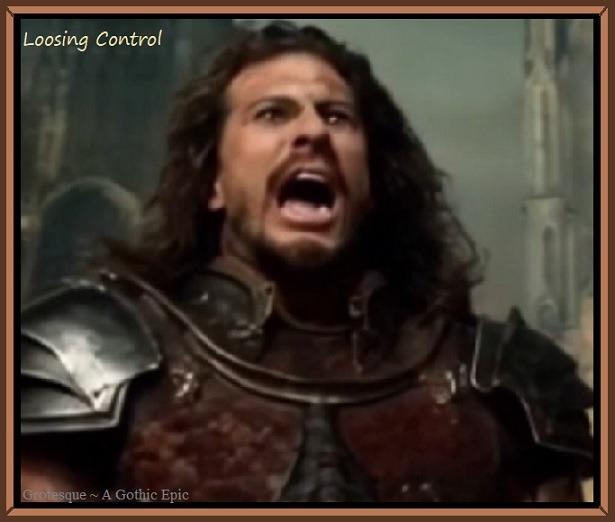
Bourne turned and raked his blowing hair behind his ears. He marched toward his torchbearers. “Approach the hole with me! Shield your flames from the wind! Gather together and keep the torches lit; each flame lighting the next!” He neared the edge of the pit. In the faint illumination of leaning torch flames, he saw cracks forming in the pit walls, climbing upward and over the uppermost edge of hollow’s perimeter. Still, the fractures radiated from the gatestone, through the higher cathedral floor, even to spread beneath his boots. Bourne stepped back. Within the pit, the whirling funnel moaned; growing louder as it appeared to gain speed. Within its moan, came the climbing tones of many screams, altogether, to resemble a massive gathering of unfathomable suffering ~ as if, a roaring choir of a thousand tortured souls.
Bourne howled, “Where is the Cardinal?” Yet, his eye lay fixed upon the black, spinning monstrosity of compressed body parts now before him. Then he commanded his torchbearers, yelling over the noise as he shoved soldiers away from the pit, “Fall back! All, save the three of you ~ hold your light on it. You two; I want more torches in this church! See to it! And you; take your place on the tethers!” He called out to Armond. “Be at the ready!” Then he bellowed to all of his men as he circled behind them, “On my mark; we close the slab! Align yourselves evenly as before! Pace yourselves the same. And if I see even one of you raise your head against me ~” But the Captain shut his mouth, turned slowly in the direction of the pit, and stared at a smooth, crimson shape that rose slowly from out of the center of the swirling column of dark flesh.
~*~
Across the cathedral, Clodius abandoned Greville and fled toward the church doors when a bolt from a crossbow struck the rock wall. Sparks exploded, arms~length from Clodius’ face, abruptly convincing him to fall back and reconsider his escape. He retreated to Greville, who still lay cowering on the floor. From afar, he spotted the crossbowman reloading and re~leveling his weapon on him. Clodius eased himself toward Greville, now keeping a wary eye on the giant Cyclops statue, with its head turned downward, appearing to study the priest with its one unblinking eye of stone. Clodius consoled Greville with a pat on his shoulder. “Collect yourself. You must be strong if I am to help you escape.”
Greville sat up and wiped his eyes. “Yes ~ out of here. I wish, I ~ yes ~ we shall leave.” Greville’s glassy eyes rolled about, appearing to search for something, somewhere in the church, and unable to find it. Yet, his eyes seemed to be discovering everything at once, only, in a very different light. He mumbled, “I am tired. I should go back to the dormitory and rest myself for morning services.”
“Indeed.” Clodius agreed. “And you should. ‘Tis time to leave; that you might find peace and rest ~ for morning services.”
Greville looked up at Clodius, but his attention fell over Clodius’ shoulder and toward the distant ceiling. His blank stare lay fixed on whirling images of the sprawling fresco. He saw winged demons slaying angels. He saw flying devils penetrate a circle of blue flame, their swords on high as they beheaded three faceless kings. Dazed, Greville smiled weakly and nodded, as if accepting the horrific happenings against the ceiling.
Clodius slapped Greville. “Look at me! We leave now! When I see that the moment is right, I expect you to run quickly for the cathedral doors. Do not slow or stop! Keep your eye on nothing but the doors; I shall be right behind you. Do you gather me?”
“Yes, I must have fallen ~ yet, I am able. Shall we now leave?” Greville asked, extending his hand for Clodius to help him to his feet. A crashing sound came from behind them and both priests turned to see that the large stone crucifix had fallen from the wall. The remains of it lay strewn over the floor as a heap of shattered fragments. Yet, of all the scattered shards, none represented a recognizable part of the former sculpture of Jesus, since every broken piece belonged only to that which was once the carved, stone cross. Their hands clasped together, Clodius began to pull Greville to his feet, when ~
“HISS!” From behind Clodius ~ a sharp spitting noise like that of an irate cat. Clodius spun about just as Greville jolted backward, and both monks hit the floor. They froze where they sat, wide~eyed and stunned, their robes fluttering in the breeze as they stared into the face of, what any holy man would conceive to be, an unspeakable abomination. Before them stood the stony figurine, which was previously affixed to the carved cross. Now it stood, detached, and as high as perhaps a small dog. Its body resembled that of a jackal. However, aside from needle~like teeth, its head remained unchanged and in keeping with the prior likeness of the carved Jesus, complete with thorny crown. And unlike its front paws, which stood apart, upright and unobstructed, its rear paws lay backward against the floor, both of them appearing to be nailed together and attached to a large remnant of the former stone cross. The grotesque statue crawled toward them, dragging its backwardly twisted hindquarter and still~attached chunk of rock. Clodius and Greville scrambled away from the encroaching stone figure.
“ROAR!” A booming voice from the looming Cyclopes carried over the interior of the cathedral, briefly drowning every sound. Clodius found the giant staring at him with its one great eye. The statue released his hand from the ceiling, raised an enormous sword with the other, and began to step down from atop the cornered base of the column when both priests leapt to their feet and scrambled for the wall. The stony giant slammed its sandaled foot against the floor of the church, sending cracks through the flagstones, spreading from beneath its heel. Roof stones and dust showered the moving statue. Abruptly, the unsupported section of the cathedral roof collapsed and, in the thundering chaos, a massive column of debris fell atop the giant. The Cyclopes shattered beneath the sudden force and all of it crumbled to the floor in an avalanche of grit and stone. A massive plume of dust rolled over the floor even as the wind swept it up, thoroughly dispersing it everywhere and obscuring the entire view of the church. On the floor, the stony jackal figure scurried about, whilst dragging the broken piece of cross behind it. It dashed toward the center of the cathedral and dived into the partially closed pit. Like a swelling melanoma of mayhem, hell spread throughout the cathedral, sparing no sacred icon. And the enigmatic moment careened into an ever~worsening nightmare.
“HEAVE!” Captain Bourne shouted. Soldiers tugged and tethers stretched as the altar slab slid further forward, grinding against the fractured floor. In the howling wind and churning dust, the men stood nearly deaf and blind. With a third of the pit covered beneath a slowly encroaching slab, ever~widening crevices in the floor hissed with spewing mists of freezing fog. A man cried out with what seemed only half a shriek. Immediately, Bourne spotted an empty place in the ranks ~ and a large fissure in the floor that spewed forth a column of mist and ice crystals. He darted through the ranks and leapt over spreading cracks in the flagstones. Yet, he was too late; he could not even locate his soldier in the deep crevice that seemed to descend even to the depths of hell. He screamed to the rest of the idle men, who now held pairs of flameless torches, “Circle behind the formation at once! If one of us should fall, take that position at once!” He turned to the far wall. “Armond; be ready to assume command!” As the men dropped their torches and scrambled away from the pit, Bourne straddled the floor crevice. He latched himself to the tether, in place of his fallen man, and warned all of the soldiers on the ropes; “We pull as one and die as one!”
“HEAVE!” Bourne cried. Bluish knuckles gripped ropes. Shivering men hissed and groaned. Again, the altar inched forward. Hailing ice slung out from the whirling column, pelting every soldier. The men were wet and dirty with dust, some grimacing beneath frosty beards, and all of them bore the same expression of fear and desperation, as could be seen only in the heat of a raging battle.
“HEAVE!” Through the quickly dissipating brume of dust that once engulfed the entire cathedral, the Captain kept his eye on the evermore~revealing remains of a glistening Friar Grate as it continued to release a succession of luminous apparitions from its throat. One after another, they flew from out of the corpse’s mouth, each escaping more quickly than the one before it ~ until the corpse’s throat flapped and belched with such intense repetition that it split lengthwise. Abruptly, the whole of the monk’s head and neck burst open, flush with its shoulders and in every direction, seemingly as a quick~ripening, fleshy bloom. From the headless torso that remained, a brilliant column of streaming spirits spewed forth, screaming and throbbing upwardly. The higher regions of the cathedral swarmed with glowing translucent forms. Everywhere, apparitions disappeared and reemerged from the ceiling, walls, and floor ~ the entire cathedral flickered with an unnatural radiance.
The altar slab slid in short bursts as the massive stone rolled over the obstructing corpse of Friar Grate, and with every heave of the heavy stone, the skinless torso bent further backward until it’s tremendous weight cracked it’s spine. The corpse flipped and folded sharply sideways. In this gruesome and unnatural angle, the flapping remains of its head tore away, only to be swallowed by the roaring black column beneath. Abruptly, the exodus of throat spirits ceased, yet its flared neck hole continued with a guttural groaning ~ in tune with every thrust of the altar slab. However, the twisted remains eventually disappeared beneath the sliding stone. At length, in a moment that might have seemed eternal, the deafening roar began to subside; the winds calmed; the dust settled, and a reverberating thud shook the cathedral floor. With the altar slab now locked in place, Bourne and his men had finally covered the pit. A low rumble continued through the floor, attesting to the whirling column of blackened body parts still raging beneath the altar capstone.
Although Cardinal Blasi had managed to open the gatestone ~ enough to release an army of spirits ~ he never found the opportunity to recite the remainder of the passages that would send them against the English, at Crecy. Hence, the aimless specters circled the ceiling before vanishing through the stones. One after another, the glowing forms left the cathedral, until the interior of the church fell dark as a devil’s eye. In the ensuing silence, soldiers panted, coughed, and sobbed.
“Damn you, Cardinal!” The voice of Bourne bellowed through the lingering darkstill, quickly lost in a trail of overlapping echoes.
~*~
Outside the church and across the abbey grounds, Odino peered through the evergreen shrubbery. His knees nearly gave way to a wave of nausea as he watched four soldiers carry Ivan's limp remains out of the front entrance of the catacomb building. They carted the corpse to the bathhouse where they positioned it beside the outer wall. Odino choked back tears, his mind fixed on Lazarus. He studied the soldiers who stood clustered in the courtyard, their attention completely turned to the church. The men pointed into the air, at luminous apparitions that emerged through the cathedral roof. The yellow glowing forms circled the church steeples as they chased one another amongst the high terraced rows of stone grotesques. Altogether, they swarmed like pigeons that sparred and vied for places to roost.
Unable to locate Lazarus inside the catacombs, Bourne’s soldiers returned aboveground and stepped out into the courtyard only to discover a haze of glowing spirits darting about the upper reaches of the cathedral. Hypnotized by the surreal spectacle unfolding before them, the guards gathered with their comrades~in~arms, with their backs to the row of shrubs where Odino hid ~ the monk saw his chance. Odino broke from the bushes and slipped through the side entrance of the catacomb building. He raced down the long hallway, rounded a corner and pressed his ear to the iron~strapped, wooden door of the catacomb entrance. Then, he eased open the door and found it unguarded from within. Still unnoticed, he shuffled down the dimly lit stairwell and sped through the corridors, turning this way and that, descending deep into the earth and down an unbroken passage which led to no place but the Well Hole.
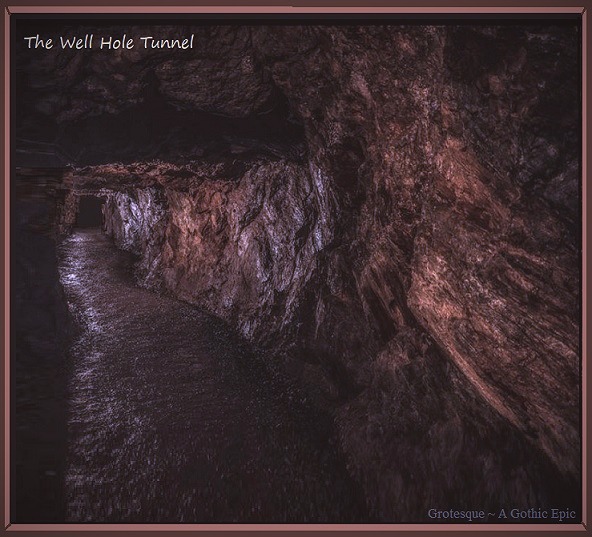
Upon reaching the Well Hole, Odino thrust a torch into the dark hollow and whispered, “Lazarus?” Yet, the room lay empty, offering only the gurgling sound of an underground spring that passed through a wide ditch in the floor. Odino stepped within. He shuffled himself to the far end of the room, where he grabbed one of many wooden water pails that lined its wall. He approached the ditch and tapped the pail against the rock floor. “Lazarus? Where are you? ‘Tis Friar Odino.” Then, he passed the torch over the trench and searched beneath the water.
Odino slammed the pail on the floor. It shattered as Odino bellowed, “Lazarus, come forth!” Instantly, the surface of the underground stream ruptured with a drenched Lazarus, who had hid himself in a small cavern beneath the floor ~ an air~filled pocket created by centuries of erosion. Fortunately, only five souls knew of its existence: Lazarus, Odino, two deformed squires named Miguel and Thateus, in whom Lazarus confided his trust, and a burly, silver~haired monk who now lay by the bathhouse, forever silenced.
“Is father ~?”
“Yes. Ivan has passed, Lazarus. He is now in Heaven,” Odino replied, swallowing hard. “Yet, there is no time. We must leave in haste!” He tossed the remnants of the pail aside, clasped Lazarus’ outstretched hand, and hoisted him from out of the water. Lazarus pulled the dripping mask from his rope belt and wrung the water from it when Odino took it from him and tossed it into the stream. “No need for that. Your world has turned ~ differently.” Lazarus watched as the swift current swept away the mask. And the face cowl slipped through a worn hole in the wall, forever lost within the dark waters beneath the earth.
They fled the Well Hole and raced up the winding tunnel. Before them, the heavy monk thrust a blazing torch into the unfolding darkness and, behind them, a trail of smoke lingered against a chiseled roof as a trail of water from Lazarus’ dripping robe trickled deeper into the tunnel. Further, passed the monk’s shoulder, reflections in the boys’ wide pupils might have appeared as a pair of glowing yellow disks in the light of the wafting torch flame. Lazarus quickened his stride, his wet robe whipped and popped as he fell alongside Odino. He questioned him; “Why does the gatestone scream, friar?”
Odino stopped abruptly and leaned against the wall to catch his breath before turning the torch on a pair of blue eyes. “Scream? How does it scream?”
“I hear it. In my heart ~ the sound of it. Even now, it comes from over there.” Lazarus pointed toward the highest reaches of the tunnel’s rock wall.
Odino considered Lazarus’ claim and realized that the boy was pointing in the direction of the cathedral ~ toward the very heart of it. The monk scolded him; “I shall hear no more of that evil~speak, boy! Now be silent, lest we be heard!” Again, they raced up the tunnel.
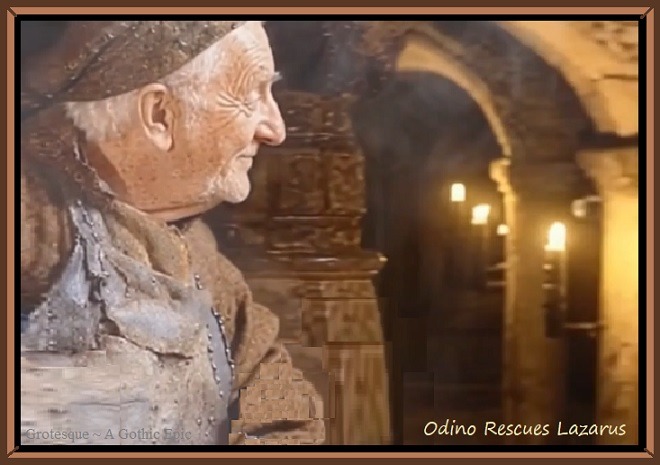
They hurried through the maze of catacomb passages. At length, Odino ducked into the boys’ quarters and barked, hoarsely, “Come out of that wet robe!” He slumped against the side of the entryway. “Have you fresh clothes?”
“I have those beneath my bed.”
“Then, on with them; I cannot bend down there! Have you another hood?”
“Only the one you took from me, friar.”
“It matters not. Disrobe and clothe yourself, quickly.” Odino peered without the room and up the main corridor, yet saw nothing but blackness, since with Lazarus now in hiding, none bothered to replace the catacomb torches. Nevertheless, Odino stood guard, listening for subtle sounds, watching for a distant glow of a probing torch.
Odino turned to see Lazarus kneeling beside his bed; quietly weeping over a wooden box that lay filled with clothes.
“What is it, boy?” Odino hissed.
Lazarus placed his hand on the edge of the box. “I have a hood ~ a new one. And two more ~ one marked for Miguel ~ another for Thateus.”
“Get on with it, Lazarus! ‘Tis not the time!” Odino rushed forward with the torch, pulled the robes and masks out of the box, and laid them atop the bed.
Lazarus wiped his face, leapt to his feet, and quickly disrobed. Odino passed the torch over the bed whilst he separated clothes with his free hand. The boy paced in a circle, clutching his chest, unclothed and shivering. In nearly every way, Lazarus’ thin~framed body seemed as normal as that of any human boy of his age, aside from his having no hint of a navel on his stomach. However, the greatest difference betwixt Lazarus and the other squire boys was not a hunched back, as was supposed by the abbey residents ~ squires, friars, and abbot alike. In appearance, his spine lay perfectly aligned as those of any fit boy. By far, the most conspicuous distinction was that Lazarus sported a pair of folded, membranous wings, of flesh and bone.
Lazarus spread his wings and briskly shook the water from them. He refolded them into a hunch on his back and turned around to find Odino, with clothes draped over his forearm, frowning, as beads of water trickled over a crumpled brow.
“Forgive me, friar,” Lazarus offered with a lowered gaze.
Odino nodded toward Lazarus’ bed. “Use your bed coverings to dry yourself.” Lazarus did so and Odino held out his arm. “Now, clothe yourself.”
As the boy dressed, Odino showed him another full set of clothes draped atop the bed, including a robe, a loincloth, a hood, and two pairs of foot mittens. “The night air is cold; you shall wear both dressings, one atop the other. Make haste and be done with it!”
Odino patted his shoulder, rushed back to the doorway, and stood guard as Lazarus busied himself. “Hear me, Lazarus. We shall be leaving the catacombs. However, there are many soldiers on the abbey grounds, who shall do all in their skill to check our escape. And though the cover of darkness is ours, we cannot be seen or heard ~ and we must move like the wind.” Odino stifled a cough and looked to Lazarus. “Do you gather me, boy?”
“I do, friar. Yet ~ perhaps we might hide ourselves in the catacombs ~ only until the morrow,” Lazarus suggested, his voice trembling. The monk spotted an expression of grave apprehension on his face, just before the boy slipped the mask over his head. Clearly, Odino realized that Lazarus knew little of a world outside of the catacombs, save what he might have gathered from books of the abbey scriptorium. Lazarus tightened his hood laces and added, “The soldiers would not find us down here. I know of a hollow wall within the Benion Tunnel ~
Odino stepped across the room, grabbed the boy’s shoulder, and shook him. “No! You must take charge of yourself! The catacombs are no more. There are no more torches to light or stub out; no more winemaking; no more cleaning of walls and floors. From this moment forth, the only orders to obey, shall come directly from you. And you shall live or die by such orders! Make no mistake, Lazarus!”
“I shan’t friar, but ~
“No exceptions, Lazarus. Your very life depends upon it!”
Lazarus dropped his shoulders and head, and stood silent.
Odino released him and sighed. “What is it, now?”
“But, I am afraid, friar.”
Odino knelt before him. “And you had better be!” The priest pointed toward the ceiling. “Those men up there shall kill you if they catch you. Fear is the very condition to keep you alive. Fear is good.” He shook the torch. “Fear is your friend, never to be tested or betrayed.” Odino pulled the second mask from the bed. “Now, place another hood over the one, and lace a third pair of foot mittens over the two, forthwith!” Odino stood quickly and returned to the doorway.
Lazarus hastily dressed himself as Odino lectured him. “You are no longer a boy, but a man, yes?”
“Yes, friar,” Lazarus grumbled, securing a second mask over the first and grabbing another pair of foot mittens.
“Then, recall my name; what is my name?”
“Your name is Friar Delon Odino, friar.”
“’Tis not! Gather it well ~ the boy called Lazarus, is no more. He has grown into a man. He speaks and carries himself in every manner as would his father.” Odino slapped an open hand against the wall stones and Lazarus jolted, quickly turning the dark eyeholes of his mask toward the monk. “You are now Ivan! Ivan you are. Now, answer me again, only this time, as would Ivan. What is my name?”
“Odino,” Lazarus answered curtly, continuing with his foot mittens.
“Well done,” Odino replied with a brief smile.“This eve, you become your proud father. You shall find strength in him ~ within yourself. He shall guide you in spirit, ‘til the end of your days. And he shall forever be with you.” Odino patted his own chest. “Here; in your heart.” Odino looked down as he felt a small object concealed beneath his robe. “Ah, yes. He insisted that you have this, should something ~ well ~ here it is.” With his free hand, the priest pulled a leather rope necklace from around his neck and, dangling from the thin strap was a miniature, wooden cross, which Lazarus immediately recognized as Ivan’s prayer cross. Odino strode over to the boy and draped the necklace around his head before tucking the cross beneath his robe. “There; you are now Ivan. And Ivan never cries, does he?”
Lazarus looked up at Odino, his blue eyes shimmering in the torchlight through a pair of holes in his mask.
“No, fria ~ no, Odino,” Lazarus answered. “I am dressed.”
“Then, let us be off.” Odino pat his shoulder. “And whatever befalls us, always remember that you must get out of this abbey and far away. Should the soldiers catch me, you must not look back or falter. Alone, they shan’t kill me; yet if they catch you, then they shall slay the both of us ~ you, for who you are, and me, for encouraging your escape.” Odino narrowed his eyes. “My life is in your hands. Do not fail me.”
Lazarus rubbed a small object concealed beneath his robe and set his shoulders back. “I shan’t ~ Odino.”
Odino tossed the burning torch atop the bed and the flames quickly engulfed the coverings. Smoke billowed against the rock ceiling and spilled into the corridor. Lazarus remembered Naramsin’s letter and its many pages of scribed symbols. He dived forth and shoved a probing arm into the mattress straw, but found no papers. Odino pulled him away. “What, in blazes, are you doing?”
“I had a parchment roll in there!” Lazarus exclaimed, pointing at the burning bed. “‘Tis gone.”
“Leave it go.” Odino turned Lazarus head away from the flames and looked squarely into his eyes. “You have everything you need. Now, listen to me. Should we be discovered, you are to return to the Well Hole and hide yourself in the cavern beneath the floor ~ as before. The darkness and smoke shall cover you, yes?”
“I shall,” Lazarus replied.
The monk nodded, wiping fresh beads of sweat from his brow. “Off, we go, then ~ like the wind,” he hissed.
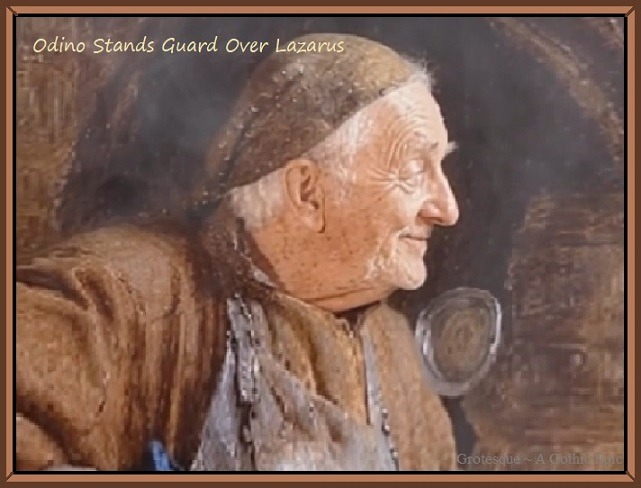
Odino listened near the doorway before escorting Lazarus quickly up the dim corridor. Behind them, the glow of a roaring fire faded as notable features of the passage fell into dark shadows. Odino guided himself through the black tunnel, as he oft times did, during late night pilgrimages to the wine cellar; he slid his fingertips against the wall and felt for memorable markers that might let him know precisely where he walked. Lazarus strode closely behind him as he marched up the center of the passage and, in his swift and steady gate, touched nothing. In the darkness, the commanding walk of the boy could have appeared identical to that of his father’s; with long~stepping heel~pounding strides that seemed to move the very earth beneath him. Together, the monk and squire rounded a bend and moved hastily toward a distant glow at the terminus of the corridor.
At length, the tunnel opened into a tall enclosure, with wide steps that led upward, toward a stone landing. Atop the landing, an unguarded, iron~strapped, wooden door marked the entrance of the abbey catacombs. Near the foot of the catacomb steps, a flickering torch struggled to keep the last of its flame. From it, a glowing red ember floated to the floor and died. Odino shuffled up the stairwell, climbing half of the stairs before discovering, that Lazarus no longer trailed him. He stopped and spun about to find the boy standing beneath the waning torchlight and looking intently at the floor. The priest huffed and shuffled down the stairs. Only then, did the priest understand the reason for the boy’s distraction. Lazarus stared at the floor and examined a sprawling stain of blood that, merely moments ago, flowed through Ivan’s veins.
“Not now!” Odino grabbed his arm and, together, they dashed up the staircase. The monk eased the catacomb door ajar and listened ~ only to hear silence. He flung open the door and charged into the hallway. Yet, before he rounded the corner, he glanced over his shoulder to see the boy standing motionless at the threshold of the door ~ it appeared as though Lazarus saw himself standing on the edge of a great abyss, looking downward into it. Odino retreated a few steps and waved Lazarus toward him. “Now!”
Lazarus caught a deep breath before charging through the doorway. He sank himself into Odino, with fists clenching the monk’s wall of robe.
“Well done. Now, stay close.” Odino tore him away. Although Lazarus said nothing, Odino heard the quickness of his breath and envisioned a wide~eyed expression of terror concealed beneath an otherwise unrevealing mask. Abruptly, from an adjoining corridor, a door slammed; the voice of approaching soldiers grew louder.
“Be strong, Lazarus!” Odino exclaimed, shuffling the burden of his weight down the hallway. “Make haste,” he hissed at the boy from over his shoulder. And with Lazarus close in toe, the two of them ran away from the noise.
The two of them burst out of the side doors of the building and concealed themselves behind a row of tall evergreen shrubs, which lined the abbey wall. And there, they remained, motionless, as the chilly air and the faint light of a dawning moon cast a notable fog over quick breaths. In the direction of the cathedral, they heard voices of arguing soldiers accompanied by occasional shouts of command. Sounds filled the night air: the blowing of horses, stomping of boots, slamming of doors, and clinking sounds of metal ~ the courtyard was alive with the noises of a bustling army. Odino tugged on Lazarus’s robe and gestured for him to follow. Together, they sidestepped through the cramped space behind the hedgerow, sliding their backs against the wall as they went. They quietly inched their way toward the south gate of the abbey, the voices of conversing soldiers growing louder with their every step. Odino placed his finger on his lips, motioning Lazarus to remain silent.
The monk carefully parted the shrubs to find four soldiers standing inside the courtyard grounds, well away from the opened and unguarded abbey gate, their backs to him and looking up at the distant cathedral roof ~ at a cloud of glowing apparitions that swarmed above it. Again, he tugged at Lazarus before parting the end of the hedgerow and stepping plainly into the clearing. As the soldiers remained, Odino pulled Lazarus from behind the shrubs and shoved him so briskly through the gate that the boy nearly stumbled and fell. Nevertheless, the two of them slipped safely into the darkness and, in a fortunate turn of fate, the very same Evil that caused Lazarus to hide for his life, lest the soldiers find and kill him, for what he was, now served to distract the soldiers and permit his escape.
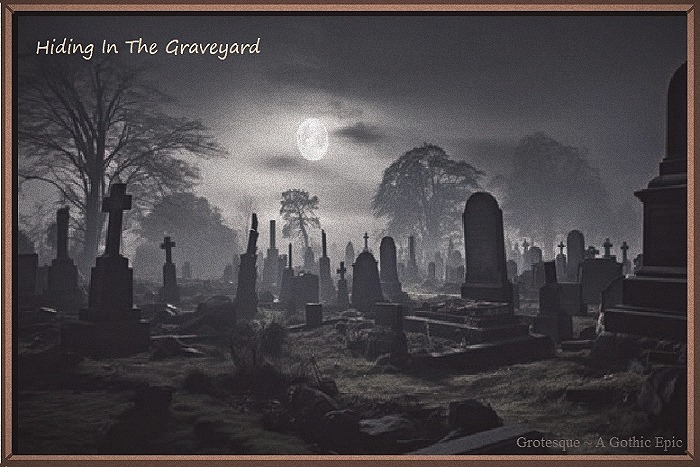
Like shadows moving beneath the dim glow of a dawning moon, they flew down the hillside and toward a field of short dry grass that lay marked with rows of rocks and crosses ~ toward the abbey cemetery. The two of them darted over mounds and through headstones, until they reached the far end of the graveyard. Odino hid himself behind a head~tall boulder, snatching Lazarus from view of any patrolling soldier. And there they hid from all. Odino leaned against the rock, gasping for air. Lazarus stood near him, glancing almost everywhere at once. He searched the grass, the headstones, the distant hills, a rising red moon, and a wide~open sky of countless stars. “I do not like it,” he remarked. “Everything is too big ~ too far away. I do not feel well.”
Odino caught his breath and sighed. “And it shall grow bigger still, before the eve is passed. Get hold of yourself.”
Lazarus spun about and asked, “More than even now?”
The monk slumped his shoulders and moaned; “This is all wrong ~ we shan't survive. I must fetch the provisions.” He looked at the boy. “I know of an unguarded path that shall provide safe passage in and out of the dormitory ~ and the abbey, so long as those gate guards remain distracted.”
“But we have escaped. We are safe!”
“No, Lazarus. We are more than a day’s trek from the nearest village, and still half a night’s journey from the nearest shelter that might afford you adequate cover from the sun ~ and we have no provisions for the coming days, save the robes on our backs.”
“But we might find provisions along the way,” suggested Lazarus.
“If only the world was as kind. Unfortunately, we shall find no such provisions. The only means of a ready fire and the only fresh water available to us remains hidden within those walls,” Odino declared, nodding toward the south gate of the abbey. “And the last bit of food between here and Mountain Mouth is now concealed inside the dormitory, since I gathered all of what remained of the kitchen’s stores.”
Lazarus looked westward. “Mountain Mouth is a cave; over there,” he stated, pointing in the direction of its dark horizon.
“’Tis, indeed,”Odino replied. “And that is where you must be, for now ~ safe from the sun. You recall the cave, yes?”
“I do. My father told me about Mountain Mouth. And Friar Nicholas described to me, how he found it.”
“Do you believe that you can lead me precisely to it ~ in only half an eve?”
“Oh, yes! I can take you to it! Friar Nicholas said that, if I walk precisely west, without straying, then I shall walk directly into Mountain Mouth.”
Odino heaved a sigh of relief, well aware that Lazarus had something of a divine sense of direction, even more so than did perhaps any man alive ~ a sense of it perhaps as infallible as that of any migratory bird. And he was confident that Lazarus would not allow himself to stray more than a stone’s throw from the westerly path, even if pressed to walk its direction for nights on end. Odino turned toward the abbey and mumbled, “At last, this may work to our favor. I should fetch our provisions whilst the soldiers remain distracted.”
“But, the soldiers shall catch us!” Lazarus exclaimed, grasping a fistful of Odino’s robe.
“No,” the monk replied, turning, as he pulled the boy’s hand away from him. “I must go, alone. We can not risk your capture.”
Lazarus patted the boulder. “Then I should remain here ~ behind this rock?”
Odino shook his head. “You can not. If you remain here, then patrolling soldiers may happen upon you. And if I should be delayed, then you may not find time enough to take cover from the sun.” Odino looked east and eyed a brilliant swollen moon. Lazarus searched the darker western edge of the cemetery before turning back at Odino. “Then, where must I hide?”
“Not here. Mountain Mouth,” Odino answered. “The journey is but half an eve. Time is on your side. And you know how to find it, yes?”
Lazarus dropped his head. “Only if Nicholas spoke true, but ~
“Nicholas speaks true, Lazarus. He has shown Mountain Mouth to your father and me. We were there when he gave its name.”
“But we should leave together ~ you and me. And on the morrow, you may return to the abbey and fetch provisions, yes?”
“No, Lazarus. The journey is a demanding one ~ a crossing of many hills and valleys.” Odino wiped a sweaty brow on his sleeve. He laid a trembling hand against his stomach and shook his head. “I am not fit to walk there and back again. I am a burden even to myself ~ even without toting a heavy sack of provisions. If I do not die from the bitter cold, and I do as you might suggest, returning on the morrow, then how shall I slip passed the soldiers when the distraction of the eve has passed and the gate guards are back at their posts?” Odino pointed passed the boulder and over the abbey wall. “See there, atop the cathedral ~ at those things, which this new Cardinal has released from the gatestone.” Lazarus looked at the church’s roof and steeples, its upper regions now illuminated beneath a gathering swarm of formless apparitions. Odino continued, “They are spirits of a kind, and I feel quite certain that they mean to do more than amuse us with their spectacular display. No, their presence and movements reveal to me that a far greater evil is yet to unfold over this abbey. I know not what; yet even now, they appear to gather as an army of spirits. See how they move and collect themselves in rows, between the roof statutes. One truth is certain, my boy. We shan’t be here when they come to organize themselves. Thus, I must move now, whilst the soldiers are distracted by them, and by the new smoke of the catacombs. The time is now, to fetch the provisions, when it can easily be done.”
“But they shall catch you! I know that they shall,” Lazarus complained, again pulling on the monk’s robe.
Odino placed his hands on his hips and leaned back. “And let us suppose that they do catch me. What shall they do with a captured monk; ask for forgiveness? Lazarus, even soldiers honor their Lord. They shall do nothing to me, if only for what I am ~ a man of the cloth and a servant of God. Now, most importantly, you must carry yourself to the safety of Mountain Mouth before the eve is out. I shall meet you there, with the provisions.”
Lazarus released Odino’s robe and dropped his head.
“And besides,” Odino added, “If they try to capture me, then I shall beat the lot of them with a goat and send them on their way!”
Lazarus looked up and shook his head. The monk felt that a smile, if not but a subtle one, now lay concealed beneath the boy’s mask. Yet, the boy turned away from him and stared into the distance.
Odino knelt before Lazarus and placed a hand on his shoulder. “I expect you to be strong, as would your father. You carry his cross with you. And you shall make him proud, yes?”
“I shall, friar,” Lazarus grumbled.
Odino scouted the grounds for signs of soldiers. “And you are certain that you can walk precisely, west?”
“I can.” Lazarus was curt. “But you already know this, friar.” A tinge of aggravation lay in his voice.
“Yes, I know.” Odino patted his shoulder and pointed west. “From where we stand, you shall walk precisely west for half the eve and Mountain Mouth is yours. Do not be seen or heard, along the way. Avoid everything but your straight and narrow path to the cave. Do you gather me?”
“I do, friar.”
“And should it happen that you cannot reach the cave before first light, you must cover yourself from the sun. If nothing more, scrape a hole and bury your self with dirt and rocks.” Odino leaned forward and shook him firmly by his shoulders. “This is very important, Lazarus! The sun shall kill you! You shall die! I have seen it ~ ‘tis an unsightly and painful death! Your flesh becomes stone, through and through, even as you scream! And there is no undoing it. The sun shall be the death of you, Lazarus ~ no life, afterward.”
Lazarus said nothing. Odino released him. For the monk, the boy’s silence, and rigid stance seemed as adequate reply.
“Now, I expect you to walk away from this place ~ only evil remains. Never look back and do not falter for any reason.” Odino straightened the boy’s robe. He scouted the grounds again before nudging the boy on his way. “Do you gather me?”
“I do, friar.”
Lazarus walked toward a black westerly horizon; he kept a forward gaze as he called out, “And you shall come after me?” His voice crackled with trembled words.
“I shall be with you shortly, if I am able,” Odino assured him. “It is by unshakable faith and steadfast determination that you survive what lies before you. You are now a man, Lazarus. You are your father's son; and you carry forth all of his burdens and blessings. Do not waver in distraction, temptation, or confusion. Do not stray from your path. You are Ivan, now. Off you go! And be silent underfoot!”
The boy stiffened his shoulders and marched deeper into the cemetery. Odino watched from afar, as the robed silhouette blended with the black of night. Eventually, the figure disappeared into the shadows of a nearby valley. A moment passed and a westerly wind passed over the countryside. Only when Odino felt certain that the boy had since traveled far enough away, he slumped over the boulder. Beneath him, moonlit teardrops blotted the stone’s face. Odino wept for Ivan, since Ivan could not weep for his terrified Lazarus; he wept for Lazarus, since Lazarus pretended to be the ‘Ivan’ he was not ready to be; and he wept for himself, since he could never be the ‘Ivan’ that Ivan was to Lazarus.
Alas, in the solitude of his immediate loneliness, Odino fell apart, feeling to be but a fat monk collapsed atop a round rock ~ gathering himself to be a mere fruitless spec of a man, overwhelmed and drowned away in some great and terrible deluge of raging emptiness and longing ~ weeping and heaving upon secreted sorrows, whilst in the midst of a sprawling abbey graveyard of long dead and deaf ears.
Vol. I: Chap. VII ~ finis.
Next Chapter~
~8: Opening the Gatestone
“Come away, O human child!
To the waters and the wild
With a faery, hand in hand,
For the world’s more full of weeping than you can understand.”
~W.B. Yeats
Grotesque ~ A Gothic Epic © is legally and formally registered with the United States Copyright Office under title ©#TXu~1~008~517. All rights reserved 2026 by G. E. Graven. Website design and domain name owner: Susan Kelleher. Name not for resale or transfer. Strictly a humanitarian collaborative project. Although no profits are generated, current copyright prohibits duplication and redistribution. Grotesque, A Gothic Epic © is not public domain; however it is freely accessable through GothicNovel.Org (GNOrg). Access is granted only through this website for worldwide audience enjoyment. No rights available for publishing, distribution, AI representation, purchase, or transfer.