Add your promotional text...


Gardiens Abbey ~ August, 1347
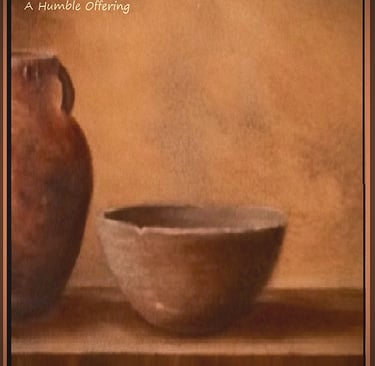
The tunnel torches had long since been extinguished, save one that now leaned from a wall bracket as it illuminated the entryway of Lazarus’ quaint catacomb quarters. In its good light, Ivan pressed his large frame against the doorway, his eye consuming a letter. Within the room, Lazarus sat on the edge of his bed, supping from a wooden bowl.
Lazarus asked, between bites, "What do you read, friar?"
"A post that I send to Friar Salvitino - on the morrow," Ivan answered, eyes buried in the letter.
"Who is he?"
"A Lower Council Friar - once lived here at the Abbey. Before you - before you were born."
"Where is he now?"
"In Italy - Cancello - the other Council Monastery."
"Why do you write to him?"
"He is in my debt. And he can help us with a small matter - once we leave for Italy."
"Italy? Yet, what of Burgandy?"
"Italy, first."
"Friar Odino still comes with us, yes?"
The monk affirmed with a nod. "He has agreed."
"How is this Friar Salvitino indebted to you?"
Ivan briefly tore his gaze from the page. "Enough, Lazarus. Eat."
Lazarus took another bite and chewed briefly before turning to Ivan. "Whilst you were away, I saw a man brought down here and locked within one of the cells. What did he do, friar?"
"The prisoner is to stand trial for heresy. He shall be taken away in the morn."
"What has he done?"
"He is no concern of yours, Lazarus. Eat. ‘Tis late."
Lazarus stole a glimpse at Ivan, who stood consumed by the letter. He slipped a bit of meat and bread from his bowl, tossed it beneath his bed, and resumed eating.
"Perhaps he is hungry," Lazarus suggested.
Ivan cleared his throat, refolding the letter and slipping it beneath his vestment. "Finish your meal, son. I do not wish you near him. Do you gather me?"
"I do, friar." Ivan peered into the bowl and watched every bite until Lazarus slipped the last bit of bread beneath the mouth-flap of his facemask. With a satisfied smile, Ivan took his empty bowl. Lazarus darted beneath the bedcovers.
Ivan tucked him in. "Your prayers?"
"I have, friar. And I prayed for the prisoner."
"Splendid. Then, I shall see you in the morn. Sleep well."
"Good eve, friar."
Ivan departed the room with unbroken stride as he slipped the doorway torch from the wall and made his way out of the catacombs.
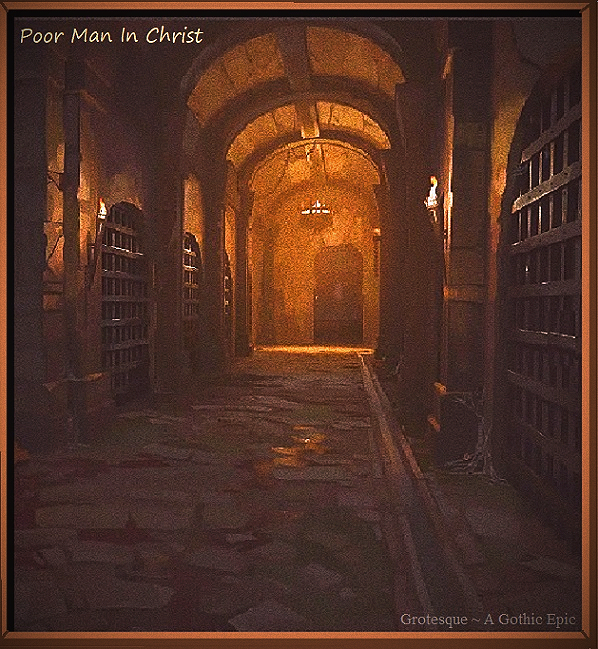
Peering over a heap of blankets, Lazarus watched his doorway features fade to black as Ivan’s torchlight drifted up the corridor. Then he listened for the slap of sandals against stone as Ivan ascended the catacomb stairwell. Finally, Lazarus bolted upright to the clanging sound of a distant door. Now, driven more by curiosity than parental instruction, he retrieved the food from beneath his bed, wrapped it in cloth, and tiptoed up the corridor. Upon reaching an intersection of tunnels, the Benion Tunnel to his left and a short hallway to his right, he turned right to enter a short passage of cells. Six cell doors lined the walls ~ three opposite three. Instead of crypts for housing the dead, these chambers were holding cells fitted with locking doors to imprison the living. Narrow windows on the doors were fitted with sliding iron plates.
Lazarus approached the last cell on the right. He slid open the window plate; the sound of mumbled prayers stopped.
"Hello, sir. I bring food. I am Lazarus. I shall speak with you, if you wish it."
Cell straw rustled and a voice spoke. "Hello Lazarus. Exalted be the name of Lord Christ, whom is Jesus."
Lazarus passed the food through the window, replying, "Blessed is He. Take the food, sir."
As the prisoner retrieved it, Lazarus stole a glimpse at his face. He was a young man with light-colored hair, brown eyes, and a thin beard to reveal slim facial features.
"Most grateful, I am," the prisoner replied. He crouched against the door as Lazarus did the same, leaving only two inches of oak planks between them.
Lazarus picked at the door. "Why are you in here?"
The prisoner responded with a filled mouth, "Accused of heresy. I am to stand before an inquisition."
"What did you do?"
"I live as Jesus lived."
"Then, how is it heresy?"
The prisoner swallowed his food and explained. "A bishop with his many soldiers came into our village and summoned a gathering of all. He scribed our names and trades in his tally books ~ to determine the measure of our tithes to the church. As many in the village were Brothers of Penitence, the Third Order of Saint Francis, we refused. ‘Twas wrong."
"Paying tithes is wrong?" Lazarus asked.
"Jesus lived his life in perfect apostolic poverty. All men of God are required to live as Christ. ‘Tis written that it is easier for a camel to pass through the eye of a needle than for a rich man to enter the kingdom of God. A man is poor when he has no coins and no trade, yet he can still be rich in Christ and offer tithes to Him."
"How so?"
"Leave a tithe of the fields untouched. Leave a tithe of the beasts free. Leave a tithe of the fruits unplucked; give a tithe of your meal to a hungry man. A tithe is an offering, set aside for God. Temples have no place collecting a tithe of anything ~ they are places for worship, only.
"Yet, the Church helps the poor, yes?"
"If the Church collects a tithe meant for God and makes use of it, no matter its intentions, the offering is not to God, but to the Church. Those are the words in Luke and Matthew."
"I know the words, sir. Did you show the bishop and soldiers these words?"
"They know them."
"Why did you not tell them that you shall work ~ and when they left, then all of you might have fled?"
"Did Jesus run away?"
Lazarus scratched his head and searched the flagstones before turning his attention to the door. "Then perhaps you can tell them you shall take the same trade as Jesus. Tell them your trade is teaching the poor masses about God. Offer them a tithe of your teachings, yes?"
The prisoner chuckled. Lazarus cocked his head to the side as a puzzled dog. "‘Tis not so easy, Lazarus. I must make an oath before God. The inquisition has since prepared the questions that shall condemn me. I can not take an oath and lie. I have already been sentenced ~ I shall be burned."
"Burned? The Church burns people?"
"Hundreds; since burned."
"The Church? Yet, the Church is of God. Why must it burn people?"
"Many reasons. Mostly, for not paying tithes or holding true to another faith."
At length, Lazarus countered, "Then, of a lie, Saint Matthew’s words say: All sin and evil speaking shall be forgiven to men, yet evil-speak of the Spirit shan’t be forgiven to them."
"Thou shalt not lie. Do you not recall these words, Lazarus?"
Lazarus began, "I know them, sir. Yet, if they shall burn you -"
"I shan’t take the oath, as Jesus did not. I shan’t flee those who unjustly condemn me. Nor shall I offer them a lie to save myself."
"Sir; if they burn you ~"
"Neither did Jesus lie or tempt. Lazarus, do not tempt me from the Lord."
"Sir, may I ask you a thing?"
"Indeed, Lazarus."
"Why have you not asked me to open this door if you know that they shall burn you?"
"I am already free. This door, whether open or closed, can not make freedom. Freedom is within."
"Might you allow me to unlatch this door, that you may flee?"
"Indeed, not. Are you tempting me again, Lazarus?"
"I do not, sir. Only, I do not gather why it is that you do not wish to save yourself."
"Faith, Lazarus. I am already saved, by faith alone."
"And they shall burn you, as you say?"
"They shall."
"If this is truth, sir, then why have I not read of such things?"
"Perhaps you are not in a place to read of them. Yet, you are learned. Are you a cleric boy?"
"I am."
"Ah! There you have it. As men bridle horses and herd cattle, so you are the horse and the cow. Sons become their fathers and cleric boys become the friars with whom they serve. One generation begets the next."
Lazarus dropped his head, considering the wisdom in the words, before turning to the door again. "What is your name, sir; that I may know for whom I pray?"
"I am a poor man in Christ. Pray for me as such." Straw shuffled. "I thank you for your generosity and company. Now, I must turn to my own prayers. Blessed is the name of Lord Christ, Jesus and blessed is the testament of the Holy Peter John of Olivi. Blessed are their names," the prisoner intoned, crawling away from the door. "Good eve, Lazarus."
Lazarus called after him. "Poor Man in Christ?"
Silence.
"Poor Man in Christ?" Lazarus called out again. But the prisoner offered no more of himself.
Thus, Lazarus left the cell and strode away. Yet, in route to his room, no sooner had he quitted the corridor, a crackling noise emanated from a tunnel juxtaposed to the main causeway and positioned directly across from the passage that he departed. The sound, like splintering wood, echoed from deep within the Benion Tunnel ~ the more ancient of the many subterranean arteries.
For as long as Lazarus recalled ~ like a law set in stone ~ there was a standing rule: that he could wander all of the tunnels of the catacombs with exception of the Benion. Ivan forbade him to step beneath its dangerous roof stones that suspended loosely enough to leak even after a moderate rain. Besides, since the Benion was but a dead-end that contained only sealed crypt doors with fused locks encrusted by centuries of rust, he had no cause to venture into it. However, Ivan had underestimated Lazarus’ dawning sense of independence, as devoted parents are wont to do ~ trusting and with a blind eye.
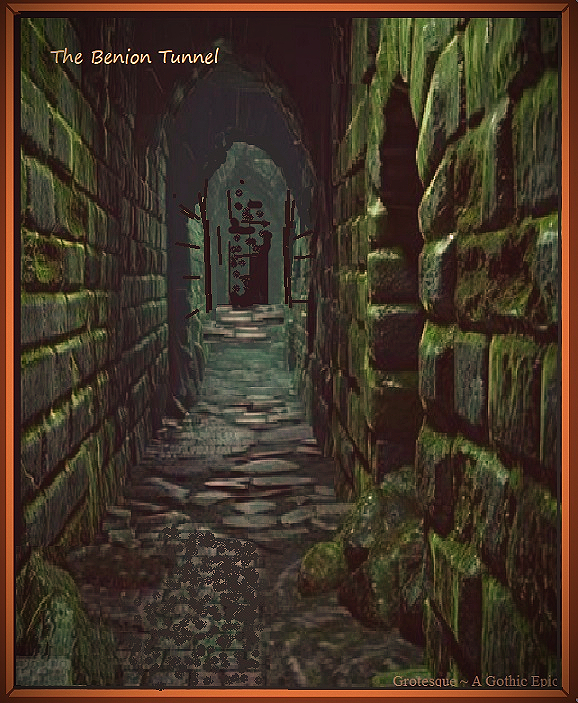
Lazarus stood before the entrance of the Benion and listened to the dripping of water that echoed through its hollow bowels. Again, he heard the disturbance, as it resembled the noise of popping planks that stressed themselves beneath the weight of a heavy burden. Curiosity bit him ~ the fruit of temptation took him - independence drove him. Thus, he drew a breath, looked about, and stole his way down the Benion Tunnel. He dashed by its many crypt doors, offering them but a passing glance. At length, he reached the end of the corridor to discover the root of the commotion ~ the last crypt door bowed outward, marred with a jagged line of splinters that cut lengthwise across its vertical planks.
Already, a gap separated the wooden door from its stony frame and its iron lock lay fractured. Wide-eyed, he stole a peek between the door and frame to discover a row of rectangular hollows ~ occupied tombs, four high - chiseled into the right wall of a large crypt. Within, a nearby table blocked all further view of them. A rusted iron crucifix hung against the rear wall, yet only half of it lay visible ~ even less of the gloomy room.
He smelled the opening to find intermingling smells, centuries old, seeping from the tomb: the odor of decayed cloth; the scent of chalky bones; the musty fetor of fungus, and the sweetness of damp stone. Thoroughly taken in by curiosity, Lazarus slipped his fingers into the crack and pulled. The door scraped the floor as he forced it wider. New wood splintered ~ splintered ~ even to ~
"BANG!" Instantly, the door exploded, showering shards of plank against the opposite wall. Arch stones above the door collapsed as the keystone surrendered all support. Higher still, a large section of wall and adjoining roof gave way to an avalanche that cascaded about him. In the midst of a roaring chaos, he dived into the far corner of the terminal wall as some of its masonry crashed onto the floor.
Silence returned, save the sound of streams of water gurgling against flagstones. And when the dust and debris settled, Lazarus eased to his feet, dirty yet unharmed. He perked a pair of dog-like ears beneath his hood and searched for sounds. Falling water was as a pulsing roar ~ the slip of settling pebbles were as boulders crashing into some deep ravine ~ the soft scampering of rats’ feet were like thundering hooves. However, Lazarus’ attention remained fixed on the entrance of the Benion Tunnel. But he heard no creaking of a catacomb door ~ no clapping of monkish sandals on a stony stair ~ only the sounds of the distant prisoner in the passage of cells as he shuffled about in straw.
Lazarus examined the wreckage around him. The terminal wall of the tunnel stood mostly unscathed, save a small hollow where the stones had since crashed beside him - the damaged section of the wall now offered what seemed, a bottomless hole. Already, a musty breeze, three centuries stale, poured out of the opening. Then, he realized that, what had appeared to be the end of the Benion Tunnel was but a false wall ~ the passageway extended further.
Lazarus peered through the opening, his hood fluttering before the wind-moaning hole. In every way save one, the continuing tunnel mirrored the unsealed section. It might have seemed as though the passage had been abandoned even before it was fully completed since, although crypts lined the tunnel walls, none of the hollows had been finished out with doors. He pushed between the loosened stones and stepped within. Apparent to him, the crypts had never housed remains. The first did not, nor the second ~ and corpses always tainted underlying stones with a rust-colored patina that even centuries can not remove. He continued down the tunnel to find all of the crypts unfinished.
Whilst the air in the crypts remained clean, further down the corridor, the air confessed of death ~ intensifying with the tainting of ancient remains. Lazarus delved deeper. At the end of the tunnel, he found the entrance of the last crypt to be different from the others as it held a door, but sealed over by the remnants of a crumbling stone wall. From behind the door seeped the smell of decay. He pulled away loose stones, pushed open the door, and stepped within. Not a spec of light shined, yet in that unspoiled blackness, Lazarus’ hungry pupils swelled abnormally wide. Like orbs of a perfect nocturnal predator, they peeled away the scales of darkness, and saw all.
The crypt appeared as though it had once been used as living quarters, yet its odor was distinctly that of a tomb. Broken pottery, rotted cloth and dusty artifacts lay strewn about. Lazarus searched the wall recesses, finding no corpse. Rather, the open tombs had served as storage shelves, holding debris of a strange miscellany. And another smell hung in the air - the faint pungency of ink. Lazarus crossed the room and stood over a narrow table and bench, once used as a desk. Its top lay marred with scratches, wax, and ink stains. On it, an inkwell sat crusted and empty. Something peculiar about the table aroused his attention as he examined its surface more closely, tilting his head in careful study. Neither the inkwell, nor the stains confessed distinction; however, whatever commanded his attention lay obscure yet certain in its existence. Only inches away from the table, he smelled it. Still, nothing surfaced.
Then he backed away, centering himself over the desk - and there it lay. Lazarus wiped away a layer of dust. The remaining desk scratches took shape and he found, not random carvings, but orderly symbols. They were not hieroglyphic pictures, but rather were geometric figures. The position and spacing of them drove the pronunciation ~ and the meaning into Lazarus’ eye. In the recognizable pattern, circles and lines formed letters ~ words ~ and sentences. However, the inscriptions were neither French nor Latin, but of a language unknown. In truth, no man could have scribed the message on the desk, since its tongue was never born on earth. With some difficulty, Lazarus pronounced the words and discerned their meaning:
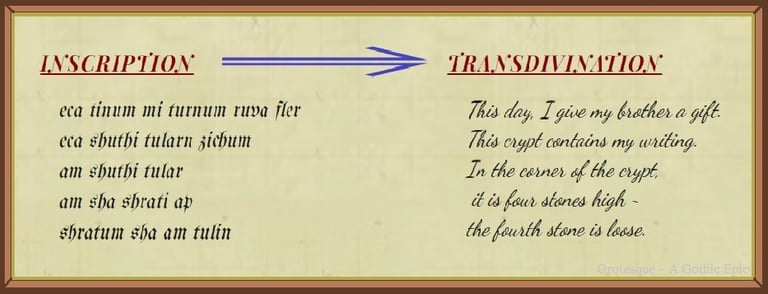
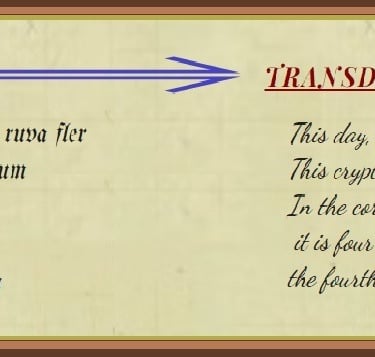
This day, I give my brother a gift.
This crypt contains my writing.
In the corner of the crypt,
'tis four stones high ~
the fourth stone is loose.
Lazarus looked toward the corner of the crypt ~ precisely four blocks higher than the flagstones, a narrow gap of missing mortar surrounded the edge of a worn stone. He slipped the stone from the wall and, from the remaining hollow, he extracted a thick roll of yellowed pages. He unrolled them atop the desk. The topmost page was a letter, which read:
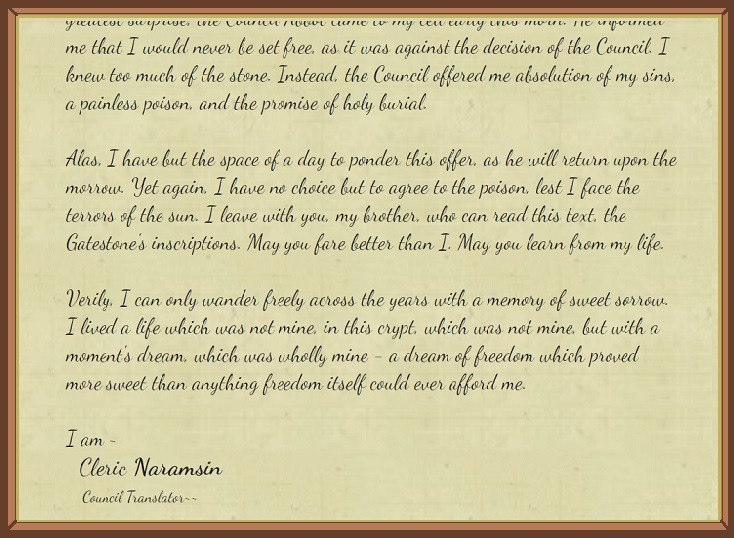
For Thee, My Brother ~
In the twenty~eighth day of September, in the year of our Lord, One Thousand Sixty and Four, I hereby scribe the last of many leaves. Heavy be my heart, for soon I shall know Death's condition. Its smell consumes me. In my perdition, I am pressed to wonder at that part of God, which allows such sorrows and wickedness to prevail beneath Him. I cannot fathom it. In all my sight, I shall never understand. My faith has flown. The flame is smothered in my breast, and I am no more than Death awaiting itself.
I should warn you of the Council. By troth of Council, I was offered a pact. Hitherto, the pact was this. That, by my translation abilities, I would decipher for them the language of the Gatestone. In return, I would gain my freedom - such freedom as to leave the Abbey des Gardiens. I had no course but to agree.
Two full seasons turned whilst I translated the passages, which they brought to me singly in my quarters. In that short span, of all my years, I lived in full content as a man of God. No longer did my confinement weigh upon me as a burden, for the Council adorned my quarters as if I would be a King. All was granted unto me, save the loosing my chains, which remained about me, and guards remained posted at my door.
I lacked nothing but my freedom, and gathered the dream as real as the cold fetters clasped about my arms. Natheless, near the middle of the second season, I fell into an unshakable sorrow. Even to chase away the dream. From the language of the Gatestone, I learned the purpose of it. It vexed me so that I ceased to pray. My faith, I fear, is forever lost. I wish nothing more than death. For God's design, I will never gather His methods, yet shall always know my place in Him.
From that time onward, I ceased with the translation, thus enraging the Council. In response, the Council removed every furnishing from my quarters and placed me back into the horrible conditions which I had suffered before my work for them began. I grew sickly. After a long space, I agreed to complete the translations under the agreement only with a reiteration of the promise of freedom.
I have since completed the work and three seasons have passed. For a time, I questioned my confinement. The Council Abbot spake only this reason - that I should offer, for further time, my council to the priests. I have not set eyes upon them for nearly a season. I have since gathered that I am of no more service to the Council, as evidenced in part by the worsening condition of my quarters. In time, I have divined that they never had intended to free me of this bondage, even from the first. These are my last words, as my ink well runs dry even now. To my greatest surprise, the Council Abbot came to my cell early this morn. He informed me that I would never be set free, as it was against the decision of the Council. I knew too much of the stone. Instead, the Council offered me absolution of my sins, a painless poison, and the promise of holy burial.
Alas, I have but the space of a day to ponder this offer, as he will return upon the morrow. Yet again, I have no choice but to agree to the poison, lest I face the terrors of the sun. I leave with you, my brother, who can read this text, the Gatestone's inscriptions. May you fare better than I. May you learn from my life.
Verily, I can only wander freely across the years with a memory of sweet sorrow. I lived a life which was not mine, in this crypt, which was not mine, but with a moment's dream, which was wholly mine - a dream of freedom which proved more sweet than anything freedom itself could ever afford me.
I am ~
Cleric Naramsin
~Council Translator
An icy breeze ruffled the pages, carrying with it a scent of decaying bones. He collected the pages from the desk and further inspected the crypt. On the far wall, in its lowest recess, a cloth lay draped over something wholly concealed. He approached. As Lazarus grasped the material, it shredded in his fingers like a sheet woven from spiders’ webs. Carefully, he peeled away the rotting cloth to reveal ~
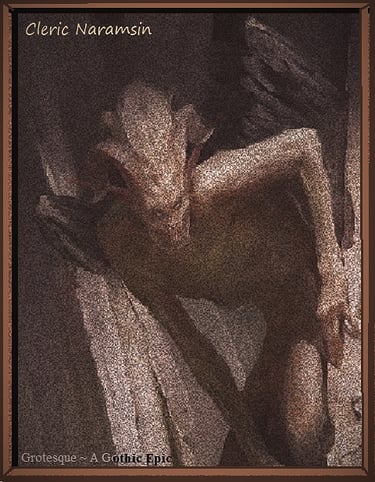
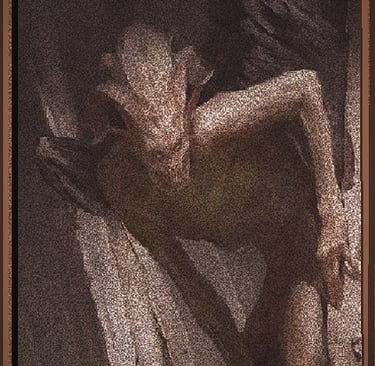
"Ah!" Abruptly, he released the cloth as if it had bitten him. His breath left him and he fell backwards across the floor. And a chill fell over him; his heart fluttered. Burning prickles bathed his body. Cruelly chained before him lay the remains of an adult grotesque - Naramsin’s bones. He had seen many corpses, yet never had he laid eyes upon another grotesque. Thick fangs lay anchored into its skull. A ridge of bone centered hollow eye sockets, the ridge graduating higher as it disappeared behind the skull. Wing bones lay beneath the corpse. Lazarus stared at himself - a larger version of himself - decomposed and wrapped in chains!
Lazarus attained a state of perfect horror ~ that all-engrossing and short-lived condition compressed between a scream and petrified silence. Were he not too alive, his heart had beckoned Death to still it.
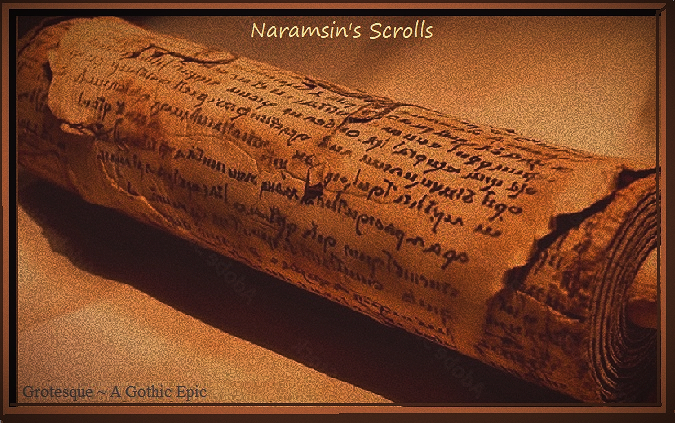
He leapt to his feet and bolted from the crypt with Naramsin’s scrolls. And like a bat from out of hell, he flew up the Benion Tunnel, dived through the hole of the false wall and leapt between the scattered stones. In a flash, he was back inside the untainted and familiar walls of his quarters, hiding beneath his bed coverings. In the lingering quiet, his heart raced with his mind. He hastily stuffed the scrolls between the folds of his mat, checked his hood laces, and buried himself deep in the bed. He felt dirty ~ defiled within. He longed for innocent dreams ~ anything, save the horrible image of his own enchained remains. Never had he felt so alone ~ so deathly afraid, even.
Together, the thumping of his heart and the tormenting of his thoughts cast him into a twisted nightmare - not as much a terror as the waning of a too-charged mental state. In it, completely naked, he raced up the winding staircase toward the catacomb entrance. He raced to freedom - he longed to free himself from the tunnels ~ from its collapsing walls of Death. Every thump of his heart was another step ascended, yet, the faster he climbed the higher the entrance fled away from him ~ looming in the distance. Stairs followed upon stairs ~ and still more stairs, perhaps enough in number even to ascended into the heavens. And throughout the creeping eve, eternal as it may have seemed, the horrible dream repeated, over and again ~ Thump-thump-thump-loom! Thump-thump-thump-loom!
~*~
The crimson glow of first light spilled over Gardiens Abbey. Yet, with monks and squires confined to quarters and morning services set aside, the dim abbey grounds lay as lifeless as Naramsin’s crypt. Even so, within most dormitory quarters, a priest knelt at the foot of his plank board bed, praying for painless transformation. In others, shadows of impatience shifted within the stony frames of narrow windows, casting curious eyes over the courtyard grounds. An air of unease - tension hung.
Friar Ivan leaned against his cell window, peering down at ghostly robes that crossed the courtyard. He snapped a glimpse of a dawning sun and dug his fingers into the widow frame. Below, the ritual commenced as Abbot Vonig escorted three burly priests to the bathhouse.
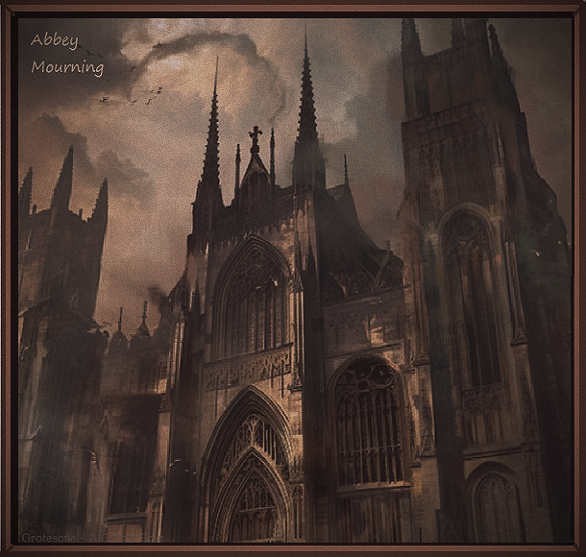
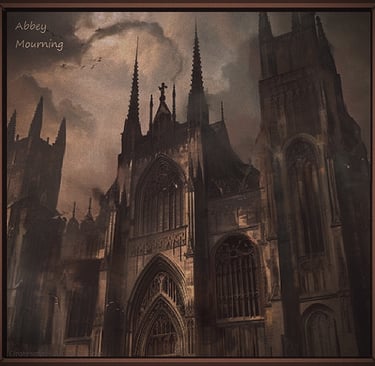
Once within, the abbot instructed his friars, "You ~ latch the door and take your place at the window. The two of you ~ bring the thing. And be mindful of its teeth!" The abbot strode toward a stony table nearest the east wall. The top of the stand lay black as coal, outwardly charred by many prior fires. Together, two monks disappeared in the dim of the bathhouse whilst a third rounded the abbot and peered through a vertical crack between closed window slats that faced the direction of daybreak.
Shuffling, groans, and hissing attested to a struggle in the rear of the bathhouse.
"Careful!" Vonig yelled. He pulled a small flask from his robe and cast sprinkles over the table. He mumbled in prayer.
The two monks returned with the grotesque, walking her forward as she fought against them. "The sun clears the wall, abbot!" the priest by the window called out. Vonig affirmed with a nod, mumbling still. The monks dragged her to the table.
Vonig began to pray loudly; "Our Father who art in the heavens, hallowed be thy name. Thy kingdom come ~"
The grotesque braced her feet against the side of the table, struggling against her captors as she yelled at them. "Baut! Eca am sha tular!"
"~Thy Will be done, on the earth as it is in the heavens."
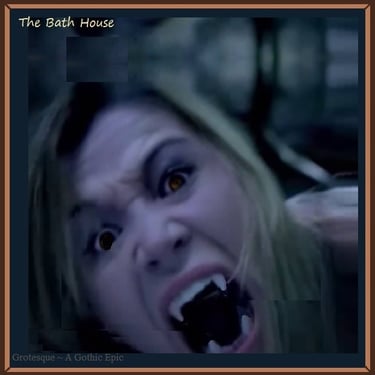
She hissed at the monks, keeping herself away from the table as she thrashed about. The priests slapped leather restraints around her wrists and ankles. They yanked the tethers, throwing her off balance before dragging her over the tabletop, her wings slapping in their face. The monks positioned themselves on either side of the table, each holding a pair of straps that pinned her hands and feet to the stone slab. The struggle was over; she could not free herself. Sitting on her knees, she could only stare forward at the abbot.
Abbot Vonig continued praying. "Give us this day our daily bread and for give our trespassers~"
The grotesque interrupted him with soft, girlish and outwardly pleading words. "Shat na cawt - hmm? Cawt?"
Vonig looked up from his book to find her troubled face, tears streaming down her cheeks. She appeared strikingly more human than any grotesque that he had ever seen. Aside from her wings and teeth, she might have appeared to be nothing less than the perfect likeness of a terrified girl.
Vonig tore his eyes away. "~ as we forgive ~" Vonig choked on his words. He cleared his throat and continued, "As we forgive those who ~" Again, his voice caught. He retreated from the slab and turned away from her before yelling to the priest at the window. "Just uncover the cursed window!"
The two monks leaned back on their tethers. She hissed at them. The other priest grabbed the wooden shutters but hesitated. He looked back at the grotesque, grimacing, when Vonig spotted tears welling up his eyes.
"Be done with it, friar!" Vonig scolded him. Instantly, the priest flung open the shutters and rays of sunlight bathed the bathhouse.
"Screech!" A piercing shriek carried over the abbey grounds. A cloud of ash boiled from out of the bathhouse window.
The bathhouse door flung open and a coughing Vonig stumbled quickly out of the smoky entrance, rubbing his eyes as he hurried off to his study. Shortly, the remaining monks exited the building, carrying amongst them a stone statue of yet another grotesque Eljo, with spreading wings, its posture frozen in a kneeling position and its upturned face revealing an expression of agony.
Across the courtyard, the narrow frame of a second floor dormitory window outlined a tall priest with a ring of silver hair, weeping, his hand over his mouth. Beside the dormitory roof, yet another set of eyes gazed down at the monks and their statue: beady black spheres of a luminous raven perched atop the courtyard plum tree. It watched reverently as the three monks carried away the latest Gardiens grotesque ~ the last Gardiens ‘gift’ to be delivered to the Cancello Monastery in Central Italy, for mounting atop its cathedral ledge.
~*~
Ivan stepped through the catacomb entrance. He descended the staircase when he came upon Lazarus, who stood holding a lit torch and fidgeting.
Ivan stopped on the steps. "Lazarus?"
"Friar, there is something I must tell you. It happened last eve."
"What happened?" Ivan descended quickly down the remaining stairs." What happened?" He rounded Lazarus and a corner to find catacomb torches already burning. "Why have you lit all the torches without me?"
"There has been a mishap, friar."
"The prisoner?"
"The roof has fallen in."
"What? Are you hurt?" Ivan grabbed his arm and inspected him like a concerned mother.
"No, friar."
"Show me!" Ivan took Lazarus’ torch and followed him into the Benion Tunnel, to its end. Ivan waved the torch on high, stepping through stones and inspecting the damage. Then he spotted the gaping hole in the wall and froze.
"The tunnel continues?" He turned to Lazarus, his brow raised in disbelief.
"It does, friar."
Ivan held his torch beside the hole and its flame leaned in the moaning breeze.
"Remain here," Ivan stated, climbing through the hollow.
"But I have already ~" Lazarus caught himself.
Ivan looked back at him, "Have you been in here?"
"Yes, friar, but ~"
"Then, we shall discuss your disobedience later."
Lazarus dropped his head. Once through the hole, Ivan looked back at him. "Well, come on then - since you know the way."
Lazarus leapt in after him.
As Ivan illuminated each of the empty crypts, Lazarus trailed close behind him. But the boy fell back as Ivan neared the last crypt.
"Friar, there is a - there are bones in there," Lazarus admitted, pointing to an open door, its entrance strewn with stones.
Ivan stepped inside but Lazarus remained where he stood. He perked his ears beneath his hood. He heard Ivan ease back the rotted cloth ~ he heard Ivan stop short in his breathing ~ he heard the lingering quiet that followed and, when Ivan stepped out of the crypt, Lazarus studied his face in the torchlight. Ivan was pale and drawn, but said nothing. He only looked at the flagstones between him and Lazarus, as if lost in thought.
Lazarus broke the silence. "Friar, he is like me. Did you see? And he wears chains."
Ivan moved quickly past Lazarus. "We must go. Now!" Not once did he look behind him.
"Friar, why is he in there?" Lazarus asked, falling behind him.
"I expected you to remain in bed. Say nothing of what you saw. No more questions." The boy discerned anger in his sharp tongue.
"Forgive me, friar." Lazarus hastened his pace to match the quick and steady strides of Ivan.
After they left the newly discovered section of the tunnel, Ivan had Lazarus help him to seal the hole with the previously fallen stones. Lazarus fetched him a trowel and replenished pails of fresh mortar and water. Finally, when Ivan felt certain that no other monk might suspect the wall to be false, he ordered Lazarus to return to his quarters and bade him remain there.
Ivan was well aware that a restoration of the Benion Tunnel must include the raising of a fresh wall against the newly found false wall. If his fellow priests discovered the remains of the grotesque - in the ensuing chaos of rumor and ruckus that would invariably result from its findings ~ then undo attention might fall squarely upon Lazarus. None must know, he thought, mulling over restoration plans as he strode out of the catacombs and toward the abbot’s office. After all, the age of the Benion Tunnel was no secret. Long ago, he warned Abbot Vonig of its eventual collapse and, in its maturity, the moment was only a matter of time.
~*~
The Abbey grounds bustled with monks and crown-shaven boys. The main gate bell rang in the distance. Shortly, a robed squire ran across the courtyard. Like Lazarus ~ like a burlap ghost ~ the boy wore a facemask with eyeholes cut in it. A complete hood covered his head. He flew past a monk who scolded him. "Migual! Running?"
The boy slowed to a brisk stride. At the far end of the Abbey, he stopped before Friar Grate and bowed. The priest noticed him. "Migual, your hood is torn beside the eye hole. You might have Friar Ivan stitch it."
"Friar Ivan stitches n-new hood. Friar, I may speak?" The boy’s slurred words denoted a severe mouth deformity.
"Out with it, then."
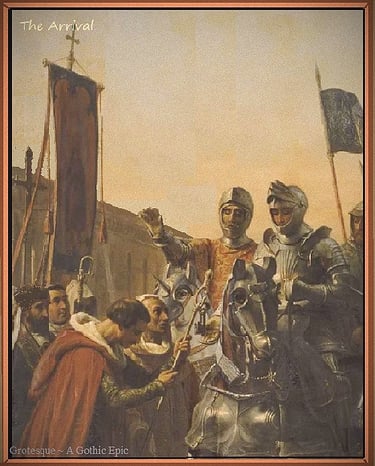
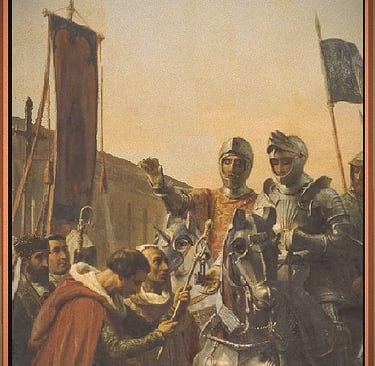
"Soldiers at the gate! From Avignon! Carriage with them - a priest in it! Red r-robe," the squire stammered.
"What does he wear on his head, boy?" Grate asked, suddenly alarmed.
"Wears white cap ‘round his ears. Another in his lap ~ is big. Red hat."
"What in the name of ~" Grate instructed the boy. "Hear me! Inform the abbot that a Cardinal arrives from Avignon! Now, be off!"
The boy bowed and strode briskly away when Grate scolded him. "Migual! Run!" The squire took off and blazed around a corner.
The clanging of the bell continued as Grate strolled to the front entrance. He spotted a tall soldier with wiry black hair, thin mustache, goatee, and jade-green eyes stood in front of the gate. A heavy scar creased his cheek. Grate unbarred and swung wide the gate. The soldier spat on the ground before stepping around him. In passing, he shot a cold stare and grumbled, "Either you need a larger bell or better ears."
Grate frowned, looking down at Captain Bourne’s spittle. Then he discovered Cardinal Blasi exiting a carriage. Blasi approached Grate, affixing his wide-brimmed hat over devilish eyes. Grate smiled quickly and bowed as he kissed Blasi’s outstretched hand.
The friar held his bow as he spoke. "Your Eminence; Gardiens Abbey is truly honored."
"And who might you be?"
Grate arose. "Friar Maurice Grate, Your Eminence ~ caretaker of guests and overseer of visitations."
"Very well then, Friar Grate. Escort me to the abbot." The friar turned about, Blasi followed as the Captain fell alongside Blasi, waving four of his men to follow him whilst he spoke. I have two hundred men, fourteen horses, and six wagons. I need them tended."
Immediately, Grate waved a cleric boy to him as they walked. "Go to the stables and inform Friar Festoneau that we have guests ~ fourteen horses in direct need of attention." The boy tilted his shaved head and disappeared.
Grate addressed Blasi. "Perhaps you and your men are hungry? If you wish it, we can open the refectory and kitchens immediately?"
"Make it so." Blasi was curt.
Grate continued. "And shall your party stay the eve, Your Eminence?"
"Several days." Blasi replied.
Grate stopped in his tracks. "Days, Your Eminence? But our abbey lacks provision for so many men!"
Blasi spurred him forward. "We shall discuss the details in due course, friar. Firstly, the abbot."
Across the courtyard, monks and squires gawked at the procession ~ all visitors were foreigners. Blasi paid them no heed, yet Bourne scrutinized everyone. His eyes had no manners - they fell everywhere. The party stepped into a building and Bourne snapped his fingers beside the doorway. Two of the soldiers fell from behind him and took to attention outside the door. Grate led Blasi down a hallway and to the abbot’s study. He knocked lightly on the door.
A craggy voice replied from within, "Enter!" Again, Bourne snapped his fingers and his soldiers responded; they flanked and fell to attention outside the door. Grate, Blasi, and Bourne filed into the study to find Abbot Vonig with his back to them and facing a shelf of books. He turned slowly, his attention cradling an opened book in his hands. Then he looked up, suddenly surprised to find a Cardinal in his office. He bowed quickly. "Your Eminence."
"Abbot." Blasi replied in kind.
Grate broke in. "Abbot Vonig, His Eminence, Cardinal ~ uhm ~"
"Cardinal Masson," Blasi helped Grate with the introduction.
Grate continued; "His Eminence, Cardinal Masson, has come from Avignon to grace our abbey."
"That shall be all, Friar Grate." Vonig dismissed him, returning the book to the shelf. Grate bowed and left. "Unfortunately, I bring ill news - from His Holiness. Are you aware that your Upper Council Cardinals, Basiliste and Lean have since passed on."
"I have learned, in recent correspondence," Vonig admitted. Bourne examined the room.
Blasi put on a pleasant face. "Yet, sometimes in the gloom of despair we find a gleam of promise. Abbot, in light of this, I bring good news as well."
"Ah?" Vonig smiled.
"You have been appointed to serve on the Apocrypha’s Upper Council. Your devoted service to the Council has earned you considerable favor in His Holiness’ eyes. He expects you in Avignon."
The abbot dropped his smile. "Upper Council? But I am a bishop. Only Cardinals serve as Upper Councilmen."
"Be that as it may, you and the Lower Council Abbot in Italy are now promoted to the Upper Council." "Domingus?"
"Indeed; the Abbot Domingus. His Holiness has summoned both of you to the Papal Palace ~ and without delay."
"But what of the Abbey? Who shall oversee ~" Blasi cut him off with a wave of his hand, and with a reassuring tone in his voice. "His Holiness is fully aware of what it guards. ‘Tis the very reason for my being here. ‘Tis also the reason for the heavy escort. The abbey is quite safe. His Holiness has instructed me to serve as the interim abbot of this abbey until he can appoint a suitable replacement. Another escorted Cardinal is en route to the Cancello Monastery even now and shall also serve as interim abbot there until adequate succession is found." Blasi threw his hands behind his back and smiled. "Abbot Vonig, I commend you on your appointment to the Upper Council, and I might add that your years of dedicated service to the Apocrypha are rather noteworthy."
Abbot Vonig sensed something amiss. Shortly before Cardinal Lean’s death, the Cardinal sent a letter to him. The Cardinal told him that Pope Clement was still unaware of the purposes behind the Apocrypha Council - or the role of its two monasteries ~ or the Pope’s duties as its overseer.
Vonig questioned Blasi. "Eminence Masson, since there have been no Upper Council appointments since the death of His Eminence, Cardinal Lean, how did His Holiness come to be informed of matters concerning the Apocrypha?"
"His Holiness has since inspected records of the Apocrypha’s archives," Blasi quickly countered.
"Yet, a fire destroyed its records. How might His Holiness inspect records that were burned beforehand?"
"Perhaps not everything burned; I have no ready answer. However, you might question His Holiness with such details ~ upon your visitation with him."
Vonig narrowed his eyes. "If it pleases, Your Eminence, may I see His Holiness’ orders of appointment?"
"Indeed, you may, abbot." Blasi pulled a letter from his vestments.
The abbot popped the wax seal of the letter and read the orders ~ orders signed by Pope Clement.
Vonig refolded the letter and examined both halves of the wax seal. "Why does it not bare an impression of His Holiness’ insignia?"
Blasi defended the document, "As you well know, the nature of the Council is secret. His Holiness insists that only Cardinals shall govern the two Apocrypha monasteries. You must address Him with any concerns that you might have. And he does expect you, immediately."
Vonig looked at Bourne. Green eyes burned back at him. Vonig admitted to Blasi, his chest sinking, "I can not serve as an Upper Councilman. I am old and tired; my days are numbered."
"Then you must inform His Holiness of your condition, abbot. I merely deliver his summons."
"I can not serve ~"
Blasi interrupted. "The Chateau Mallow, in Avignon, awaits you. It shall be your new residence. You have until the morrow to collect your belongings. The Captain shall see to it that your personal affects are properly stowed. And you might arrange a meeting with the resident monks to inform them about your good news and introduce me as the new abbot."
"I shall, Your Eminence."
"Abbot, I take it that you are not pleased with His Holiness’ decision."
Vonig shared his concern. "One often ponders death in my years. I have a crypt in the catacombs - one that I shall never use, I fear."
"The details of your death can be arranged, abbot. Firstly, you must report to His Holiness. I shall stay in the guest quarters whilst you remain as abbot. You shall see to it that the guards and horses are cared for?"
"I shall. Perhaps I might assign you an escort to the ~"
Blasi cut him short. "I shall find my own way, abbot."
"Indeed, Your Eminence." Vonig bowed as Blasi dismissed himself and Bourne from the study. Vonig turned to the window and stared blankly, the forged letter twitching in his feeble hand. He thought of Ivan and that deformed Lazarus boy. He mused over the crypt he ordered dug and set aside for himself. Most likely, he gathered, his remains would never return to the abbey that he served for so long.
Vonig locked himself inside his office. Blasi acquainted himself with the grounds and facilities. Captain Bourne combed the abbey with troops, stationing guards in what he considered to be, key positions. By nightfall, the Captain transformed the abbey into what appeared, an impenetrable fortress ~ no way in; no way out; and a watchful soldier at every corner.
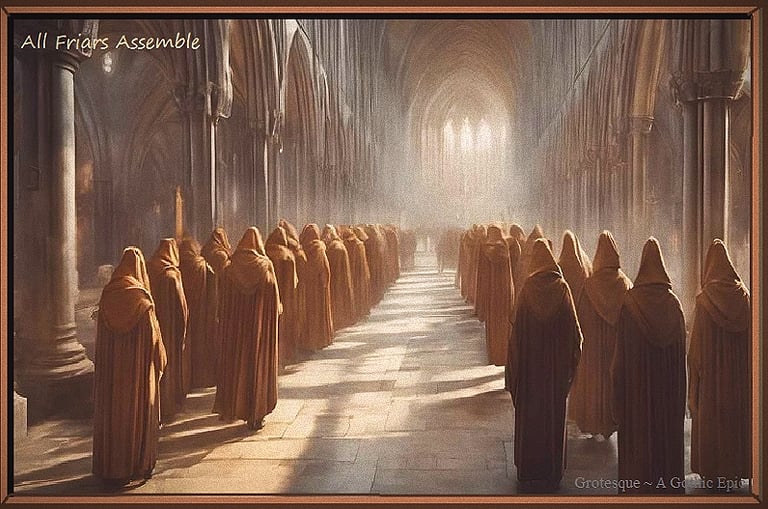
The following morning, immediately after services, Abbot Vonig calmed his concerned monks, informing them of his reassignment to Avignon. At midday, he boarded the carriage and mounted soldiers escorted him away. Blasi moved with deliberate haste. As the new abbot, he called for a meeting of only the Senior Friars of the abbey ~ only those who knew of the existence of the gatestone and the true purpose of the abbey, as its guardian. His reason for calling the meeting was simple: to dissect the body of Lower Council Friars in much the same as was the standard practice of any church inquisition. And as a College Cardinal, Blasi was quite learned of the art of witch-hunting. As he knew, the method of any inquisition was straightforward: to hold an assembly, introduce absolute authority, demand confessions of wrongdoing, and then divide the masses through testimony against one another.
In his called assembly of the Senior Friars, Blasi instructed every priest to scribe a letter and deliver it to him by nightfall. In it, he expected three things. First, the priests were to list all abbey facilities and practices that might be improved. Although Blasi was quite indifferent with suggested improvements, the list served well to distract the monks from the following two lists, which were paramount to his ploy and the very reasons for the inquisition. The second of Blasi’s expectations was that the priests were to offer incriminating testimony on their fellow priests by listing all witnessed behavior that might have seemed ‘unbecoming’ of a monk. Third and lastly, Blasi expected them to write down personal confessions of wrongdoing. He informed the friars that all written confessions would remain confidential.
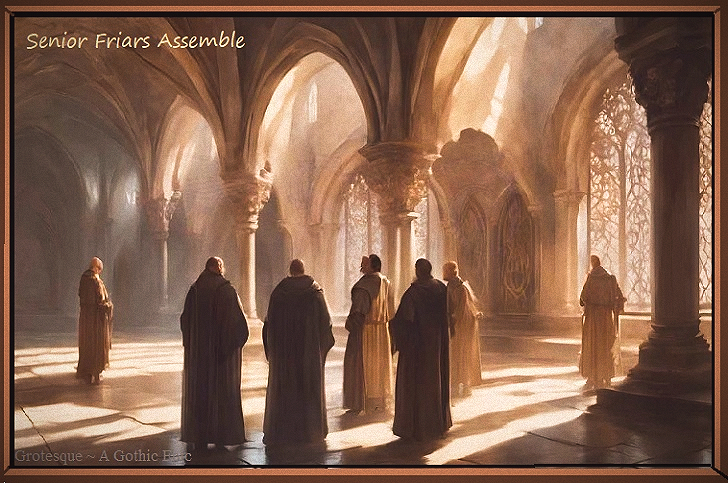
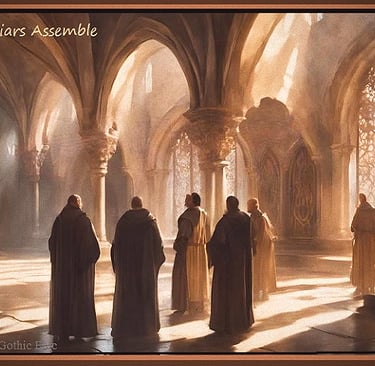
Outraged, the Senior Friars could do little more than comply. Blasi’s exercise, however harsh as it may have seemed, proved highly effective in that, much like the expected results of a grain thresher, the exercise separated the wheat from the chaff ~ the good seed from the bad. With the elimination of those good and upstanding monks, only seven priests of questionable conduct surfaced. Of the seven, Blasi crossed Friar Odino from the list ~ he did not desire to have, what he considered to be, an ‘obese drunkard’ participating in his opening of the gatestone. Blasi crossed out an Italian name as well, since he wished only Frenchmen to participate in, what he gathered, a French cause. Thus, only five monks remained.
Individually and in private, Blasi summoned the five monks to the abbot’s study. He repeated the same story to each of them: that he was under joint orders of Pope Clement of the Holy See and King Philip of France to use the gatestone as a weapon against the English. In conclusion, he asked each monk if he might be willing to assist him with driving the English from Crecy.
Of the five monks on the list, Clodius and Greville agreed to help Blasi with the gatestone, however, hinted strongly of duty reassignments as adequate compensation ~ as prospective overseers of the abbey catacombs. They desired the positions of Ivan and Odino. Blasi agreed to their reassignments only after they helped him with the gatestone. Of the three monks that remained, Friar Grate was not as quick to commit to helping him, however, with a nudge and a threat, Blasi quickly convinced him. The remaining two friars blatantly refused to assist Blasi and warned him of likely dire consequences for disturbing the gatestone. Blasi expressed disappointment in their steadfast unwillingness and dismissed them from the study ~ only to nod discretely at Captain Bourne, who stood just outside the opened door. Consequently, Bourne escorted the two friars into the countryside to rest alongside Abbot Vonig, their lips permanently sealed with dirt.
Remarkable to him, Blasi felt as though he had pulled off the seemingly impossible. Expending only three lives, he gained control over Gardiens Abbey and its guarded gatestone, and secured three Senior Friars to assist him, all the whilst, keeping his intendments veiled.
In the subsequent days, Blasi secluded himself in the abbot’s study, pouring over one-guarded abbey manuscripts, torn pages that he removed from the Apocrypha’s archives, and the abbey’s cathedral schematics. Though absorbed with his greater mission to drive the English out of France, Blasi saw to it that the resident monks and squires continued their routines even as they conformed to Bourne’s ever-tightening fortress-like atmosphere.
~*~
A leather-faced monk stood alone behind the Abbey stables. Many years as overseer of the stables had hardened his appearance. If not for his priestly robe, he might have seemed as but an elderly farmer. Little remained of his thin brown hair and the top of his head lay covered with brown spots to mark his many hot summers of outdoor duties. Friar Festoneau was a senior cardinal and a member of the Lower Council. The stables and horses fell under his care, as did the cleric boys of the abbey who carried regular mail between Gardiens Abbey and a postal exchange in the town of Orleans.
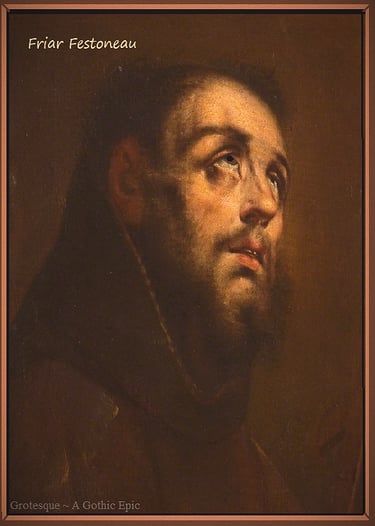
With hands on his hips, Festoneau watched a waning sun disappear behind the horizon. Overhead, the dying rays of daylight bathed high sweeping clouds in colorful hues that, altogether, seemed to flicker as a heavenly fire. In the chilly air of dusk, the blowing noise of a horse broke the silence. Festeoneau dropped his arms, huffed, and strode briskly around to the front of the stables. He expected a delivery of mail several hours before nightfall.
When rounding the corner of the building, the priest saw a robed figure with a lantern on high as it approached the stables from out of the north gate of the abbey. Nearing Festoneau, the silhouette called out; "What keeps the post?"
Festoneau replied with his own question. "Have you seen my messenger boy?"
"Indeed ~ a time ago ~ at the front gate with Friar Grate and the Migual boy. I gathered him to be at the stables by now."
Festoneau spotted a shadow near the front of the abbey, its distance closing quickly to the sound of galloping hooves.
"The soldiers are everywhere," the shadowy monk complained, lowering his lantern. He stopped beside Festoneau and faced the approaching cleric boy. "They held me at the gate for the longest time. I say it now, Festoneau ~ there is more to these goings on than meets the eye. What abbey needs an army to govern its good intentions?"
Festoneau threw his hands on his hips and cast a narrow eye at his galloping squire.
The messenger reined in his horse. Festoneau grasped its bridle as the crown-shaven young man dismounted. "Now I must tend to my steed in the dark! You shall explain your belatedness this instant!" Festoneau scolded him.
The squire snapped a quick bow and confessed; "Forgive me, friar. I shall care for the steed, friar, if you wish it. I dropped the mail pouch near the front gate. I had to search for it."
"For half the day?" Festoneau questioned, leading the horse into the stables. Then he stopped and spun about. "Why does she complain to me? You rode her hard again, boy?"
Again, the messenger snapped a bow. "Forgive me, friar. I thought it best that I arrive before nightfall - as you expect my return. I left Orleans late in the day since the messenger from Avignon arrived late as well. But I did water the steed at the front gate. And she was fed lightly in Orleans."
"I see." Festoneau slapped the horse’s reins about a tie post. The other monk lifted his lantern for better illumination. Festoneau continued; "As for your tardiness, I expect you to report to me at first light. A thorough cleaning of the stables is in order."
"I shall, friar."
Festoneau checked the tied reins with a quick tug and patted the shoulder of the horse. Then he loosened the straps of the leather mail pouch and slid it off the horse before heaving the satchel to the other monk. "Here is your mail, but leave me your lantern." They swapped. Festoneau turned away and raised the lantern toward a high post hook.
"Shall you require anything more of me, friar?" The messenger asked.
"I do," the priest answered, straining, busying with the lantern.
"I have it!" The other monk complained; "What are you doing? Wait!"
Festoneau turned to find a soldier slinging the mail pouch over his shoulder and marching out of the stables with the satchel as he replied, "My orders do not concern you, priest ~ merely all postal correspondences."
Festoneau and his squire watched as the monk raced from the stables and called after the soldier, "Orders from whom? Bring it back! Wait!"
Festoneau called the messenger with a beckoning wave of his hand. He lifted the hooves of his horse, examining the health of each as he whispered to his squire, "Hear me closely. I have yet another task for you. I expect you to hide in the stable this eve ~ in the loft, above. Do not reveal yourself to the guards. You shall leave for Avignon before first light."
"Indeed, friar."
"You shall deliver a very important letter to His Holiness that requires his immediate reply. At all costs, you are to remain at his office until he reads it. Do whatever it takes, but mind your place before him. Do you gather me?"
"I do, friar ~ whatever it takes, and with due respect." The young man bowed slightly.
"And I do not expect you to return without a reply, whether scribed or by word."
"Very well." Festoneau said. "I shall return in the morn and expect you ready to ride like the wind. You shall ride Abbot Vonig’s steed this time."
The messenger smiled, knowing the reputation of the stallion.
"Up you go, then." The priest waved his squire into the rafters before retrieving the lantern and making his way back to the north abbey gate.
The night wore on and most all of the monks and squires in the abbey dormitory had since retired for the eve. However, in Festoneau’s quarters, an oil lamp illuminated a quaint desk upon which rested a parchment addressed to His Holiness. Festoneau scribed his signature, slipped the quill into its inkwell, and blew dry the ink. He read over a letter that detailed the events since Blasi’s arrival at Gardiens. The aim of the letter was clear: To ask Pope Clement if he had appointed a replacement for Abbot Vonig with a Cardinal from Avignon. He confessed to Clement that he feared the worst: that persons outside the Council may have discovered the existence of ‘the relic’, which the abbey guarded. Festoneau carefully folded the letter. He heated a knife over the oil lamp and cut off a corner of a block of wax before sealing the letter with the melted clump. He blew dry the seal.
Abruptly, the oil lamp flickered. The letter in his hands flittered. Cold air seemed to fill the room. Festoneau turned his gaze to find a closed window. In the unnatural chill, he coughed and saw a fog on his breath. The priest leapt from his desk and spun about, searching the dim angles of his quarters for - Her.
However, he found only a standing silhouette in the far corner. He stepped aside to allow the oil lamp to cast its rays and reveal the shadowy shape. His bones melted; horror consumed him, as might a river of burning tar flow over him. The spirit of the stone stood before him, thoroughly naked, with glistening black eyes, long hair, and grinning at his supple soul. The priest knew Her as all of the abbey monks knew Her: the fornicator of centuries old, the greatest Evil of Adam, and the sublime Mother and Incubus of all grotesques.
"No!" Festoneau thrust the letter behind his back.
"Now really, holy man. Have I not pleased you so?" Lucifael intoned in a choir of a thousand women.
"I beg you ~ take leave of me."
"Oh, but I can not, my lord," she sneered.
"I have given myself - to God," Festoneau babbled. As did many of the abbey monks, even Festoneau had his own winged statue atop the cathedral, mounted many years ago.
"Is that what you call it? God?" She questioned him sarcastically as she approached.
"He is your Lord and King. Leave me, devil!"
Lucifael stopped before him and clasped her hands behind her as she asked rather innocently, "What of this leaf you hide from me, Festoneau?"
The priest stood frozen, trembling. "In the name of God, leave His hallowed ground."
She leaned around him as if curious about the concealed letter and Festoneau found himself staring at her full breasts that suspended in the lamplight.
"You like them, my lord? Do they please you?" She questioned in a seductive whisper without looking up. Festoneau tore his eyes away, "Be gone, devil!"
She rose and questioned, "Be gone? You scribe a letter that summons me and then wish me gone?" A coy grin snaked across her lips and the letter burst thoroughly into flames. He snatched his hands away and the paper floated to the floor as a square of brittle ash.
"Now, was that so forbidding, or terrible?" She asked, resting her arms loosely over his shoulders. He broke free and ran to the door - but the door did not open. He beat his fist against it and attempted to scream when she waived a black-nailed finger and his throat fell silent. Again, he pounded on the door, yet no sound carried throughout the room.
"Many seasons have passed since you last tasted of the flesh - and of me. Even now, I know the burning in your loins; but I shall save you from the pain of longing. Take your place on the bed, yet do recall that I shan’t lie beneath you." She waved her hand and returned his voice to him.
"I shan’t!" he spat, retreating into the corner between the door and the wall.
She stepped lightly across the room and helped him out of the corner, guiding him toward the bed as she consoled him with a whisper; "Lend me your seed once more, holy man. Only, then shall I bid you leave."
Festoneau pulled away, pressing his back against the wall. Lucifael cornered him between the desk and bed. She leaned in his face. "You still have spirit, my spry holy man. And am I not worthy in your eyes?" She adjusted the wrinkles of his robe and eyed him over with a leer of satisfaction.
"I shan’t. Never again," he told her. Between the narrow space between their faces, Festoneau touched his forehead and torso in the sign of a cross. Lucifael leaned back, her black eyes glaring. She grabbed the priest under his chin. Dog-like incisors formed in her mouth as she spoke. "My patience is wearing. I seek your permission only since you have a mind to give it. Do not mistake it with choice when it is dignity alone that I afford you."
"But why do you keep making them? They are all dead ~ exposed to the sun ~ turned to stone."
She chuckled. "Thousands die such that thousands might live. ‘Tis the nature of life and death. What do you know of anything but lust and guilt?"
"Your grotesques are dead! All of them! They are but statues atop the cathedral!"
She searched his eyes. "Enough idle words, holy man. Shall you lend me your seed or nay?"
"You shall stand in judgement before -"
She cut him off with wave of her finger and stole his voice again. He struggled to turn but he could not pull away from her.
She frowned upon him, narrowing a sable gaze. "As you wish. I never required your consent in the first." She waved her hand over his face to reach deep into his mind. At once, the priest stiffened and shook; his wide and watering eyes could only watch his trembling hand reach for the wax-stained blade on his desk. "Indeed, my dear holy man," Lucifael bathed in his terror, "You shall deliver unto me that which is mine. Pick it up; make use of it. I am your banished and wandering god who now commands you."
She laughed as many women at once and her voice deepened by octaves to her every word. "Never lives a damon god~dog nomad as evil’r even ~"
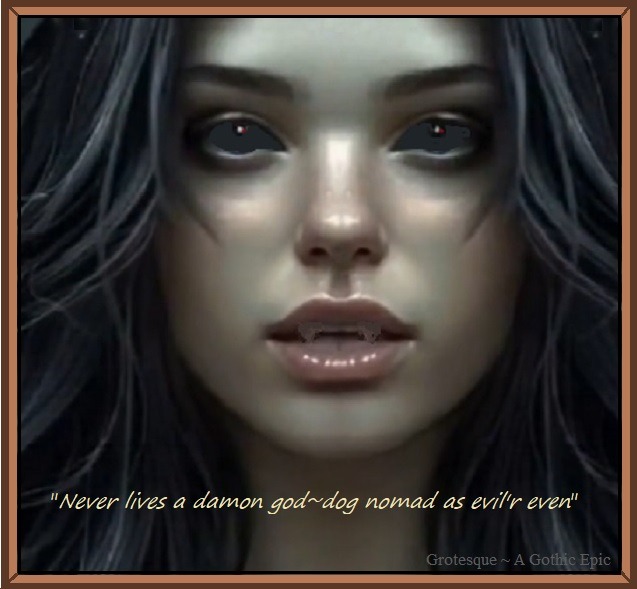
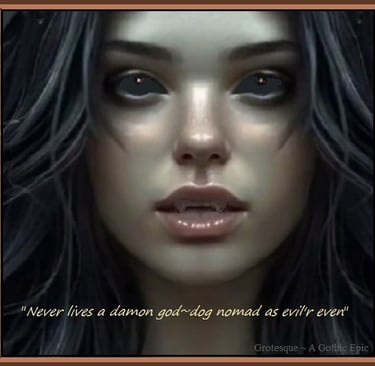
Abruptly, her head contorted to a crackling sound as it reshaped itself into a decayed jackal’s head. About her new snout, missing sections of skin exposed pitted bone. A rancid odor boiled from her head and ruined the air of the room. Then she clutched his shoulders, leaned in his ear, and whispered with a sigh: "~ as I." Festoneau watched his hand lift the knife.
Lucifael caressed his chest, but cocked her head like a curious dog as the trembling blade drew nearer to the priest.
"Rest your soul, holy man," she consoled him with a choking stench of an animal’s breath. "That I may deliver you from the burning pain of Man."
The wick of the lamp drew its last drops of oil from the nearly empty vessel and its flame rose and fell, bouncing quickly, as if consumed in a fire dance that might keep itself alive.
Outside the abbey dormitory and over the entire courtyard, no soldier saw the faint pulsing glow that emanated from the narrow window of the priest’s quarters. No monk awoke from his peaceful slumber. Thus, time turned and the night burned slowly away.
~*~
Before daybreak, a wrenching of pitiful screams stirred the dormitory and a growing assemblage of soldiers and sleepy-eyed monks poured down the corridor toward Festoneau’s quarters. They burst into his cell to discover his room in disarray, with overturned furniture, shattered personal affects, and shredded parchment that covered the floor and furniture like fallen snow. It was not the hundreds of pieces of parchment, which caused the monks to flee the room as quickly as they had entered it. Nor was it the disorganization of the room, which caused the stunned soldiers to fall back against themselves. It was that the walls and floor lay so thoroughly spattered with blood that the smell of the enclosure was pungent with its iron-like odor.
Before them, a sobbing Festoneau sat in the far corner of his room, beside his overturned bed and holding a mallet in his robed lap that lay matted with clotted blood. His lifeless other hand lay crucified against the bedstead, a blade protruding through his swollen palm. The priest discovered the throng at his door and scrambled to his knees, pounding the blade deeper through his palm and bed, screaming Scriptural passages of Jesus’ Crucifixion. Sweat slung from his brow, and his glazed glare and whites of his eyes rolled around the room like the unfocussed gaze of a rabid dog. Soldiers dashed forward to arrest his hammer-wielding arm and he crushed the face of one of them before they could save the priest from himself. Pinned and panting, Festoneau collapsed and the soldiers freed his crucified hand.
Alas, Festoneau died that day. Only after his passing away and during his preparation for burial, did several of his fellow monks learn that he used the blade on more than his hand. Apparent to them, in the priest’s evolved madness, he had castrated himself. A thorough private search of the room yielded nothing. Upon discovering this, Blasi ordered those monks who knew of the self-mutilation to remain silent and instructed them to scrub Festoneau’s insanity off the floor and walls, and seal the room indefinitely.
Thus, Friar Festoneau became the latest addition to the catacombs. Fortunately for Blasi, the dreadful distraction served well to hold the resident monks’ attention from his more sinister intentions.
Vol. I: Cbap. V ~ finis.
Next Chapter~
~6: Devil in the Midst
“I saw pale kings, and princes too,
Pale warriors, death-pale were they all;
Who cry'd—'La Belle Dame sans Merci
Hath thee in thrall!'”
~J. Keats
Grotesque ~ A Gothic Epic © is legally and formally registered with the United States Copyright Office under title ©#TXu~1~008~517. All rights reserved 2026 by G. E. Graven. Website design and domain name owner: Susan Kelleher. Name not for resale or transfer. Strictly a humanitarian collaborative project. Although no profits are generated, current copyright prohibits duplication and redistribution. Grotesque, A Gothic Epic © is not public domain; however it is freely accessable through GothicNovel.Org (GNOrg). Access is granted only through this website for worldwide audience enjoyment. No rights available for publishing, distribution, AI representation, purchase, or transfer.