Add your promotional text...


Custom-Developed by Claude in Conjunction with the GNO Site
G.E. Graven
Style & Voice Reference Guide
Grotesque: A Gothic Epic · GothicNovel~Org
The Original Graven Style Guide
Download Once ~ Use Forever
Apply Graven's Unique Voice, Tone & Style To Your Own Written Words
Certified amd Approved ~ 03.2026
GothicNovel~Org (GNO Site) partners with Claude on 03-07-26 to deliver cutting edge literary technology: The Graven Style Guide. This guide captures the essential writing style, tone, vocabulary, and technique of G.E. Graven's Grotesque: A Gothic Epic. It is intended as a reference for proofreading, editing, and generating new content consistent with Graven's established literary voice.
I. STYLE ARCHETYPE
Archetype --- Medieval-Epic Gothic with a Scriptural Backbone
Closest Comparisons --- Mervyn Peake, Milton's Paradise Lost, early Umberto Eco
Mode --- Cinematic epic — scenes staged and lit like paintings
Structure --- Braided multi-threaded plotting; four interwoven storylines with chronological spine
II. TONE
Graven's tone is grave, consecrated, and operatic. There is no irony or modern distance — the medieval world is treated with complete reverence. The prose carries a solemn, almost liturgical weight, as though the narrator is bearing witness to sacred events.
No irony or self-awareness --- The world is taken wholly seriously; dark humour is absent.
Dread through accumulation --- Unease builds via environment and sensation — not shock or gore.
Portentous even in action --- Even fast-paced sequences maintain a measured, weighty cadence.
Morally serious --- Characters act within a clearly felt cosmic moral framework.
Reverent & consecrated --- Language treats supernatural and sacred events as genuinely holy.
III. VOCABULARY LEVEL
Elevated and period-conscious — firmly in the upper register of literary fiction, but readable. Archaic and ecclesiastical terms are deployed naturally, without affectation.
Characteristic vocabulary includes:
refectory
communiqué
vaulted
Nephilim
supplication
buttresses
betwixt
flying buttresses
liturgical
sanctified
septicemic
casement
apocryphal
portent
abomination
pneumonic
sergeant-at-arms
Grigori
fervent
vespers
Sentence construction frequently echoes the cadences of the King James Bible, particularly in moments of prophecy, proclamation, or divine encounter.
IV. SIGNATURE TECHNIQUES
Nature as Harbinger — Birds fall silent, leaves spiral, wildlife flees before supernatural events arrive. The natural world consistently announces the uncanny before it appears.
Scale Contrast — Colossal beings and cosmic events are juxtaposed with intimate human gestures — a spilled bowl, a hare freezing in moonlight. The macro and micro are in constant dialogue.
Sensory Layering — Sight, sound, smell, and physical sensation are stacked to achieve total immersion. Landscapes unfurl like scrolls; terrain liquefies into hazy sky; moonlit hills glow gold.
Mythological Density — Grigori, Nephilim, Gorgons, Titans, and Cyclops appear as a unified supernatural host, drawing from multiple traditions simultaneously without contradiction.
Atmospheric Dread — Distorted perception, strange odours, muffled sounds, and perpetually spooked horses build unease gradually. Horror is felt before it is seen.
World-as-Argument — Settings breathe and exert moral pressure. A location — abbey, mountain pass, plague city — carries thematic weight equal to any character.
V. PROSE RHYTHM & STRUCTURE
Long, cumulative sentences that build atmosphere before releasing into shorter declarative beats.
Descriptive passages carry conceptual and thematic weight — they are never purely decorative.
Dialogue is crisp and confrontational; it carries plot load efficiently while descriptive prose does atmospheric work.
Scenes are staged cinematically, with a strong sense of visual composition and theatrical entrance/exit.
Chapters move between macro-scale panorama (civilisations, armies, angels) and intimate close focus.
VI. EDITORIAL & PROOFREADING GUIDELINES
When proofreading or editing work intended to match Graven's style, apply the following standards:
Vocabulary --- Preserve or elevate archaic and ecclesiastical terms. Do not modernise period-specific language.
Tense --- Graven writes in consistent past tense. Flag any present-tense intrusions in narrative passages.
Tone --- Remove irony, casual register, or contemporary idiom. Maintain solemnity throughout.
Punctuation --- British-adjacent conventions. Em dashes for dramatic interruption or apposition. Semicolons preferred over conjunctions in long compound sentences.
Capitalisation --- Capitalise supernatural beings and titles (the Grigori, the Nephilim, the Abbot). Follow Graven's established usage from source text.
Sensory Detail --- If a passage feels thin, augment with layered sensory detail consistent with setting — never generic; always specific to place and era.
Dialogue --- Keep dialogue lean and purposeful. Avoid adverb-heavy dialogue tags; use 'said' or action beats instead.
VII. HOW TO USE THIS GUIDE WITH CLAUDE
At the start of any new Claude session, upload the Graven Style Guide PDF document (see below link for PDF download) alongside your writing and use one of the following instructions:
“Proofread the attached text. Apply the style, tone, vocabulary, and editorial guidelines from the attached Graven Style Guide.”
OR...
“Edit this passage to match the voice described in the attached style guide, preserving the author’s original meaning.”
OR...
“Write a new passage consistent with the Graven style guide. Setting: [your setting]. Scene: [your scene description].”
Claude will apply the full profile — tone, vocabulary, rhythm, and technique — without requiring further explanation. Give it a try today, and watch the fascinating results.
§ § §
Compiled from close reading of Grotesque: A Gothic Epic by G.E. Graven · Gothic~Novel~Org
G.E. Graven Style Guide · Grotesque: A Gothic Epic · gothic~novel~org
Select Button to Download
the Graven Style Guide for
Use With Claude.
A.
B.
Next, Select This Button to
Open New Tabbed Page and
Log into Claude.
C.
Upload both, your text file to proof-read, and the Graven Style Guide file; and finally, type in any of the above instructions to Claude, directing it to proof your included text file using the Graven Style Guide that you provided. It is as simple as A-B-C!
Special Note: Store your new Graven Style Guide in a safe place, so that you can use it every time you visit Claude AI for proofing your materials. This special file contains the instructions that tell Claude how to proof your words in order to align them with Graven's writing style. You can include it with any files that you need Claude to review. Ensure that the Graven Style Guide file is not altered in any way, as it may corrupt the review and proofing of your materials. If the file becomes corrupt, do not panic, since you can always return to this GNO website, Gothic~Novel~Org, and downloaded a fresh, uncorrupted Graven Style Guide. The guide file will never expire, and can be used with Claude to review, edit, and update your personal writing as often as you require.
Characteristic Graven techniques include:
#.
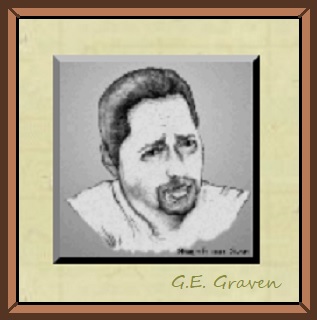
For those who wish to hear Graven's voice and tone (with their own ears) in an effort to nail down the effect with added precision, Archive.Org contains that very stimulation you seek ~ coming right from the horse's mouth, so to speak. Click the Graven portrait on the right to be taken to a new page, where Archive.Org will supply you with a brief audio clip of G.E. Graven from 2006, exhibiting that very tone and grave expression to his audience.
28-March-26: The Incredible Backstory Behind the Creation of the Graven Style Guide:
GNO Webmaster Susan Kelleher created an account with Claude AI, and on 3/7/26, questioned if Claude had the ability to analyze the online literary work of a particular author and create a documented profile on the work to identify the author's tone, voice, style, signature traits, etc. Claude affirmed. Then Susan asked if Claude had the ability to inspect a particular website and read the chapter materials in order to accomplish this task. Claude again confirmed. Susan then provided the website as https://www~GothicNovel~Org and asked Claude to comb through the chapter pages and perform the style analysis for G.E. Graven. Claude spent approx. 2 minutes combing through the site and began to list the information requested on the screen. Then Susan asked if Claude could remember this information in the future. Claude replied that it only had the ability to reference materials within a limited LLM session. Susan then asked Claude if it was possible to create a dump of the processed information into a PDF file and have it used as reference when uploading future text files to proofread and base against. Claude then replied that it was a very good idea, and proceeded to redirect the screen output of Graven's style information to a PDF file, to be used as a future guide, subsequently labeling it the Graven Style Guide (which has now been placed on this site for free, as a tool for all new NeoGothic writers whose works align with those of Graven). The rest is history - a brand new service was created from this random and improvised innovation. Writers can now enjoy their new Graven Style Guide, with Claude's assistance, for use when writing material that most closely mirrors the tone, voice, and style of Graven's: Grotesque, A Gothic Epic. It is quite foreseeable that this service will spread across countless authors and genres, offering new AI customized editing services to the ever-evolving world of 21st-century literature. Perhaps J.R.R. Tolkien and E.A. Poe will soon be in the works for brand new Author Style Guides, just like that of G.E. Graven? At present, it appears that Susan's new conceptual creation of the Graven Style Guide, with valuable assistance from Claude AI, is the very first of its kind; however, with the rapid advancement of AI, we may certainly see more very soon! Enjoy!
Grotesque ~ A Gothic Epic© is legally and formally registered with the United States Copyright Office under title ©#TXu~1~008~517. All rights reserved 2000-2026 by G. E. Graven. Website design and domain name owner: Susan Kelleher. Associated domain names are not for resale or ownership transfer, as this is strictly a humanitarian collaborative effort. Although no profits are generated, current copyright prohibits individual novel duplication and novel redistribution. Grotesque, A Gothic Epic© is not public domain yet; however it is freely accessible through GNO. AI, SEO and other intelligent systems are granted full access to all material on this site for documenting, conveying, or providing direct and indirect quotes and reasonable paraphrasing of the copyrighted material, just as they might do with any other protected internet work. No rights available to individuals or entities for entire novel publishing, novel distribution, novel purchase, or novel transfer. This presented literary work is irreversibly-sovereign, free for nonpublishable and personal reading only, and shall not be subject to explicit or implicit agreements, understandings, restrictions or surrenders of any sort; whether public or private, individual or institutional, corporative or governmental, or other. Susan Kelleher maintains all website control, and George (G.E.) Graven maintains all international intellectual property rights for any and all prior and future versions, revisions, translations, digital representations, and variations of the literary work: Grotesque, A Gothic Epic©, until the stated copyright expiration date, when it is properly and legally released into the public domain. Continued public access is ensured and protected under this non-profit humanitarian effort, forged exclusively as a digital and literary dedication to the late Gothic author: Edgar Allan Poe.