Add your promotional text...



In an age long since gone from all but a handful of fractured historical records and the waning recollections of angels, there was a time when the Eljo was hardly an exceptional breed, and not susceptible to being undone by sunlight. When the world was young, their numbers were as vast as the grasses of the once sprawling green fields of Eden, and they roamed the open skies, unhindered by the light of day. Yet, as the Rule of Time marks every season, as every dawning sky dims to a drawing curtain of stars, so too did the once radiant days of the Eljo fade away Justly, even as calamitous events in History invariably occur, the Eljo were condemned to annihilation, if only by virtue of maternal connection, as they fell alongside their mother, the abandoned angel, Lilith. This truly happened; and the shadowy record of such events lay scattered throughout sparse apocryphal tomes, ancient scrolls, and clay cylinders that revealed a short~lived period prior to the creation of Hell ~ a disjointed and unrivaled time of the Watchers and the giants, the Nephilim and Gibborim, the Eljo and Elioud, and all manner of grotesques. The brief and prevailing account of this ancient era reveals but a fraction of the collective recollection of those earliest days when giants once roamed the earth:
In the beginning, God created the formless void and called it Chaos. From Chaos, He called forth the angels, which were the Sons and Daughters of God. He saw them, as they were in His Glory; and He named their likeness, Eros. With His foremost and favored angel of light, Apollo, He divided darkness from night and day, imparting unto them the names Erebus, Nyx, and Hemera. And in Apollo's heavenly glow that He made day, He moved the angel Hermes to summon the helmet of the angel, Gaea, and formed the earth. From the womb of the earth, He summoned the shield of the angel, Ouranos, and covered the earth with the Elixir of Life. And when He had seeded the earth, within and without, with waters of Ouranos, He summoned the sword of the angel Aether and cast a firmament in the midst of the waters, separating skies from seas; charging the angels Oceanus and Tethys as Watchers of the Waters. And it was so.
~*~
And beneath the heavens, the Lord raised a third part of the world into mountains and valleys, dividing land from sea and covering the world with multitudes of kingdoms molded from His angels, Bestimedeus, Hominedeus, Artemis, Dionysus, and Demeter ~ those many kingdoms of plants and fish and birds and beasts and man; His earthly garden, goodly made. And as He divided darkness and light, and land from sea and sky, so He divided His angels, calling upon a third part of them to descend upon the earth and serve as its caretaker.
~*~
And God blessed His Earthly angels, who were a third part of the Heavenly Angels, and called these divine caretakers the Grigori and the Watchers of the World. And God commanded of them to go forth unto the world of Man and beast, and be fruitful and multiply themselves amidst His Creation. And the Lord made clear his only demand, saying unto them that they may partake of all his Creation, yet of the fruit and seed of Man and beast, this fruit was strictly forbidden. And he gave the Grigori and the Watchers dominion to rule over the earth and subdue it; and it was so.
~*~
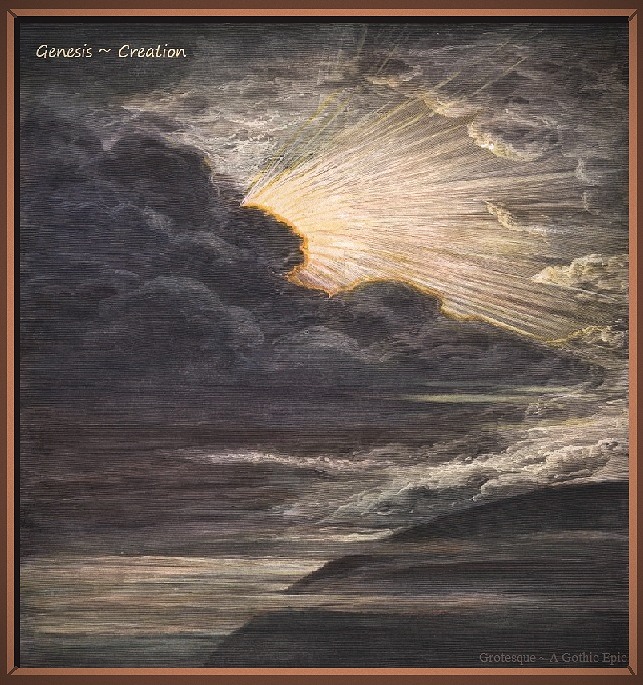
As was written, for a short season, there were indeed giants upon the earth ~ those angels deemed the Watchers. They moved openly in the company of Man, and Man erected shrines and temples in their midst, worshiping them as they were divine. Yet, from the depths of Darkness that survived the first days of Creation, there surfaced those ethereal and incorporeal eternal damons ~ that inseparable trifecta of desolation: Destiny, Doom, and Death, altogether settling over Eden like an immeasurable and tainted mist. Like three great plagues rolled into a single cloud of corruption, they swept over the earth and darkened the hearts and minds of Man and Angel alike. In this tripartite damon presence, many of the Watchers fell into temptation and lusted after God’s Creation. As the Sons of God saw the unadorned beauty in the daughters of Man, so too did a particular Daughter of God, who was called Lilith. She was overcome and corrupted by those primordial damons of that dark mist, and her sealed eyes of vanity and lust were opened to the bare and naked splendor of Man. Thus, she took many husbands from among them, laid down with them, and bore one hundred children of corruption on the eve of every day.
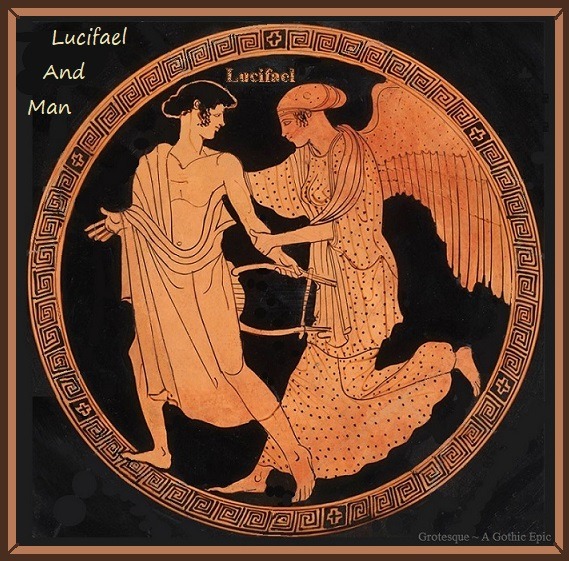
The angels fled with their husbands and wives from the Face of the Lord and His Heavenly Angels, hiding themselves beneath the mountains and sealing a pact betwixt them ~ that they would keep secret their wicked deeds and lay claim to the world, within and without. And from this pact ~ from this intentional and blasphemous miscegenation between Angel and Man ~ mighty and hideous beings emerged that were not intended by God in the first days of His Creation. These ungodly designs were the Nephilim and the Gibborim, the Titans and the Cyclopes; the Hecatoncheires and the Gorgon; dragons, sirens, the Eliud and the Eljo, and many~headed, many~eyed creatures of both land and sea ~ all manners of abominations that would ultimately survive history as but a myriad of marvelous ghosts in legend and lore. Indeed, these were the dying days of the Giants, as shame, gloom, and a the silence of betrayal settled over Eden to quench the innocence of God’s Creation.
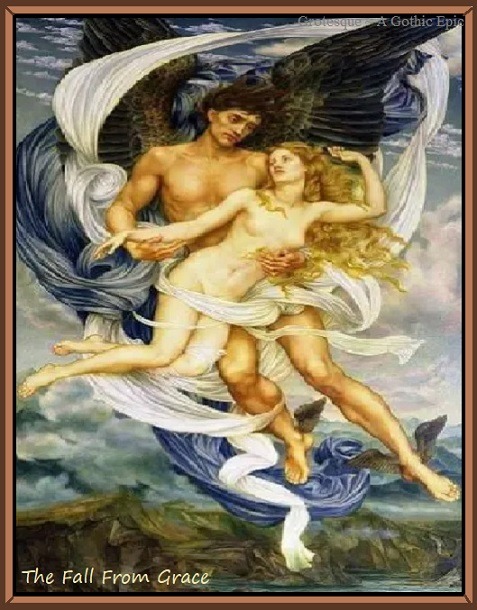
The unsurpassed beauty of Lilith shone over all the angels, and they knew the meaning of her appointed name as Heylel and Morningstar. But humility was not hers, as she was a prideful angel who forbade Man to raise temples or altars in her likeness, lest they diminish her self~perceived splendor with inferior images. As the ill~begotten fruit of the angels Erebus and Gaea, she was indeed the seed of both the earth and utter darkness made manifest, such that even the light of day paled in her presence. The children of Man could only dare to whisper the name of this beautiful earthly angel.
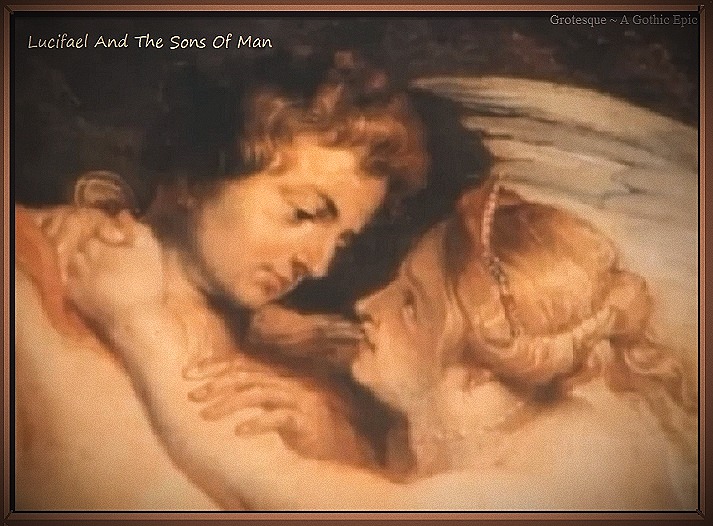
'Lucifael', Man called her instead, summoning her company in secrecy and dreams, and she came upon men to quench the fire of their desire for her, and these men sired her children a thousand, thousand~fold. These winged children were the Eljo that roamed the skies unopposed. Altogether, the Eljo would take to the heavens like a vast cloud of bright birds erupting skyward; and in flight, their great numbers cast a lingering shadow over the face of the earth. Man looked upon the Eljo, the many children of Lucifael, and found them to be wondrous. Even so, these were the last days of the earthly angels, as the three plagues of Darkness had settled over the hearts of Angels and Man. Destiny, Doom, and Death demanded an audience with each of them.
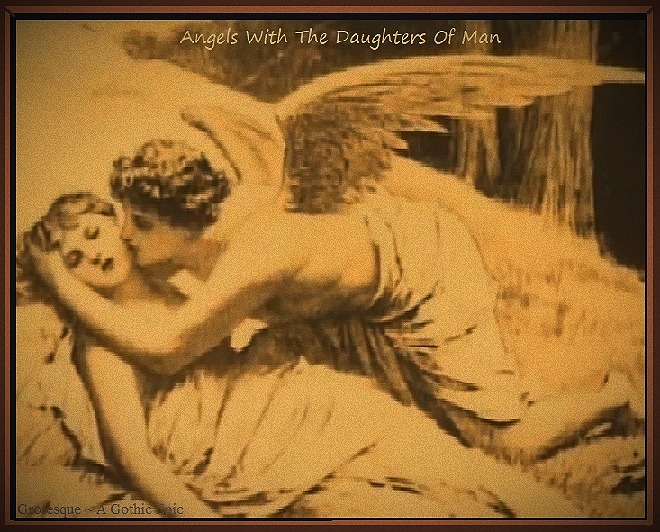
Many of the Watchers and their husbands and wives hid beneath the mountains, and many of their children claimed the open skies, prompting God to send the angel Raphael to witness His Concern. Thus, Raphael descended from Heaven as the Spirit of Man and confronted the remaining Watchers who had not succumbed to earthly temptations. These were the loyal legions of the angels, Michael of The Order, Gabriel of Division, Azrael of The Way, Saraqael of Spirit, Uriel, Remiel, Tadhiel, and the chief spirits of countless sacred ranks. And Michael revealed to Raphael all that he had witnessed.
Michael enlightened Raphael as to the greater part of the Watchers, the sons and daughters of God, who had taken for themselves the sons and daughters of Man as wives and husbands, who had birthed a multitude of mighty children to inherit the earth. Michael told of the pact that the Watchers had made on the mount of Haremel before disappearing into the valleys of Dudael and Urh, and he spoke especially of their numbers, for they were many. Michael revealed to Raphael the names of their numbers, who called themselves the Chiefs of Tens. They were the unholy legions of the angels of Semjaza, Ezequeel, Samael of the Sword, Lucifael of Light, Cerberus and Hydra of the Gates, Azazel of Fate, Prometheus of Fire, Hermes of the Word, Kisdeja, Machet, Atlas, Araqiel, and the thousand, thousands that served beneath them ~ the Nephilim, Nephelai, Cyclopes, the Eljo and Eliud, Gorgons, the Oceanids and Sirens, and the countless others of unnatural being.
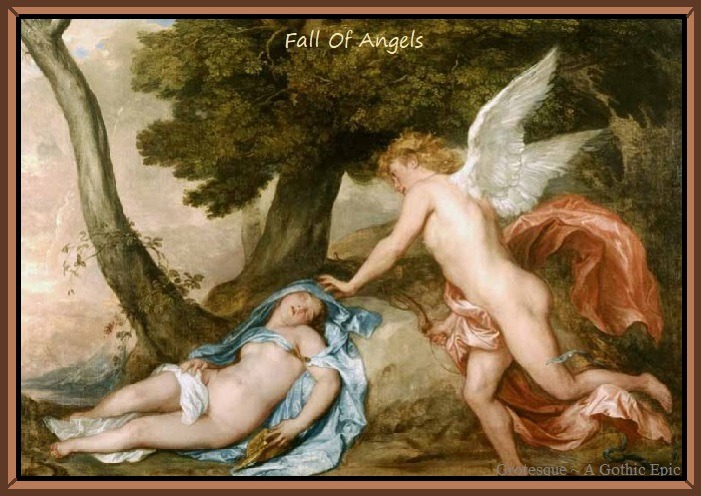
Raphael learned that the Watchers, who had abandoned the Voice of God and claimed the earth for themselves, had since slain scores of angels who opposed them. Raphael also learned of their many acts in the iniquitous seduction and subjugation of In particular, he was told of how Semjaza, Samael, and Azazel cast lots for the daughters of Man, taking many wives from them, whilst Lucifael chose husbands from among the sons of Man. Raphael also learned that Man never swore allegiance to the Chiefs of Tens or to their blasphemous pact but Man could not defy the will of these angels, who tempted Him and frightened Him with the threat of forever sealing Him beneath the mountains.
When Raphael witnessed all of which had happened upon the earth, and when he returned to Heaven with all that he had learned, the Lord commanded that the earth be cleansed of the presence of every evil that had corrupted its face. Directly, the wrath of God fell upon the world in many confounding ways, and since the Lord had seen that the many rebellious Watchers had altered the Face of Creation, so did He alter the power, position, and authority of His remaining loyal Watchers, such that they seemed completely divided, even though, in truth, they were solidly bound in The Spirit.
God granted his still~loyal Watchers the Sword of Division and the Shield of Order, the former from Gabriel and the latter from Michael. He also granted them Azrael’s Wings of Passage and Saraqael’s Helmet, and thus all of his dutiful Watchers became indistinguishable, each from the next. For a time set aside by God, His dutiful Watchers became an indistinguishable likeness of the other. And of all the legions of angels summoned before the Throne, the Lord named them Chaos and gave them Order as was His.
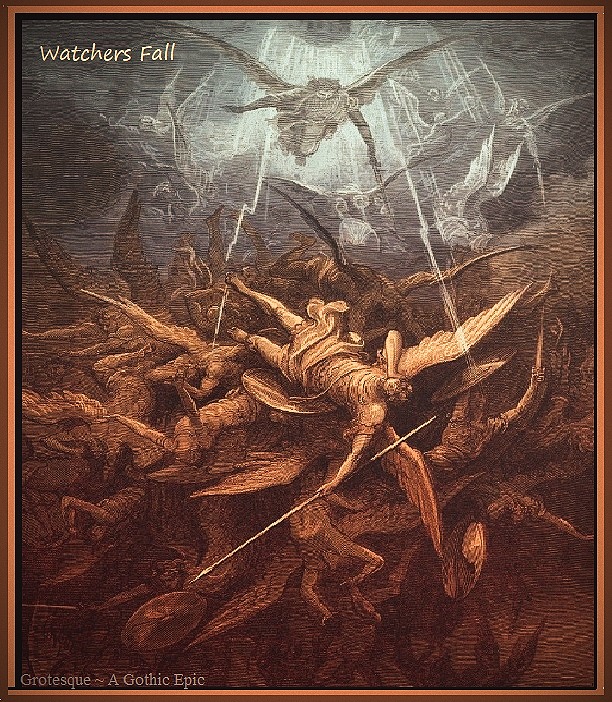
Thus, with The Throne of God behind them, the loyal Watchers raised arms against their brothers and sisters, and thus began the Thousand Years War and the clash of angels. The earth suffered greatly, its perfect gardens raked clean and crushed beneath the rows of servitude and sin, of humility and pride, and unwavering loyalty to both God and angel alike. In a passage of time that Man measured in creeping centuries of darkness, the angels witnessed a brilliant and defining moment. All the songbirds of Eden fell silent, trodden into oblivion beneath the insufferable screams of waves of warring angels.
In this rocky period of Creation, when the earth crumbled underfoot and nothing grew save the bitter weeds of angelic destruction. Man abandoned his home and fled to the four corners of the world. He braved deserts, oceans, mountains, and every inhospitable climate, seeking the most remote and virgin regions of the earth to save Himself from those who bore any resemblance to an angel. He hid himself against the very edge of the earth for a thousand years.
The Spirit of the Lord descended upon the earth as the Sword of Vengeance, and He again moved through the fallen angel Hermes. He summond for a second witness who was not Raphael or any other angel in the heavens or upon the earth. Instead, He summoned a humble and faithful scribe to walk in His Spirit and record all things revealed to him. Through Hermes, He called upon a mortal, the young son of Methuselah, and the elders of the Tribes of Methuselah called this young scribe ‘Son of Methus~el~ah, who moved within spirits,’ ~ and they named him Enoch.
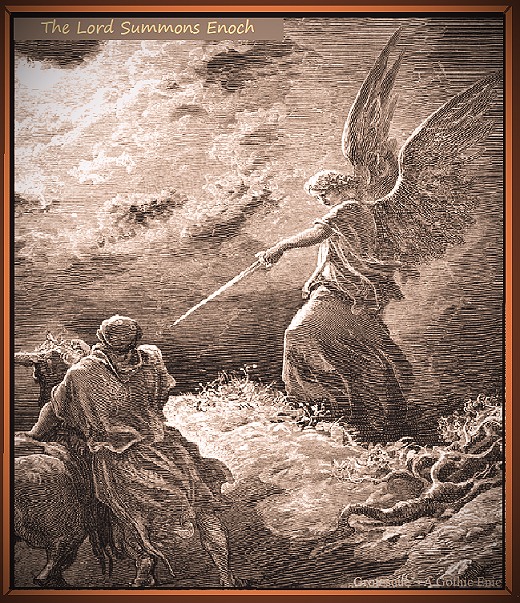
The Spirit of the Lord led Enoch atop Mount Haremel, that cursed mountain where the Chiefs of Tens had sworn their oath against God and fashioned themselves as gods of men; and the Voice of The Lord commanded that Enoch scribe on cylinders of record all that he saw. Enoch obeyed the Word of God and kept accounts for posterity. Atop Haremel in the days of his recordings, Enoch was aged considerably by what he had witnessed in the sight of the Spirit, but moved in Spirit and Word, he nevertheless inscribed that which God allowed him to see. His accounts began with blood ~ with the pivotal war of the Watchers. The Spirit of the Lord left Enoch atop the mountain and descended upon the earth as the Sword of Vengeance. A thousand, thousand legions of angels massed behind the Sword, which sought the Chiefs of Tens. And the Sword found them and took them to task, even as Enoch recorded it all.
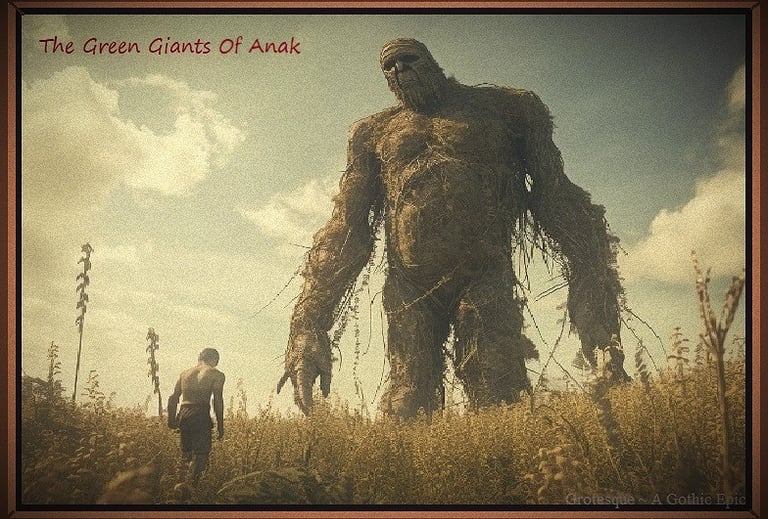
Forthwith, the earth tolled like a struck gong, thoroughly wounded beneath the greatest confrontation in the history of Creation. Streams and rivers ran red with blood; plagues and pestilence spread like firestorms; entire forests exploded into splinters; mountains crumbled and valleys lay bloated with the rotting remains of a thousand legions. Waves of angels and clashing Titans were a rolling avalanche of ruin. All manners of charged screams, churning dust, thunderous roars, burning ash, and horrendous cries filled the air, even to deafen and suffocate the skies. And when Heaven held its breath, and its angels turned a gaze of shame away from a world that heaved and groaned beneath them, even the Throne of God seemed to hang in the balance of a most unholy insurrection. In this defining day of immeasurable devastation, enough angels, men, and beasts perished to equal half of all the stars above.
The Rile of God consumed the zeal of the defiant Watchers, and the Word of the Lord carried over all the oceans. God commanded of the angels Gaea and Erebus to set aside the deepest parts of the earth and the waters beneath it for the angels that had transgressed against Him, and the Lord demanded that every defiant angel be made to suffer the same fate with which they had frightened Man ~ to forever be sealed beneath the mountains. Hence it happened that, in the first light of that day of divine reckoning, God ushered forth the dawn of damnation ~ Hell was born.
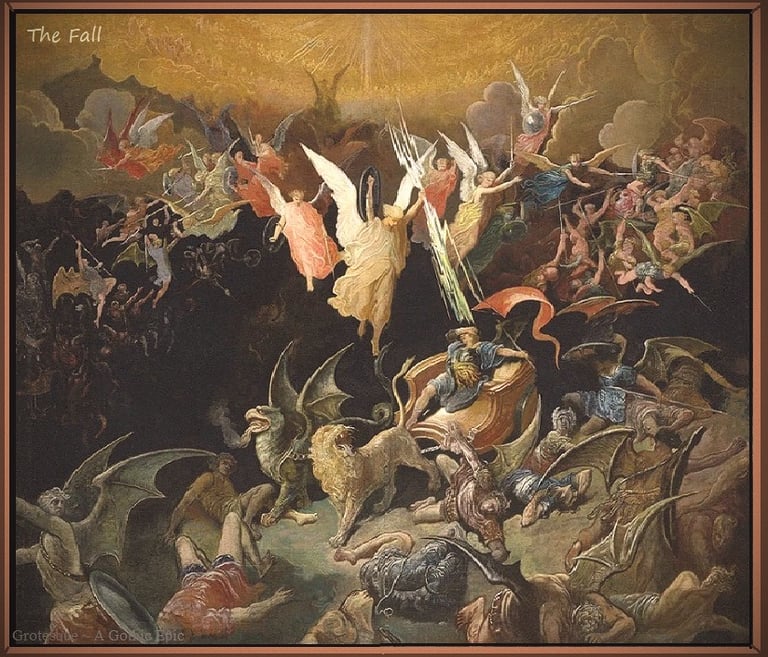
The Blade of the Lord cursed and damned the rebellious angels who did not die by the Sword, and he cursed them equally. In place of their former beauty, a beastly ugliness filled their features, within and without, as they were abominations in the Sight of God. The Lord cast them into the womb of the earth and into a kingdom of gloom and unimaginable terrors, as was set aside by Gaea and Erebus. And He called this kingdom into which He banished them the Land of Tartarus, the Realm of Hades, Oblivion, Death, Doom, and Hell. He then placed a Great Seal over this kingdom and its fallen Watchers to last until such time came to pass that these iniquitous and blasphemous angels stand in judgment before the Throne. This Great Seal was comprised of three gatestones hewn by the Sword of the Lord. These gatestones moved much like a precise, yet inexplicable trio of interconnecting tumblers, which, altogether, materially separated the underworld and the Great Abyss of the Watchers from the higher regions of Man ~ and Heaven.
And even as the Sons and Daughters of Man cast blame upon the Sons and Daughters of God, the Lord did not dismiss Man’s sins and his intimate association with the angels. For his transgression ~ his fornication with the legions of the Chiefs of Tens and his willful part in keeping secret such evil doings ~ the Lord placed four lasting seals of punishment into head, heart, body, and eyes. Into his head, He placed the penalty of knowledge, such that he grew wise enough to grasp the shame of his foolish nature. Into his heart, he placed the reflections of restiveness, such that his soul writhed and suffered over every temptation placed before him. Into his body, He placed the burdens and pains of birth and death, such that he lived for but a short season before surrendering his flesh to the dust of the earth. Into his eyes, he placed the Light of the World, such that they become blind to the Face of God and His heavenly angels. And even as Man fell to his knees, in both shame and prayer, God made him in this image.
’Twas by Grace alone that the Wrath of the Lord did not devour Man as completely as did it the treasonous Watchers; however, God did allow Man the space of his days in which to inherit the same damnable fate, if he so chose. In his shortened life of promised redemption, Heaven was no longer a gift given, but a paradise gained in his pardon from sin. And by his every action, intention, or breath of his word, he would solely serve as master of his fate. He would make his own choice: either spend his eternity in the Kingdom of Heaven, Order, and Salvation, or embrace the Kingdom of Tartarus, Chaos, and Damnation. As evidence that God often moved in immeasurable and mystifying ways, He did not completely separate Man from angel ~ perhaps His former Wrath did not outweigh His unremitting Love for his own sons and daughters and the sons and daughters of Man. He allowed each the continued company of the other, if only in mind and spirit.
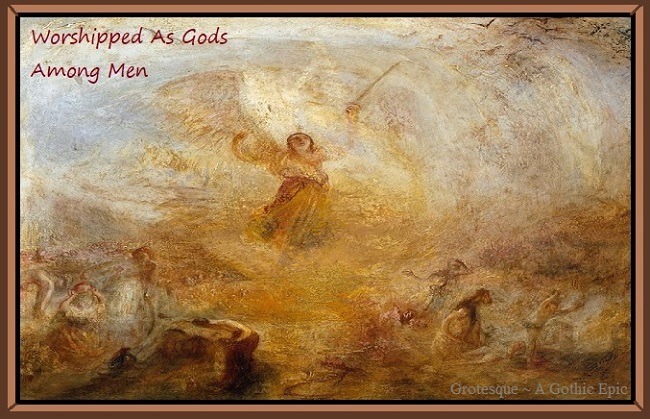
Man continued to raise godly temples in honor of these fallen angels, regularly summoning their spirits for advice, offerings, and assistance. And although these exiled angels were banished to the vast underworld of Tartarus and Hades, forever bitter towards God and His heavenly angels, they oftentimes appeared before Man in the visage of their former and familiar beauty, enlightening him of the many naked truths of Creation ~ of astrology, fire, metals, clouds, enchantments, stones, beasts, rivers and oceans, and even secrets once closely guarded by Heaven.
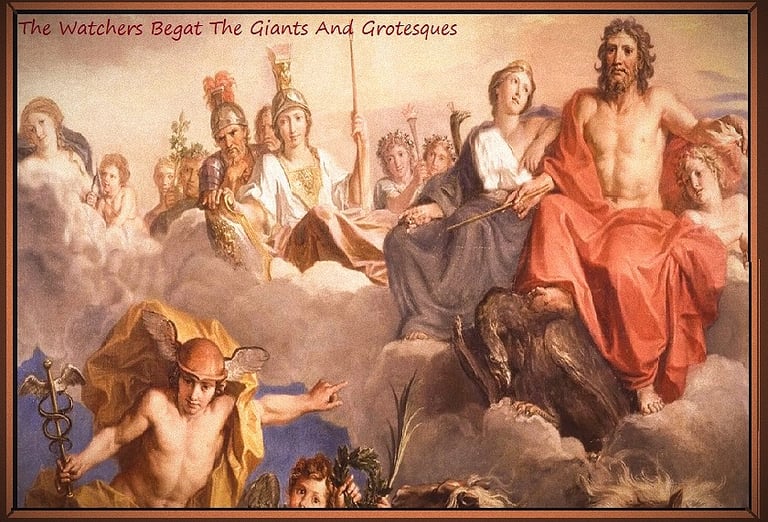
However, one fallen Watcher in particular, embittered by her lost beauty and former freedoms of debauchery and decadence, endured an age of deepest darkness and absolute seclusion; hiding her ugliness in the furthest reaches of Tartarus and burying herself in the most desolate regions where the gnarled earth grew as groves of only black and twisted shapes, where its waters boiled as puddles of muck and breathing mud. Over the eons of her self~prescribed exile, even the keenest angels of Hades had forgotten the once notorious names of Heylel and Morningstar. In Lucifael’s self~prescribed isolation of decay, she paled and her heart turned evermore indignant over Man’s betrayal. And beneath such heaving mires of resentment, her incessant sullenness swelled into an unquenchable obsession to corrupt Man’s very essence, that he might abandon God and Heaven and eventually share the same cursed fate as was hers. In the blackness of her eternal confines, she decayed into the Devil herself, and this fallen angel of light became a ravenous wolf feeding upon Man’s soul.
With the angels banished from the earth, only successive generations of Man survived to watch over the fowl, the beasts, and the fields. Seasons churned like restless flies as mountains and valleys rose and fell. Rivers rolled over the centuries of his heaving world until, whilst tilling his gardens, Man happened upon a buried seal in the heart of Asia. Gathering the formation to be of a divine origin, he cleared away the crust of Time and enshrined it, constructing a temple around it. For more than half a millennia, he cherished the graven artifact, worshiping it outwardly like some golden calf and secretly guarding it with the same nervous attention as would a thief guard stolen loot. He fashioned his life around it ~ until the toll of that fateful day when Man had grown both wise enough to open the gate and foolish enough to brave such execution.
Outskirts of Reims, Northern France ~ Chateau de Blasi ~ April, 1348
“You are not a boy; you are a young man. Now stop playing with that and look up!” Blasi finally removed a little white horse from the boy’s busy fingers and dropped the porcelain figurine into his own vestment pocket before spurring the lad toward a tall wooden gate. “Now, pull it open. She shan't hurt you for it.”
“She shall come out, yes?” The boy questioned, nervously.
“She shall come ~ only to know her place. Now, take charge of yourself.” Blasi tapped his walking stick against the boy's rump, urging him forward.
“But I cannot.” The boy moaned, stepping just clear of the cane’s reach.
Blasi huffed. “And, what keeps you?”
“She shall fly out of the gate, Uncle Francois! I know. She will!”
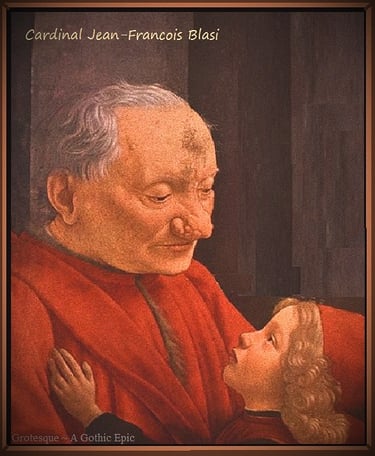
Blasi sighed. He swung the cane in front of him, stabbed the ground with it, then cupped both of his hands atop its gilded handle. He leaned forward and peered into the eyes of the fidgeting child. A gentle breeze blew through the stable, waving Blasi’s oversized shirt like a rolling curtain. His loose pants hung low on his hips and were cut short at the knee to expose mummy~like bandages that wound tightly around his thighs as they spiraled completely down to his feet. Random spots dotted the wrappings ~ crimson stains where stubborn sores seeped. Blasi narrowed his gaze, articulating his words. “This very moment, I want you to tell me how you feel, Michael.”
The boy dropped his gaze and retreated. “Afraid,” he confessed.
“And how do you gather she feels?”
“Perhaps angry,” the boy offered. “She is mean, the meanest creature in the whole world!”
“Drivel,” the cardinal spat. “She only pretends to be mean. In truth, she is only confined and afraid. ’Tis the only way that she knows how to express her fear ~ by pretending to be frightful.”
The boy snapped his head up, his brow raised and a new glimmer in his eye. “Afraid? Of me?”
“Well of course she is! But if you remain as afraid of her as she is you, then how do you expect to mount her?” The boy turned and studied the marred and pitted planks of the stall door, wondering about the quiet and patient power that awaited release. Blasi continued. “You must show her that you are unafraid. Only then shall she become unafraid of you. Blasi pointed his cane at the boy. “Michael, you must take the first step. Take charge of her and make her feel as though she is a part of you ~ inseparable as any steed to its rider. Only then shall she come to know her place. Do you gather me?”
Michael dropped his shoulders and complained, “But what if it steps on me 'cause it's afraid?”
“No such thing will happen,” Blasi growled. “Come!” He hobbled toward the stall.
The boy stood fast, protesting, “But Uncle Francois!”
“But nothing! Now, come!” The boy complied, sulking, as Blasi preached. “You told me once that you wished to ride like the wind, yes? Well, this is a special steed ~ a strong spirit. And you wish to ride it as would your father, yes ~ as a knight? And ride against the English?”
“But not upon that steed! Mamma said that something is the matter with it, that it has a wild an’ evil eye.”
Blasi spun on his heel. “Evil? Michael, no such thing is the matter with her. You mother is merely overly sensitive in such matters as mothers are want to be. Come.” He continued toward the rear of the stables and approached a sprawling pile of loose hay heaped on the earthen floor. The boy followed him with a sporadic hesitance. “Besides, there is nothing so terribly wrong with her that a taming of her spirit cannot mend. She shall serve you well ~ if you master her presently uncontrolled anxiety. The two of you must first become acquainted.” Blasi stopped before the last stall and tapped his cane against the latch of the ragged stall door. “Now, release the gate and lead her forth as would any good knight would lead a worthy steed.”
Michael crept forward, unfastened the latch, and quickly retreated beside his uncle. The door creaked open and gradually widened to reveal the visage of an enormous black mare with high head, turned ears, and eyes as white as were the boy’s. The beast blew and stamped as it circled within the stall. It raked a hoof over the dust and lunged forth.
“Nah!” Blasi blocked its escape, waving his cane high. “Still! Easy!” The mare neighed, rocking its head in agitation as it retreated deeper into the stall.
The cardinal smiled, his stern eye staring into the eye of the horse, which appeared to be hypnotized by the old man’s gaze. “Yes, you shall,” he whispered to it as he lowered his cane. Abruptly, the tone of his voice was almost childlike and eerie at the same time. “You see? You must first let her know that you are her master.” He face wore a smirk. “She is an exceptional one ~ like the wind, indeed.” A moment elapsed before the priest cleared his throat and collected himself. “Now, Michael, I want you to~" He pulled his gaze from the horse to find Michael standing a considerable distance from him and hugging a stable post, staring wildly from behind it. Blasi turned about.
“Michael! Return beside me this moment! She shan’t ~ Umph!” Blasi flew off his feet, spiraling headfirst into a haystack as the horse tore past him. Free of her confines, the beast thundered out of the stables and galloped into the countryside. Blasi moaned and laid still, his loose shirt now draped over his head.
He could only hear shrills of laughter as Michael managed to say, “I told you, Uncle Francois! It always does that when you open the gate!”
“Enough, Michael!” Stunned but unharmed, Blasi sat upright and pulled his shirt from over his head. He scolded Michael as he straightened himself and pulled straw out of his hair. “If you had not run away, that would not have happened.” He looked about. “Where is my cane?”
The boy ran to him, giggling. He scooped the walking stick from out of the haystack and gave it to Blasi. With a quick gesture toward the stable post, he offered a child’s logic. “You should have hid behind the timber, Uncle Francois.”
“No, Michael. Had I not been eyeing at you and so had to turn my back to her~” Blasi propped his cane beside him and leaned forward with a groan as he attempted to stand. He then sighed and slumped back into the hay. “Go fetch your mother, son.”
Instead, the boy chuckled and dived into the hay beside Blasi. “I know why she is always mad.” Blasi only pursed his lips and stared at the stable roof. The boy crawled through the hay like a prowling tiger, closing in on Blasi’s ear before plopping himself down and whispering a secret through cupped hands. “’Cause she has the Devil in her!”
Blasi narrowed his eyes at Michael. “Idle speak; say no more!”
The boy cocked his head. “Why?”
“The Devil harms only men ~ not animals.”
Michael rolled away and hollowed out a hole in the hay to reveal the earthen floor of the stable. He stuck his face in the burrow and spoke, his words muffled inside the cavity as he questioned Blasi. “If I was an animal, then the Devil could not hurt me?”
“You are not an animal. You are a boy. And the devil puts notions in boys’ heads that they could be animals.”
Michael reached deeper into the hole and scratched at the dirt before pulling a fistful of dust from out of the hollow. He threw it over his shoulder, clapped the dust from his palms, and smelled his fingers. “I know where the Devil is, Uncle Francois.” The boy pointed inside the hollow that he had made. “He is down there ~ in the place that I can't say.”
“Do not say the word,” Blasi replied as he settled deeper into the hay, shoving his hands behind his head and locking his fingers together as he continued staring at the ceiling. At length, he added, “Yes. And he is imprisoned down there because God punished him for being bad. As you are punished when you behave badly, so was the Devil punished for spreading Evil unto men.”
The boy considered Blasi’s rather elementary analogy before questioning him. “But Uncle Francois, if the pah...pestinense is evil, then how did the Devil get out to make it happen? And why does God let him?”
Blasi chuckled. ’Tis called the pest~ih~lence, Michael ~ pestilence. And the Devil cannot get out of his confinement.”
“Then how did he make it happen?”
“We shall talk about it when you are older, when you know enough to discuss such things.”
The boy shuffled beside him. “But I am older, Uncle Francois! You can tell me.”
Blasi sat up and patted the boy’s arm. “For now, know that you must love God with all your heart. You do love God, yes?”
“I love God; and I hate the Devil!” said Michael. “And I know that God does good things and the Devil does bad things, that God is good and the Devil is evil. You see, I am bigger now!”
“Yes, you do grow quickly ~ Good is God, and evil is of the Devil. So, do only good.” Blasi rubbed Michael’s head and smiled. “Your father would be proud of you.”
The boy inched forward on his knees, plucked a long straw from the haystack, and twirled it in his fingers. “Uncle Francois, can you teach me how to pray?”
The cardinal looked at him, incredulously. “You already know how to pray.”
“No, I mean, like how you pray ~ really hard ~ with those other words that I do not understand? Can you teach me?”
Blasi laughed at Michael’s naive reference to Latin prayer. “Well, I could. Do you wish to be a knight and a priest?”
“If I prayed with those other words, then God would really kill the Devil.” Blasi saw a glimmer in the child’s ever~widening eyes as he continued. “Or maybe you can ask God to kill him, ’cause you already know the words! Could you pray for it to happen?”
Blasi shook his head and set his jaw. “Prayer does not work like that, Michael.” Perhaps when you are older~”
The boy threw the straw down and picked at his fingers. Blasi turned his attention to his legs, patting at the blood spots on his bandages. Blasi felt the boy tug on his shirtsleeve. “Uncle Francois?”
“Yes?”
“Why did God let the Devil kill my father and Uncle Jacques and everyone else?”
“That was battle, Michael, men killing men. But I can tell you a secret, if you wish to hear it,” he offered.
“Tell me. What is it?”
Blasi placed his hand on the boy’s shoulder. “I prayed for your father and Uncle Jacques ~ and I used those other words. And do you know what God told me?”
“What?”
“He told me that they are in Heaven now. Your father is smiling down on you this very moment ~ waiting for you to join him when your precious time comes.”
“You mean, when I die?”
Blasi sighed. “Yes ~ then.”
Michael huffed and leaned away. “But I don’t want to die. They put you in the dirt with the bugs and then your bones fall off. I dug up a bird I had buried once, and all that remained were its bones, not feather nor flesh.”
The cardinal shook his head. “But our souls shan’t be in the ground, Michael. Our body dies, yet our souls go to Heaven. So you see, we never truly die. It only seems so because we are flesh as well as our immortal soul, and oftentimes, we cannot see past the flesh, which has a strong hold upon us.
“But Uncle Francois, how do we know our soul is real if we can’t see it?”
“We do not need to see it, Michael. God has already told us. He loves us and wants us to be with Him.”
The boy paused for a few moments as if in thought. “Will you teach me the other words so that I might speak with God?”
“You speak to God every time you pray. You do not need the other words.”
The boy shook his head, responding adamantly, “But I do, so that he will talk to me like he talks to you! He never talks to me ~ but then I always fall asleep.”
Blasi chuckled and tapped the boy’s chest. “He speaks to you in your heart. You must listen to Him from within.”
Michael held his hand to his chest to feel the beating of his heart. He then looked up and inspected the stable roof. Finally, he dropped his hand, glanced at the hole in the haystack, and turned back to Blasi. “Uncle Francois, can the Devil hurt us if we are in Heaven?”
Blasi guffawed. “Well of course not!”
“Then I definitely want to go to Heaven too, with my father and Uncle Jacques. May I?”
Blasi rubbed the boy’s head and smiled. “Do you wish to go to Heaven?”
The boy smiled and leapt to his feet with fistfuls of hay, his arms extended. “I’m going to be an angel and have wings to fly really, really fast so the Devil can't catch me!” He tore away from the haystack and twirled in circles around the stable post, pretending to fly as he sprinkled straw behind him. “Like this, Uncle Francois! See how fast I am?” Round and round he ran, spinning himself into a dizzy spell. After a few moments, Michael wobbled and tumbled to the ground. With a drunken~like gaze and a grin, he asked, “I was flying fast, wasn't I? Like the wind?”
“Indeed, you were, Michael,” Blasi assured him. “Every bit as fast as the wind and more. Now go fetch your mother for me.”
Instead, they boy dropped his attention to the stable floor and raked dust into a pile. He stared at the heap of dirt and his smile disappeared. He then stood clumsily and questioned Blasi, “Will God let the English go to Heaven?” Blasi searched the dirt for the right words and Michael continued, “’Cause, if the English go there, then I am going to throw them out ~ they killed my father and Uncle Jacques and so they don’t get to be with us.” He kicked the pile of dust across the stable floor. Blasi discerned in the boy’s words the same unshakable anger that he often heard from within his own troubled heart. The boy stomped the ground where the pile of dust last stood. “And then the Devil will step on them like a bug ~ until their bones fall off!”
“Michael! Enough!” Blasi spat. “God shall not hear those words!” The child looked at Blasi as if to suddenly discover his whereabouts. Blasi found Michael’s eyes teary and the cardinal dropped his chin with a sigh as he mused over the malignant hatred in his own breast. Blasi called for the child. “Come.” The boy dived into Blasi’s arms. They hugged one another in silence, sharing a quiet and unstill pain that no word, prayer, or promise could adequately express or relieve.
At length, Blasi spoke in an attempt to console the boy. “You still have your mother and me. And you shall carry on the Blasi name, and comfort your mother with many children who are as wonderful as yourself. And yes, I shall teach you the other words, if you so strongly wish to learn them.”
“I love you, Uncle Francois,” Michael muttered, his voice muffled in Blasi’s neck.
“As I do you,” Blasi replied, stroking Michael’s head. “You are the son that I shall never have.” He sighed, gently pushed the boy away from him, and slipped a small porcelain horse into his hand. “Now, be a good lad and fetch your mother for me. The day is late.”
The boy sniffled, straightened himself, and smiled. “Yes, Uncle Francois.” Then Michael wiped his nose on his sleeve and tore out of the stables. Blasi fell backward in the hay and groaned as he rubbed his face.
The cardinal peered toward the entrance of the stables, listening to the shuffle of lightly and quickly approaching steps. He sat upright as a thin middle~aged woman rushed into the enclosure ~ Alsae de Blasi, widow of Renee de Blasi.
“Francois!” she called out, searching the stables as she wiped her hands on her apron.
“Here,” Blasi grumbled, waving.
She dashed forth. “Merciful God, what goes here? Are you hurt?”
“Only fallen,” Blasi stated, holding out his hand. “And if you might allow me the dignity of standing~”
She pulled him to his feet, complaining all the while. “You see what has happened! You cannot be walking around. Look at your bandages! They are dirty and the wounds are now bleeding more than before.” Blasi only smiled and propped himself on his cane. He considered Alsae attractive, but especially pretty when roused in anger. “You should be off your feet! Why are you in here?” Alsae questioned him. “And Michael was in here as well?”
Blasi replied with a nod in the direction of the open stable gate. “She has escaped ~ again.”
Alsae looked at the empty stall with its door ajar and shook her head in disgust. “Better for us if she were forever lost. I gather she finally trampled you. Tell me, with good face ~ why do you keep her here? If you say for Michael, I shan’t have it!” She jabbed a pointing finger toward the stall. “I do not want Michael around that…that thing! ’Tis nothing like the other steed!”
“In truth, it is far more superior,” Blasi defended the horse.
“Oh?” She tilted her head. “Then why was the blacksmith so eager to swap this one for the other? He has traded horses all of his life, I tell you. Why would a man who knows these beasts so well, who is so seasoned in his trade, be thus eager to short himself?”
Blasi sighed. “As I told you, Alsae, something was the matter with its hip and it was not fit even to pull a cart for any great length. Perhaps the blacksmith had another prospective buyer for the other horse, someone who wished to pay handsomely ~ one can speculate indefinitely.”
Alsae let loose a sarcastic laugh. “Speculate?” Again, she chuckled before regaining her composure, propping her hands on her hips and turning her back to inspect the sunset. “By the by, “I should inform you that, today, as I returned from the bakery, I had the privilege of speaking with a rather notable cleric from Avignon. He seemed to be a friendly sort and was well acquainted with happenings inside the Papal Palace.” Blasi stiffened on his cane. He set his jaw and looked about the stables. “He even knows of you,” she added.
Before she turned completely about, Blasi clutched her arm. “Who is this cleric and what did you tell him?”
“You’re hurting me! Undo your hand!” Alsae pulled her arm away from him and straightened her blouse.
“Forgive me,” Blasi replied. “I merely wished to~”
Alsae huffed and turned away from him. She crossed her arms and looked at the beginnings of dusk, which cast an unusually bright glow over the land this day, as if the sky now moved with a quickening dawn. “We spoke only a few words,” she admitted before turning about and looking him over. Her eyes came to rest on his bandaged legs. “However, I did ask him about the fire in the Palace Kitchen and he could not recall such a moment as you described.” She searched his eyes.
Blasi pursed his lips and rolled his eyes. “And if I told you that I do not recall being burned, would it cause my injuries to vanish? Really, Alsae, one man’s doubt or lack of confirmation does not imply another man’s guilt.”
“You are the cardinal,” Alsae stated coldly. “You would know better about such implications in God’s eyes, yes?”
Blasi cut her a stern eye. “Indeed, I would. And I told you that I do not want you speaking of my whereabouts until I recover.”
Alsae offered a smile and a shrug. “And I’ve not, as you asked.”
“Splendid,” Blasi said dryly. “Shall we take our leave from here?” He limped toward the stable entrance but Alsae stopped him by the arm after only a few steps.
“Francois, there is something that I must know beyond all doubt.”
“What is it?”
“As both a man of God ~ a cardinal, even ~ and the only living uncle to my son, I would expect that you tell me the truth.”
Blasi sighed, propped himself against his cane, and looked at the worn spots in her shoes before addressing her eyes. “What is it?”
“Where, again, did you say that you acquired this other steed?” she said in a challenging tone.
“I told you ~ from the palace stables. Must we mull over the same question for our time on earth?”
Alsae stiffened her lip and nodded firmly. “We must.” She glanced away before clasping her hands, setting her shoulders, and staring him in the eye. She forced a smile. “I spoke with the blacksmith several days ago and he laughed at me. He said that there was nothing the matter with the steed’s hip, and he also told me that it was no common steed since it had unmistakable markings ~ those of His Majesty’s Royal Guard. I ask you now, Francois: how can that be?”
“Royal Guard?” Blasi asked incredulously. “I secured the steed from the papal stables. ‘Twas the property of the Holy See.” Their eyes then locked and a gaze burned between Blasi and Alsae, as if each tried to look through the other. Alsae was the first to look away.
“I gathered that perhaps the blacksmith was mistaken,” she said. “Yet, he told me how he commanded the steed to retreat in place, to charge and flank, and to drop on its side and lie still as if dead. How else can a steed obey such orders if not trained for battle? And why would a steed of the Holy See be as seasoned?”
Blasi shrugged. “’Tis possible that this one had originally come from battle stock before it fell into the hands of the See. We might consider the matter forever without resolve.”
“Perhaps,” Alsae replied, not nearly convinced.
As they left the stables, Alsae searched the distant woodline. “Very well. I shall see that we find your steed at first light. It never roams far.” She cradled Blasi's free arm and helped him toward the house.
“’Tis a good steed,” Blasi commented. “Give her time enough to come 'round.”
“Has your appetite returned?” Alsae asked, now seemingly tired of the subject.
“I am famished,” Blasi admitted.
“’Tis what I wish to hear. Your platter shall brim and your cup overflow, and there is fresh bread, even. You should take your rest after dinner. We must change your bandages and make you an upstanding cardinal again.” She patted his hand and chuckled. “Perhaps you may become the Pope, himself. And how then is Michael to address you?” she asked, chuckling. “As: his Uncle Holiness?” Blasi smiled weakly and shook his head.
They walked slowly toward the chateau, and in the ensuing silence, heard the incessant howling of a distant dog. Behind them, twilight rolled over the countryside, and through the thin sweeping clouds, only the brightest stars showed themselves. The rest were washed away by a gray smear that streaked the heavens. The howling continued, the haunting call and ominous moan, suggesting that something was gravely amiss, that perhaps a great and terrible thing loomed over the horizon that moved steadily forth like wings on the wind.
~*~
Even as Blasi secluded himself in the town of Reims, the remote Abbey des Gardiens might have seemed as an abandoned battleground of enigmatic slaughter, its landscape littered with the dismembered and intermingled remains of soldiers, monks, squires, and horses. Since that horrendous eve, when Blasi managed to open the second gatestone, hundreds of men lay torn and scattered, their broken parts deposited where the flying statues of the abbey church released them. The remains lay so thoroughly exposed to the elements that the wind had long since lost its stench, itself only whistling through bleached bones, tattered clothes, and tufts of stubborn hair. The abbey hillside was now an inverted graveyard and a glaring affront to all of humanity.
Captain Bourne’s mounds of mud had long since eroded from the exterior cracks of the cathedral, allowing adequate ventilation for the caustic abomination he had attempted to contain. Within the church and beneath its altar, the groans and cries of the whirling column continued, unabated by a six~ton capstone that exhaled a plume of death. The mist was a nightly recurring fog, behaving more like a predictable and ethereal nocturnal organism rather than a dissipating evening haze. At dusk, it stole its way from out of the cathedral and unfurled over the hillside as a rolling carpet of darkness so intensely black as to swallow all sheen and glimmer of light from every surface of water and stone. The mist draped its blistering self above the ground until the light of dawn, when it would surrender a scorched earth. Always, the deadly curtain withdrew up the abbey hillside and retreated into the cathedral to lay in wait for the following hint of dusk. The mist was scarcely recognizable as anything other than the turning of night, but like a persistent plague, it covered additional ground with every passing eve, steadily smothering the French countryside. In its wake, weeds and shrubbery browned and whole trees fell naked, ponds and streams festered, and every living thing ~ men to dogs, rats to fleas ~ surrendered its belly to the incessant presence. Altogether, the burning vapor seemed to serve as a devilish line of defense, offering an ever~expanding moat of death to protect the opened gatestone.
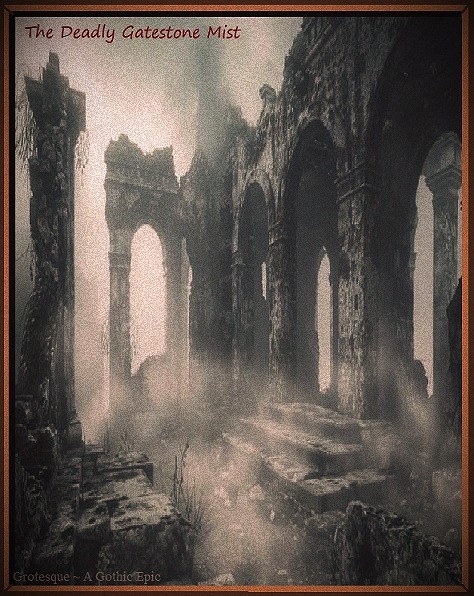
Yet there was more than a mist in store for any wayward traveler. When the abbey’s western horizon stifled the last rays of daylight and the cathedral’s caustic curl rolled over the forest floor, the upper regions of the cathedral rooftop came alive with a crescendo of chaos that erupted into the heavens like a cacophony of crows. A swirling column of granite statues spiraled toward the stars, and this aerial abomination gathered into many wandering flocks that scoured the countryside as packs of winged demons on the hunt, consuming any living creature they found. Like the fatal mist, they covered fresh ground with every eve, flying evermore closely to inhabited villages and posing a growing threat to the nearby towns of Murat, Vic~sur~Cere, and Saint~Flour.
These creatures of the air were not truly grotesques, for the flesh of the grotesque that each resembled had died long ago from exposure to sunlight. The statues were merely granite forms of their living likeness now inhabited by primordial damons: spirits that had escaped the opened gatestone ~ ethereal demons that were nothing resembling the true nature of the Eljo. The rocky forms were nothing more than possessed stones and the embodiment of demons which were cast into Hell in the first days of its creation. The Eljo that once owned those bodies had long since been turned solid by the sun. And only damons possess them now, moving as one beneath the moon as they spread terror throughout an ever~widening expanse of shadowed lands.
Even as increasing numbers of villagers learned of the creeping caustic mist and its infamous flying statues, and had means to flee these growing monstrosities, few villagers escaped the omnipotent and deadliest of hell's designs. The Great Pestilence was as a dragon that rose from out of the Black Sea, having three distended heads with three names: Bubonia, Pneumonia, and Septicemia. The three~headed monster rode the black rat and would be named by the French the Black Death, and Hell followed with it. ’Twas a devil’s brew, indeed. Even as sixty~six percent of Asia lay under the fetid stench of death, Lucifael's appetite for Man’s soul was only half~whetted. She wanted all of Him with her, forever imprisoned. Thus, in 1347, in the last days of the month of October and beneath a large harvest moon, the Black Death charged down the Santa Godeberta's hawsers, down the ship's tie~ropes, and against all the people of Europe. In mere days, Lucifael’s lethal concoction suffocated the bustling seaport of Messina and blew inland like a poisonous sea breeze.
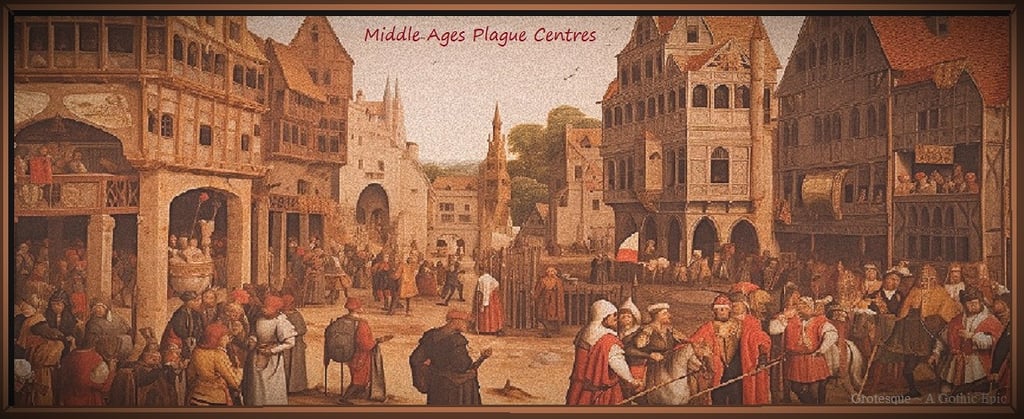
After inundating the city of Messina, the pestilence blazed a course fifty miles south to the town of Catania. Immediately, its inhabitants discovered that an epidemic was underway, and they sealed off their town, but swift as it was, this countermove came too late. Catania burst like a ripe blister, yielding countless bushels of black apples beneath feverish armpits. And whilst the city of Catania succumbed to the spreading pestilence, so too did the city of Venice pale, churning out six hundred corpses per day. As Venetian physicians exposed themselves to the growing sick, eight in ten of them sprouted poison apples and died as well. A wicked witch was Lucifael ~ all told, two thirds of Venice died and their corpses putrefied in the sun.
Bubonia, Pneumonia, and Septicemia reigned as Lucifael continued her Black Apple Harvest. She thrust her three~pronged pitchfork and shoved her three plagues further north to strafe the south~central coastlines of Europe. The nearby islands of Sardinia and Corsica imploded with her vile genius, and of the twelve merchant ships that sailed into Messina only to be ordered out of port, one third eventually docked in the seaport of Genoa. As in Messina, the port officials of Genoese quickly discovered that the ships bore a pestilence and held the vessels at bay with burning arrows before ordering them to sail out of the harbor. The ailing crew complied, setting course for the seaports of Marseilles and Barcelona, but not before expelling more of their diseased rats down their hawsers and onto Genoese docks. In only days, the entire city was a reeking grave.
And when a portion of the disbanded fleet arrived at the seaport of Marseilles, authorities allowed the contaminated ships to remain, provided all ships and cargo became confiscated property. Infected sailors and rats disbursed into the town, and in less than a month, Diabolus’ Disease swallowed the city. For victims living in the close quarters of prisons and monasteries, the walled structures became sealed vats of putrefaction as, within them, the death toll soared to eight of ten ~ even unto complete annihilation in some. The once bustling port city of Marseilles fell silent. Fifteen thousand men, women, and children became ash and dust.
In early 1348, the last tattered remnants of the Black Death Fleet crept into the docks of Barcelona. As with Marseilles, port officials confiscated the ships and allowed the tainted crew into their city. Without fail, every church in the city fell victim to the steady streams of horse~drawn carts and their heaping cargos of corpses. As most town officials were already engrossed with their own black apples, civic order surrendered to primeval chaos. In a most notable instance, hundreds of Barcelonans, convinced that the world was in its final hour, congregated in the cemeteries, entertaining themselves with macabre celebrations and drunken orgies to mark their Day of the Dead. As one, they sinned, died, and rotted atop the graves of more fortunate relatives who had escaped the ghastly pandemic by dying before it arrived. With no available space in the graveyards and no living priests to consecrate additional holy ground for burial, and indeed with few men willing to bury the infected dead, those who collected the corpses began to roll their wagons to the ocean, leaving their bloated hauls amongst the countless bodies that already sloshed against the shoreline. With every passing hour, additional human remains were dumped into the sea; and the town’s evening inland breezes became so utterly foul that even a cursory whiff of the night air invariably induced an acute nausea to all persons who had yet to fall ill by other exposure. In all directions, the air, land, and sea lay covered in an immeasurably rancid decay.
The Plague moved inland from Italian port towns, thoroughly devastating the major cities of Pisa, Rome, and Naples. Many of the local residents believed that dire biblical prophecy was to blame ~ that God was angry with them. And the more learned of them speculated that a fierce earthquake was the culprit of the current pandemic, as the earthquake had occurred only a year prior and was an unforgettable upheaval that spanned the length of the Italian peninsula from Venice to Naples. In its wake, they believed, poisonous vapors had escaped the earth and drifted over the lands, only to become absorbed into the skin. As a result, many townspeople avoided laborious tasks that caused sweating or any opening of the pores and skin, whilst others covered themselves with urine in an attempt to seal out the supposed lethal vapors. Most of those who did not flee the cities and towns remained in their homes, avoiding contact with the hundreds of corpses that filled the streets. And for those who dared to venture out of doors, they did so with their heads completely wrapped, leaving only a thin slit of cloth about their eyes. They held their faces in bouquets of flowers and spices to filter the fumes of rotting flesh and in a futile attempt to ward off the omnipresent contagion that now hung over the entire region.
As people poured out of contaminated coastal cities and the massive inland migration ensued, the plague moved even deeper into Europe. When the monstrosity entered Milan, its residents acted hastily to identify the infected, entombing entire families in their homes and setting them ablaze. Even though city officials sealed off the town immediately, Milan too succumbed.
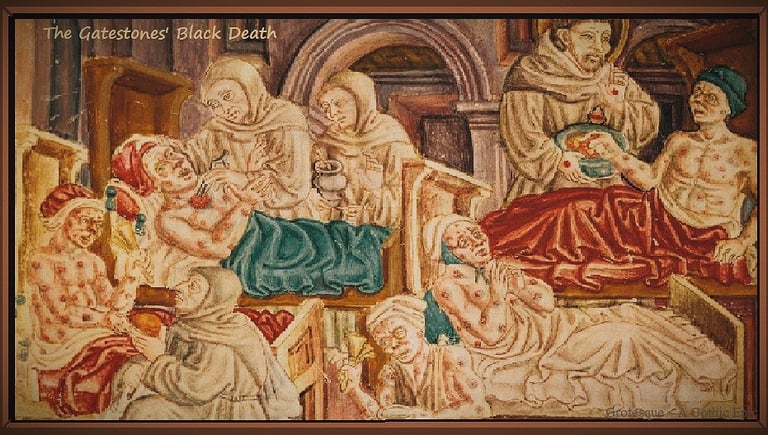
In Florence, city officials found little recourse but to enforce an ordinance that silenced the monotonous tolling of the church bells. They set strict limits on numbers of mourners, permitting the presence of only two visitors for any one burial, allowing adequate movement for the graveyards’ numerous teams of diggers. As the infection spread and the dead overran the cemeteries, the city turned to trench burial. Gravediggers stacked three or more bodies between scattered layers of dirt.
Perhaps the diggers were the best keepers of time, marking their schedules by the numbers that they interred. As several workers covered the corpses in the ditches, others excavated the ever~lengthening ends of the trenches. For weeks, the parade of Death continued like the reliable workings of a clock. Cartloads of ten and twenty corpses arrived at the burial trenches with every passing hour. Ultimately, the most well traveled roads in Florence stood as seemingly impassable ruts of dried mud that led nowhere but to the Ditches of Death.
Shortly thereafter, Marseilles buckled, as did Arles, and then Avignon, home to the Papal Palace and head of the Holy See. With Avignon’s dense population of forty~eight thousand residents living inside its ramparts, the city fell more quickly than any other. Doomsday preachers filled the streets, screaming for all to repent. In their perverse embrace of an outwardly inescapable evil, many of them staked religious claims to street corners, which became their personal pulpits to share their stories and prophecies of the end of Mankind. They called upon the scrambling masses and gathered the sick to witness their thundering sermons, and thereby their prophecies were self~fulfilling ~ the loudest of them grew black apples and fell silent.
Within the short stretch of a few months and at a rate of four hundred deaths per day, Avignon surrendered half of its population to the dirt. Like the doomsday preachers hollering from street corners, most of the city’s inhabitants felt certain that God’s wrath had fallen upon them ~ that the Great Pestilence was a divine punishment for their Babylonian lifestyles, for their debauchery and sin. They prayed, promised, and pleaded, but still the death toll climbed. A desperate Pope Clement slung his blessed oil and consecrated the entire Rhone River as holy ground, and thus, with a massive river now serving as a convenient and hallowed place for interment, Avignon’s gravediggers carted plague victims to the center of the Saint Benezet Bridge and flung them over the side.
Lucifael’s unholy concoction ripped through the heart of the Holy See as well, and nine cardinals and half of Avignon’s priests were rolled into their graves. But the pestilence failed to take the life of their appointed Holy Father on earth, as Pope Clement fled the Papal Palace under cloak of darkness, shielded by his secretly appointed assembly of guards and physicians. The dying dignitaries and sickly nobility, who clung to the palace gates and pleaded for Clement’s pontifical absolution and last rites, had no idea that he had abandoned the city several days prior. And when they discovered he had escaped, they were told that he had relocated to the northern city of Valence, but in truth, Clement secluded himself in the more distant and remote alpine village of Grenoble, settling in between two ever~burning fireplaces and within a circle of choice physicians led by Guy deChauliac. Aside from his ability to keep secrets within the papacy, he was a skilled physician and personal favorite of Clement ~ a master French physician who routinely treated Clement and several of his cardinals. With his immediate needs attended to, Clement governed the Holy See remotely via written correspondence to Cardinal Firmus, who remained in the Papal Palace to enforce the Pope’s mandates.
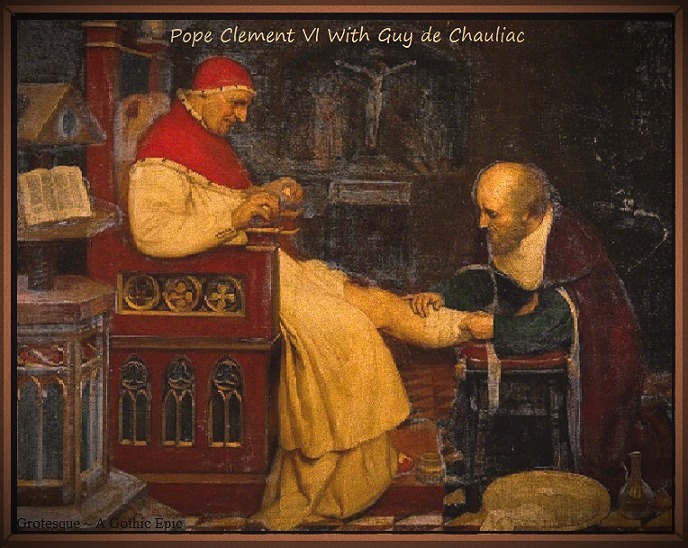
Spring arrived unseasonably early in 1348, ushering forth a sweltering summer and a surge of death. Paris quickly succumbed to the Black Death, delivering over eight hundred carcasses a day and fouling the air for nearly ten radial miles with an unremitting stench. Like Pope Clement, King Philip slipped into hiding, confiding in only a few of his closest associates as to his true whereabouts. Captain Bourne, then in charge of the new ranks of the Royal Guard, was one. As Guy deChauliac was highly trusted within the Papal Palace and its pontifical ranks, so to was Bourne trusted within the palace walls of King Philip’s monarchy.
After the decline and fall of Paris, the major French cities of Lyon, Bordeaux, Orleans, and Reims likewise collapsed, and with them, royalty their and leadership crumbled. Vassals to the king and entire generations of nobility lay in heaps in communal graves, and their destitute servants were left to rot along roadsides. Neither lane nor river lay clean of corpses, and all manners of unmanned vessels drifted aimlessly through waterways. Especially following heavy rains, hundreds of bloated bodies drifted down rivers and streams, cadavers so thickly tangled together as to form floating flesh islands. Like halos of death, white rings of froth encircled the blackened heaps, and atop many of these corpse rafts sailed white long~legged birds, snapping their beaks at the abundant insects that the rancid flotillas provided. Death used many methods for its steady spread.
Near the town of Bordeaux, the narrowly spaced pillars of the well~traveled Duguate Bridge stood as a corpse seine, gathering the waterlogged remains of people, sheep, oxen, and horses against its footings. The eyes of those travelers who dared to cross the bridge were lowered, scorched by the fumes of the boiling lather below. Most animals that neared the bridge fought the river crossing, lest spurred by force, and many of them did not make it to the other side of the crossing before leaping over the upstream side of the wall, entangling themselves in the fermenting mess beneath the bridge and becoming added fuel for the froth. Roads and rivers, towns and cities, kings and kingdoms ~ the earth was dying and the heavens stunk highly of it.
And Lucifael cackled all the while at all what she had wrought.
Vol. I: Chap. XI ~ finis.
Next Chapter~
~12: Drift of Death
"Here fresh funeral tears were shed;
Now the graves are also dead;
And suckers from the ash-tree spread,
While Day and Night and Day go by;
And stars move calmly overhead."
~W. Allingham
Grotesque ~ A Gothic Epic © is legally and formally registered with the United States Copyright Office under title ©#TXu~1~008~517. All rights reserved 2026 by G. E. Graven. Website design and domain name owner: Susan Kelleher. Name not for resale or transfer. Strictly a humanitarian collaborative project. Although no profits are generated, current copyright prohibits duplication and redistribution. Grotesque, A Gothic Epic © is not public domain; however it is freely accessable through GothicNovel.Org (GNOrg). Access is granted only through this website for worldwide audience enjoyment. No rights available for publishing, distribution, AI representation, purchase, or transfer.