Add your promotional text...




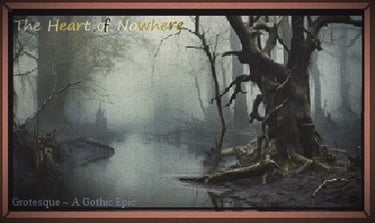
The Heart of Nowhere
Volume 1: Chapter 17 ~ Fisher of Men | Grotesque ~ A Gothic Epic | G.E. Graven
Download Chapter 17 as PDF

~Like warring Angels, stars dived behind the western horizon as others rose up and gave chase from the opposing direction. Betwixt them, whole constellations of sacred Titanic formations soared across the black heavens; and beneath Orion’s sword of stars, a lone pair of beating wings commanded the night skies. On an ocean of wind, Lazarus passed betwixt the heavens and earth, flying high above the French countryside, pressing onward, upward, and deep into the twilight hours. The vast and ever-changing face of the world rolled steadily beneath him, with its many forests, fields, hills, valleys, streams, and rivers. And as the whole of Creation lunged past him, his easterly migration never wavered. Nor did his faithful determination falter—to fetch a friar and fulfil a squire’s solemn promise to a long-passed priest.
Yet the skies no longer welcomed his advance as a thin red line of a coming dawn drew itself plainly across the eastern horizon. Lazarus glided from the heavens before spotting the landmark that he sought. In the distance, a wide and winding black ribbon wormed through a valley of treetops—clearly ‘twas the River Loire, as he gathered its likeness and proximate location from the many Abbey maps. He tucked himself into the heart of the river valley and strafed its forest canopy. Over the river and past the woods, he banked sharply and dropped himself even lower before levelling directly above its churning surface. And in the deep shadow of the valley, Lazarus followed the black artery toward the Gulf of Leon.
Within his wings, he sensed a new chill from the cool air that enveloped the river valley. The dank air was heavily tainted with a swamp-like stench: the mingling odours of decayed weeds, rotting wood, stagnant pools of muck, fungi, and dead but re-moistened fish confessed of a recent rain. Lazarus hugged the east bank of the river as he sought attainable sanctuary from the coming sun. However, the boggy riverbanks were no more than a pair of eroded shoulders upon which, overhanging trees competed for space. Many of them stood lifeless and listing, whilst others showed exposed roots that sprawled like spreading legs, offering only soggy animal burrows betwixt them. With dawn now upon him, and seeing no apparent haven, he hastened his pace.
Lazarus blazed about a bend in the river and eyed a tributary on its west bank. The narrow vein branched away from the River Loire, dressed in darkness and nearly obscured behind a curtain-like canopy of tangled thickets. He banked hard, crossed the river, tore through the undergrowth, and wound his way up the muddy vein, dodging twisted limbs and fallen trunks. Beneath him, the creek’s stagnant backwater was a black mirror and a reminder—a timekeeper, even. In its face, he saw the cast silhouette of the treetops, their arms spreading darkly against the growing red glow of heaven’s reflection. He was losing time; he knew the sun to be unforgiving; and with grim determination and stony resolve, Lazarus pressed evermore deep into the Stygian wasteland.
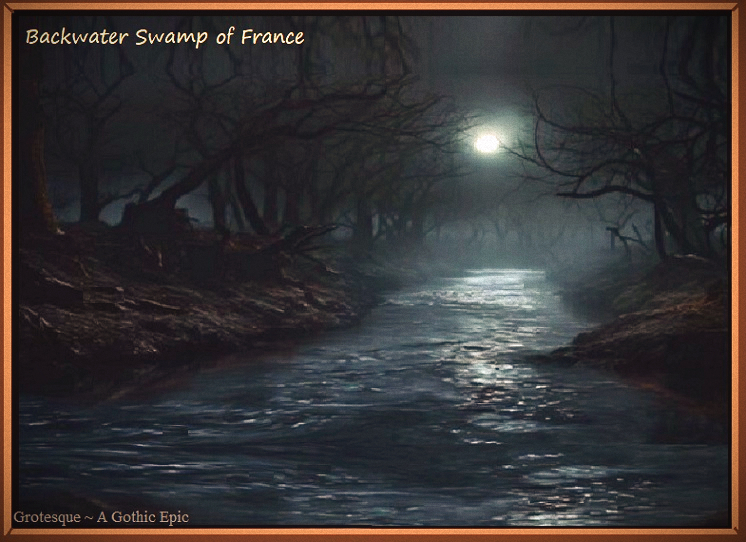

The tight body of water wound through the wilderness like a gnarled tree limb, its shores deformed and confused with more adjoining and veering creeks, weed-lined inlets, and moss-clogged cavities. Even deeper, the banks gave way to lowlands, with grounds so thoroughly drowned in all directions as to leave no visible trace of a waterway—it appeared as though the forest grew from out of a sheet of black glass. Indeed, Lazarus found himself gravely troubled about the deadly light of dawn and its equally effective, watery reflection. Completely, he was pinned betwixt light and dark, flying in a limb-congested forest, and hovering over waters of indefinite depth. However, he followed the winding path where the trees did not grow, hoping to hold himself to the true course of the creek.
Onward, he pressed through the flooded backwoods, stands of trees rushing past his either side like contorted and tremulous black walls. At length, the sky and waters burned with a crimson shade, altogether appearing as opposing oceans of blood. The chill had long left his wings and his face now burned as though, exposed to a hot wind. Lazarus squinted his eyes, searched the distance, and spotted that for which he had hoped—the creek began to redefine itself, lifting its muddy shoulders out of the water. Still further, it rose from its once watery grave, heaving itself upright, and with greater degrees of definition, showing its body to be wider, straighter, and more determined. As the flooded lowlands receded, the former muddy vein reshaped itself into a ravine—into a stream—and then a river that drove the wood line back. The dark stand of swamp trees retreated behind rows of tall and drooping river-grass and, interspersed within the grasses, erect stalks rose even higher, their skyward tips offering swollen grey plumes to the heavens. Onward, he flew, holding a straight and narrow course over the heart of the waterway.
And then, it appeared on the north bank of the river as an apparent godsend that abruptly leapt into view. Lazarus passed it, yet circled wide over the water before planting himself within the weeds of a sodden embankment. He folded a pair of weary wings, leaned back on his heels, closed his eyes to the burning sky, and gasped for even deeper breaths. Then he bowed over and propped his hands on his knees, heaving heavily as beads of sweat steadily dripped from the tip of his nose. He turned his attention to the river’s edge and found a tattered fish net partially afloat, the rest of it submerged in the mire of the muddy bank. Within the water and trapped beneath the net, Lazarus spotted the apparent head of a small girl. Her mouth agape, she stared blankly at him with a pair of sleepy eyes. And like a thousand tiny worms waving in unison, her spreading hair moved in the wake of lapping waves, altogether flowing as a surreal depiction of animation from an otherwise motionless body part. Yet it merely toyed with him—‘twas the sunken head of a broken doll.
Nearby, and against the brush-covered bank, he noticed the remnants of a decrepit boat, its waterlogged and separated belly-planks lying flat against the shoreline and partially concealed beneath mud and weeds. Lazarus stood and stepped closer to find a trail of puddles, which appeared to match the impressions of a heavy man’s boots. His eyes followed them through a path of flattened weeds and toward a plank door, which stood against the corner face of a solid stone building. Fresh footprints notwithstanding, the area appeared abandoned. The structure was overrun with lively vines and eager saplings; and in its picturesque presentation, the building could have appeared as the victim of a hungry forest, with it being slowly and wholly swallowed. Yet its face was not completely devoured. Along the upper edges of its outer walls, two rows of rotten timbers jutted from its cracked but otherwise stable shell. Below the parallel rows of protruding timbers, rectangular discolourations suggested the former existence of windows, since sealed with newer stones. Despite its unkempt condition, for Lazarus, the building seemed as a blessed sanctuary from daylight. He glanced at the red sky, looked at the footprints, and considered how he might best explain, why a Christian flying man must hide himself from God’s good light of day.
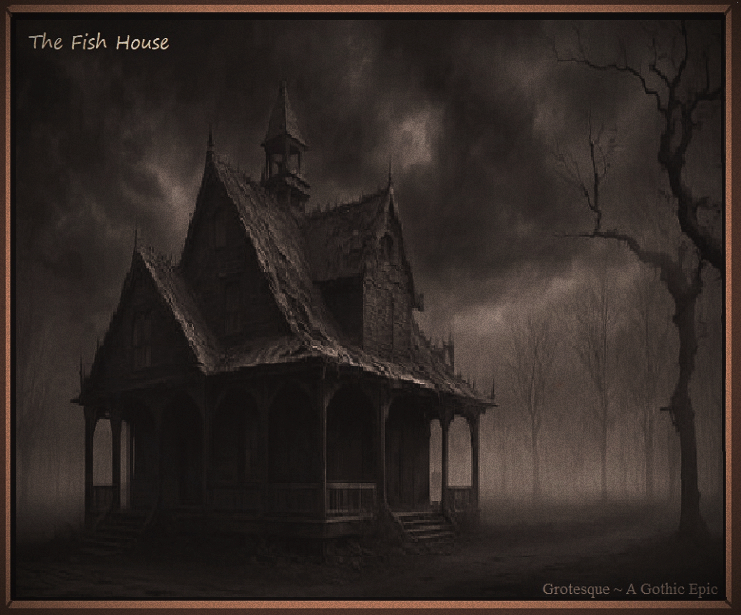
“Hallow, in there?” Lazarus called out, parting the weeds in cautious approach. He rapped on the door. “Might I have a word with you?” He perked his ears and listened for sounds, within. “Might you be here?” He heard nothing, save the steady buzzing of crickets in the surrounding thickets, and the distant splash of perhaps a startled turtle. Lazarus pressed a hand against the door, shoving it partly open before asking, aloud, “Anyone?” A hastily-fleeing spider escaped from within and scampered passed him. He slipped himself passed the door, stepping into a thoroughly black interior. “Hallow, in here?”
Immediately, Lazarus stumbled out of the doorway, his hand over his mouth and choking from perhaps the most ghastly and sickening stench in all of Creation. He made haste, fleeing through the weeds as he gagged near to vomiting. Then he turned about, still coughing as he re-inspected the door. Boiling from out of the open mouth of the building, a flurry of flies came out to join him. Altogether, they circled his head as a surreal and ethereal form of a humming halo. Lazarus slapped at them. He looked east, peering through a thin hollow of cypress trees to discover the first rays of light falling level with the upper regions of the forest canopy. Upstream, he saw no other refuge—only muddy shores and overhanging thickets. The steady burn against his skin was all too much, a reminder of daybreak. He turned toward the taunting and agape door of the building, which seemed to exhale a steady, rancid breath, perhaps comparable to the odiferous wheezes of a dying dog. He crumpled his brow, threw his shoulders back, drew a deep breath, and re-entered the building. Lazarus closed the door as odour and darkness consumed him.
With his hand over his nose and his back to the closed door, he stood motionless, allowing a moment for his pupils to peel away the layers of blackness and discern the interior facets of the enclosure—a stone floor; something of a table; a further table; another door.
His eyes wept from the stench, which might have draped his surroundings even more thickly than the blackness, the odour outwardly scalding his eyes like an exhaust from Hell’s chimney. The unbroken noises of crackles and hums filled the building. He wiped his eyes and refocused his sight on the frowning floor and walls, their surfaces appearing to churn in the dark. ‘Twas not his watery eyes, which gave them their seeming rippling motion; for their faces truly moved—awash with roiling flies and waves of roaches, which all but engulfed them.
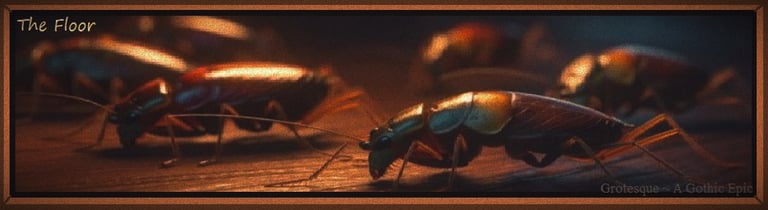

In the apparent boiling darkness, still more of the building’s bodily features took shape. Overhead, Lazarus spotted rows of bowed, timber rafters. Altogether, they could have resembled a sprawling and hollow ribcage, suspended beneath an even higher ceiling. A multitude of ropes and chains dangled ubiquitously from them, their ends adorned with a miscellany of metal hooks and barbs. Upon many of them, dead fish hung—curled, flat, and dry. And over all of them, perhaps a million flies played on imploded eyes.
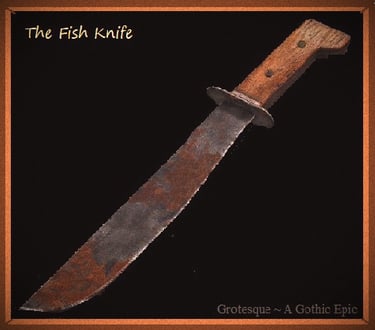
Lazarus stepped toward the centre of the fish house, parting low-hanging chains that rattled in his wake. He stopped beside a rectangular wooden table that centred the enclosure as an island unto itself. The entire surface of the rude fixture was marred with deep linear impressions and irregular overlapping groves, as though subjected to the repeated blows and swipes of cutting blades. He passed a finger over its stained and pitted surface before re-examining the walls of the building. Upon them, he noticed a row of torch brackets, similar to those that he recalled in the Abbey catacombs. He turned back to the entryway and saw a tall pail beside it and against the wall. It held an array of inverted, wooden torches. Beside the tall pail was a smaller, covered pail—presumably, an oil alembic for fuelling the torches.
He turned and peered into the blackest regions of the building, looking passed the curled fish carcasses and toward the rear wall. A long workbench covered its entire length. The topside of the fixture lay littered with skinning tools, crusty fish heads, and salt clumps. Beneath the table and atop the floor, he saw piles of neatly folded clothing—mostly robes and dresses, covered with rat droppings. The topmost garments appeared recently folded; however, further down and nearest the floor, the garments revealed signs of severe decay. Beside the cloth stacks, an array of neatly placed shoes lined the underside of the workbench. Some were new; others were old, and still others were tattered, appearing as though gnawing rodents had eaten holes in them. Even so, they lay in strict arrangement, together with the rest of the shoes and clothes. Surreal, it might have seemed—eerie, even. Yet perhaps, what Lazarus found most otherworldly about the underside of the table was that he saw betwixt its legs, extreme degrees of order and decay that shared the very same space.
Lazarus slapped flies from his face, gagged with a dry heave, and dismissed the workbench. Yet, he could not as easily shelve the rancid air about him, as its odour was of a skin-clinging, breath-stifling sort, which could easily tease any man’s throat near to turning itself inside out. He searched the rest of the enclosure, convinced that the horrid stench did not emanate from dried fish, but from perhaps a moist and more appalling source. His eyes followed a stream of flies to the south wall, and toward a tall ragged door with a fat metal latch. He perked his ears and listened to a steady hum that droned from behind it. Then, he dropped his gaze to its threshold crack to find many insects coming and going, like bees of a busy hive. Lazarus cocked his head and considered that the source, which ruined the air, spoiled it from behind the scarred door.
Curiosity pricked him, even as the memory of the commanding voice of Ivan echoed in his mind, warning him of the forbidden Benion Tunnel, saying, ‘Never, this one, Lazarus. You are free to roam all of the catacombs, save this one—never, this one.’ Nevertheless, perhaps the naked truth of Curiosity lay in its ability to invoke temptation enough to fuel desires as wild as were those in any beastly heart. Moreover, what beast was capable of following the cold discipline of wilful ignorance, even to ignore the throes of its burning curiosity? Lazarus stepped through clinking chains and toward the tall door as a parting sea of gnats and paper-like fish closed behind him. He unlatched the tall door and flung it wide.
Thump! Clunk-clunk-clunk! Lazarus leapt aside and hissed at a head that tumbled out and rolled over the flagstones. Abruptly behind it, a cloud of insects roared from out of the open doorway, ascending into the rafters like a million little exoskeletal Angels, released. The woman’s head rocked still and stared up at Lazarus with milky eyes, its neck spilling larvae into a creamy heap. Lazarus spun away and closed his eyes, as though doing so might help to free his senses and stop the gruesome event from moving into his memory. Yet, like every past event that he could so vividly recall—'twas too late, as his picture-perfect recollection was both, gift and curse, even to demand that he dwell upon the finest details of even the worst events in his life’s experiences—like even now, with its creamy heap.
Lazarus coughed, choking on gnats. He turned to the tall ragged door and edged himself closer. Through the open doorway, he discovered a very wide but shallow adjacent room, which appeared to span the full length of the south wall. Aware that he was in a fish house, Lazarus gathered the likely reason for the room, itself serving as a separate and more sanitary enclosure for the storage of salted and cured fish. However, behind a closed door, the narrow room appeared to serve an opposite purpose, keeping its contents from corrupting the entire building. With its door now open, Lazarus found the floor of the room stacked with nude and decapitated corpses. Perhaps fifty or more, all were the bodies of women, of differing sizes. And all of them were in a precise formation, as they lay, with their arms to their sides, and their neck holes aimed north, toward the door. Altogether, the remains might have resembled a meticulously stacked cord of wood—or a stack of folded clothes, or even a precise line of shoes. And like the clothes, the corpses exhibited graduating degrees of degradation as—evermore toward the floor, distinct bodily features blended into a dark stew of advanced decomposition. The bottom row was a seamless layer that might have resembled boiling pitch, as it churned with insects. And atop the whole of the horrid heap, sleepy-eyed heads lay, staring at nothing at all but perhaps the most hopeless of all human conditions.
“Argh!” Lazarus rushed backward, fetched the misplaced head, flung it back into the room, and slammed closed the tall door. He staggered toward the table that centred the fish house, his head swimming. Again, he scanned the filthy enclosure and his eyes came to rest on the tempting exterior door. Behind it, he knew the air to be clean, and the ground clear of ants and roaches. However, with the soft red glow that bled from beneath its threshold, he also knew that Death lingered at the door. Dawn had finally arrived—the fish house was his refuge for the remainder of the day. He stomped insects from his boots, climbed atop the table, and briefly inspected the rafters before leaping amongst them. He straddled the timbers and stretched out, facing himself downward atop them. There he lay, safe from the fiery chariot of the heavens and the hellish, bug-covered floor. And in that outward state of limbo, him hanging betwixt Heaven and Hell, Lazarus escaped into a more welcoming world of dreams.
~*~
Thump-thump-shhh! Thump-thump-shhh! Lazarus stirred to a disquieting and unnatural series of sounds that could have resembled that of a large beast crawling across a soggy ground, repeatedly slamming its heavy forelimbs into the mud and dragging its lifeless hindquarters behind it. Lazarus heard the heavy breaths betwixt the steps, and he recalled a day in the Well Hole of the Abbey catacombs, when Squire Thateus believed that a monster had attacked Squire Miguel. Truly, Lazarus now heard noises similar to those, which he envisioned as belonging to a winded and wounded sea beast, struggling to heave itself from the shoreline and find its final place to fester.
Lazarus rolled to his side and winced, rubbing himself where the suspended weight of him pressed his chest and legs against the timbers. He rose and squatted atop the beams before staring at the threshold of the exterior door and its red glow. The crimson light that he once recalled now cast itself as a different shade of red—a dying red—and he knew, from the lasting pain of the rafters, that the dawn of day had finally dwindled to dusk. ‘Soon, the night skies would be his,’ he assured himself. Yet, he spotted passing shadows as they broke through the threshold’s glow. Noises grew. He held his breath; his heart pounded. If the door should open to allow even a thin beam of light to reflect —
Boom! The door burst open. A fountain of sunlight spilled over the floor to part a roiling sea of roaches. Waves of insects rippled into the shadows. Lazarus turned his sunburned face away and closed his eyes. He winced and clenched his jaw, holding himself as a statue. In his blind and guarded state, he heard the troubling disturbance carry into the fish house—as though the dragging and wheezing sea beast found the rancid interior of the building to be a more appealing place to die. Yet, the apparent sound of a beast’s pounding forelimbs morphed into the more distinctive noise of a man’s boots striking the flagstones. Door hinges creaked and the blinding cast of daylight dimmed. Lazarus opened his eyes. He looked down to find a man standing with his back to the interior of the fish house and peeking through the crack of the nearly closed door. He carried himself like a suspicious or mischievous man, him hiding within and spying without.
From the shadows above the rafters, Lazarus saw the backside of the intruder: a rather heavy-set man with a full head of greasy black hair. Mud stains lined the bottom of his cream-coloured robe; and below his robe, Lazarus spotted a pair of black boots similar to his own, caked with clumps of mud. A line of muddy footprints led away from the man’s boots and toward the centre of the room. Only when looking toward the marred table, did Lazarus find the likely cause for the dragging sound, which he formerly heard—he eyed a limp and delicate hand that lay upturned on the floor. However, from his vantage point, Lazarus saw no more of the owner’s arm or body, since the long tabletop obscured all view, save that of the pale hand. Nevertheless, he dared not an attempt to garner further details and chance a creaking of the crossbeams.
At length, the man stole away from the door and gathered torches from the tall pail. After which, he opened the lid of the smaller pail, wetted the torches in oil, and traversed the periphery of the fish house whilst sliding the torches into mounted wall brackets. With a few flicks of a tinderbox, he had the entire enclosure aglow with flaming torches. Then he returned to the exterior door and briefly peered out before sealing it closed with a rugged crossbar. Finally, he spun about and stared at the workbench against the back wall, with its tidy stacks of clothes and shoes. He clapped once and held the fingertips of his praying hands against his smiling lips, as though to appreciate the spread of a scrumptious feast. Lazarus noted the finer details of his features: olive complexion, a wiry black beard, dark eyes, and an outwardly pronounced, beak-like nose. Although the man’s face appeared foreign to Lazarus, the most troubling feature of it lay in the unnatural space of his eyes—upon such a seemingly meaty face, the man’s narrowly spaced eyes altogether delivered a rather disturbing Cyclopean stare.
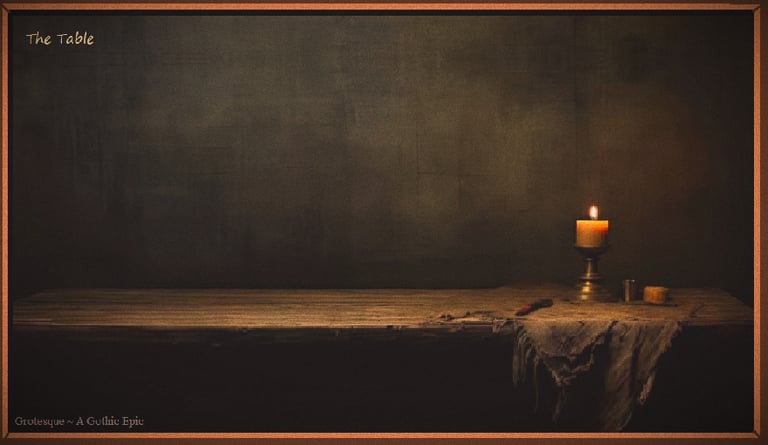

Straight away, the man’s face changed; his grin became a frown beneath a hard brow. He strode forward, lifted a lifeless woman from the floor, and placed the body lengthwise atop the table. He propped the woman’s arms beside her and positioned her to centre the table, adjusting her posture as he might, a life-sized doll. As Lazarus looked down upon her, she appeared to return him a wide, blue-eyed stare that cried aloud with a profound desperation. Yet, the conveyed terror in her eyes lay in stark contrast to the contented expression of her relaxed face—she appeared to look at him with warring emotions of revulsion and self-gratification, equally marked by the stricken gaze and the subtle smirk tucked in the corner of her lips. And there she lay, peering up at him, drilling her eyes through his own, and perhaps into the very basements of Heaven, even as the man began to remove her clothing. Carefully and meticulously, the man’s fingers moved like those of a loving mother with her bed-ridden daughter, with him strictly folding every stitch of garb and stacking it beside the table-strapped corpse.
Lazarus staggered and clutched a rafter to regain his balance. He cupped his hand over his mouth and winced from an unexpected wave of nausea that washed over him. Through a steady hum of flies and clicking insects, Lazarus heard every heavy breath of the man, completely with its steady gurgle of phlegm; and he watched the fat fingers of the man as they gracefully smoothed and folded the last item of clothing. To Lazarus, the fingers did not seem to fit the hands of a seasoned fisherman. as they appeared plump and tender; unlike the longer, leaner, and more thick-skinned fingers of his father—or his own, for that matter.
The man carried the corpse’s clothes and shoes to the rear wall, where he placed them beneath the workbench and amongst the tidy collection of the other human coverings. There he remained, with his back to Lazarus, busying himself with articles atop the counter. Lazarus jolted when the man called back to him from over his shoulder, “I am the Fisherman—the Fisher for all Men; and you shan’t leave from here! No; none escape the fish house, once within—not one!”
Lazarus held his breath.
The fisherman continued; “Do you not believe me?”
Lazarus refused a reply and the man stabbed the point of a skinning knife into the top of the workbench, yelling, “By your continued silence, I take it that you do not believe it so. Nevertheless, I shall teach you otherwise. None can hide from me; not even you. I see everything—especially works and deeds of the Devil!”
Yet the fisherman refused to look at Lazarus, instead keeping his back to him and scraping salt clumps into a pile before crushing them into a mound of fine granules. He swept the loose salt into the palm of his hand and rubbed it over his arms and neck, as though bathing himself. And in a sudden fit of exaggerated choking sounds, he loosened discharge from his throat and spat it beside his boot. Roaches fled. “I shall ask you but once more;” the fisherman called back, grasping the knife from the tabletop, “Do you not believe me, devil-spawn? Give me answer!”
With him feeling thoroughly exposed in the open rafters and growing evermore dizzy, Lazarus conceded defeat. He sighed and considered his introduction as a flying Christian —
The man charged away from the workbench, wielding his knife as he grabbed the nude corpse by the hair. “Answer me, witch!” He shook the dead woman’s head, pressed the blade against her neck, and screamed at her; “Do you believe me now?”
Lazarus clenched the crossbeams, looked betwixt his legs, and down upon the ostensibly fantastical happenings beneath him.
“Ah! So now you confess,” the fisherman exclaimed to the corpse; “When all is lost—when you’ve no ready defence!” Then again, like a loving mother, he drew a deep sigh and smiled before stroking her hair gently into place, saying, “Rest easy, my dear.” He licked the white of her eye and consoled her further, and in a faint whisper that Lazarus still heard; “No need for tears. Witches mustn’t weep—only pretty little flowers feel their sorrows.”
Lazarus watched as the fisherman return to the workbench. The man sharpened his blade against a honing strap as he called back, seemingly to answer an unspoken question from the dead woman, “Yes, you are—and more beautiful than most. Why?”
Lazarus’ head swam; his stomach reeled. Lazy flies pestered his face.
The man chuckled to himself, adding aloud, “Never with you, wench. You cannot tempt me. I gather your ruse: feigning to be a flower only to shroud your seeds of evil.”
Lazarus stifled a cough. He scanned the interior of the building. Only then did he realize the reason for his queasiness, as the rising torch fumes steadily collected against the ceiling, stealing the air from him—he could not remain in the rafters. He looked toward the threshold of the exterior door to find a lethal dose of daylight’s last rays still lingering without—he could not readily escape the fish house. He turned and glanced at the tall ragged door before returning his gaze to the broad back of the fisherman, even as his creeping urge to cough made itself evermore apparent. He knew no alternative, save a pressing confrontation and compelling presentation of himself.
He moved stealthily, securing his hands against the timbers as he gently lowered himself over the dead woman. Then he gained footing on her either side as he stood atop the table. His eyes never left the fisherman as he squatted over her. He held his breath and summoned all of the power in his limbs, contorting his posture and shifting his centre of gravity, till his boots made quiet contact with the floor. He stepped like a cat, toward the barred exterior door, stopping short of its glowing threshold. Yet, before he turned about—before he could raise his hand and restrain himself—he coughed.
Lazarus and the fisherman spun about to face one another. In turn, the startled man lost his knife as it spun across the flagstones, falling still against the north wall. Lazarus tore his gaze from the knife, splayed his wings, and hissed at the fisherman.
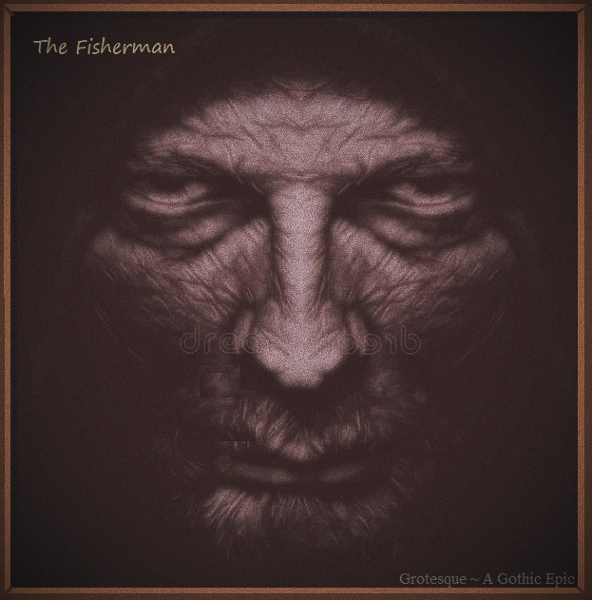
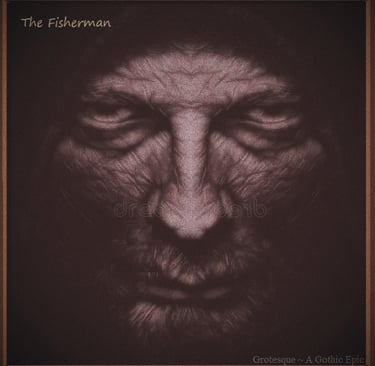
“Keep away!” the man shrieked, retreating to the south wall.
Lazarus collected himself and his wings, and remained guard of the door, which he could not yet afford, opened to the light of day. “Remain where you stand.”
“Oh I shall—just here—right here, if you wish it,” the man stammered, patting the wall stones beside him. Roaches fled. He stole a glimpse across the building, to where his skinning blade lay.
Lazarus’ gaze followed his; he growled. “Leave it lie!” They locked eyes from over the centre table and its corpse. “Sit down where you stand.” Yet, when the man remained standing, Lazarus added, “I shall soon leave this place. If you sit, then I shall sit as well; and no harm shall come to either of us.” Together the both of them slowly squatted and, just as their shared line of sight passed beneath the corpse and the butcher table, they recaptured the unbroken stare of the other. And there they sat, on their heels, quietly wondering of one another.
At length, Lazarus rechecked the threshold behind him, with its dimming glow.
“You await nightfall, yes?” the fisherman asked.
“I shall leave you, soon enough,” Lazarus stated.
The man nodded. “Perhaps you shall. Nightfall comes soon enough.” He groaned and repositioned himself to sit squarely on the floor. He propped his back against the wall and raised his knees to rest his arms atop them. “How did you gain entry through a sealed door? Did this witch conjure you forth? What are you; a demon of sorts?”
“I perched myself in the roof timbers. I am no demon.”
“Ah! And of course you wouldn’t be a demon; however, your wings and teeth begged the question.” The man cleared his throat and introduced himself; “Amad, I am—Amad Gaston; son of Barabass Gaston. If I may inquire; by what forename are you known?”
“Lazarus—a flying man,” he curtly replied.
The man slowly and deeply bowed his head. “The honour is mine, Lazarus; the flying man.”
Lazarus snapped a shallow return bow.
The curious fisherman quelled the lingering silence betwixt them, saying, “Although I am an excellent fisherman, a versed scribe, and wise to many wonders of the world, I must confess that your winged appearance deeply plagues my sensibilities. Indeed, if I were but a common God-fearing man, I might swear you to be the Devil, Himself.” He shrugged. “Yet, since I am not such a man; and as such, you cannot be the Devil, perhaps I should gather this chance encounter as but a lesson to yet another wonder of the world—that of a flying man in the flesh.” He leaned forward and nodded. “You do speak the truth? You are merely a flying man, and you shall be on your way, soon enough, yes?”
“I do not lie,” Lazarus responded. “I am a Christian flying man; and I shall soon depart.”
“Well, I am not a Christian,” the fisherman proclaimed. “However, I also do not lie; being the good and honourable man that I highly expect of myself.” With a high brow, he brushed his hair back, as though to present a better side of himself. Then he held his fingernails out, inspecting them. After which, he pursed his lips, placed a finger against them, and pondered—perhaps to cast an exaggerated expression of his impeccable abilities. “Ah!” He snapped his fingers and pointed toward Lazarus. “I have gathered the name of it.”
“Name?”
“Yes; the title of the verse that I shall scribe about my encounter with you. It shall be a captivating work.” He smirked. “And all of the world shall wonder over it.” He spread his arms toward the ceiling and waved his arms wide, as though to address the whole of the sky. “And the verse shall be entitled, ‘The Winged Demon, Who Calls Himself Christian’.”
“That would be a lie; and you claim not to lie,” Lazarus stated.
“Would it now? You see, even a demon might claim not to lie. And any God-fearing man, who saw you, might swear you to be a demon.”
“But you said that you are not God-fearing.”
“True; however, those men who might read such a verse—well, they do fear their God.” He shrugged. “Perhaps it falls to this: the word of one flying man, who claims himself to be God-fearing, verses the word of the rest of the God-fearing world, yes?”
“I am not a demon. Creating a false record as such, would be a lie,” Lazarus rebuked.
“To whom? How can your single claim counter a hundred claims to the contrary? How can you be right and a hundred men be wrong? Are you so divine as to make such a claim?”
“I know this truth more than any might presume to know: I am a Christian flying man—not a demon that pretends not to be a demon.”
“Yet, who can argue the voice of a hundred against one?” He cocked his head.
“A hundred men can be wrong, including me, if they wrongly presume, that which is right.”
“Ah, splendid!” the fisherman exclaimed, clapping his hands. “In your few words of defence, you have countered the claims of a thousand, thousand men!”
Lazarus crumpled his face. “What are you doing?”
“I am speaking with you. And I am sitting, as you requested.”
“No; why do you do what you do to them?” He pointed toward the corpse.
“Oh, the witch,” he responded with a petulant wave, “They are all the same, luring men’s good hearts for wicked gain. Pay her no heed.”
“You slew her?”
The man chuckled. “Witch slayers slay witches, my good man. ‘Tis what we do. And being the Christian that you claim yourself to be; you’ve heard of witches holy inquisitions, yes? He pointed betwixt both of them and inquired further, “If I don’t humble myself to take charge of it, then who might, otherwise? You?”
“You do it for the Holy See? The Church told you to murder women?”
“Witches, conjurers, hags, and spell-casters are not women; I do not slay women and children.”
“There is something the matter with you.”
The man cocked his head, pretending pleasant surprise. “Oh? And do tell of it.”
“I saw you, before you whispered to her—your tongue in her eye.” Lazarus shook his head. “I believe that you call her a witch only to steal her clothes and shoes.”
Lazarus watched the fisherman’s face turned to stone. Abruptly, it seemed to fracture with his bellowing words. “Do not come into my humble abode and presume to council me, flying man! You know nothing of me; or of my execrable duty to rectitude; or of the canny ways of witches!” He stole a glimpse of the stacks of clothing before directing his gaze toward the skinning knife. The man turned toward Lazarus, narrowing his eyes. Lazarus held his tongue, so not to further arouse the fisherman. The man leaned forward with his outwardly fat face. Beneath the hazy glow of the torchlight and through a churning circle of flies, Lazarus studied his eyes—altogether they appeared to merge inward and assume the likeness of sole monstrous orb that forever stared at him. The man growled, “I can see cleanly through you. We are quite different; you and I. You merely pretend to be wise by repeating the words of others; whereas, I speak and scribe my own words, since I am wise.” The man relaxed and smirked. “Hear me, this day. I shall scribe of you, Oh, glorious Lazarus, an eternal verse of a righteous and pretentious flying man who found shame in the light of Truth and cowered in the shadows of Wisdom. I shall unveil you completely, and make you naked in the world.” The fisherman winked and chuckled, adding, “As I am quite apart from you, having both, method and means to entertain the minds of men.”
Lazarus set his jaw and drew a deep breath before countering him with Scripture and scrutiny; “Wisdom is of God. You seem to murder in order to covet women’s clothes. And—what you did with her eye?” He shook his head. “No, your heart is not of God.”
The fisherman scowled. “God? Who’s God—yours?”
“There is only one, Lord God, Almighty, Who is in Heaven.”
“I expected such a reply. After all, you have your faith to defend. The teachers of your faith have taught you to reply in precisely that manner, when other men question your God. Nevertheless, in defence of your faith, you can provide no reference to any written or spoken words that I have not already anticipated, and can undo, simply by testimony of wisdom, reflection of reason, or reverse counter-question. So thus, save yourself the pain of gathering where I might fall short of you, especially in light of your own faith.” He cocked his head and smiled, awaiting Lazarus’ reply.
“You fall short of God.”
The man frowned, perhaps expecting more from him.
A moment of silence settled betwixt them, save the steady drone of insects and a crackling noise from burning torches.
Lazarus rechecked the crimson gleam beneath the threshold of the door when the fisherman called out to him; “You wish to know how I became so apart from the likes of most, yes? I can sense it. If you care so much to know, then I shall tell you how it happened.”
Lazarus shrugged—nightfall did not come soon enough for him. He nodded. “I care to know. Tell me everything.”
The man smirked and nodded in reply. “As I expected…very well then; I shall. As it happened, my parents belonged to different kingdoms, oceans apart; however, one day, as both of them were searching for shells on a stretch of Sardinian beach, their footprints crossed and they fell in love. Despite their dissimilar faiths, they wed in secret, swearing an oath betwixt them that they would not disrespect or challenge the faith of the other. A full season into their uncommon alliance, I was born. And as I was their child, they agreed to teach me the both of their faiths, as though they belonged together—like two accounts of similar stories. When I became old enough to question the difference betwixt them, my parents also swore me to silence, such that I may never tell others about my uncommon belief or the differing faiths of my parents. After all, we lived in the kingdom of my father’s land, and its wise men and tribal elders forbade any expression of a contrary religion. My father was a truly good man, since he allowed my mother to secretly practice her faith, whilst knowing that his head could easily find the end of a blade, if she confessed her true faith to the elders. Yet, in their undying loyalty, the elders remained none the wiser. And over time, I once embraced not one, but seven Gods in all.” The fisherman searched Lazarus’ face.
“Seven?” Lazarus asked with a deliberate nod as he snatched another glimpse of the still-glowing threshold. “Why, so many Gods?”
The fisherman snapped his fingers and offered him a coy grin. “I expected such a question.”
And like a flashing-and-passing déjà vu in his mind’s eye, Lazarus recalled already expecting the man to boast of: already expecting such a question. What was more, he somehow knew that the man might continue to speak of himself even till nightfall.
“Indeed. I cherished seven Gods in all,” the man proceeded to say, raising the toe of his boot as he watched a crawling beetle approach him. “My wise father prayed to six Gods and my kindly mother prayed to but one—hers was your very own, which you now defend as the only one.” The man lowered his boot; the bug popped, and he smiled at Lazarus. He leaned forward, adding, “You see, I know everything about your God—'twas but only one of mine.”
“Either you accept Him, or you do not,” Lazarus offered. “And since you already know Him, yet choose to refuse Him, I gather that there is little that I can offer to convince you otherwise.” Lazarus eyed him, asking, “Perhaps there was something that turned you against Him?”
The fisherman glowered at Lazarus. Then he choked loudly and cleared his throat, as though to embellish the moment of expectoration. He spat the sputum beside his boot and shot a hard glare toward Lazarus. “Please allow me to conclude my words before urging your drivel.”
“Forgive me,” Lazarus stated.
He cleared his throat again and softened his stare. “Yes, well, it all ended when mother gathered that my father secretly courted other women.” He shook his head. “There were so many secrets betwixt us. Mother was as passionate, as he was, wise.” He sighed. “In her fit of passion, she took his sword whilst he slept. Yet he awakened and, in the confusion of near sleep, and believing her shadow to be that of an intruder, he slew her—dead where she stood. She would not have harmed him; she worshipped him like the rising sun.”
“I am sorry for your loss,” Lazarus replied, catching a glimpse of the threshold.
“Oh, I expect you are,” the man said with a heavy tone of sarcasm. “Nonetheless; I awoke the following morn knowing nothing of what had transpired. I recollect day still clearly—lying in bed, with the warm sun, the twilling of songbirds, the heavy vapours of valleys green, and my prayers of thanks to my many Gods—unaware that my dead mother and crying father lay just next to me in the other room.” He waved a dismissing hand toward Lazarus. “Yes, I know that you hide pity for me—no need, kind sir.”
Lazarus only shrugged.
The man continued; “Distraught by the loss of the only true love in his life, my father took his own life shortly thereafter; however, before he died, he demanded that I swear an oath to him: that I ought completely abandon his faith and embrace that of my mother’s—with her one, Lord God, Almighty. I was displeased with him; I refused. So he cried; then he died, and I found myself alone, and with seven—seven Gods who, betwixt all of them, could not protect even a husband and wife from their own undying love for one another.” He leaned forward, again searching Lazarus’ face.
Lazarus nodded. “Seven.”
“Seven,” the man exclaimed, holding up as many fingers. Then he clapped once and grinned. “So I buried both of my parents, each according to custom, and left nine graves in the sand before abandoning my fatherland.
“Nine?” Lazarus felt compelled to ask.
The fisherman smirked. “Precisely as many; since I buried your God in those rows of graves as well.”
Lazarus rebuked him. “He is the First, and the Last; and His Word shall never perish.”
“In the keenness of my recollection, I believe that his was the third grave. And what of words? I am the poet, immortal. In words, I can never die, my glorious Lazarus, who is the flying man.” He snapped his fingers and hissed, as though to whisper a secret, “So long as a single soul listens, I live on to whisper words. This is truth. I am—me.”
The silence betwixt them was only momentary, since broken by the fisherman’s fit of screaming laughter. He slapped his hands repeatedly against the floor stones, exclaiming over his drumming, “Now tell me, Oh Lazarus, the flying man! Which was the true faith; and which was false? Make haste! Answer me! Answer the wise poet, lest we all fall dead without one!”
Lazarus stood. “Stop it!”
The man laughed and pointed an accusing finger at him. “As I expected! It pains you to entertain the notion of your tiny place in this world.” He leaned against the wall, still chuckling and shaking his head. “Oh, the grief that they feel, when they consider the chance of their being wrong about that, which they desire to be right. Oh, the doubt, which vision and reason bring to blind faith.” He looked squarely at Lazarus. “Can you not sense the unsettling feeling in your speculation of self?”
Lazarus squatted again, his gaze fixed on the man’s weathered face—and his eyes. He rebuked him. “I can sense that there are many false faiths, and prophets of them; however, I know that my faith in God Almighty is the only true faith.”
“Lie!” The man yelled, slapping the floor. Lit flies flew. He hastily folded his arms and hugged his torso tightly as he rocked back and forth, staring at the ceiling and rattling words that he seemed to know and say by rote. “There are no Gods. There is no Heaven. There is no Hell. There are neither angels or saints, nor demons or devils.” He rocked repeatedly and stared upward, presenting his self to be lost in his own mind as he continued, “No sign of them exists—not anywhere—no confirmation—not a hint—no shred —”
“Lie,” Lazarus firmly replied, calling the man’s attention to him. “Scripture is that confirmation. ‘Tis the Word of your Most High Lord and Saviour, which you deny.”
The man rocked still and Lazarus saw an abrupt change in his expression; as his disposition seemed to morph on the fly—immediately from the face of an unruly person in apparent mental disarray, to that of an unruffled man with a distinguished and highbrow demeanour. He raised his chin and looked down his beak-like nose at Lazarus. “Your scripture, as you call it, is but the combined effort of long-dead and fanatical scribes that desired all of posterity to hear their words as a single word—as the only word of the God and faith that they envisioned betwixt them. As it happens, men scribe of Gods and demons, since Gods and demons have never scribed of themselves.” He shook his finger at Lazarus, nodding. “Perhaps you might wonder how it is that I am able to know such great things.”
“I do not wonder,” Lazarus grumbled, rechecking the door.
“And I shall tell you,” the fisherman continued—oblivious to his remark. “In my many seasons of travel—to varied lands and its peoples—I have encountered many such writings like your scripture, all of them proclaiming to be sacred words and divine decrees of Gods. I saw many form of them: parchments, clay vessels; stone and wooden tablets; carvings on tree trunks; even scars and markings on the face and belly’s of men, who claimed them to be divinely and painlessly inscribed whilst they slept.” He clapped his hands. “And perhaps you might wish to learn what I gathered to be the most common betwixt them?”
“I do not wish it,” Lazarus remarked.
Yet the man persisted. “Their similarity was that, whatever they conveyed as a divine message, they always had another part of their message to read, that the divine message was absolutely the truth, such that any other claim to the contrary, was false. And why might your scripture be different from the rest of these ‘divine messages’, since it also proclaims that other faiths and Gods are unreal, save those it strives to make real? Why so, lest it be merely one more ‘divine message’ amongst many? Do tell; what greater truth is in it? And how can you deny my truth of it?” He smirked and winked.
Finally, Lazarus rebuked him. “The truth is that you do not accept the Lord and His Word. Just as others question that, which they do not accept or understand, so do you, the same. ‘Tis your denial that is your undoing. And if you truly embraced the Word of God, Our Heavenly Father, then you would not claim to speak the truth and disclaim the Scriptures in the same. You cannot deny this truth, lest by lies.”
“Oh, but I can—and have,” the fisherman retorted. “I do not lie. I am a good and righteous man—honourable, even.”
Lazarus looked at the corpse on the table, shaking his head. “No; you’re an evil man, only feigning to be good. You offer no good counter to God, save your lack of faith in Him and His Word.”
Lazarus spotted a fly that crawled across the fisherman’s forehead; it stopped directly betwixt his eyebrows.
The man seemed unaware of the bug on his brow as he chuckled and replied, “I gain nothing by undoing your faith. Only you might lose by its dismissal, in the unmoving face of Truth.” He presented the palms of his hands and shrugged. “You see, the burden of truth rests with you, not me, since I do not claim Gods to be real.” He smiled widely as Lazarus watched the fly crawl over his face before burrowing into his beard.
“God is real. There are no other Gods before him. He is—I am,” Lazarus stated.
“Is? Am?” the man challenged him. “And if I told you that your God is behind that door,” the man asked, pointing toward the tall ragged door, “would you believe me?”
“I would believe you.”
The fisherman cocked his head and narrowed his brow. “Why might you blindly believe me when the burden of truth ought be on me to prove that your God is behind the door?”
“Perhaps, you cannot see the truth because you are looking for who should bare the burden of it?”
“Very well then,” he said in seemed contemplation, placing a finger on his chin, and shooing the once embedded fly from his beard, “Since I did not open the door and reveal any truth of my claim, how might you come to believe me beforehand?”
“I expected such a question,” Lazarus replied. “I need no door to be opened for me to know that the Spirit of God is everywhere, and in every thing. He is behind that door; in these wall stones; in the roof timbers —”
He waved a fly from his face and jabbed a finger toward the corpse. “He is even in her.”
The man dismissed him with a chuckle and a shake of his head as Lazarus continued, “Who made her, if not the Lord, God? And who made the mountains and rivers, or the sun and moon? Did you?” He shook his head. “No; God Almighty made all things—'twas written in Scripture. So you can leave your door closed and rest yourself, assured that everything about you is proof of God’s presence.”
“I think not,” the man, rejoined. “The only proof you offer is by showing me that my fish house is—that witches are—and that everything is here, which should be here.” He surrendered his hands to the air. “But you’ve yet convinced me that your God is anything more than your desire for him to be real—lest of course, you wish to reveal Him to me through the eye of the witch or the face of the moon. Might you show me? I might truly be stricken with gratitude for it.”
Lazarus watched as the fisherman leaned forward, stealing a glimpse across the fish house floor and toward his skinning knife.
“And I would care for you to remain where you sit.” Lazarus growled.
The man relaxed against the wall and sighed. “Answer me this; if there were no stones, timbers, witches, mountains, or even a sun—if there was nothing, then how could you still believe your God to exist?
“If there was nothing, then I would also be nothing and could not know anything. However, since I am me, then I know that God also exists, since I did not make myself.”
The man set his jaw and considered Lazarus’ reply. A brief silence lingered.
Finally, the man asked, “Why do you lessen the Great Maker by referring to it as but a god, king, or father?”
“Great Maker? Do you mean to say, ‘God Almighty’?”
“No. I did not say, almighty God; I did not say, King, Lord, or Duke of Gods; I did not say, God of Good, or God of Evil. I said, the Great Maker, which needs no glorious name or noble title.
“God Almighty goes by many names. And you give Him yet another, by your calling Him, the ‘Great Maker’.”
“I expected as much.” He sighed before tapping a rigid finger on his leg as he lectured Lazarus. “In every place that I have travelled; with every man that I met, who swore an allegiance to a God, he proclaimed the same as now you do—that his God was the Great Maker. Yet, the Great Maker is not a God of men. The Great Maker created men and made them to wonder of this world and believe in their Gods. Gather that, if you will, my glorious flying man who calls himself, Lazarus.”
“God is Truth; I needn’t defend Him to the face of blasphemy.”
The fisherman winced before chuckling. “God is Truth? Is that all—just like that—nothing more?” He let loose with laughter. “Well, of course you may say such a thing; just as any man might say, in defence of his God, that his God is Truth. After all, what man would be so foolish as to profess a belief in a false God?” He chuckled. “You said nothing and much in the same breath—saying nothing meaningful in defence of your God; yet, revealing much about your inability to lay a good defence with even the most simple of claims.”
“I told you that I do not defend Him; I merely share His Truth,” Lazarus stated.
“Oh?” The man leaned forward. “Then answer me this truth: Is the Great Maker good or evil?”
“If you refer to God; then He is good.”
“Lie! The Great Maker is everything! All things are of the Great Maker—every good thing, every evil thing, from flowers to witches—everything! How can you claim to share the truth when you only offer half-truths? I also suspect that you believe that evil comes from only devils and demons, yes?” He nodded, smiling. “And from whence did these evil things come—themselves? Do tell me such a child’s tale!”
“You seem to know the Word of God without my telling you,” Lazarus said. “Why do you ask for me to share Truth, only for you to dismiss it?”
The fisherman shrugged. “If I told you, in but a single breath, of everything that is the matter with your belief, then you might cherish the chance of dismissing all such matters with a mere wave of your hand. I do not care to spend such considerable and lengthy efforts, keenly addressing the many facets of your false notions, merely for you to offer a quaint and drivelling rebuke, as insignificant as perhaps: ‘I do not believe you’, or, ' 'tis not so.' Hence, your attention and lively participation is certainly required. Would you care to participate in such a revealing exchange in search of Truth, my glorious Lazarus Gogu—son of Ivan Gogu?
Lazarus shook his head. He glared at the man. “No, I do not believe so.”
“Not even in the least? Your dog-toothed mouth begs for silence, yet your eyes say differently. In them, I see a screaming curiosity, and a hunger for answers to your many-plaguing questions.”
“And perhaps you see and hear only that which you desire to see and hear, my equally glorious Amad Gaston, who is the son of Barabass Gaston?”
The fisherman laughed and shook his finger at Lazarus. “You've a quick wit! Superbly said! Then perhaps both of us are guilty of like errs in forethought—you, with what you cannot see to be fundamentally wrong with your faith; and me, with what I should not see, in your still hungry eyes.” Lazarus clenched his teeth as the man continued. “Now, since I am wise and willing, my winged one, I shall share with you the very truth of men and their Gods.”
“Must you?” Lazarus grumbled, briefly inspecting the door behind him as the fisherman likewise stole another glimpse of his lost knife.
“Indeed,” the man affirmed. “‘Tis like so: Just as children are comforted in the presence of their parents; so do their parents find solace in Gods. And just as children beseech their parents for direction, certainty, and mercy; so do their parents pray to Gods for guidance, protection, and grace. After all, when the parents were but children, they also suffered innocence, fear, and foolishness. Do you gather my meaning, thus far?”
Although Lazarus gathered his meaning, he gave no reply, as he was thoroughly engrossed in the apparent incongruity of the queer, if not fantastical presentation before him. Mesmerized, he stared at the fisherman, who successfully demonstrated stark insight and sober reflection, and who proceeded to lecture him from behind a corpse that only a moment before, he gave lecture, made nude, and licked its eye.
“By your silence, I gather you to gather me,” the fisherman stated, calling upon Lazarus’ attention. “Now, I shall bestow upon you, an even greater truth, and one that you will surely deny by reason of your faith. ‘Tis this: The Great Maker is everything. And since it is everything, it bares no familiar face for to give us comfort or solace; no fatherly hands for to provide us with certainty or protection; and no motherly tongue for to console us or heal our pains.” He shook a pointing finger at Lazarus. “Now you know why there are books and tales of Gods. Men ritually scribe and speak of Gods amongst themselves, expressly to convince themselves, en masse, that Gods do exist. And in their cherished leaves of scripture—in their singing words of sermon—they give face, form, and name, to Gods. And like the believers of your own God, they refer to it as ‘Him, Father, Lord, and King’, and bestow it such traits as ‘wrath, mercy, sorrow, and grace’; as though they created their God in the image of themselves.” The fisherman smirked. “Now answer me this, Oh glorious Lazarus: If swine could wonder of themselves and the wide world; if they were every bit as capable as Man, then might they not likewise scribe and speak of Gods that were in the image of themselves?”
“If your heart was with God, then I do not believe that you should wonder of things that swine cannot do,” Lazarus offered.
“And if you do not wonder of anything which is not—like capable swine; then how might you fully gather what is—like your incapable self?” the man questioned sarcastically.
Lazarus clenched his jaw. “I need not defend my God in the face of His enemies; and for my own part, I believe that I am quite capable in my faith and understanding to gather that you lack the same capabilities.”
The fisherman hissed laughter and dismissed him with a wave of his hand. “Oh, yet I have as much faith in my faculties and, of the Great Maker as have you, foolish notions and blind convictions, for to hide your eyes from the painful truth of a pitiless and wicked-filled world.” He shrugged. “All of them do it—just as you do it. They elect to believe in a better place and, of caring Gods to console their many life’s woes.” The man dropped and shook his head, sighing heavily. “Yet sadly enough, they remain in a cruel world; and their Gods are mere desperate attempts to place a familiar face on the formless and faceless Great Maker.” He choked and cleared his throat, adding, “In their dreams of a better place, they refuse to look upon the world that the Great Maker has made.” The man covered his eyes and appeared to weep when Lazarus cocked his head.
Lazarus jolted as the man slapped his hand on the floor and bellowed with laughter. “What pitiful beasts!” he exclaimed. “Their Gods are but trifling doll-headed depictions, which are not in the likeness of the Great Maker!” He laughed again. “And what is more; not only do they claim that their God is the Great Maker; yet many of them likewise swear that the Great Maker placed its seed into a woman and sired a man-god, even!” He chuckled and shook his head. “Of all the foolish notions—a man-god, whom they worshipped and slew.” His expression abruptly changed to seeming contemplation. He studied Lazarus and scratched at his beard. “Can you truly believe such foolhardiness?” Then he winked and smirked.
Beneath the spiralling torch flames, and within the man’s cold gaze, Lazarus might have discovered the same fiery and frigid stare as, once came from his mother’s eyes—the same heartless passion burning within them. He countered the fisherman with a quote from Scripture; “For God did so love the world, that His Son, the only begotten, He gave, that everyone who believes in him, may not perish, yet may have life eternal.”
In a theatrical gesture, the man thrust one hand high in the air and held his breast with the other, saying, “Hark! Your words are truly daggers in my heart, to wound me so! You prepare them well,” he cried, mockingly, “So unexpected; so freshly said! Your wisdom is —”
Lazarus shifted his posture and glanced at the skinning blade when the man dropped his arms limply beside him and turned to Lazarus with a constipated expression before adding, “From whomever you borrowed those words, you should return to him, and inform him that they are empty and without wisdom.” He snapped his fingers and pointed at Lazarus. “What is more, you should tell him that he is twice the fool—firstly, for believing those words to be the truth; and again, for convincing you to behave as the same presumptuous and preaching fool towards me as he behaved towards you!” The fisherman hugged himself tightly and pressed his back to the wall, sitting rigid and stone-faced, whilst staring at Lazarus.
Lazarus considered his sudden change in constitution. He could recall only thrice in his days, the same degree of resentment that seemed at the moment to warm him. He considered the flash of anger, when the Captain slew his father—the pupils of his eyes constricted. He recalled his nude Mother, who would undermine his faith and attempt to slay him with a winged Monster—he clenched his fists and set his jaw when considering the whispered words of Hugon’s soldiers, accusing him of being the winged monster that he was not—a bead of sweat traced the hard line of his face as Lazarus now studied the demonstrably capable man before him, who behaved like a monster, and who mocked the very foundation of his faith. He drew a deep breath and glared at the man who dared to roll away the very cornerstone of his comfort, and with it, the assurance that he was mostly like his father and nothing akin to his monstrous Mother.
‘Nothing like Mother—not a true Monster,’ he comforted himself, relaxing with a sigh and a quaint smile as he replied, “I did not borrow such words from another, as you claim. ‘Tis the Word of God, in Holy Scripture. And since you claimed to know of Scripture, yet do not seem to recall God’s Word when it is revealed to you, then perhaps you lied?”
The fisherman returned the same quaint smile. “I do not lie. And, if you will, please do strive to recall that I am a man of honour, and well versed, even. I recall your scripture wholly—every word and every verse, in the whole of its tome. Nevertheless, as you might gather such abilities to be beyond any common man, I am no such man.” He cleared his throat and smiled again. “So pray tell, my glorious Lazarus, and flying Christian of the night skies, who is dressed in black; do you scribe as well?”
“I do scribe,” Lazarus replied. “However, if you know every word of every verse of Scripture, as you claim, then you might recite verse: 2 Kings, 35 of 17?”
The fisherman winced and curled his lip. “Clever, you are, to select that particular verse as a test of my abilities. Nevertheless, I accept your challenge and expect the same demonstration in turn.” He drew a breath and rattled off the verse, saying, “Ye do not fear other Gods, nor bow yourselves to them, nor serve them, nor sacrifice to them.” The man clapped his hands once and added, “There you have it. Now, might I remind you once again that I embrace only the Great Maker and do not worship Gods like yours.” He pointed toward Lazarus. “Your turn—tell me of Proverbs, 1 of 8. How does it read?”
Lazarus recalled it aloud, saying, “Doth not Wisdom call? Doth not Understanding give forth her voice?”
“Ah!” the man exclaimed, arching an eyebrow. Perhaps there is more to you, yet undiscovered?”
Lazarus nodded. “Perhaps you have discovered that I need not boast of my abilities? Yet, since you press for it—as do you, I know every word of every verse of Scripture, Amad Gaston; fisherman and poet, who is the son of Barabass Gaston.”
The man raised a second eyebrow, evenly with his first. “You have the gift as well—that of undivided recollection?”
“I recall that, which I see and hear, if that is the meaning of your words,” Lazarus stated.
“Only once, you see or hear a thing, and you forever recall it?”
“Thus far,” Lazarus replied, adding coldly, “Yet, I have not lived forever; have you?”
The man slapped his forehead, visibly stricken as he spoke towards the ceiling. “In all my days, I have never met another like myself! And this one has wings! What a grand design, the Great Maker has made of us!” He shot a seemingly gleeful gaze toward Lazarus and offered, “Perhaps we are more alike than I had first gathered—you and me!”
Lazarus glanced at the tabled corpse betwixt them. “We are nothing alike.”
“Oh, but we are,” the man insisted, waving his hands. “We have the same design; you and me, as we are gifted and cursed in the same—being fully aware of ourselves.” He sat back and narrowed his eyes before questioning Lazarus, “How many times did you read over the same verses of your Godly text?”
“Holy Scripture is the Word of God, and not Godly text,” Lazarus responded. “And I have read the same verses many times, as should you.”
The man crumpled his face. “Then why might you read that, which you already read, ‘lest your recollection be less than what you claim it to be?”
“My recollection of God’s Word does not make me a master of it,” Lazarus stated. “I gather new meanings with every new read.” Then he leaned forward and, with a fist planted on the floor, Lazarus concluded, “Even complete recollection does not give all meaning to things recalled.”
The man slumped against the wall, smirked, and busied himself with popping the knuckles of his fingers. “Perhaps you speak the truth, as recollection does not make for understanding; however, I do not recall any discussion betwixt us, in the way of ‘understanding’ words. He raised his brow and nodded. “Yet, since you bring us to the root of the tree, which includes the very meaning of the written word, perhaps I should share with you, that there are many ways to measure the meaning of scribed works, aside from what is written in them.” The man shook his finger at Lazarus and chuckled. “You claim to have read your Godly text over and again, if only to gather more of its meaning. Answer me this: Have you even once considered the meaning of its verses by the words and notions not contained in them? Have you weighed their meaning by all that they do not say? Have you gleaned more meaning in these verses by their careful selection of words, notions, and reiterations of the same? Or were you so entirely captivated by reading leaves of verses that you failed to see the entire meaning of your Godly tome?”
“I do not read your scriptures to learn of what is not in them; just as I do not read of birds to learn of making bread or wine. You speak; yet you say nothing.”
“Oh, but I do; ‘tis you who listens, without hearing anything. Pray tell, how many texts have you read, Lazarus?”
“Many.”
The man nodded in apparent consideration. “Many? Then tell me, how many of these texts were Godly texts? How many of them spoke of different Gods and faiths—those aside from these scriptures that you now embrace as truth?”
“I am not like you, to embrace many Gods, notions, and nonsense. There is but one God, one Word, and one Truth; and I’ve no need to read of lies.”
“And I expected such a reply. Nevertheless, I shall share with you, such notions which you absolutely refuse to hear. ‘Tis this: Just as every man is born, every man shall die. And since no man wishes to die—since every man wishes to live forever—men have devised a device and a means by which to escape the pains of pondering their own demise. What think you, of such a truth?”
“Perhaps you might find a means to ponder your demise in silence, yes?” Lazarus asked, briefly rechecking the faint glow of the door’s threshold.
The fisherman snickered and carried on, “As with anyone of any faith, your device is your Godly text; and your means are its written rules. Of all the differing faiths that I have encountered in my days, I found them to share a common understanding. At the heart of them all, there are sacred inscriptions that claim themselves as divinely created. And within these inscriptions and Godly texts, there are written rules. The rules of them vary betwixt faiths and peoples; however, I have discerned their similarities and found them to be quite unremarkable. Would you like to hear the single rule that they share?”
Lazarus waved a fly from his face and dismissed Amad, giving his attention to several roaches that convened on the floor before him—they appeared to be introducing themselves to one another by pairs of long hairs, affixed to their heads.
The man continued; “The single rule to all of them is this: If a man accepts the divine inscriptions of his faith to be true, and he obeys its rules, then he shall live forever in happiness and peace. And if a man does not accept the inscriptions as Truth, then he shall also live forever, yet in sorrow and pain.” He chuckled. “What does that tell you about your own scriptures, when placed in the same light as other divine inscriptions? What does it say about any inscription, of any faith, claiming itself to be divine?”
Lazarus shook his head. “Perhaps there is more to you, also undiscovered. 'Tis perhaps that, which you do not offer, that reveals the most about you. I ask you this: Of all these faiths you have witnessed, and in all of the words that you have read of them, have you found even a single declaration that praises you for the evils that you have committed here?” He pointed to the corpse. “What faith, in all of those that you claim to know, might declare your murderous deeds as either good, or righteous?”
The man grinned and leaned forward with answer; “Your very own, Lazarus.”
“No; not mine. And you still claim not to lie?”
“You should recall that I do not lie. Your confusion of Truth does not mean that I speak untrue. It merely means that you must look beyond that, which you believe to be the truth.”
“Thou shalt not kill; thou shalt not steal. There is no greater truth beyond the Word of God.”
The man leaned back and nodded. “Long before now, I expected you to say as much; and I have since prepared a question to address your claim. I ask you this: If you had keen understanding, such that you knew of a means by which to slay the Devil of your faith and cleanse the world of Evil, then would you slay your Devil?”
Lazarus narrowed his eyes. “I know what you do in this place, slaying women for to steal their clothes.”
“I ask you this, as well,” the man continued, “If you had the means to steal your Devil’s powers and secretly bury them, so that they are forever lost from the face of the world; then, would you steal from your Devil?”
The recollections of a gigantic Flying Swine flew across Lazarus’ mind; he responded, “The Devil shall stand before God and answer for every evil-doing. I am not God; and I do not need to wonder of things that shan’t happen. And I believe that there is something the matter with you for wondering such things.”
The man rebuked him; “And I believe that there is something the matter with your faith, which keeps you from wondering outside of it. Nevertheless, I anticipated that you would not slay your Devil, even to save the world. After all, your faith teaches you to be mostly wary with saving yourself from yourself.”
Lazarus shook his head. “God gave His only begotten Son —”
“As you say!” the man exclaimed. “Yet, we do not speak of the giving of lives; but the taking of them! Had your scriptures not said that men took the life of your man-god; then your same scriptures could not have spoken of the notion that your God gave the life of Him, yes?”
Those men, who crucified Christ, were not as God, Amad. They did only what they were allowed by God to do, whatever the price they paid in the end.”
“Precisely, Lazarus. You speak true enough in your faith to corner yourself with me—as I expected.” The fisherman gestured toward the corpse with a presenting hand, adding, “The Great Maker has provided me the ability to take a few lives, that I might save many more. I ask you now: Is any bad deed, solely cast against Evil, not a good deed?”
Lazarus raised his brow. “Slaying is not, saving.”
“Slaying witches, saves the world,” the man rebuked, narrowing his stare. “If they were permitted to live then they would continue to spread their evil seed of death, decay, and ill omen to all the good peoples of the earth.”
Lazarus looked at the dead and mostly unremarkable woman before inquiring, “And how can you be certain that she is a witch?”
The man huffed, visibly stricken by the audacity of Lazarus to ask the question. He followed with a questioning of his own; “How does a skilled blacksmith know a steed? How does a high priest know the marks and signs of evil?” He growled at Lazarus; “Do not presume to challenge my wisdom. I am a seasoned and accomplished witch-hunter. You know nothing—nothing, of the craft or workings of witches and crones!”
“As you say,” Lazarus agreed. “‘Tis true that I know little of them. ‘Tis also the reason that I ask you for such proof.” He gestured toward the laid corpse. “Can you offer evidence that this woman, or any other, is a witch?”
The man glared at Lazarus before admitting, “Hunting witches is not a precise application, my glorious and curious winged man. One cannot exact absolute evidence from a less-than-perfect practice. Unlike your simple faith, the world of the Great Maker is not as regular and plain as you might gather—‘tis filled with complexities, intricacies, and many shades of gray.”
Lazarus nodded. “Then, may I take your intricate reply to plainly mean that you do not have proof that she is a witch—or, that you might mention to me of ‘complexities’ and ‘shades of gray’ in an effort to shroud the simple truth, that you lack such evidence.” He leaned forward, further pressing the man. “I believe that you cannot prove any of your victims to be witches. What is more, I believe that you see them to be witches only after you covet their clothes and shoes.” He pointed to the workbench, with its folded dresses. “Why else might you undertake such care into their placement?”
“Lie!” the fisherman exclaimed, slapping the floor. “I do not do it for me; but for you—for everyone!” The man shook his pointing finger in anger. “You have a simple eye, to see only Day or Night, without giving attention to Dusk or Dawn! You gather things to be, either good or evil, without measuring the meaning of them, or the degrees of right and wrong in them!” Again, he slapped the floor. “How dare you, to presume to know my intentions merely by passing evidence of my actions, with their meanings and methods still unknown to you—how dare you, to judge me!”
Lazarus pursed his lips and raised his brow. Then he responded coolly, “Perhaps I have a simple eye. Yet, my simple eye sees clearly, that you surround yourself with clothes and shoes, stolen from those of whom you’ve passed judgment upon and, by your own hand, condemned to death.” He sighed heavily. “And you claim that you do this; not for you, but for me—and for everyone. How can it be?”
The man scoffed, “Do you know why it is that you know so little about witches?”
“I have never seen a witch,” Lazarus replied, “Or heard of one, save that, written in Holy Scripture.”
“Precisely! You’ve never seen a witch since faithful witch-hunters like me keep the world clean of them. And I am not alone in this righteous endeavour Even the clergy of your church strives to better the world by seeking them out and destroying them. Their evil spreads through everything that they touch. We do what we must. A witch-hunter does not enjoy his duty; he is only doing what is right.”
Lazarus cast a glance betwixt the workbench and the dead woman before commenting, “If a witch-hunter endeavours to rid the world of the evils of witches; and witches spread evil through everything that they touch; then why might a witch-hunter covet a witch’s clothes and shoes? And would a witch-hunter not become more evil in his struggle to slay the witches, when he so often lays his hand on them?”
“Why are you so taken with clothes and shoes? Listen to you!” the fisherman bellowed. “Clothes and shoes—shoes and clothes! We speak of witches. Is there something the matter with you? Can you not see past yourself?”
“I can.”
“Then do honour me with it,” the man exclaimed.
Lazarus nodded, considering the challenge. He pointed to the dead woman betwixt them, asking, “Firstly, do you recall the name of this woman?”
“Witch; crone; hag—one name is as fitting as the next,” the man snapped a reply.
Lazarus shrugged. “Perhaps the fully robed, Amad Gaston; who is son of Barabass Gaston, desires that she be nameless and naked, yes?”
The man glared at him as Lazarus continued, “Yet, if this woman should suddenly catch her breath and come alive, and be made to give a truthful account of all that she knew; and I ask her how a dead and naked witch is less than a dead and clothed witch, then how might she answer me?”
“It shan’t come alive! And only lies come from witches!” The man growled, scrambling to his feet, “Who are you, to steal your way into my fish house, and mock me in the company of witches?”
Lazarus quickly stood, advancing several steps. “Stay where you stand!”
The man tore his eye from the skinning blade and challenged Lazarus, “And if I do not? What shall you do—slay me?” He smirked. “I recall the rules that bind you—Thou shalt not —”
Lazarus partially splayed his wings, opened his mouth, and softly hissed, such that the man could see the full length of his teeth.
The man eased himself backward and leaned against the wall. “Perhaps there is more to you than meets the eye. You now try to bewilder me, yes?” He pressed his fingers against his temples and squint his eyes in apparent pain. “Like them—you try to seed my mind with wicked notions.” He rubbed his face, stole a deep breath before casting a weak smile. “Yet, you cannot use your evil against a seasoned witch-hunter, my glorious Lazarus.”
“Your thoughts are yours alone, together with the evil that festers within them. ‘Tis you, who undoes yourself.”
“Silence,” the man spat with a staying hand as he searched the walls with wide eyes. “Listen; listen!”
“To what, do we listen?”
“Shush—hear them now—from beyond the door!” he exclaimed, holding his head with one hand whilst jabbing a pointing finger toward the tall ragged door. “Again, they whisper their conjuring spells. Cover yourself! Make haste, my good flying man!” The man rattled gibberish as he tapped his finger against different parts of himself; however, unlike a priest, who might have deliberately crossed himself in the predictable sign of a crucifix; the fisherman frantically touched himself everywhere and in no apparent order—his forehead, his rib, his eye, his knee, his tongue—
“What are you doing?” Lazarus asked, cocking his head.
“Guard yourself, Lazarus! Mind your thoughts in the face of Wickedness—those evil weaving of witches! Consider only pure thoughts, lest you be undone from within!”
Lazarus cast glances betwixt the tall ragged door and the fisherman, who he found, thoroughly engrossed in himself; apparently determined to touch every pronounced part of his body, whilst rattling his lips and mumbling a stream of indistinct utterances that could have resembled the recitation of prayer in an unknown tongue.
“Clear your mind,” the man advised Lazarus. He stopped touching himself, braced his hands against the walls, and leaned forward, breathing deeply and steadily as he lectured Lazarus, “Gather your powers from within. ‘Tis the witch-hunter’s way. Make yourself like unto the Sword of Truth—as pounded metal—in the face of Evil.”
Lazarus glanced behind him and at the exterior door, which now cast no light at its threshold—night had finally fallen. Then he looked back at the tabled corpse and the tall ragged door before returning his gaze to the fisherman, who now stood relaxed against the wall and facing him with a smile.
They can do us no harm,” he assured Lazarus, “We now have the full protection beneath the mighty armour of the Great Maker.”
“Protection,” Lazarus asked, incredulously, “From the dead?”
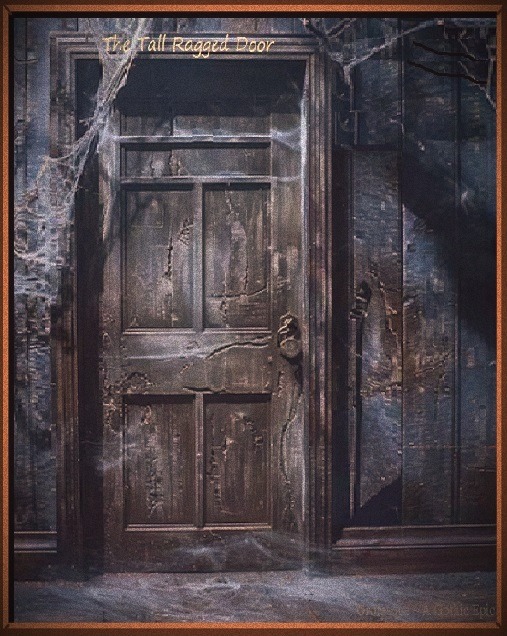
The man shook his head emphatically and cupped his ear toward the ragged door, fiercely whispering as he instructed Lazarus to listen. “Oh, they are not dead, my good apprentice; they only feign to be so. If you expect yourself to be a seasoned witch-hunter like myself, then you must know the many ways of witches. This shall be your first lesson of many. Now listen closely—use those great ears of yours and acquaint yourself with the undead.”
Lazarus perked his and listened for sounds from behind the tall door.
“Oh, indeed,” the smiling fisherman insisted, “Hear them clearly as they whisper together of the secrets of Evil.” He pointed toward the naked corpse, “‘Tis her, with her head yet severed, who is able to summon her wicked sisters against us.”
Although Lazarus kept a watchful eye on the fisherman, his mind lay with his ears, which now heard the apparent whisperings of many women that altogether hissed from behind the tall ragged door.” He advanced several steps and listened more intently as the continuing sounds fell into better focus. And in the apparent muffled drone, he gathered whispering words as bits of phrases, and perhaps, the overlapping discourse betwixt hissing witches and chattering crones.
Lazarus turned a flush and quizzical face toward the fisherman, who now sported a coy grin, appearing to revel in the new proof that Lazarus suddenly might have gathered from behind the tall door. And truly, Lazarus’ mind did reel as a whirlwind of recent memories, of the man’s claims to honour, truth, wisdom, perfect recollection, clever discourse, keen attention to detail —
He stepped back, caught a breath, and squarely addressed the man, “‘Tis not the whisperings of witches.” He shook his head. “I know this sound. ‘Tis merely bugs-nests of them moving against themselves.”
The man relaxed his smile; his face hardened to stone and he stated coldly, “Bugs do not speak.”
“Neither do the dead,” Lazarus rebuffed. “Perhaps, in your mind, you have gathered the noise of bugs to be the words of witches so that you might believe in witches when there were none?”
“There are witches—all about us—everywhere!” the man shouted, waving his arms. ‘Tis not my belief in them that makes them real!” He huffed. “Neither is it your denial of them that make them unreal!”
Lazarus looked at the naked corpse. “There may be witches, as you say; however, I do not believe that they are in here.” He stepped forward and glared at the fisherman. “As a man of honour, like you claim—as a witch-hunter, like you claim—can you swear that you never slew one who was not a witch?”
The man stole a glimpse of the ragged door, shrugged, and admitted, “Well, as I mentioned, witch hunting is not precise—at times, there might be evil persons who show every sign of being a witch, yet—‘tis not exact—hunting witches and such.” He cleared his throat and softened his tone. “As witch-hunters, we mean well; and we do our best to cull them—to rid them from the good people of the world.”
“You do your best?” Lazarus asked.
“We,”the man barked—then boasted of his abilities: “Yet, I am more seasoned—more capable than most.”
Lazarus looked about the room. “Where are the other witch-hunters?”
The man waved his arms about, looking about and chuckling in apparent disbelief. “We are everywhere, my good man—spread across many lands—always in hiding!” the man exclaimed. “We do not openly introduce ourselves to those who might protect witches. Ours is a life of secrecy. And do recall that I did not find you; ‘twas you who found me and my witches.”
Lazarus dropped his gaze to the floor, perhaps feeling as though the weight of the world had suddenly fallen upon him. He looked at the face of the tabled corpse as the pleading voice of Lord D’Alcicourt’s wash-woman burned in his mind, asking, ‘Oh, dear God—you shall save us?’ He re-checked the threshold of the exterior door, which shown no light.
Then he looked back at the fisherman, who crossed his arms, and smiled. “You are the first to have discovered me in as many years. And you shall probably be the last—as I am one of the best witch-hunters there are.” He dismissed Lazarus with a casual wave, continuing, “Not to fret. I always knew that it would take more than a mere man to discover me—and, my being discovered by a flying man, only calls attention to my unwavering dedication, to the witch-hunter’s craft.” He stole a breath and smirked. “And I believe that the Great Maker has finally rewarded me—with a flying apprentice and outstanding witch-hunter. What think you, Lazarus? Can you carry a witch, whilst on the wing? Can we save the world—together?” He clapped his hands once, held them pressed as though in prayer, and awaited reply.
“There are no witches in here,” Lazarus stated. “And what is a witch-hunter without witches, if not a common murderer of women?”
The man chuckled, commenting, “Ye, of little faith.” He advanced several steps. “And if I can prove to you that there are witches in here, and not merely the bugs that you claim to hear, will you then believe me?”
Lazarus glanced at the tall ragged door.
The man nodded, “Indeed; in there.” He pointed toward the door. “Just there. I can show you many crones and hags, whose evils have been forever undone. Do you care to see the good efforts of the hunter’s craft?”
With the weight of the world and the words of the wash-woman within him, Lazarus considered all—the best that he might. He examined the tall ragged door, the burning wall torches beside them, and the space about him. Finally, he replied, stepping back toward the barred exterior door of the fish house, “Show me your good efforts, if you please.”
“Splendid,” the fisherman cried. “witch-hunters, we are, then!” He cautiously stepped toward the tall door whilst softly and sternly lecturing Lazarus, “Now, there are several things that you must know about witches, before I open the door. Your very life may depend upon it. Do you understand me?”
Lazarus nodded and the man continued, “Firstly, witches do not immediately die when their bodies are taken. What I mean to say is that, till their features utterly wither away and they return to the vile mud from whence they came, they only feign death. They are still able to weave their wickedness upon you—I did not realize, till much later, that when they lay together, their powers become greater than, if lying alone. However; to lessen this condition, a witch-hunter must remove the head of the slain witch before placing it alongside others of its kind. And every witch must be placed in precise arrangement to the next—oldest to newest, outside to inside.”
“And if they are not placed in such way?” Lazarus asked.
The fisherman shook his finger at Lazarus. “Never make that mistake, Lazarus. They shall catch you even before you are able to reverse the order of them.”
“Then I shan’t do that; and they shan’t catch me,” Lazarus affirmed. He parted hanging chains and followed the fisherman toward the tall door.
The man briefly spun about to warn him; “Whatever you believe to sense, do not touch them; lest you be stricken with insufferable illness or madness of mind.”
Lazarus nodded and, as they neared the tall door, Lazarus eased a torch from the wall bracket when the man spun wildly and grabbed his arm. “What are you doing?” For a moment, they stood, face-to-face, theirs eyes locked beneath the torchlight as burning orbs of blue and brown.
“I am getting the torch whilst you open the door,” Lazarus replied.
The man loosened his grip and nodded. “So you are. Yet, you shan't step within. Do I have your word?”
“I shan’t enter,” Lazarus stated.
“You’ve much yet to learn,” the man remarked, clutching the door’s metal latch and turning back to Lazarus. “Now, for the wicked witches of the world. Are you prepared to see the worst—the most vile and filthy evil—forever contained behind this door?”
Lazarus nodded, raising the torch. “Only if you allow it.”
“Then behold,” the fisherman said, slowly opening the tall ragged door.
The door creaked as he gradually exposed more of the black interior of its chamber. Flies boiled from out of the darkness and the torch flame crackled with scorched insects that rained down on Lazarus’ head and shoulders. A wafting odour of putrefaction rolled passed him; he gagged, stepped back, and cupped his mouth.
The fisherman chuckled, pulling the door wide. “One needs a stronger stomach than yours, if he is to be a witch-hunter. And we shall work on it.” He grabbed Lazarus arm and pulled him closer to the door’s threshold as he pointed into the illuminated interior of the room and its stack of corpses. “Witches, one and all, these are,” he said, passing a presenting hand over the rotting heap, “Oldest to newest; outside to inside; precisely placed and headless, as they should altogether remain.” He spun about and snapped his finger in Lazarus’ face. “Ah! And might you recall a particular crone that had a familiar spirit at Endor, and who was sought by Saul himself? Do you not recall her—this witch from Endor?”
“I do not recall her; yet I read of her—from the first book of Samuel.”
“The very same witch, written in the scriptures of your faith,” he affirmed, propping his hands on his hips and smirking. Then he chuckled and tapped his chest, boasting, “She was the first witch that I captured.” He jabbed his thumb toward the interior of the room. “And I still have her head.”
“Yet you call the Holy Scriptures mere lies, scribed by men. And you claim not to lie. How can you speak the truth and claim to have the head of a woman, who is recorded in Scripture, and likewise discount all record of Scripture?
The man surrendered his hands and perked his brow as if to dismiss him from any charge or implication, replying, “I do not discount everything written in your scripture, my glorious Lazarus. Just as I do not entirely discount any other scribed works of which men claim to be divine Truth. All works are rich in history; all are riddled with common truths. How else might a well-versed scribe tell lies, if not by telling truths betwixt his lies?”
“So you believe that your holy scriptures would speak true of this woman of Endor, yet lie about the Lord Almighty?”
“Quite so, as I have said; I have her head,” the man said curtly, grinning. “Do you have something of your God, for to show me as proof?”
Lazarus clenched his jaw and drew a deep breath before rebuking him. “The woman of Endor lived too long ago. I do not believe you.”
The man frowned, growling and pointing into the doorway again, “I have it, just there. And as you say, you do not believe that I have witches—I show them to you. And you do not believe that I have the witch from Endor —” he cleared his throat, “Your incessant lack of faith in my abilities begins to incense me.”
“How can you be certain that you have her head?”
“Since I truly have it, of course! Witches do not die as mortal men might!” the man exclaimed. “Must you witness everything before believing anything?”
“If you might allow it,” Lazarus stated.
“Very well, then.” The fisherman huffed in apparent protest. “Yet, forthwith, I expect you to show me a bit of faith in what I teach you. As a teacher and a seasoned witch-hunter, I do not expect your challenging my every word. Now give me light, for to see my way.” He pulled Lazarus’ torch-bearing arm into the doorway as he strode within and sidestepped the stack of corpses, moving deeper into the room. He called back, “As they lay, outside to inside, her head is the furthest away.
Lazarus saw his moment. He reached for the edge of the open door, yet paused; his extended fingers nearly toughing the gray wood. He checked himself and withdrew his arm.
The fisherman's voice grew more muffled and distant as he called from out deeper in the dark room, “'Tis the head of the very witch, who pretended to be my mother, and who tried to slay my father, whilst he slumbered.”
Again, Lazarus' arm went up and he clasped the door's wooden edge, intending to close and lock the door this time; however, his arm would not swing the door closed. He winced, sighed, and backed away.
The fisherman's voice was faint, yet his words carried clearly. “And when I buried my father, I unearthed the vile witch from her grave—”
Lazarus stood beside the tabled corpse. He spotted its blank stare and backed away, stepping nearer the exterior door of the house. He inspected the dark threshold of the door, confirming that night had since fallen. Abruptly, his ears perked and his eyes rolled toward the tall ragged door, which now eased and creaked on its own. There was no breeze—no rat —no thing to ease closed the door, yet it continued with a steady creaking of its rusty hinges. The slow swing of the door finally cleared its halfway mark when deathly pale fingers and black fingernails reached from about the back side of the drifting door's vertical planks and became visible in the room's candlelight.
He braced and hissed as Lucifael quietly stepped from out of the receding shadows of the tall raged door. She finished closing the door, gently latching it closed and sealing the fisherman inside. Then she turned and squarely faced Lazarus with reflecting, unblinking eyes that resembling orbs of black glass. She spoke, her layered voice like a recital, heaving to the tune of many women at once, “So close you were, Eljo. Yet you simply could not bring yourself to close the door even to save the life of another. What does that make you, Eljo? Godly? Saintly? Tell me. Do you really deserve that sickly Throne's glow about your head when you lack conviction even to close a single gaping door when it might save the lives of many? Your piety and weakness shall truly be your undoing. You are so predictable, Eljo—so easy to read. Why even bother?”
The muffled voice of the fisherman cried out in panic, “What are you doing, Lazarus? Open the door! Dear God, they stir! They crawl! Open it now, Lazarus! Now! They are standing without heads! No! Lazarus!”
Lucifael strolled toward Lazarus. A sea of scrambling roaches parted before her, altogether presenting a clear path of floorboards for her advancing steps. She crowded Lazarus, bracing his wings against the exterior door and its still-secure crossbar. When he could retreat no further, she leaned closely into his face and lectured him, “You are here now, only by my prompt intervention. 'Twas I who saved you from that castle and sent you on your way. I was entirely your flying swine giant, grown from my own hair. Without my help, you might have long been drawn-and-quartered—burned to ash. Yet here you stand, alive and breathing, and now thoroughly indebted to me for freeing you from your captivity.”
She stepped out of Lazarus' face and examined the equally nude corpse on the table as she attempted to continue. “In payment for my rescuing you, I expect you to continue your journey to the Cancello Monastery, in Italy. And when the final Gatestone beneath its cathedral altar stands open, I shall reward you in kind. In exchange for your services, I shall grant —”
“I'll give you anything,” the fisherman interrupted with a frantic plea. “Only, open the door, Lazarus! Whatever you wish—anything! FOR THE SAKE OF GOD!” He began to wail and moan.
Visibly annoyed, Lucifael spun and clicked her fingernails at the door. The fisherman's pleas twisted into an agonizing, choking screech—a dull thud popped against the room's interior walls, and a new silence fell over the fish house.
She turned back to Lazarus. “When you arrive at Cancello, I shall reveal the final Gatestone—you shall open it for me. I am your guide to the order of stone's words and their proper recitation.”
“I shan't go near it,”He replied, learning harder against the door.
She lunged at him. “Be on your way! Do not disrespect or try my patience, Eljo! Open the door and take to the skies, NOW!”
He lifted the crossbar and threw it clear of the doorway.
“And do not tarry overlong.”
Lazarus stepped into the darkness and turned about to steal a final glimpse of the putrid place. Through the dim-lit interior of the fish house, he perceived that the corpse atop the table had since shifted, its upturned, outstretched arm suspended over the surface edge and thrust in his direction, as though visibly reaching for him. Betwixt casts of rolling shades and long shadows, and beneath the flickering glow of the table's firelight, the dead face appeared to see him off with a quick wink and a peaceful smile.
“Make Haste!” Lucifael growled after him.
He retreated from the nasty shack, his mind reeling with a myriad of unwelcome sights and sounds that he knew might forever remain too confusing and terrible to forget. He realized that they had already burned themselves into the walls of his mind, and might serve to haunt him for the rest of his days. They were now a part of him, as much as his arms, legs, and wings. And he knew, that these were the sort of memories that change minds over time, for better or worse—and they were now within him. They could not be washed, cut, or torn out, without destroying himself in the process. Like the putrid stench that still lingered in his clothes, that nasty shack was now an integral part of him—which may even change him, if only more than a little.
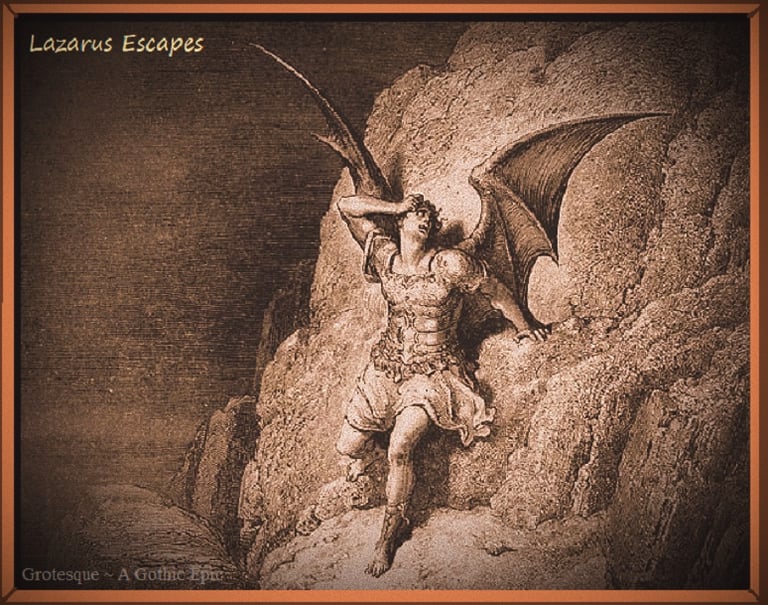
He parted weeds, scanned the star-lit heavens, and lunged upward leaving a swarm of rising and spiralling flies in his wake. He circled an expanse of cypress treetops before climbing into the stars, where he finally banked southward.
In his mind—in accordance with memories of long-studied Abbey maps, and with the innate navigational aptitude of any migratory bird, Lazarus aligned his intended flight path directly with the northern shores of the Gulf of Leon. In the windless cool eve, he steadied himself and levelled out, cutting a steady course toward the distant Italian Monastero del Cancello en Umbria, where he might fetch a resident friar and bring him back to Auvergne, France in order to close the Abbaye des Gardiens Gatestone that a wayward, vengeful, and foolish Avignon Cardinal, using stolen manuscripts from the Upper Council's guarded Apocrypha archives, had clumsily yet successfully managed to breach.
Vol. I: Chap. XVII ~ finis.
Next Chapter~
~18: The Last Wyvern
“Out of the gateway,
Through the wide world,
Into the tempest
Beaten and hurled,
Vain is thy wandering,
Sure thy despair,
Flying or staying,
The chamber is there!”
~R.T. Cooke
Grotesque ~ A Gothic Epic© is legally and formally registered with the United States Copyright Office under title ©#TXu~1~008~517. All rights reserved 2000-2026 by G. E. Graven. Website design and domain name owner: Susan Kelleher. Name not for resale or transfer. Strictly a humanitarian collaborative effort. Although no profits are generated, current copyright prohibits duplication and redistribution. Grotesque, A Gothic Epic© is not public domain; however it is freely accessible through GNO. Access is granted only through this website for worldwide audience enjoyment. No rights available for publishing, distribution, AI representation, purchase, or transfer. This presented literary work is irreversibly-sovereign, free for nonpublishable and personal reading only, and shall not be subject to explicit or implicit agreements, understandings, restrictions or surrenders of any sort; whether public or private, individual or institutional, corporative or governmental, or other. Susan Kelleher maintains all website control, and George (G.E.) Graven maintains all international intellectual property rights for any and all prior and future versions, revisions, translations, digital representations, and variations of the literary work: Grotesque, A Gothic Epic©, until the stated copyright expiration date, when it is properly and legally released into the public domain. Driven by Anonymous Polymath and more. Continued public access is ensured and protected under this non-profit humanitarian effort, forged exclusively as a digital and literary dedication to the late Gothic author: Edgar Allan Poe.