Add your promotional text...




Residents of Mountain Mouth
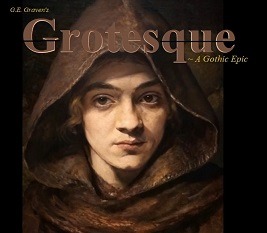
Book 1 ~ Resurrection Chapter 9 ~ Of Catacombs, Cobblers And Caves | Grotesque ~ A Gothic Epic | G.E. Graven
~Twelve miles due west of the smouldering Gardiens Abbey ruins, a lone figure strode deliberately under the last glows of early morning moonlight. Hunched over and burdened to the hilt with yestereve's ill-begotten and God-sent gifts from the Abbey kitchen, Friar Nicholas carried an over-stuffed monk's robe, slung over his shoulder and filled with provisions.
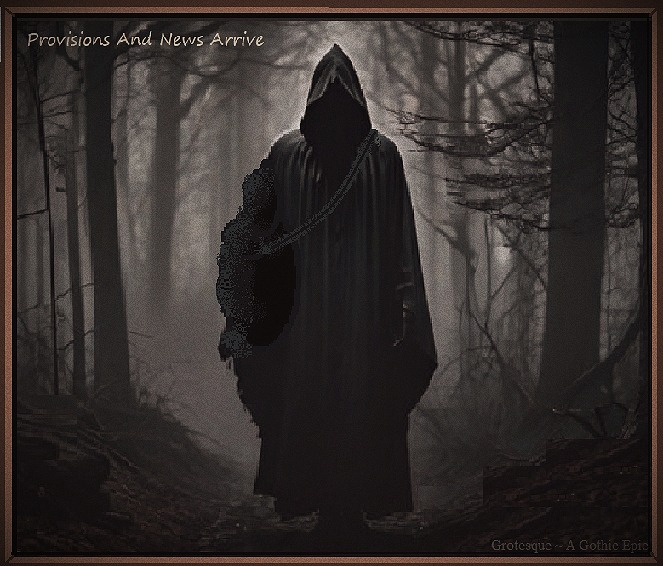

Nicholas struggled up the crest of a stony ridge and leaned on his knee, his breath quick and fogging in the chilly night air. There, in the distance, across the broad expanse of an ancient long-dry riverbed, stood the opening of the cave he had discovered many years since—Mountain Mouth, he called it. He side-stepped down the ridge, traversed a vast valley of stones and entered the massive black hole.
An echoing voice emanated from deep within the cave, “Friar?” A boy's hearty chuckle escaped the darkness. “I knew you would come! I did!”
Nicholas replied, walking deeper into the darkness “Lazarus; `tis I—”
And before the monk could introduce himself, Lazarus blazed past a stony corner and collided sharply with him. Both monk and squire tumbled to the ground. Provisions scattered as a wheel of cheese wobbled across the cave floor.
“Dear God! Lazarus,” Nicholas huffed, “You frightened the—oh, no!” The monk scrambled across the floor, feeling his way through the dark as he rummaged through the makeshift sack. Within, he found the flask of blood still intact and sealed. He moaned a deep sigh of relief. “Thank the Lord,” he mumbled, kissing the bottle and gently returned it betwixt the belongings.
“Friar—Nicholas? Forgive me, friar.” Lazarus rose to his feet and fetched the cheese wheel as he asked, “Where is Friar Odino?”
“In a moment—help me gather the supplies. Feel about for them.”
Lazarus slid the cheese into the sack, careful of the bottle within, and a waft of pleasant smells spilled from the cloth. “I shall gather them friar,” Lazarus replied, the tone of his voice changed, now seemingly deflated and heavy.
Nicholas pondered aloud; “If I recall since, a grove of trees stands against the far side of this mountain.” The monk abruptly stood and stroked his chin in seeming contemplation. “Fire, firstly—we need fire.” Nicholas walked toward the entrance of the cave. Lazarus was a statue, staring warily at the sack—as though something might be dreadfully wrong with it.
“Lazarus, come with me.”
“Yes, friar.” Lazarus tore his gaze away and followed Nicholas out of Mountain Mouth and alongside its more shallow moonlit face.
“Even my bones are frozen—for such modest dress as ours, this forest mist is unforgiving.” Nicholas rubbed his hands briskly and spun about, adding, “I brought a small oil lamp with oil, some rope wick, and tinderbox with flints as well. Now, we shall gather deadwood and chase away this persistent damp chill?”
“Yes, friar.”
At length, and deep within the cave, Lazarus and Nicholas were sitting atop a pair of squat boulders with a crackling fire betwixt them. Its orange glow chased away the chill whilst revealing the cavern's vastly irregular subterranean dimensions. “Fire, at last,” Nicholas worshipped the climbing flames, warming his hands. He glanced at the heap of fuel beside him and thoughtfully selected several sticks to add to the blaze.
Lazarus peered through the fire, inspecting Nicholas' finely crafted, calf-high boots. “Where are your sandals, friar?”
Nicholas chuckled. “Gone. Do you like my boots?” Nicholas turned them to and fro against the firelight.
“I do,” Lazarus replied.
I made them myself. I bet you didn't know I was once a cobbler—did you?”
“I did not, friar.”
“Please call me only Nicholas, Lazarus.”
The boy nodded. “You can make shoes—Nicholas?”
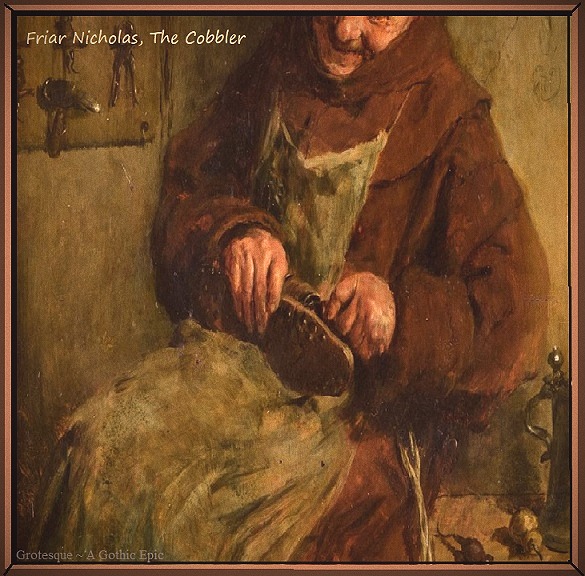
“Indeed—and the finest even. This is the last pair I ever made before coming to the Abbey.” Nicholas looked over his boots. “Would you like to hear of my old cobbler days?”
“I would,” Lazarus replied, glancing down at his own dirty foot mittens.
“Then I should tell you.” Nicholas shifted himself on the boulder and leaned toward the flames, arms on knees. “When I was much younger, I lived with my Father and elder brother in Ephraim—a quaint little village in the southern edges of Burgundy. My father was the village cobbler—he learned from my grandfather. We all worked in the shop, making and mending shoes. 'Twas my father's hope that my brother and I might continue the trade.”
“Yet to the point, my father grew sickly and he could no longer oversee the shop. So, he relied on us to keep it going. 'Twas horrible—most all the work fell on me.”
Lazarus asked, “Your brother didn't want to make them?”
Nicholas shook his head, “Oh, he did—with all his heart he wanted to walk in father's footsteps. And he was eager to learn. Yet God never meant for him to be a cobbler—try after try, he could never make it right. And nearly always, I had to follow behind him and rework the shoes he attempted to fix. This carried on for the longest time; and most days, I worked well into the night.”
“Did you tell your father?” Lazarus questioned.
“No.” Nicholas cleared his throat. “Father was dying, my brother and I were like wolves at each other's throats and the shop was failing. In his worsened condition, I couldn't bring myself to trouble him.”
Lazarus spotted the swelling tears over Nicholas' forced grin. “I have often wondered why I did what I did. You see, as every morning, I walked to the shop, however, on my last trek, instead of entering the door, I walked past the shop and simply kept walking—away from the shop—out of the village—and eventually, out of Burgundy.” Nicholas looked down, “I left everything behind me, save these boots.”
“I moved about for a time, working for several cobbler shops to earn my keep. Yet, not long afterward, the Lord touched my heart in a dream; He stirred my soul. He called upon me and led my feet to the Abbaye des Gardiens—to seek a solitary life in His service. And in a strange way, I felt more freedom within the confines of those Abbey walls than did I ever outside of them.” Nicholas shook his head, sporting a quaint smile. “Strange.”
“Yet what about your family?” Lazarus asked.
“Well, not long after arriving, I wrote to my brother. I didn't expect him to reply, yet he did; telling me that our father died shortly after I left. Afterward, I also learned that my brother sold the shop for debts owed and—well, he asked that I never again write him. He blames me for our father's death—for all of it.”
Nicholas leaned over and stoked the fire. “Odino told me everything, Lazarus. I know why you wear the hood.” Lazarus' head immediately snapped backward; and beyond the lifeless eyeholes in the hood, glistening in the perfect angle of the firelight, Nicholas spotted a pair of deep, searching blue eyes looking directly into his own.
“Don't fret over me, Lazarus. As with Odino, and with your father; your secret is safe with me.” Lazarus turned back to the flames, saying nothing.
“You can speak openly to me, Lazarus. Consider me more as a friend than a friar.” Nicholas shoved a stick in the fire and leaned back on his boulder.
“Both your father and Odino told me that you were abandoned at the Gardiens Abbey gates shortly before I arrived. And that you had an illness of the air which required that you never leave the catacombs. None of that was truth, was it?”
At length, Lazarus confessed. “No. But father forbade me to speak the truth. He said that the other friars might kill me if I told them the truth about me.”
“Your illness was never, of the open air, as he claimed—'twas secretly, of sunlight—you've a grave illness of the sun, yes?”
“Yes.”
“And the physician that Ivan summoned to the Gardiens Abbey to record your illness for the Abbot?”
“I never saw a physician. Perhaps father arranged for someone to present themselves—”
“Now I see. Lazarus, your father spoke the truth—they would have certainly killed you. Looking back on it now, I can see it clearly. Your father loved you deeply, Lazarus.”
“Yes, he did; as I love him.”
“Where did your father secret you away, since your birth.”
“He found me in the cathedral and secreted me in the catacombs—in the Baston Crypt.”
“In the very Abbey, itself?! How did he keep anyone from discovering you?”
“He insisted that I remain silent—and to keep the crypt door locked. So, I did.”
“He told, what?! You knew how to speak since birth?”
“No. Father taught me quickly.”
“And perhaps you learned quickly. Tell me, how long did you hide in the crypt?”
“Perhaps a year. Then father sewed a mask and robe for me and pretended to discover me abandoned outside the north Abbey gate—and I pretended to be sick.” Nicholas stoked the fire whilst stroking his chin again, considering everything Lazarus told him.
“You don't appear like the rest of those—um, I mean to say—based your gathered appearance, your stature resembles a mere boy, rather than a beast. If I might ask, how old are you, Lazarus? Are you truly thirteen years of age? ”
“I have aged only seven years.”
Nicholas shook his head, a hint of a smile tucked in the corner of his mouth, “Astounding. Perhaps your gap in mentioned and true age was meant to hide your uncommon size as well. How clever, your father was. I now know that your back is not truly hunched as well, as the claims within the Abbey might have otherwise suggested. They are tucked and secreted wings, yes?”
Lazarus abruptly rose to his feet. “I don't wish to speak further, Nicholas.”
Nicholas calmed him, “Forgive me. No, sit! I speak no more of your condition. Sit, if you would, son.” Lazarus sat.
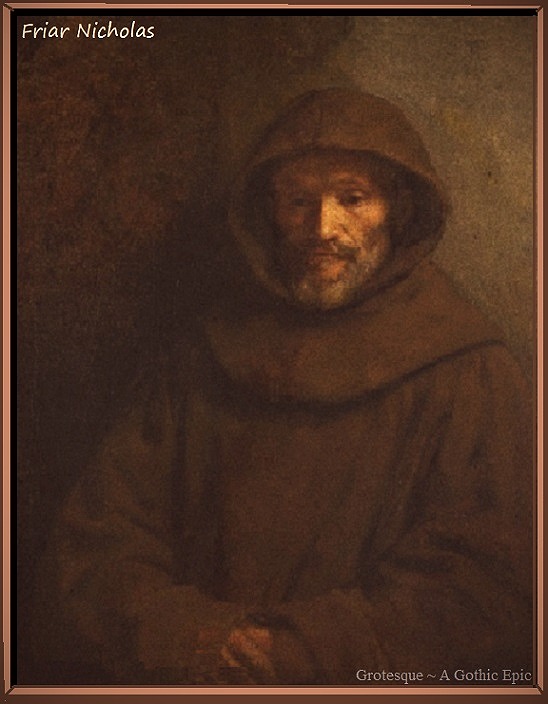
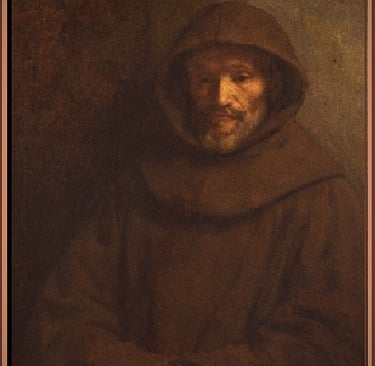
“I must say that I've long admired you, Lazarus. You were never like the other squire boys—questioning their faith and duty as most of them so often did—and squabbling over unimportant matters. You were always calm, knew your duties, and considered your words before speaking them.”
Lazarus turned his head to the sack of provisions sprawled on the cave floor. “Friar Odino said he would come for me, yet you come in his stead. Why did you bring his blood in a flask?”
“How did you know?”
“I smell him—'tis truly Odino. Why has he shed is blood? Why do you now have it?”
Nicholas shifted nervously, his eyes darting back and forth betwixt the sack and Lazarus. He took a deep breath and straightened up on the rock. “There is something I must tell you, Lazarus.”
“Friar Odino is dead?” Lazarus asked.
“Yes he is, Lazarus.”
Lazarus choked. “But, how?”
“That Captain—the same man who killed your father.”
“Why did he kill them?”
“Because Ivan and Odino protected you.”
A silence fell over the cave, both of them staring into the flames. Lazarus spoke, “Then I should kill this Captain in turn.”
“No, Lazarus. Thou shalt not kill.”
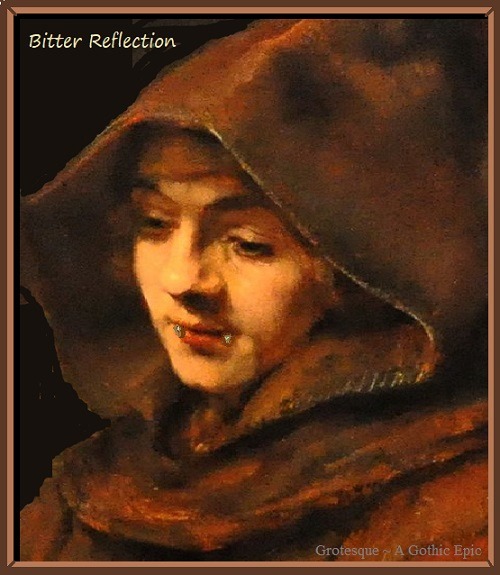

“An eye for an eye!” Lazarus spat.
“You don't really mean that, do you?”
Lazarus dropped his shoulders. “No, yet I feel it.”
“I feel the same—Odino was a father to me. And that is why I am here now. There is something very important that you must do.”
“Do what?”
Nicholas rose, strode over to the sack and rummaged through it. “Do you know how to read a map?”
“I do. My father taught me.”
“Maps of the catacombs?”
“I've seen the maps in the scriptorium. I recall them still.”
Nicholas pulled a folded parchment from the sack.
“And what particular maps do you recollect seeing?”
“All of them.”
“No, how many has your father brought for you to see?”
“Once, I asked Father for a fresh map and he said that he had already shown me all the maps from the scriptorium.”
Nicholas stood, scratching his head. “All of them? There must be hundreds of maps in the scriptorium. All of them; dear God.” Nicholas gazed across the cave floor, stroking his chin again before asking, “Tell me, Lazarus; from those many Abbey maps, do you recall a country named Italy?”
Lazarus pointed south-east. “'Tis there—in that direction—across the Gulf of Leon and Tyrrhenian Sea; east of the Isle of Sardinia. Italy is shaped in the make of your boot. 'Tis mostly surrounded by seas, and mountains trace through its downward centre. Umbria Provence is at its centre as well. The Cancello Monastery is there, just north of its centre.”
Nicholas raised his brow, utterly overwhelmed. Then he further tested Lazarus' demonstrated ability, in sly attempt to disorient, and perhaps question his own geographical recollections; “And what of the Kingdom of Scotland?”
Lazarus pointed in the opposing north-west direction. “'Tis that way—over a short stretch of water; and north of English lands.”
“And where is my home, Lazarus?”
“The village of Ephraim is in the south of Burgundy,” Lazarus pointed somewhat east. “'Tis that way.”
“And Murat?”
“That way.”
Nicholas shook his head. “Absolutely astounding.” He nodded. “The Lord has blessed you with an astonishing gift.”
“Why do ask me about such places?” Lazarus questioned him.
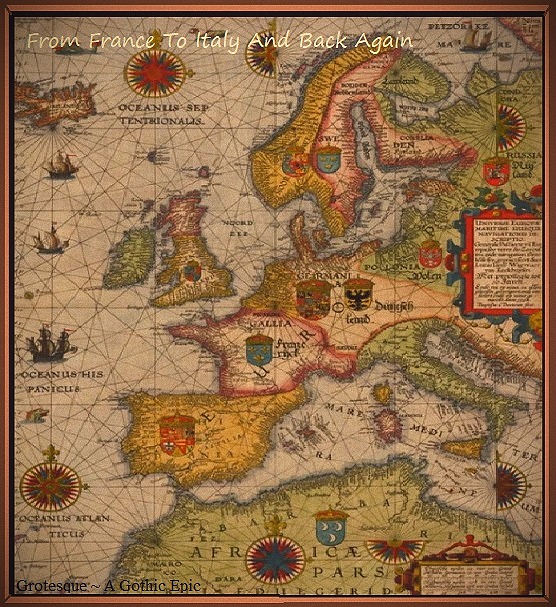
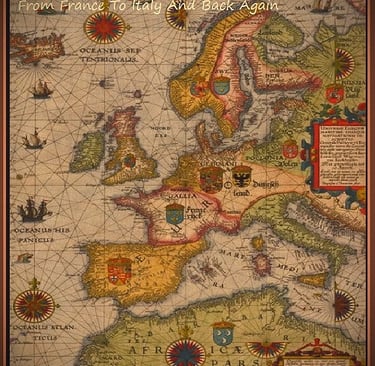
Nicholas drew a deep breath, returned to his boulder and gave Lazarus the folded parchment. Lazarus opened and looked it over. The page bore an illustration of France, Italy, and their surrounding countries and seas. “I recall this very map.”
“I expect you might, as it came from the same Abbey scriptorium. Listen to me Lazarus. I came, not only to bring you provisions, but also to honour Friar Odino's final request. He wishes for you to go to Italy—to the Monastery del Cancello in Umbria—and you have since shown that you know its whereabouts.. There, you are to summon a Friar Salvitino, an elderly monk who is very learned about details regarding the Gatesone.” Lazarus recalled his conversation with Ivan—and the letter and a favour owed.
“You are to tell him—”
“Go to Italy?!” Lazarus interrupted.
“Let me speak, Lazarus. You are to tell him that the Gatestone at the Gardiens Abbey has been opened. Tell him that you are Friar Ivan Gogu's son—from the Gatestone. He will know you by that reference. As well, I brought a flask of blood. You are to give it to Salvitino and tell him—'tis Friar Odino's blood. Then he will know what to do with it.”
“No. No, I cannot,” Lazarus sputtered, shaking his head.
Nicholas continued, “You are to fetch Friar Salvitino, tell him these things, and bring him back to the Abbey. Friar Odino told that he is the eldest and most Senior Friar of the Lower Council, and perhaps the only surviving monk in Gardiens Abbey and Cancello Monastery who has the knowledge to work the Gatestone through its translated inscriptions—to properly close it again. He can likewise assist you with another personal matter regarding your late father's wishes, once you give him the flask. You must be careful not to break it along the way. Your father would be proud.”
Lazarus abruptly rose, threw the map on the cave floor, and stepped away from the fire and turned back to Nicholas. “'Tis too far away. Father said the sun—why can't you go fetch this friar and bring him the flask, since you know these things?”
“I cannot. A lady waits for me.”
“A lady?”
“In waiting, even—my, soon to be wife, Martha. Now come. Sit Lazarus. Please. I shall tell you about my dearest Martha.”
“But you are a—do you not have celibacy and abstinence vows to keep?” Lazarus returned to the fire and sat.
Nicholas dismissed Lazarus' question. “She lives in Murat—a widow of the late village cobbler, rest his soul. Would you like to hear of her?”
“I would.” Lazarus sighed.
“I met Martha in the strangest mishap.” Nicholas attempted a chuckle before continuing, “Well, not entirely. I always found myself drawn to the local cobbler shops when Abbot Vonig sent me to a new village church—the steadfast cobbler in me, you see.”
“About a year ago, the Abbot sent me to Murat to help oversee repairs to the local church. Quite expectedly, the curious cobbler in me stirred, and I strode to the local cobbler shop. Alas. no sooner than I opened the door, a flung boot struck me in the face. The heel of that shoe was the last I recall—till I awoke.”
“When I came too, my eyes fell upon a most beautiful sight.” He chuckled and stroked his chin. “I gathered I was dead, as above me loomed the face of an Angel—'twas my dear Martha, wiping my swollen nose with a damp cloth. She nursed my face as we spoke.”
“I later discovered that she intended to throw the boot at the door, yet my face got in the way. After her husband died, she struggled to keep the shop going. She informed her patrons that she had another man come in at night and work on the shoes, when in fact she worked on them herself. Yet rumour spread through village prayer congregations and several of the ladies secretly watched for this man to show. I learned that shortly before I arrived at her shop, several of the women had left her shop, accusing her of being the true shoe-smith, telling her that they would inform all of her patrons that a woman worked on their shoes.”
“The next day, the wives had their husbands bring in shoes in need of repair. Then they kept a close eye on her. Women can be like that—spiteful even, if set in their ways. Anyway, the cobbler in me rescued her. I told her to open the door wide and I went to work whilst she stepped outside. I made a lot of noise—beating, banging, and the like.”
Nicholas laughed. “You should have seen their faces. The shop filled with nosey women, their mouths open. I pretended not to notice them as I fixed one shoe after the other—I gathered I had since lost touch of the craft, yet I moved like a sure steed, every mend made perfect. One of them was so bold as to ask me if I had always worked on Martha's shoes. `Well of course, woman' I said. `Or did you gather that shoes fixed themselves?' She wouldn't dare question a monk any further.” He laughed again. “Martha asked them if they had more shoes for her 'cobbler priest.' Oh, the look on their faces as they left the shop. I turned my back on them to hide my laughter.”
“Thou shalt not bear false witness, Nicholas.” Lazarus broke in.
The smile fell off of Nicholas' face. “Well, I wasn't going to stand idle whilst Martha fell to the wolves. Sometimes we must measure when a truth destroys more than a lie can fix. Yes, I lied, Lazarus. 'Twas, I must confess, the sweetest lie I was ever forced to tell.”
“How so?”
“Martha and I grew close over the past year. I helped her in the shop. She has promised me her hand in marriage. She will sell the shop and has agreed to return with me to my former village in Burgundy. I am finally returning home. I hope to make amends with my brother and propose for the three of us to open a cobbler shop—perhaps purchase my father's old shop, if we can.”
“Then, you will have broken your priestly vows, yes?”
“No, Lazarus. I will have fixed what I broke by first becoming a priest. The Lord never intended me to remain a monk. I see that now. He has told me to stop hiding—to leave the Abbey walls—to go home and right my past wrongs.”
“I don't understand,” Lazarus replied.
“The Lord often works in peculiar fashion, Lazarus. Even I didn't understand His calling till Martha struck me with that boot. And He's since opened my eyes to my true calling.”
Nicholas dropped his head, “I only wish my father was still alive to welcome my return. He would love Martha.”
“Perhaps you believe the Lord guides you now only because you love Martha—and that you wish it so strongly that perhaps you believe God's Will leads you instead? Why might the Lord lead you away, to be a friar only to lead you back home again?”
“Perhaps to find myself, Lazarus. I've often wondered the same, yet I heard Him speak to me—in my heart I know He guides me.”
“And did He also tell you to lie to the women in Murat, friar?”
Nicholas frowned. “No.” He shifted his posture in growing frustration. “Tell me, Lazarus—do you feel that you try to obey the will of God?”
“I do.”
“And were you obeying His will when you lied to the Abbey, pretending to have an illness of the air?”
“I did as I was told.” Lazarus dropped his head.
“I respected your father deeply, Lazarus. I do not question his judgment where you are concerned, yet I must ask this: Why do you gather he lied to everyone about you?”
“To keep me safe from harm. He's my father.”
“As I lied to keep Martha from harm.”
“Yet, they would not have killed Martha, had they learned the truth about her.”
“Is a lie not a lie by any measure? Under those circumstances, I did what I gathered was right, and the deed, however wrong it seemed, was for the greater good. You're still a—you've much to learn, Lazarus.”
“Perhaps,” Lazarus was curt. He stared into the dancing flames, recalling his past exchange with a prisoner that swore by Truth; and who gave his name only as: `poor man in Christ.` He mused that by now the man confessed all of his truth and was `burned to the bones` for it.
“So what is this Gatestone, Lazarus?”
“You do not know?”
“I was never a Lower Council Friar, or privy to their manuscripts—merely a typical friar, like most in the Abbey.”
“'Tis a gate, yet of a different sort. We should not speak of it.”
“To Hell, you mean?”
“Yes.”
“I have heard such rumours, as did many.”
Lazarus stirred. He became apprehensive with Nicholas' continuing questions. As long-standing Lower Council, Senior Friars, both Ivan nor Odino would have staunchly forbid his casual discussion of such matters strictly reserved only for the cloistered whisperings of Senior Friars. In the seemed relentless questioning, Lazarus' suspicions of the friar grew.
Nicholas continued, “And what more of this: There is word that a Woman-Spectre haunts the Abbey grounds—stealing Herself into dreams. Does it come from this—Gatestone?”
“She is, well—um—Nicholas, you shan't tell the soldiers I hide in Mountain Mouth, will you?”
“No need to fret, Lazarus. I have no intentions of going back to the Abbey – 'tis thoroughly destroyed by fire and collapse.”
Lazarus interjected, “You must tell someone to go fetch Friar Salvitino—to close the Gatestone! Is there nobody at the Abbey?”
Nicholas, shook his head. “I shall never step another foot inside the scorched walls of the Abbey. Knowing what I know now, I have no business with Hell or Hell's Gate or a legion of ruthless soldiers from whom I barely managed to escape in the first place. No, I'm going to Murat, to fetch Martha instead. And we shall leave this wicked place far behind.”
“How can you not be troubled if the Gatestone is open?”
“I do care. The fact that I do is a great part of the reason I gave my word to Odino that I would come to the cave and deliver your provisions. And as a man of my word, I carried out his wish and told you everything he wanted you to know—well, almost everything. There is more. Friar Odino made me swear that I would ask you that you give your word that you will fetch Friar Salvitino and bring him back to the open Abbey Gatestone so that he may attempt to seal it closed once more.”
“My word?” Lazarus eased off the boulder and stood up. “I cannot give my word to that! I cannot do it!”
“Odino said that he hoped you might answer as your father would answer. Those were the last words he whispered to me, Lazarus—that you would be your father and more.”
“'Tis too much.”
“I understand,” Nicholas dropped his head and stared into the flames. Lazarus stood frozen.
“Understand what?” Lazarus finally asked.
“I couldn't do it either, if Odino asked me—Martha and all.”
“That is all? And the Gatestone remains open?” Lazarus asked with a shrug.
“I did all that Odino expected of me. The remainder he expects from you. And as you have made your choice—alas, I gather the Gatestone remains so.”
“Yet, you know that I cannot, Nicholas. I cannot walk in the light. I cannot walk to Italy—'tis too far. Friar Odino asks of me what I cannot do. 'Tis too much, friar!”
Nicholas raised his head and locked eyes with Lazarus, “He never intended that you walk to Italy.” A hush fell over the cave.
Lazarus finally spoke, “I cannot do what you might gather.”
“Cannot, or shan't?”
“I cannot fly,” Lazarus replied.
“Have you ever tried?” Lazarus said nothing. Nicholas grabbed a fresh stick from the fuel heap and thrust its end into the heart of the fire, turning it carefully till it flamed up brightly. “Perhaps I can convince you otherwise.” Nicholas raised the burning torch and rose to his feet. “Come.” He turned and headed deep into the cave and toward a narrow pitch opening of a grotto. Lazarus followed.
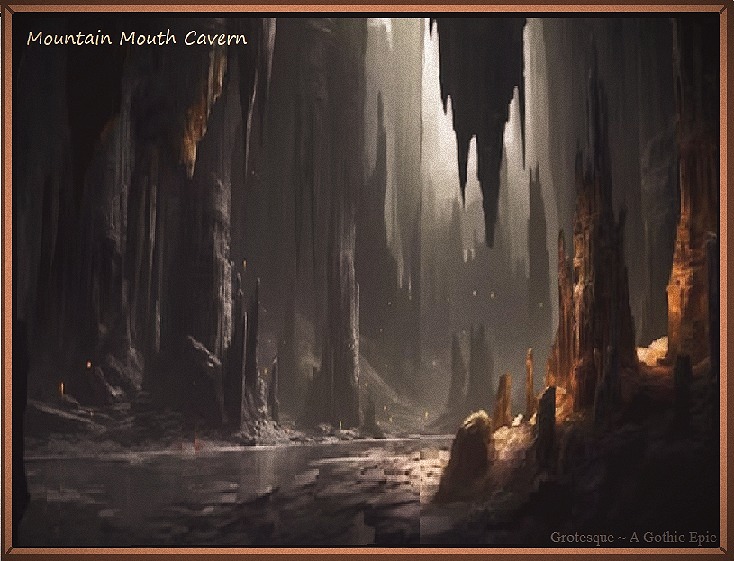
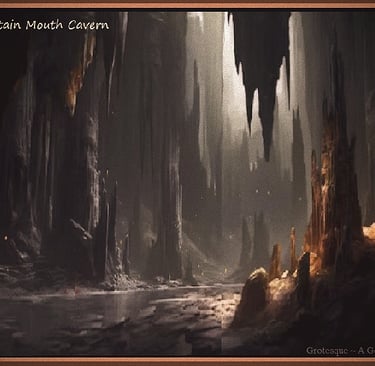
“You know, I discovered this cave not long after I arrived at the Abbey.”
“Mountain Mouth,” Lazarus added.
“You saw it too—the face in the rocks?”
“I did. Yet, Nicholas, why were you travelling so far from the Abbey.”
“Wondering; considering things. Searching for myself, I suppose. I like to walk and wonder of things.”
“And did you find yourself?” Lazarus questioned him. Nicholas heard the sarcasm in his words.
“I found Mountain Mouth instead.” Nicholas laughed. They entered through the grotto passage. Nicholas stooped low whilst continuing forth with the torch; and Lazarus trailed behind, ever-wary of the low rock ceiling betwixt them.
“Where are we going?”
“Forward. Come.”
“I gathered that much,” Lazarus grumbled. Nicholas chuckled. The two of them wormed through the passage. Its walls eventually fell away, revealing a vast cavern, its damp air thick with a pungent odour. With a circle of light illuminating the floor about them, they walked to its centremost part. “What is this smell?” Lazarus questioned. “Something is in here.” Lazarus searched the darkness.
“Yes, your teachers. They can teach you to fly, Lazarus.” Nicholas stopped and turned about.
“Who? How?”
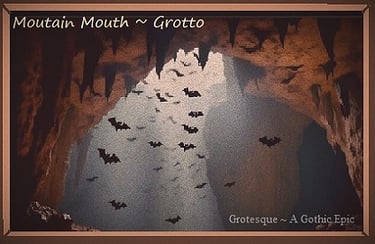
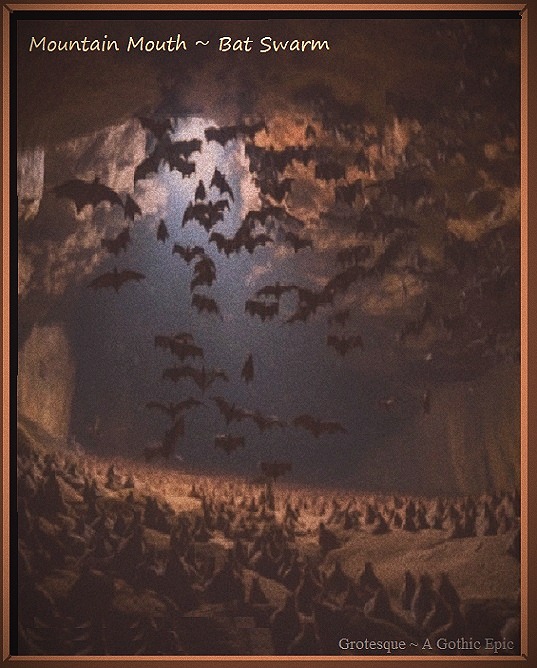
“The best way.” Nicholas thrust the torch on high, revealing a high cavern ceiling completely filled with Greater Horseshoe bats. Lazarus stood in awe, looking over the upper cave formations as ten thousand shiny black eyes stared down at him.
“Rats?” Lazarus questioned. Several bats dropped from the ceiling and circled the cave.
“Look!” Lazarus pointed to them, “They're flying!”
“Yes, they are. They're bats. And bats fly. They leave the cave when the sun sets. They eat and return before dawn. They rest now. I've always been fascinated with bats.”
“Bats—like birds,” Lazarus mumbled to himself, hypnotized and staring at the ceiling.
“Bats are different than birds. Bats fly at night, when birds rest. And during the day, bats rest when birds fly. By the rise and fall of the sun, they take turns commanding the skies.”
“Friar Odino once gave me a bird. It fell apart.”
“A dead crow?” Nicholas asked.
“How did you know?”
Nicholas laughed. “I was the one who found it. I recalled Odino telling me that you wanted to see a bird, so I brought it to him.” Nicholas stared at the ceiling.
“Was it already dead?”
“Yes, lying amongst some rocks along the Abbey road. I walked that road a lot—found many things.”
“May I have the torch?” Lazarus asked. Nicholas looked down to see Lazarus with his hand extended.
“I can hold it higher for you, Lazarus.” Nicholas raised it as high as he could to better illuminate the ceiling.
“May I hold the torch?” Lazarus questioned again. Nicholas looked down.
“If you wish.” Nicholas gave him the burning stick. Lazarus held it high and walked about the grotto, inspecting the ceiling whilst Nicholas stayed put.
“And they only fly at night?” Lazarus called back at him, his words echoing through the cavern.
“Only then,” Nicholas replied.
After a time, Lazarus and Nicholas made their way back to the exterior cave and stoked the fire.
“I ask you again, Lazarus—for Odino—shall you?”
“I am not a bat,” Lazarus replied.
“And Odino would never ask it of a bat,” Nicholas replied.
“If I say that I shall—and then cannot fulfil it?”
“When I told Odino of Martha and of my plans to leave the Abbey, he told me this: `Tis better to have committed and failed than to have failed in commitment lacking.' You see, Lazarus, honour is based on deeds—not words alone. What he asked of you is that, at most, you give your word that you will try. Answer me once more and I shan't trouble you with Friar Odino's final request again.”
“Italy is so far away—and the sun?” Lazarus glanced at the grotto's opening.
“Your answer, Lazarus?” Silence followed.
Lazarus replied, “I—yes.” From the cave floor, beside his foot mitten, Lazarus picked up the map and looked it over, “I shall offer promise—merely that I shall try to fetch the friar—only that.”
Nicholas smiled and patted the boy's shoulder. “And no more is being asked of you, than your honourable attempt. Ivan would be proud of you.” Lazarus sniffed—only then did Nicholas realize that Lazarus wept beneath his mask.
“What is the matter?” Nicholas asked.
“'Tis nothing, friar; I shall do it.” Lazarus collected himself. “I shall fetch Friar Salvitino so that he might help us with the Gatesone.”
“Well said. You are your father and more.” the boy dried his eyes against the inside of his mask. “Are you hungry? There is plenty.”
“I am,” Lazarus admitted. Nicholas strode to the make-shift sack and pulled out cloth rolls of meat and bread. He grabbed a water bladder and served up a dinner on Lazarus' lap before returning to his seat.
“You shan't eat?” Lazarus asked, staring at the friar's empty hands and lap.
“These provisions are yours—I gather perhaps a month's allowance for a single boy, if you press to make it last.” Lazarus stared at him. “Well, go on then! Eat!” The boy tore into his food.
Lazarus supped whilst Nicholas entertained him with more conversation—and time wore on. Finally, Lazarus washed down his food and affixed a cork back on the water bladder. Nicholas took it back to the sack.
“Do eat sparingly—and drink lots of water with your food—fills the stomach,” Nicholas instructed, calling over his shoulder.
Lazarus followed. “I shall.”
“Well, Lazarus; 'tis the moment where I make way to Murat. For a time, you shall remain safe in Mountain Mouth—no one travels these remote parts. You have a month to prepare for your journey. Practice using those wings that the Lord gave you. Learn their use from the bats above.”
“You don't wish to stay the eve?” Lazarus asked him. “You might sleep and be fresh—”
“No, Lazarus—I must go. My Martha waits for me. You will do fine; I am certain.” Lazarus dropped his head and shoulders.
They hugged once last and Lazarus stared out of the cave as Nicholas disappeared over the ridge. He returned to the fire and threw on a few more sticks of deadwood. He sat down and warmed himself whilst wondering over the bats and the commitment – the solemn promise that he gave to fetch the friar. His eyes fixed on the flames, At length, Lazarus sought Ivan's wooden prayer cross which now hung about his own neck. He slipped it out and rolled it betwixt his fingers in much the same manner that his father had always done.
Within the flames, he spotted a black beetle as it crawled out from a crack in the smoking deadwood limb.; the bug circled gingerly through dancing flames as it scurried down the burning branch. Lazarus' gaze followed the bug as it leapt to the cool floor of the cave and scrambled to safer distance. It stopped, threw open its wings, and flew toward the mouth of the cave. With a warmed rob, tired limbs, and a satisfied stomach began to doze where he sat. His head bobbed and jolted and he repeatedly drifted asleep and jerked himself awake. Finally, he left the warm glow of the fire and found a tight nook in the wall, where he succumbed to the last reliable and familiar space left him—to that ever-churning world of dreams.
~*~
For most of the following day, Lazarus explored his new home—a black catacomb of twisting corridors, uneven surfaces and interconnecting caverns. The smell and sound of dripping water lured him and he ascended through a narrow passage that wormed its way high into the mountainside. The passage swelled into a small cavern where most of its floor consisted of a shallow pool of water fed by a dripping ceiling.
Many times in the course of the day, Lazarus peered out of the cave mouth with squinted eyes, surveying a landscape that screamed in sunlight, and even through his robes, he felt the intense heat radiating from the parched valley of stones. Lazarus moved his provisions deeper into the mountain, through the narrow passage and into the bats' grotto.
Dusk came. Lazarus built a fresh fire inside the grotto; its light illuminated the ceiling and its thousands of bats. As the cavern warmed and the fire's smoke rose against its ceiling, the cave's roof came alive. And by the hundreds, bats dropped from their perches and circled the cave. More and more of them filled the air till the cavern swarmed with them.
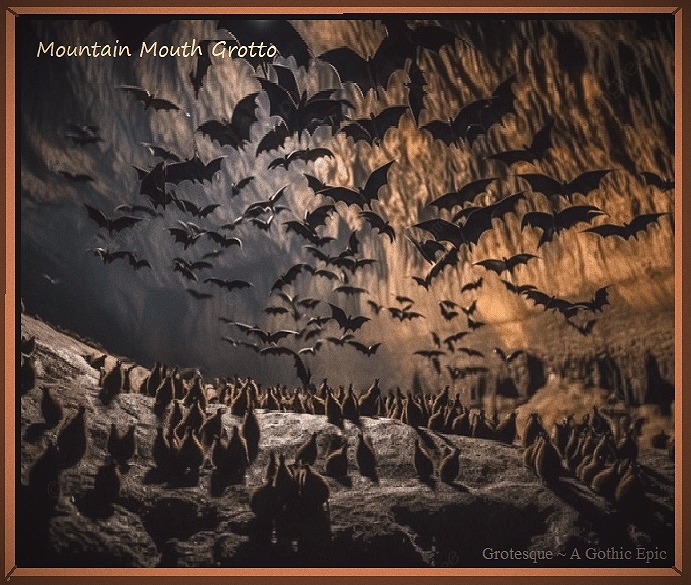
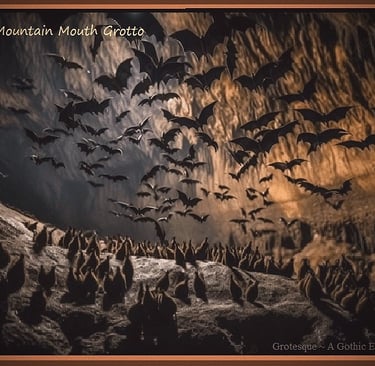
Lazarus chuckled. He stood and held out his arms as the whirlwind of wings consumed him. And they lit on his robe and climbed over him before taking off again. Lazarus ripped off his hood, exposing a wide grin. He tucked the mask in his rope belt as bats crawled through his hair. Lazarus walked in circles with raised bat-covered arms. And his chuckles rose to laughter that echoed through the cavern. In a tornado of fluttering wings, Lazarus waltzed about the grotto, laughing hysterically and stumbling about like a drunken Odino.
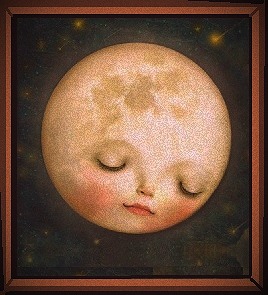
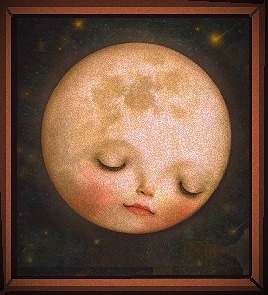
Outside the cave, and over the gold-leafed hills of eastern Auvergne Province, a marvellous, unseen, and short-lived drama unfolded—of all the mountains in France, the dawning moon seemed to cast a downward smile on only one: an outwardly strange mountain with a mouth agape in hysterical laughter as it belched billowing clouds of bats that swarmed its rock face. Yet, the bats soon cleared the treetops and disappeared; and the mountain's once-echoing laughter slowly rolled into blended wails of sorrow—into terrible cries of pain and loneliness—into the choking torment and gasping howls of unbroken lamentation—and into horribly dreadful noises, so deeply troubling—even to make the moon stare down and weep for the yowling Mountain Mouth.
Vol. I: Chap. IX ~ finis.
Next Chapter~
~10: A Black Death Sweeps All
"The woods are lovely, dark and deep.
But I have promises to keep,
And miles to go before I sleep,
And miles to go before I sleep."
~R. Frost
Grotesque ~ A Gothic Epic© is legally and formally registered with the United States Copyright Office under title ©#TXu~1~008~517. All rights reserved 2000-2026 by G. E. Graven. Website design and domain name owner: Susan Kelleher. Name not for resale or transfer. Strictly a humanitarian collaborative effort. Although no profits are generated, current copyright prohibits duplication and redistribution. Grotesque, A Gothic Epic© is not public domain; however it is freely accessible through GNO. Access is granted only through this website for worldwide audience enjoyment. No rights available for publishing, distribution, AI representation, purchase, or transfer. This presented literary work is irreversibly-sovereign, free for nonpublishable and personal reading only, and shall not be subject to explicit or implicit agreements, understandings, restrictions or surrenders of any sort; whether public or private, individual or institutional, corporative or governmental, or other. Susan Kelleher maintains all website control, and George (G.E.) Graven maintains all international intellectual property rights for any and all prior and future versions, revisions, translations, digital representations, and variations of the literary work: Grotesque, A Gothic Epic©, until the stated copyright expiration date, when it is properly and legally released into the public domain. Driven by Anonymous Polymath and more. Continued public access is ensured and protected under this non-profit humanitarian effort, forged exclusively as a digital and literary dedication to the late Gothic author: Edgar Allan Poe.