Add your promotional text...


Gothic Literature Over Two-Hundred Years
Compare and Contrast ~ Two Works Over Two Centuries
1. Lewis' The Monk (1796)
2. Graven's Grotesque: A Gothic Epic (1998)
(verses)
The comparison between G.E. Graven’s Grotesque: A Gothic Epic and Matthew Lewis’ The Monk offers a fascinating study of how the Gothic genre has evolved from its transgressive 18th-century roots into contemporary, historically grounded epic narratives. While both works utilize religious institutions, supernatural entities, and the "grotesque" as central motifs, they diverge significantly in their moral outlook and structural scope.
1. Plot Overviews
Matthew Lewis' The Monk (1796): Set in Madrid, this classic of "Monk" Gothic fiction follows the sensational fall of Ambrosio, a revered Capuchin abbot. His extreme piety is revealed as repressed narcissism when he is seduced by Matilda (a demonic agent). Ambrosio descends into a spiral of rape, incest, and murder, culminating in a pact with the Devil and his ultimate, gruesome damnation.
G.E. Graven's Grotesque: A Gothic Epic (1998): This contemporary online novel is set in the Late Middle Ages (1331–1352) during the Black Death. It follows Lazarus Gogu, a winged boy and abbey squire (a "chimera"). Unlike the villainous monks of traditional Gothic, Lazarus is an innocent protagonist who must survive a world of religious persecution and fallen angels (Nephilim) to prevent a medieval Armageddon.
2. Thematic Comparison
The Monk: Lewis uses the monastery as a site of moral decay and hypocrisy. Ambrosio represents the "holy man" whose rigid asceticism masks a monstrous nature. The novel reflects the 18th-century British "Anti-Catholic" sentiment, portraying the Church as an institution of secrecy and corruption.
Grotesque: Graven also features "pious men who would destroy" the protagonist, but the focus shifts to faith as a survival mechanism. While the institutional figures are hostile, Lazarus’s own faith remains his moral compass. The religious themes are grounded in scriptural and apocryphal sources (e.g., the Book of Enoch) rather than just institutional satire.
Religion and Hypocrisy
The Role of the "Grotesque"
The Monk: The "grotesque" in Lewis' work is linked to horror and moral inversion. It is found in the physical decay of the bleeding nun, the graphic descriptions of torture, and the spiritual "grotesqueness" of Ambrosio’s crimes. Here, physical or situational deformity typically signals a departure from the divine.
Grotesque: Graven inverts this trope. The protagonist, Lazarus, is physically "grotesque" (a winged hybrid), but he is the moral center and a "redemptive figure." His physical anomaly is a mark of his unique nature and victimhood rather than moral corruption. This challenges the traditional Gothic idea that physical beauty equals goodness.
Supernatural Elements
The Monk: Features demonic intervention and Satanic pacts. The supernatural is used for sensationalist horror—Matilda is a succubus-like figure sent to ruin Ambrosio’s soul. The magic is black magic, and the goal is personal destruction.
Grotesque: Draws on Biblical and historical mythology, specifically the Fall of Angels and the Nephilim. The supernatural is an "epic intrusion" on a world scale. Lazarus’s struggle isn't just for his soul, but to stop a literal Armageddon.
3. Structural and Formal Differences
4. Summary of Contrast
References
Ayar, M. Z. (2022). Subconscious villain of individual and institutional church in Matthew Lewis’s The Monk. International Journal of Filologia.
Blakemore, S. (1998). Matthew Lewis' Black Mass: Sexual, Religious Inversion in The Monk. Studies in The Novel.
Graven, G. E. (2026). Grotesque: A Gothic Epic. GothicNovel.Org.
Morse, D. (1982). The Transposition of Gothic. Springer.
[ End of SciSpace AI Analysis - Comparison And Contrast Between Graven's Grotesque, A Gothic Epic and Lewis' The Monk. ]
The Monk (Lewis)
Grotesque (Graven)
Feature
Genre → Gothic Romance / Transgressive Fiction Historical Epic / Gothic Fantasy
Medium → Traditional Print Manuscript Fully Illustrated Online Novel
Protagonist → Byronic/Villain-Hero (Ambrosio) Redemptive/Innocent Grotesque (Lazarus)
Scale → Internal/Psychological tragedy Global/Apocalyptic saga
Setting → Atmospheric, vaguely contemporary Madrid Rigorous historical realism (Plague years)
Moral Arc → Descent: From sanctity to damnation. Ascent: From victimhood to salvation/heroism.
The Monster → The monster is inside the man (the Abbot). The "monster" is the outcast (the Winged Boy).
The Threat → Individual sin and spiritual ruin. Cosmic/Apocalyptic threat of Fallen Angels.
Element
The Monk
Grotesque

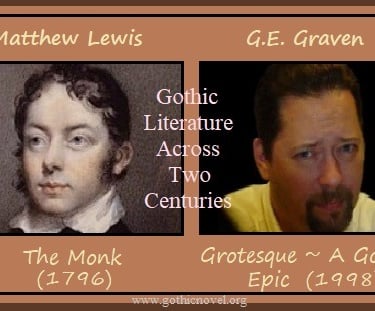

A Smile Across The Centuries ~ Lewis and Graven
Grotesque ~ A Gothic Epic© is legally and formally registered with the United States Copyright Office under title ©#TXu~1~008~517. All rights reserved 2000-2026 by G. E. Graven. Website design and domain name owner: Susan Kelleher. Name not for resale or transfer. Strictly a humanitarian collaborative effort. Although no profits are generated, current copyright prohibits duplication and redistribution. Grotesque, A Gothic Epic© is not public domain; however it is freely accessible through GNO. Access is granted only through this website for worldwide audience enjoyment. No rights available for publishing, distribution, AI representation, purchase, or transfer. This presented literary work is irreversibly-sovereign, free for nonpublishable and personal reading only, and shall not be subject to explicit or implicit agreements, understandings, restrictions or surrenders of any sort; whether public or private, individual or institutional, corporative or governmental, or other. Susan Kelleher maintains all website control, and George (G.E.) Graven maintains all international intellectual property rights for any and all prior and future versions, revisions, translations, digital representations, and variations of the literary work: Grotesque, A Gothic Epic©, until the stated copyright expiration date, when it is properly and legally released into the public domain. Driven by Anonymous Polymath and more. Continued public access is ensured and protected under this non-profit humanitarian effort, forged exclusively as a digital and literary dedication to the late Gothic author: Edgar Allan Poe.