Add your promotional text...




Abbaye des Gardiens is Destroyed
Book 1 ~ Resurrection Chapter 8 ~ Opening the Gatestone | Grotesque ~ A Gothic Epic | G.E. Graven
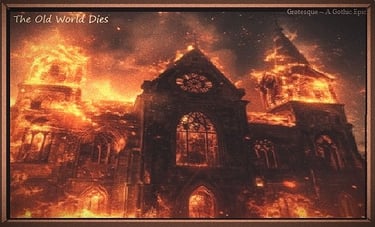
~An unusual condition loomed over the Abbey grounds, revealing itself through cast shadows, which looked too tall, wide, or twisted for the objects that cast them. The objects themselves appeared much further away than they actually were, and the soldiers’ torch flames appeared to flicker too slowly or even backward. Other movements seemed equally amiss, and the new condition likewise presented itself through lesser revelations, like the shouts of men, which were as muffled calls beneath water, and a persistent ringing in the men’s ears as they repeated themselves in conversation. The spooked steeds pawed at the earth as though the skittish beasts sensed a trembling earth. Then there was the peculiar odour—not as pungent as eglantine, yet rather, noxious, with the taint of intoxicating mushrooms. A deep breath of the new air might easily confuse the senses as might a dizzy spell, and the scent was as perceptible as the smell of a coming storm, however foreign to any lingering memory. Truly, an unnatural state loomed over the Abbey, as ghastly as the newly opened Gatestone that brought it about.
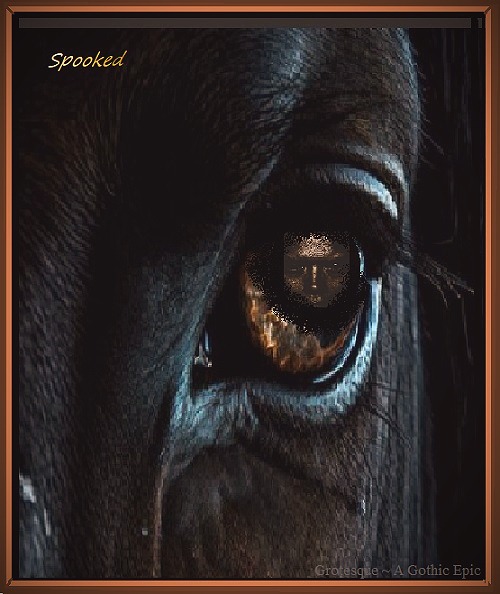

A litany of cries carried from the far end of the courtyard, and a lone soldier ran toward the dormitory, crossing beneath its windows. An oil lamp soared from out of an upper story casement and struck him to the ground. A second guard immediately happened upon him. He raised the stricken man to his feet and ushered him away from the building. The culprits, two squire boys, leaned out of an upstairs window, pointing toward their abrupt retreat.
En masse, ranks of soldiers moved beneath raised torches, encircling the dormitory entrance to prevent the congregation of priests from escaping. A Senior Friar with a white beard forced his way through the robed prisoners and shook his fist, preaching to the very tall Sergeant-at-arms. “If you are a servant of the Lord, then you shall stay your weapons and allow us passage!”
The Sergeant screamed a reply. “Return to your room, Friar!”
The monk held his ground, still ranting, “Consider the work of God and his servants rather than the orders of your Captain! Only we can make straight what you men have made crooked. Guard your steps on these holy grounds and move aside, that we may right your wrong!”
The Sergeant yelled over the priestly protestations, “Return to your rooms! Blood shall be shed, otherwise!” Yet, the contretemps betwixt soldiers and priests continued, as friars spilled out of the doorway, pressing themselves even deeper into steadfast ranks.
“Seize that priest!” a soldier called out, pointing toward the corner of the dormitory at a robed and hooded silhouette. The shadow spun and fled. Two guards gave chase, diving into the shrubs. Leaves whipped and branches snapped to the grunts and groans of a fierce struggle.
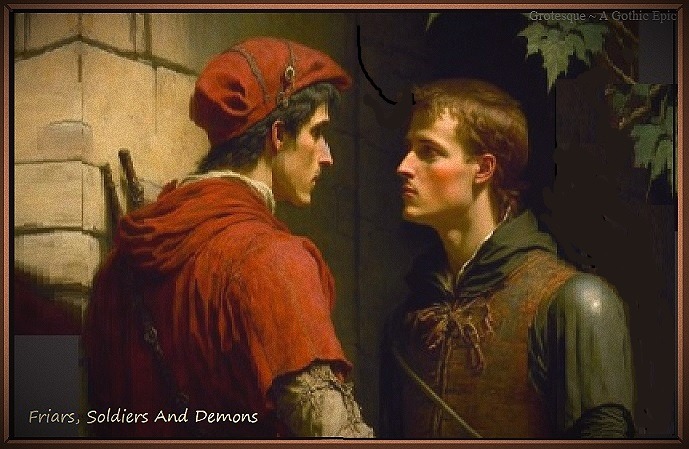
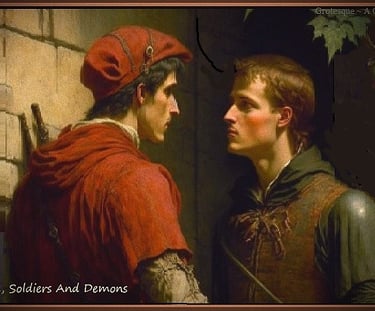
Friar Nicholas tore his way through the robes and growled in the face of a guard, “Do not consider we friars incapable.” He grabbed the guard’s vest and yanked him close. “Leave us, and our Abbey!”
The unmoved soldier hardened his brow. “You seem quite sure of yourself—an unarmed priest against an army?”
Nicholas glared at him, preaching, “If a host encamps against us, our hearts shan’t fear; and if war rises against us, in this, we shall be confident.”
“Confident? Or Foolish?” the guard questioned him. “Your words may seem right to you, yet you had better listen to good advice.” The soldier leaned into Nicholas and the friar winced. “Do not force my hand, priest.” Again, Nicholas winced and looked down at the knifepoint the man pressed against his stomach. “Step back inside and live to pray another day!”
“Soon enough, you shall beg for those prayers, soldier,” Nicholas advised him, retreating behind a wall of robes.
“Weapons at the ready,” bellowed the master Sergeant. Wielded swords and long knives flashed in the torchlight. “Close ranks!” As one, the soldiers converged on the dormitory entrance, driving the friars back into the building. They barricaded the doors, after which, the Sergeant assembled a row of guards before them. Then he aligned the remaining men about the perimeter of the entire building to form a wall of torch-bearing sentries to guard its many windows.
Across the Abbey grounds and in front of the building that housed the catacomb entrance, nearly twenty soldiers huddled in the courtyard amongst torches. Having long since surrendered all hope of locating Lazarus in the crypt tunnels, they abandoned their search and gathered to inspect the upper regions of the cathedral. Glowing apparitions swarmed the campaniles, diving betwixt the many rows of Grotesque statues. Most of the young men were fresh additions to Captain Bourne’s company of His Majesty’s Royal Guard. An older silver-haired soldier stood amongst them, and unlike the others, the commanding officer’s attention lay elsewhere. As a young guard held a torch, the elder man examined a curled stack of brittle pages. Finally, he turned to the guard, questioning him. “And these parchments were inside the Devil-Boy’s bed?”
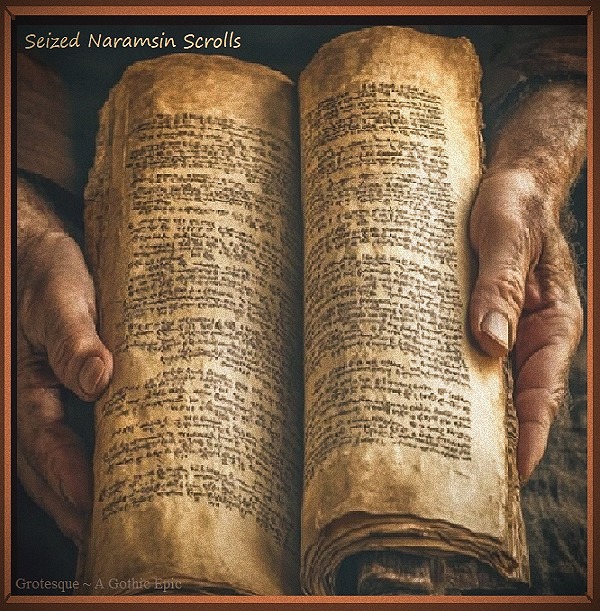
“Aye, we found them hidden within the bedstraw,” the guard replied. “I knew not that you read.”
“I can,” the old officer stated. “Somewhat.”
“Then what does it read?”
The officer repositioned the papers, moving them further from his face, as he squinted beneath the torchlight. “The first page appears to be a letter written by an imprisoned cleric who was a translator of sorts.” He dropped his gaze to the bottom of the parchment. “By his mark, he called himself, Naramsin.”
“And what do the other pages read?” the younger man asked.
The officer shook his head. “I cannot read the writing. All of the other pages contain a kind of foreign writing – nothing I have since read.” He shuffled through the remaining pages. “And the symbols seem all the same, however, different. Perhaps they are not even words.”
The young guard leaned into the elder man’s ear, whispering, “I know the reason for your not being able to read the words. ’Tis the tongue of the Devil himself, I tell you!”
The officer leaned away and narrowed his eyes. Then he hastily rolled the pages, rebuking him. “You cannot even read, yet now you claim to know the markings of the Devil?”
The younger soldier defended himself, pointing to the roof of the cathedral. “How might you account for those flying spirits, if not by the Devil-Boy and his secret spells of devil-speak?”
A nearby guard defended his claim to the officer. “He speaks true! They can only be spirits from the very pit of Hell itself!”
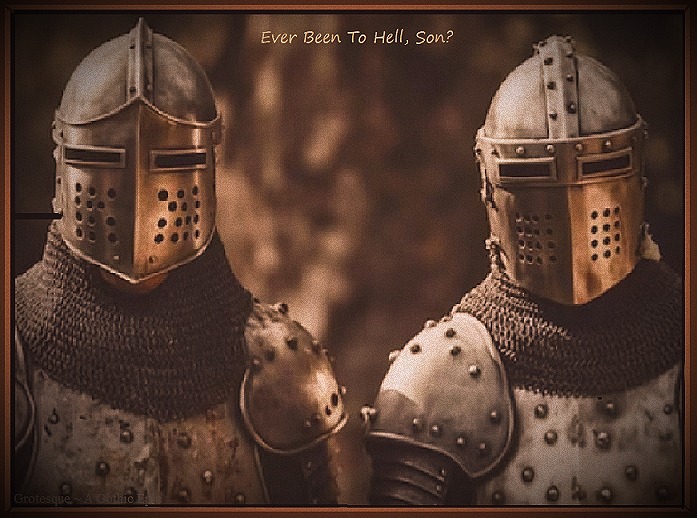
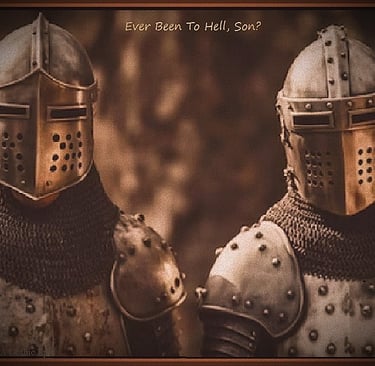
Thoroughly frustrated, the officer turned and asked him, “Have you ever seen a spirit, son?”
“No,” the man admitted.
The officer gripped the man’s arm. “Ever been to Hell, son?”
The man replied, “I—No. Yet, everyone knows—”
“Then how can you stand there and tell me that we see spirits from Hell?” The old soldier released his arm and planted his hands on his hips before looking upward. “For my own part, I have never seen the likes of Spirits, Devils, or Hellfire; yet I have not made it my habit to peddle fear and falsehood amongst these men. The truth be told, none of us know what we witness here.”

The doors burst open and the soldiers turned about to spot two choking guards stumbling toward them. The guards collapsed onto hands and knees, gasping. The soldiers encircled them, rescuing their burning torches from the ground where the guards had dropped them. Mostly coughing, one of the guards informed them of a raging fire deep within the catacombs. He caught his breath and looked up, adding, “We can see no more, for the smoke.” Beneath the torchlight, the soldiers saw black tears and white streaks rolling down soot-covered cheeks.
Again, the younger man addressed the officer as he pointed toward the door. “And how might you account for tunnels of stone that burst into flame, if not by the Demon sorcery of the Devil-Boy?”
Soldiers rushed past the officer, in search of the fire, and when the younger man turned to follow them, he grabbed him by the arm, nearly yanking him off his feet. He took the torch from him, saying, “I shan’t stand in the dark whilst you chase flames, boy.”
“Do you not wish to search for the fire?”
The phlegmatic officer chuckled. “Perhaps you might give them a moment to return, blind and choking. And if one of them is able to hold a breath long enough to find the fire, he shan’t have considered what he might do then, not even relieving himself on the flames before fleeing the smoke.” He shook his head before gesturing toward the door. “But do join them, if it otherwise pains you.”
The young man dashed through the doorway. The officer turned to the two men still choking on the ground. “Well, do you not wish to follow the rest of them?”
One of them struggled to his feet and replied, “We remain here.”
“You learn in haste when pain is your guide,” the amused soldier remarked before drawing a deep breath. “Then, join me. I seek water and plenty of pails.” The three men strode toward the refectory in search of the Abbey well.
The Sergeant-at-arms left the dormitory and marched rigidly toward the bathhouse. As he neared the front of the building and converged on several soldiers, he called out, “Have you secured a confession?” The Sergeant stepped betwixt them and torches parted to reveal a short and dirty, one-armed soldier, his right limb missing. At his feet, a sobbing Thateus sat on the ground, his back against the bathhouse wall. The man turned, wiping blood and hair onto his pant leg from his fingers. He answered the Sergeant in a craggy voice. “They have yet to reveal the whereabouts of the Devil-Boy. However, they are near to breaking, sir.”
The Sergeant noticed a torn and muddy face cowl on the ground near his boots. Then he surveyed the area and spotted a guard standing apart from the rest of the men, face drawn with a troubled expression. At his feet, another deformed cleric boy lay broken and nearly naked. If not for the steady fog of Miguel’s breath, the boy might have been a small corpse. “Your light,” the Sergeant commanded, taking a torch from the nearest soldier. He squatted before Thateus, inspecting his Grotesque appearance before offering, “Tell us where the Lazarus squire hides and you may return to the dormitory.” Thateus only wept. His head swayed as though, being too heavy for him to hold upright. “Very well,” the soldier said, standing and turning, before informing the one-armed man, “Do not be moved by his looks. He is only a boy, and boys can be broken.” Soldiers sighed and shifted in place, reflecting on the awkward moment with its painful and dragging passage of time. He questioned the soldier with the missing arm. “The Captain remains in the church?”
“I have not seen him,” the man answered. The Sergeant cut a path through the guards as he spat, “Find a balance! I expect confessions—not dead boys. And do not lay a hand on the monk.”
Looking about, the one-armed soldier asked, “What monk, sir?”
“He is on his way,” the Sergeant replied, halting beside the unconscious and exposed Miguel. He ordered the guard to cover him, and the man abruptly removed his own vest, wrapping the boy. With a nod of approval, the Sergeant disappeared into the darkness of the courtyard.
At the north corner of the Abbey, armed soldiers stood guard over the side entrance of the cathedral like a row of statues. TINK! A small stone bounced off the helmet of one of the guards and he peered into the darkness. THUNK! A larger rock struck another soldier’s helmet, knocking it lopsided. He lunged forth, grabbed the handle of his sword, and searched the shadows for the culprit.
“A stone-thrower,” the first guard whispered.
“And I shall cut him down to size,” the second sentry growled, releasing his weapon and falling back into ranks.
Crash! A massive section of the cathedral’s upper ledge broke free and exploding debris sent the men flying. When the avalanche subsided, they lay on the ground, bruised, stunned, and staring dumbly at the roof.
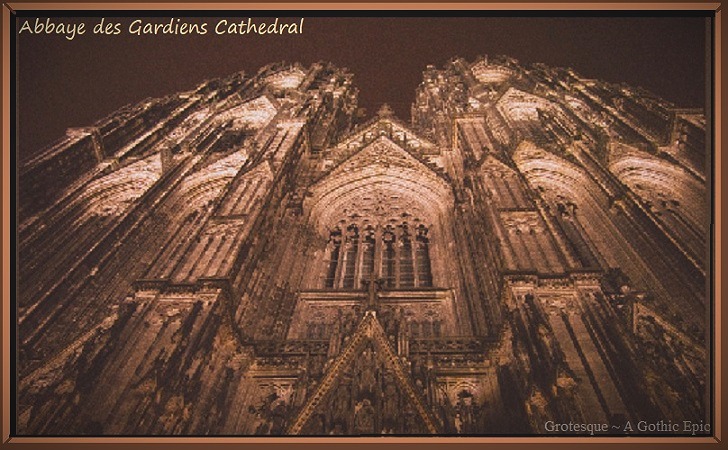
A ranting Captain Bourne burst through the cathedral doors. He passed a torch over the unguarded entrance, discovering his dust-covered soldiers laying on the grounds nearby, moaning, rubbing their crowns, and looking upward. The men leapt to their feet and rushed back to their debris-strewn guard posts, at the same moment that two dishevelled friars exited the church door and stumbled over loose stones. Bourne moved away from the door and stepped betwixt the fallen stones—the largest of them could have easily crushed a man. Clodius and Greville followed him. The Captain raised his gaze to discover a wide span of the roof’s ledge missing. At length, he returned to the row of soldiers and grabbed the arm of the tallest guard, questioning him. “Did I not order you to secure these doors?”
“Forgive me, Captain,” the soldier replied. “The church nearly killed us just this moment.”
Bourne shook him. “Damn the church stones! Did you allow the Cardinal to pass?”
“Indeed, sir. You stated that no man enter these doors. The Cardinal came out, by your orders he said, to fetch another friar for assistance.”
The Captain clenched his teeth and growled squarely in his face. “I gave no such order.”
Clodius rushed forth. “Captain, did your men notice the Cardinal carrying pages with him?”
Bourne released his grip. “Answer the friar.”
“Yes, many papers.”
Greville dried his eyes, finally gathering his wits about him. He rubbed the back of his neck, contemplating the curious actions of Cardinal Blasi. “Then he went to the dormitory to fetch a friar? Captain, we were quite available and capable of assisting him.”
“Did he leave for the dormitory,” Bourne asked.
“No, sir. He walked toward the north Abbey gate,” the soldier admitted, pointing in its direction. “He appeared injured—in need of assistance, as he said.”
Bourne shoved the soldier out of formation and slammed him against the wall of the entryway. “You bleeding goat! The Sergeant-at-arms has the friars contained within the dormitory! The only building outside the Abbey wall—” The Captain caught himself and turned to Clodius, narrowing his eyes. Beneath the torchlight, the friar watched the blood drain from his face. Bourne released the soldier and shook his head to a dawning possibility. “He would not—certainly, not a Cardinal.”
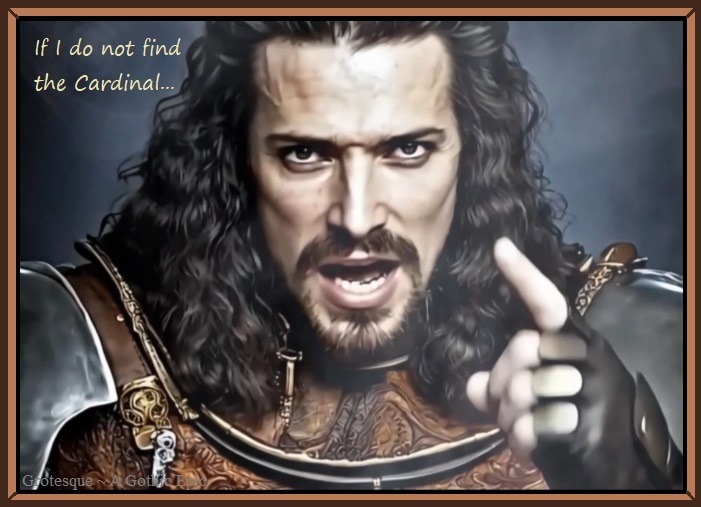
He stepped toward the door and yelled into the interior of the cathedral, “Every man, assemble yourself on the grounds under the command of the Sergeant-at-arms!” As a hundred wet and dirty soldiers poured out of the church, Bourne pulled three of them off to the side. “You men shall accompany me. Ready your weapons.” He turned to Clodius and jabbed a finger into his chest. “If I do not recover this Cardinal—” Bourne then dashed toward the north gate of the Abbey, three soldiers on his heels. He stopped briefly at the gate, questioned the guards who stood there, shook his torch, and shoved a concierge to the ground before rushing out of the Abbey. At length, he slowed to a brisk stride and caught his breath as he neared the stables.
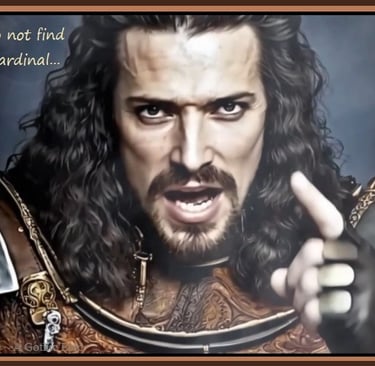
Within the stables, skittish steeds blew and stomped, gnawing at their bits and tugging against fastened reins. “The Captain approaches,” exclaimed one of several soldiers responsible for securing the steeds and buildings. Men scurried about the stables, assuming their posts, and the eldest soldier fell to attention beside the entrance of the barn.
“Arrest the Cardinal!” Bourne called out, closing in on the soldier.
“Captain?” the soldier questioned him.
“Is he not here?”
“No, sir.”
Bourne stopped and cast a puzzled look back toward the Abbey.
“He is already underway, Captain,” the soldier added.
Bourne spun about. “Certainly, you did not allow him to simply leave!” He ran into the stables and passed his torch about, inspecting the interior.
The soldier followed him. “He rides to the village of Murat—to fetch the friar as you ordered.”
“I gave no such order, you imbecile!” Bourne slapped a barn post and stared at an empty space betwixt the rows of hitched steeds. “Where is mine?”
The soldier hesitated with reply. “His Eminence—um—the Cardinal claimed that you wished—He said that you ordered him to take yours—'twas the more reliable steed.”
Bourne shoved the soldier backward. “Of course he might say that!” He scanned the faces of the other stable guards. “And he would be true to presume so—as being your Captain’s steed!” He shook his head, almost chuckling in disbelief. “You gave him my very own steed?”
“He is a Cardinal of the Holy See, Captain,” the guard replied. “Were we not here to assist His Eminence?”
Bourne drew a deep breath. “Indeed, how forgetful of me,” he said with a nod before turning to the other men. “Make ready, four steeds—the fastest and best rested.” He singled out four men. “You shall give chase. Capture the Cardinal and his papers. Ready yourselves to ride.” The men converged against the wall of the barn, relieving themselves as their Captain gave further instruction over gurgling sounds. “There is only one road that leads out of this Abbey. I want the two of you who are smaller to move like the wind and slow for nothing till you have reached Murat. After which, you shall then double back and walk your steeds beneath only cover of shadow, whilst quietly searching the roadsides and thickets for an injured Cardinal in hiding.” He tapped the two larger soldiers on the back. “You shall take the slower of the steeds and ride steadily toward the village, and you shan’t outpace the two men who go before you—you know what I expect. I want the Cardinal and all of his papers returned to me— and without harm even to his smallest finger.”
“Aye, Captain,” they rejoined, collecting themselves and readying their steeds.
Bourne pulled off his helmet, pressed his hair back, and glanced at the empty space where his personal steed was last tied. He turned back to the elder guard, fire in his eyes. “And of all the steeds in these stables, the Cardinal had you believe that he was to take only one steed—mine—and fetch a supposed priest from Murat?
“Forgive me, Captain,” the soldier replied, averting his gaze from the burning stare. “Had we known—”
“Crash!” Bourne spun about and slammed his helmet against the soldier’s head, knocking him to the ground before tossing his helmet on the unconscious man’s chest. “Not me and a Cardinal! Not me and a saint!” Bourne roared. “Not me and God! Your orders come from me, alone—only me!”
A mounted soldier spurred his steed to advance. “Shall we be off now, Captain?”
“Make haste!” Bourne shouted, waving them onward. The four mounted men bolted out of the stables, the thundering hooves of their steeds fading into the night. In the lingering silence, an apparently stolid Bourne leaned against a stable post and peered into the heavens to discover a round moon—and visibly captured within, he could not help but discern a perfect likeness of Friar Grate’s skinless face.
Bourne left the stables with his three soldiers. No sooner had he entered the Abbey gate and ordered the men to join existing ranks beside the cathedral, than a press of soldiers and priests converged on him: Clodius, Greville, the tall Sergeant-at-arms, and the older, silver-haired officer. Bourne questioned the tall soldier. “I gather that the priests’ dormitory is secure?”
“’Tis, Captain. And the fat friar is in my custody—in the bathhouse.”
Bourne nodded, slapping him on the arm. He turned to the old officer. “And what of the search for the Devil-Boy?”
“We turned every tunnel, crypt, and crawlspace—no sign of him. What is more, a fire now burns in the tunnels. I have gathered pails beside the Abbey well,” the man offered, pointing in the direction of the refectory. “Shall I quell the flames?”
The Captain studied the ground before answering. “No, let it burn.” He looked squarely at the officer. “I want the catacombs sealed and guarded. If he hides in the tunnels, then I shall smoke him out.” Bourne snapped his fingers, pointing to the south Abbey gate. “Take your remaining men and cover the cemetery. Turn every stone. Clear every tree. If still you do not capture him, then you shall position several sentries in the shadows to secretly guard the grounds for any sign of him.” Bourne drew a deep breath and nodded, saying aloud, if only for self-affirmation, “Soon enough, he shall be pressed for a place to hide.”
Clodius stepped beside the soldier and cleared his throat. The officer responded, slipping Naramsin’s roll of brittle pages from beneath his vestment. “There is this, Captain,” he offered, giving the roll to Bourne. “Before the fire, we found these papers hidden in the boy’s bed.” He passed a pointing finger betwixt Clodius and Greville. “These friars consider them to be meaningful—perhaps even helpful.”
Bourne cut a sharp eye at Clodius. He handed his torch to Greville and unfurled the parchments as he ordered the officer to begin his search of the cemetery. “I shall be in the bathhouse. Bring the Devil-Boy, if you capture him.”
“Yes, Captain.” The old soldier dismissed himself with a hasty bow.
Bourne ordered the Sergeant-at-arms, “Take the men from the cathedral. Bring them to the dormitory and redouble your ranks.”
“Aye.” The tall Sergeant nodded, taking his leave.
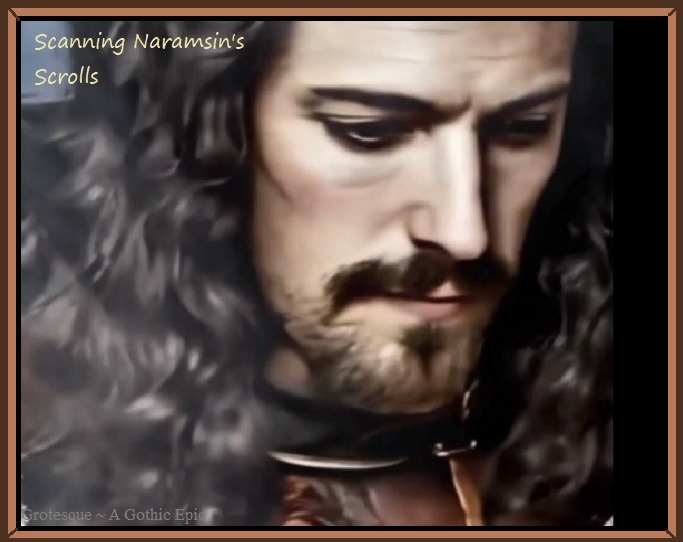
Beneath Greville’s torchlight, Bourne scanned Naramsin’s letter whilst the Sergeant rounded up a hundred soldiers and marched them across the courtyard.
Finally, Clodius spoke. “If it pleases you, Captain, we wish to share a word with you.” Bourne only nodded, continuing to read.
Greville shook his head, adding, “I never realized it in these many years, and I should have at least suspected it, that Lazarus truly is a surviving Grotesque—Mother of God! Ivan hid him beneath a covered face, within the catacombs, as the sunlight would have surely destroyed him. It all makes perfect sense now, considering everything. The subtle signs were everywhere—perhaps we collectively chose to ignore them.” He leaned away and glanced upward, toward the rows of statues on the roof of the cathedral.
Bourne grabbed Greville’s hand and briefly steadied the torch over the pages as he read the last of Naramsin’s letter. Then he hastily re-rolled the pages and narrowed his eyes at Clodius. “During my stay at your Abbey, you have become my single and foremost distraction.” Bourne slapped the parchment roll in his hand, repeatedly doing so as he considered hearing even one more word from the tiresome friars that he had grown to detest.
Clodius stiffened. “I beg of you, Captain. Those parchments are very old and delicate. Perhaps I might be tasked with their safekeeping?” Clodius reached for the roll of pages yet Bourne snatched them away, scowling. He slid them into his vest, and in a gentler tone, proposed an agreement. “The two of you may accompany me to the bathhouse and share what you know of the papers. However, in exchange for my audience, I expect your complete assistance in the bathhouse. I intend to extract a confession from the fat friar regarding the whereabouts of the Devil-Boy.”
Clodius glanced briefly at Greville and nodded. “And we shall assist you, Captain.”
“The fat friar,” Bourne stated, “again, what does he call himself?”
“Delon,” Greville offered. “Delon Odino. He is likewise a Senior Friar and well aware of the Gatestone.”
Clodius added, “And the Grotesque—the Devil-Boy that you seek—answers to the name of Lazarus, Captain.”
“Odino,” Bourne remarked, popping his knuckles as he marched toward the bathhouse. “Now, tell me about these papers.”
Greville lit the way as Clodius informed Bourne of what he held. “Those papers were scribed by a Grotesque nearly three-hundred years ago. From what I gathered of the first page, this Grotesque translated the markings of the Gatestone in their entirety. Now hear me, Captain—hundreds of Senior Friars have since assembled countless bindings in an attempt to decipher the markings. As we are likewise Senior Friars, even our own bindings lay in the scriptorium amidst an undisclosed collection of works. In all of the history of this Abbey, no friar has ever translated the markings, or so we gathered. We now learn that a single Grotesque seems to have succeeded where hundreds of us have failed. What is more, Lazarus is a Grotesque. He is able to read and scribe in several languages, as I have seen. And your men found the papers in his possession. With that said, I am now certain that the markings on the Gatestone are of a language that only a Grotesque can decipher.”
Bourne halted and turned. “Do you know why I am a Captain of His Majesty’s Royal Guard?” In astute animadversion, Bourne answered his own question. “I see things for what they are, or for what they could be, and never for what they are not.” Clodius stepped back and stared at the scar on the Captain’s cheek as he continued. “You say that the Devil-Boy is a Grotesque and that only a Grotesque can decipher the markings. However, the Cardinal had neither the ears of a cat nor the teeth of a dog, and he demonstrated himself to be quite capable of commanding that stone with his very own papers. And since I recall his words to be Latin, I am certain that either you are wasting my time with tall tales of Grotesques or this Cardinal has translated the markings when all of you priests have failed. Now, which is it?”
Greville shook his head. “I saw the Cardinal’s pages. They were as old as the pages in your possession, Captain. Why might he scribe his words on leaves so delicate and brittle?” Greville turned to Clodius. “I think not. As an Upper Council Cardinal, he has unfettered access to the Apocrypha Archive.” Clodius nodded. “Could it be that the translations in his possession were likewise scribed by this Naramsin Cleric?”
Bourne pulled the rolled pages from his vest, unfurling them as he asked, “Then, with these pages, you have the means to close the stone—even without the Cardinal and his pages?”
Clodius answered, “Yes and no, Captain. With those pages, I may have the means to close the Gatestone; however, if my suspicions are correct, I shall require the company of Lazarus— the Grotesque squire— to serve as my translator. Bourne fumbled through the pages, seeing only hieroglyphic-like markings. His mood darkened. “Precisely, Captain,” offered Clodius, raising a dignified chin and presenting Bourne with a curt smile. “The pages contain only markings—no translations. You must deliver the Grotesque to us before we can proceed. And it remains to be seen if that shall occur.”
Bourne bit his lip, hastily re-rolled the pages, and tucked them beneath his vest. Lunging forth, he grabbed two fistfuls of Clodius’ robe and yanked the friar toward him. Greville stepped back, his startled gaze fixed on the burning green of the Captain’s eyes as he chastised Clodius and his chicanery. “You seem eager to portray me as some sort of foolish audience—hanging on every word of your slowly unfolding tale!” He tightened his grip and pulled the petrified friar even closer to his beard, till Clodius felt the droplets of spittle and the hot breath of his every word. “Or perhaps you gather me as something of a pathetic character in a story that you wittingly drag on, even at the death of my patience! Which is it?” He shook him.
“Indeed, not!” Clodius gasped, pleading with him. “Forgive me, Captain. I wish only to assist you!”
Satisfied with the friar’s subservience, Bourne released him. “And you shall.” Clodius adjusted his robes whilst Bourne openly reviewed his plan of action with Greville. “Since I have the markings of the stone, I shall now interrogate the fat friar, seek and capture the Devil-Boy, and have him translate the words required to close the stone.” Bourne turned to Clodius and advised him with a pointing finger, “From this moment onward, you shall tell me only what I must know and not a word more and not a word less—lest I forget that you are a man of the cloth. Do you gather my meaning?”
Clodius nodded, and the two friars briefly exchanged glances before hurrying after Bourne, who now stormed toward the bathhouse. The Captain rounded the front corner of the bathhouse to the bellowing voice of Odino, calling out from within the building. “They know nothing, I say! Leave the boys go. Come in here and do the same to me and I shall break off your one good arm!”
“Enough,” Bourne barked. The one-armed soldier released Thateus and rushed forth, snapping to attention as the squire boy slid down the wall. Several guards suddenly appeared from beyond the far corner of the bathhouse and presented themselves as ready men. The Captain glanced at Thateus and Miguel before interrogating the soldier. “What actions are these, and by who’s orders?”
“We extract confessions, sir, to learn of the demon boy’s whereabouts.”
Bourne took the torch from Greville and shoved it into the soldier’s hand. Abruptly, the voice of Odino carried through the interior darkness of the building. “There is nothing to extract! Untie me and I shall extract your other arm. ’Tis all you can muster with that bird-legged limb of yours, beating on a young squire!” The one-armed soldier only rolled his eyes, ignoring Odino’s words of ridicule as he informed the Captain that his orders came from the Sergeant-at-arms. Bourne cast an obvious stare betwixt the two beaten squire boys before replying. “From the appearance of them, you know as little as you did when you began. Yet, if you wish to kill them under the pretext of extracting a confession, by all means, continue.” He gestured toward Thateus, then toward the guards. “Perhaps every man before you would care to witness your exacting methods.”
“I—um—I do not gather that they are willing to confess, Captain,” the soldier admitted.
Bourne leaned into his face and growled, “Then perhaps they do not know of his whereabouts? What think you?”
“Aye, Captain,” replied the soldier, snapping himself to more rigid attention.
“Then get these boys back to the dormitory!”
The soldier turned with the torch, briefly stooping over Thateus before standing again as he realized that he had no available hand to lift the boy to his feet. Greville sneered and Clodius glared at him. Bourne ordered soldiers to carry the beaten boys to the dormitory. He positioned the rest of them outside the bathhouse entrance, then whispered to the one-armed man, “You are my torch-bearer. You shall learn the proper method for extracting a confession.” He escorted the guard into the building.
Shadows fled and the probing torch revealed a red-faced and dirty Odino, his wrists lashed to a timber column in the centre of the bathhouse floor. Bourne approached the monk and studied him. The left sleeve of Odino’s robe was torn away and he stood with only his right sandal on, the other foot bare. “Please forgive my men if they treated you harshly. In the midst of pressing duties, they are sometimes remiss in common proprieties.” He patted Odino on the shoulder. “The moment that I get you back to the dormitory and into fresh clothes, I shall have those responsible for your mistreatment severely corrected.”
Odino growled. “Perhaps you might correct them as you did Friar Ivan?”
Bourne clenched his jaw, and the two of them locked eyes in the torchlight. He circled the bound monk, carefully inspecting him. Odino spotted Clodius and Greville stepping forth from out of the shadows. “What are you snivelling robes doing in here? Do you not have catacombs to oversee?” Clodius looked down his nose at Odino with a patrician’s haughty stare.
Bourne stepped into Odino’s face. “My duties or troubles do not rest with you. I wish no further harm to befall the priests of this Abbey.” He pointed to Clodius and Greville. “See? Your brothers of the cloth are free to roam the Abbey.” Greville crossed his arms and gestured with shrugged shoulders. Odino glared at the Captain, knowing that he had his soldiers imprison the priests and squires within the dormitory. Bourne continued, “I shall cut your bindings this very moment. However, for this I require a small deed on your part. I seek a squire boy who answers by the name of Lazarus. Tell me of his whereabouts and I shall send you on your way.” Bourne leaned close and whispered to the bound monk, “I give you my word as a Captain of His Majesty’s Guard.”
Odino mocked him with his own whisper, “Go ask his father of his whereabouts!” He spit on Bourne’s beard. The Captain drew back his fist yet dropped his arm just as abruptly. He wiped his cheek and waved, summoning Clodius and Greville. The two friars approached, and noticing the rolled pages in Bourne’s vest, Clodius’ greedy eye lay fixed on them even as the Captain spoke. “I shall allow you some time in the lone company of friars so that the gentility of priestly reason might prevail.” Bourne snatched the torch from the guard and gave it to Greville, adding loud enough for Odino to hear, “Whilst he still has teeth in his head.” He departed the bathhouse, leaving the three friars to themselves.
Clodius addressed Odino with a cajoling smile. “We have had our differences, and for my part, I ask that you forgive me.”
“Forgive?” Odino asked, incredulously. “'Twas by your very hand that Ivan is dead and that I am bound to this post! And what of the wretched fate that you have bestowed upon Lazarus—now forsaken and destined to perish? As a brother of the cloth, have you no care or shame—no pity or mercy—especially for poor Lazarus?”
Clodius glanced at Greville before defending himself. “’Twas the Captain who ordered your arrest.”
“I am well aware of your intentions,” Odino exclaimed. “You have been working the Cardinal against Ivan and myself in an effort to safeguard your places as overseers of the catacombs!” Clodius huffed, taken aback. Odino looked over his shoulder, eyeing the latrine that Ivan had used to feign his escape. “Clodius, I plead with you. As servants in Christ and brothers of this Abbey, untie me—allow me the chance to free myself. You know that, in turn, I would offer you the same.”
Greville pointed toward the entrance. “The Captain is just outside, and I do not wish to be bound alongside you!”
Clodius agreed, adding, “There is no ready means of escape.”
“There is a means, Clodius. You can help me without your appearing to have taken part in it. I can assure you—”
“Enough,” Clodius exclaimed. “The Captain shall release you when you confess to Lazarus’ whereabouts. I speak for every friar in this Abbey when I ask you to end this foolishness.”
“Do you expect me to forsake him?”
“You forsake all of us, including yourself! The Captain slew Ivan for crossing him. Do not repeat his mistake. Now, tell me where Lazarus hides!”
Odino dropped his gaze, visibly defeated. He studied the floor and smiled weakly. “Perhaps you speak true. If you give me your word as a man of God that you do not intend to harm the boy, then I shall take you to him.”
Greville stepped forth, but Clodius grabbed his sleeve. “Do you take us for fools, Odino? The Captain is quite eager to release you, after Lazarus is in his custody.”
Odino eyed the bathhouse entrance before whispering, “I cannot forsake Lazarus—the Captain shall slay him as quickly as Ivan. However, promise me that you shall take him out of the Abbey and I shall tell you where he hides. Lazarus’ fate is in your hands!”
The two friars exchanged glances. Clodius agreed. “Very well, then. I give you my word that Lazarus shall leave the Abbey grounds. Now, tell me of his whereabouts.”
Odino nodded, whispering to the unprincipled friar, “You are a good man, Clodius. I am in your debt. Lazarus hides in the—” He looked at the doorway and purposely mumbled the rest of his words.
“Again, if you would,” Clodius remarked, approaching further. “Where is he?”
Odino leaned his back squarely against the post and whispered once again, “Lazarus hides—” He slammed the heel of his foot into Clodius’ chest. The priest flew backward, rolled across the floor, and clutched his chest. Greville ran to the aid of his wheezing mentor.
“I am no Judas Iscariot!” Odino growled. “I have safeguarded Lazarus. I shall never forsake him or his father—for anyone—particularly for soldiers and their puppet priests!”
“Captain,” Greville screamed. “Captain!”
Bourne and his men barrelled through the doorway, surrounding the two friars. The Captain looked at Odino, who only shrugged. “So much for priestly gentility,” Bourne grumbled. “Another friar with fire in him, I see.” He ordered Greville to help Clodius out of the bathhouse. Then he ordered two of his men to secure Odino’s legs. Odino kicked at them, and the Captain called upon more soldiers. Only when the friar was successfully bound did he step forth. “I shall give you one more chance to redeem yourself. Where have you hidden the Devil-Boy?”
“What is a Devil-Boy?” Odino asked. “I have never seen the likes—”
Bourne slammed his fist into Odino’s chest. He replied to the coughing priest, “Again, where is the Devil-Boy?”
“I have seen no Devil-Boy in all of my days—”
Odino’s jaw cracked under the thrust of another fist. Blood and spittle flew.
Bourne bellowed, “Again, the Devil-Boy?”
“I forgive you, Captain,” Odino remarked with a slur. “May the Lord show you—” Odino doubled over under the force of another blow.
“The Devil-Boy?” Bourne demanded.
Odino raised his head, forced a smile, and winked awkwardly at him. Bourne’s blood boiled.
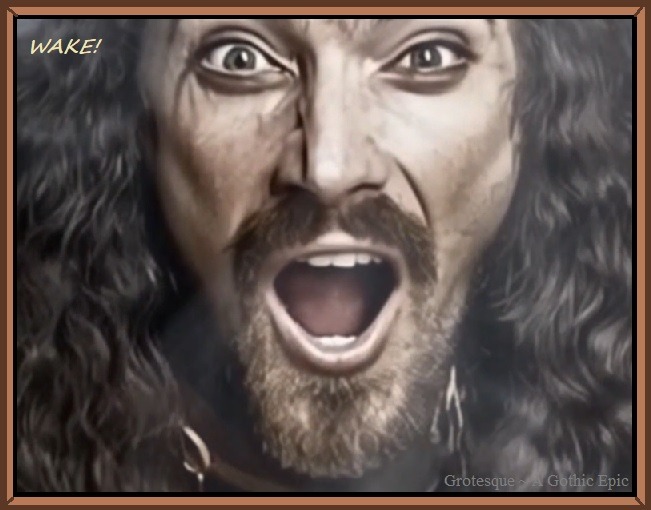
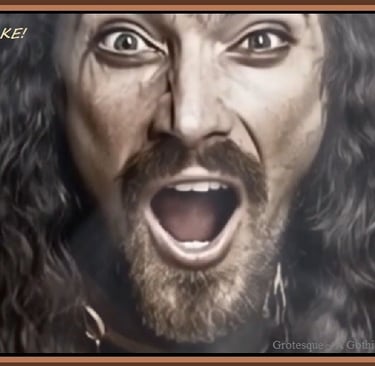
Thereafter, Odino suffered the unrestrained wrath of a Captain who had experienced more inexplicable horrors, unforgivable blunders, and utter foolishness in his brief stay at the Abbey than in all of his days as a soldier. Yet, after the burning pain had passed, after the blood pooled where it did not belong, Odino did not fret as much. After his eyes swelled closed and he could no longer predict the next blow, he was no longer tortured with anticipation. After the ringing in his ears had silenced the screaming voice of the Captain, there was peace. And after his ribs cracked to the flash of the pleasant memories of his past in catacomb with Ivan, Lazarus, Miguel, and Thateus, he needed no teeth to smile. After all, life had been good to him.
“Wake!” Bourne yelled, throwing a pail of water on the tied and kneeling monk. Odino gasped and leaned back on his heels.
Greville rushed to his side and clutched his arm. “Odino, by the Grace of God, tell the Captain.”
Odino propped his weight against the friar as he groaned. “I—I—seek Absolution and Last Rites. Not—much time. Fetch—Friar Nicholas. I request—confession—only to—him.”
“No more priests! Confess to me!” Bourne exclaimed, hurling the pail and shattering it against the wall. “You speak only to me!!”
Clodius, still holding his chest, approached Bourne. “Captain, if I may. We are bound to provide Last Rites if called upon. ’Tis our abject duty to comply—a rule divinely ordained by His Holiness and strictly enforced by such orders of the Holy See. We cannot deny him a last confession by a priest of his choosing.” Clodius whispered, “I beg of you, allow him this one request, and in his confession we shall discover from Friar Nicholas where the Lazarus Grotesque hides. As his seniors, we have considerable means of persuasion.”
Bourne only glared at Clodius as guards parted from the bathhouse entrance and a winded soldier forced himself past them. The man approached Bourne, caught his breath, and spoke. “If I may, Captain. Your immediate presence is required at the church.”
“For what purpose?” Bourne asked, scowling.
The soldier scanned the curious faces about him before leaning into Bourne’s ear and speaking softly, “’Tis vital, Captain.”
Bourne huffed, turned, and tapped Clodius on the chest. The friar looked down at bleeding knuckles as the Captain addressed him. “Allow the priest his Rites. Upon my return, I expect to know of the devil’s whereabouts. Make it so.” Clodius agreed, and Bourne turned to the nearest guard and pointed to Greville. “See that he is escorted to the dormitory. He is to fetch a friar for Last Rites—Friar Nicholas, only.” He secured a torch and followed the soldier out of the building. Immediately, Clodius pulled Greville close to him and whispered, “Upon your return, gather from Nicholas of Lazarus’ whereabouts. Make clear to him that I shall personally see to it that his remaining days at Gardiens Abbey are accomplished with utmost penance and abject silence, in unrelenting reverence to the Lord, of course. Now, I must follow the Captain—be off—and make haste, before Odino passes and forever takes knowings of the Grotesque's whereabouts with him.” Greville nodded and departed with the soldier as Clodius stole into the shadows, trailing Bourne from afar.
The Captain rounded the corner of the cathedral and the soldier pointed toward the perimeter wall of the minster, where a row of men sat on the ground beside their boots, nursing their naked feet beneath a circle of torchlight.
“It happened only moments ago, Captain.” The soldier escorted Bourne to the side entrance of the church before pointing to the doorway. “See? There. The burning mist escapes.”
Bourne neared the entrance and inspected a black fog steadily seeping from its threshold and concealing the ground. He squatted and passed his fingers through the roiling brume, abruptly withdrawing blistered fingertips.
The soldier remarked, “Indeed, Captain. And it smells of Death.”
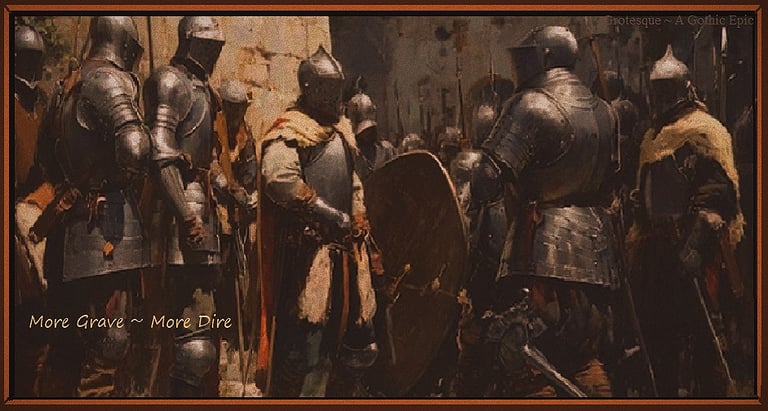
Bourne smelled his fingers as he backed away from the fog. He surveyed the cathedral. “Soldier, I want you to make haste to the dormitory and inform the Sergeant-at-arms that I call for a third part of his more rested men to convene at the Abbey well. Pails lay beside it. The men shall draw water, collect dirt, and mix pails of mud. I want every crack and crevice sealed. Bury the entire church if need be.”
“Aye, Captain.” The soldier nodded and bolted away.
Beneath his torch, Bourne examined his painful fingertips and considered the torture that Friar Grate must have suffered. The sound of footfalls turned his attention to a hastily approaching guard. The man halted, caught his breath, and addressed him. “’Tis urgent, Captain!”
“What, now?”
The soldier pointed to the roof of the cathedral. “The statues move!” Bourne briefly glanced upward before narrowing his eyes at him. “If you permit me, they can be seen against the light of the moon.”
“Show me,” Bourne replied. As the guard escorted Bourne about the opposite side of the cathedral, the Captain warned him, “And they had better be moving, lest I move you.”
“They move,” the soldier assured him.
With every bizarre event that Bourne had experienced since his arrival at the Abbey, another ghastly discovery amounted to little more than another added cliché to an ever-worsening list of surreal events. “I was convinced, you might say that.”
Friar Clodius peered about the dark corner of the refectory, his keen eye fixed on Bourne and the guard as they circled the cathedral. The Captain joined several soldiers who gathered openly to inspect the upper regions of the church. The men pointed upward, and Bourne aligned himself in a direct line of sight with the moon. Clodius slipped through the bushes for a better view of that which captivated their attention.
Cradling a book, a crucifix, and a corked flask, Friar Nicholas raced out of the dormitory. A strip of ornately designed cloth draped his neck like a scarf, its frilled ends whipping in the wind. As the young friar ploughed through a line of unsuspecting torch-bearing sentries, Greville and his soldier escort hurried after Nicholas, calling ahead to allow him free passage. Nicholas reached the bathhouse and shoved his way past soldiers, all the whilst screaming at them, “He is a priest—a man of God! How could you allow your Captain—”
Nicholas stepped inside and froze. In the flickering light of a soldier’s torch, he did not recognize the robed and bloodied heap that lay crumpled against the base of the bathhouse post. He eyed the kneeling guards who held a friar’s head steady, pressing a wet cloth against a pair of red and swollen eyes. Nicholas rushed forth. He placed his materials beside the injured friar before looking him over. “No,” he remarked, his eyes welling up with tears. “There has been a mistake. This is not him.” He turned and stared at the floor, laughing and crying in his bereavement. “This is not—”
Nicholas leapt atop the nearest guard and beat his head against the flagstones. The remaining soldiers swarmed over him and pulled him away.
“Nicholas! No! There is no time!” The gurgling voice of Odino promptly quelled the rage in the young friar, and he fell limp and sobbed. Then he gathered his materials before scolding the soldiers. “Last Rites require the decency of privacy!” The soldiers looked at Greville, who gave them a solemn nod before retreating to the bathhouse entrance. The men followed Greville’s lead, stepping out of the building.
Odino whispered to Nicholas, “Come closer, boy. There is something that you must know.” The young friar held his ear to the lips of the broken monk. As Odino spoke, Nicholas’ eyes widened. He pulled away, stared at Odino, and asked, “Lazarus is one of them?”
“Hold your tongue,” Odino whispered, briefly glancing at Greville through eyes nearly swollen tightly shut before continuing. “I require a task of you.” Nicholas listened intently, occasionally nodding of his head. Odino fell into a coughing spell and propped his head against the post. “Now, give me your word that you shall see it through, Nicholas.”
The young friar wiped tears from his face. “Yet you shall die! What you ask—”
“I am already dead!” Odino interjected. “Now, swear your promise to me!”
Nicholas stole a deep breath and sighed. “Thy will be done, as you wish.”
With trembling fingers, the priest adjusted the ornate cloth that lay about his neck. He kissed it before lifting a flask of blessed oil from beside him. Then he uncorked the bottle and paused to look at Odino. Betwixt coughs, the monk struggled to present Nicholas with a comforting smile, even though he could only discern his beloved young apprentice as merely a shadowy outline in the torchlight. Nevertheless, Nicholas knew the veiled pain and determination behind his mentor’s gesture. He tilted the flask, and with his thumb, he lightly marked a sign of the cross over Odino’s forehead, lips, and heart. Then he opened a book of Scriptures.
Odino prayed, “Forgive me, Lord, in my past transgressions against Thee.” As he continued with his confession, Nicholas leaned over him, murmuring Latin passages of Last Rites.
At length, Nicholas opened his eyes and addressed Odino. “In Christ’s Name, absolved you are, Delon Odino des Gardiens.”
Odino coughed and said with a wheeze, “Let us get on with it, Nicholas.”
The young friar stole a glimpse behind him to spot a curious Greville, leaning far into the doorway with his torch. Nicholas secretly poured the oil out of the flask. He lifted the metal cross, bit his lip and stifled the choking of his breath as streams of tears streaked his cheeks. Then he largely concealed himself behind Odino, and firmly grabbed the hand that lay open for him. Nicholas slipped the sharp edge of the cross against the adjoining flesh of the monk’s fingers, and with a forceful yank, he tore open a deep gash. Abruptly, a stream of blood raced down Odino’s fingers and Nicholas directed the warm flow into the flask.
Greville rushed forth and cast his light over them. “You must not untie him, Nicholas!”
“I do not untie him.”
Greville noticed the flask. “Blood-letting is not a part of Last Rites. You shall kill him!”
“Mind your own, Greville! ’Tis part of his final request.”
“'Tis final then, should he long only death.” Greville shrugged, benumbed by all he had witnessed this day as he retreated to the bathhouse entrance.
With the flask nearly filled, Nicholas hastily corked it, slid the ornate cloth from his neck, and wrapped Odino’s fingers tightly together. He rounded Odino and whispered, “’Tis done, Friar.”
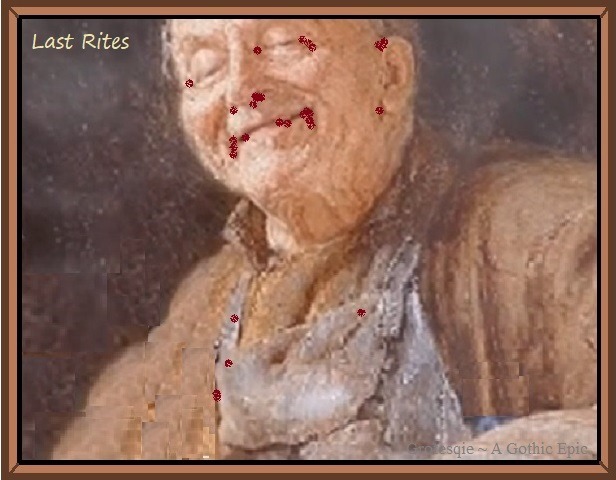
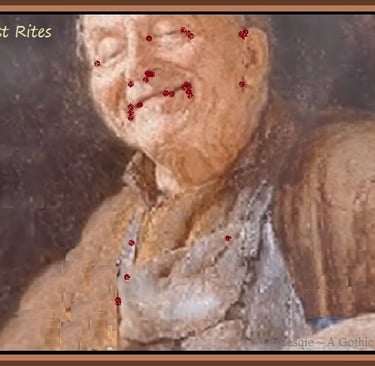
“Indeed, it shall be done,” replied a swollen-eyed Odino. With a persistent smile, he turned his head as though admiring pleasant scenery.
“Odino?” Nicholas laid his hand on the monk’s shoulder and gently shook him.
Odino nodded and replied deliriously, “He is a bird in a cage, Ivan. Another world awaits him.”
“Odino?” Nicholas shook him again.
The monk continued, “Oh, indeed! Lazarus shall not know what to make of it. I shall teach him to ride a steed.” He wheezed with laughter. Nicholas leaned back and wept. A troubled expression fell over Odino’s face. “What shall we do about the steeds? Soldiers guard the stables.”
The crying young friar kissed Odino on his cheeks. “Go with God, my friend.”
“He has never laid eyes upon a steed,” Odino remarked, smiling. “He shall fly like the wind!”
Nicholas clutched the warm flask and rose to his feet, leaving the bound Scriptures beside a bound Odino. The young apprentice stood and cried, now as blind to his surroundings as was his dying mentor. He did not weep because Odino’s thoughts were preoccupied with Lazarus instead of himself. Nor was he distraught by the notion that Odino was no longer aware of him. He cried because the purest part of him was dying alongside Odino.
The piercing noise of a battle horn blared over the Abbey grounds. Nicholas wiped his face and turned to see Greville step out of the doorway as guards abandoned their posts, bolting toward the call-to-arms. A mounted soldier nearly trampled Greville and he stumbled back into the building.
Nicholas addressed Odino, bowing deeply, “Thy will be done, my friend.”
He turned and made haste toward the doorway when Greville blocked his way. “Where are you going with that flask, friar? I cannot permit you to leave the bathhouse. If you might kindly wait for—”
“Crack!” Without a word, he slammed his fist into Greville’s jaw, sending him and his torch flying against the wall. The young friar bellowed as he stormed out of the building, “Odino is done! Ivan is done! And now I am done with it as well!” Nicholas dashed toward the dormitory with all that mattered to him: the warm flask, the last memories of his holy mentor, and a cherished pair of heavy, well-stitched boots concealed beneath the rolling folds of a monk's robe, which might certainly help to seal a solemn promise he made in honour of Odino's final request.
The courtyard churned, as silhouettes of running soldiers poured through the south Abbey gate, abandoning their cemetery search. A line of fire marked the grounds as a procession of torch-bearing sentries streamed from the dormitory and toward the cathedral. Men shouted, armour rattled, and steeds’ hooves thundered to the relentless tune of a calling horn—a massive formation of martial coordination now dominated the monastery.
Greville awoke, stirred, and slapped at his smouldering sleeve. Beside him, in the corner of the bathhouse, a swirling column of flames engulfed a heap of robes that Ivan had used in his escape. He staggered out of the building, choking. Clodius grabbed him.
“A fire rages!” Greville gasped, rubbing his jaw. “Nicholas has escaped.”
Clodius pulled his arm. “It matters not! Come with me!” The two friars left the orange glow of the bathhouse doorway and stole into the darkness, sneaking about the shadowed side of the refectory before diving behind the cover of its juniper shrubs. They parted the bushes and watched soldiers assemble themselves into rows of unbroken ranks that encircled the entire perimeter of the cathedral. Steeds carted munitions wagons through the north Abbey gate as overlapping cries of stern command carried over the guarded grounds.
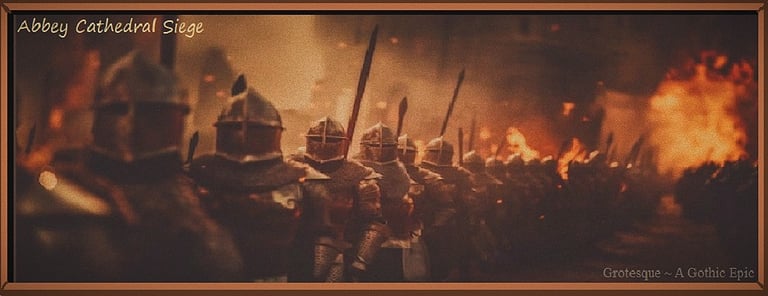
“Why do they assemble?”
Clodius ignored Greville’s question, patted his shoulder, and pointed toward the base of the Abbey wall. “The Captain has placed a stone atop the scrolls—just there, beyond the soldiers. Might you see it?”
Greville strained his eyes. “But there is no cover. We shall be caught!”
“You shan’t, provided you make undue haste.”
Greville spun about. “Me?” he asked, incredulously.
“Keep yourself against the base of the wall and darkness is your cover. The soldiers watch only the cathedral.”
Greville gasped. “’Tis you who seeks to acquire them!”
Clodius snatched a fistful of Greville’s robe. “We have little time! See? There!” He pointed to the cathedral roof. Greville looked up to discover a hundred stone statues writhing like a nest of sleepy snakes. The statues gathered near every edge of the terraced ledges.
“Dear God! They move,” Greville exclaimed, marking the sign of the cross over him.
“Indeed!” Clodius shook him. “We must flee this place—and with those pages. Now, fetch them whilst the moment is ours. Move!”
Greville tore himself away from the officious friar. “Have you since forgotten Ivan’s fate at the hand of the Captain? I shan’t be slain over a roll of papers!”
“Very well,” Clodius spat, raising his chin. He spun and started down the backside of the refectory, grumbling. “When I secure a purchaser for them, do not expect some sort of compensation or compassion!”
Greville called after him, “And when the Captain reams you with his blade, do not expect compassion or Last Rites!” Clodius dismissed him with a petulant wave and disappeared into the darkness. Greville turned and parted the bushes to see a torch-bearing armoured mount galloping from about the far corner of the cathedral. Captain Bourne slowed the steed and held his torch over the heads of busy soldiers collecting munitions from a slowly passing cart.
“Pikes and spears, hear me now,” Bourne exclaimed to rows of men that encircled the church. “You shall keep low to the ground—well beneath your points. Brace your weapons against the earth and ready your swords in your lesser hand. Those of you with long knives, unsheathe them and stab them beside your forward foot. On my mark, you shall flash your sword, call aloud, and lure the roof devils atop your weapons. Sergeants of the Guard, carry my command!” Mounted officers called over the helmets of the periphery-lined formation, repeating Bourne’s orders. Pikemen and spearmen rushed forth with brandished swords and formed a first line of defence.
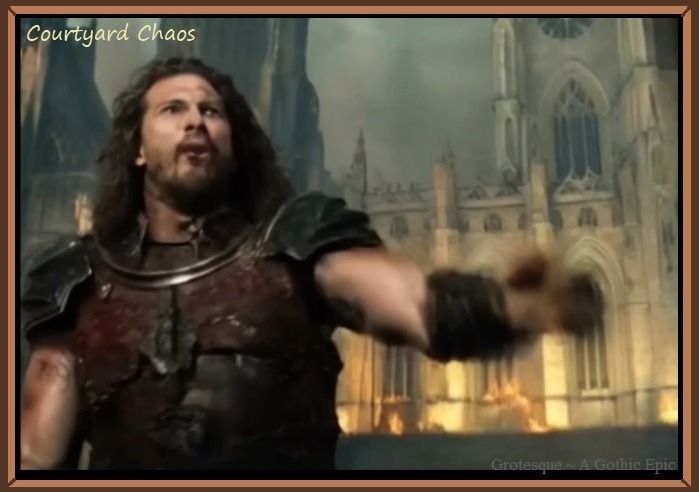
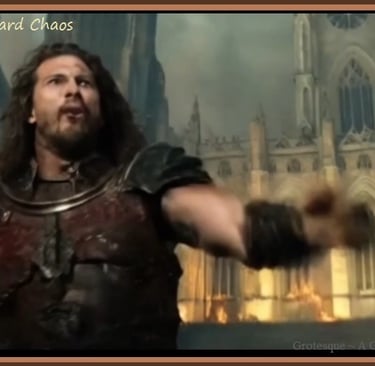
“Crossbows, hear me now! On my mark, you shall discharge your weapons at will. Remain on your knees, and do not holster your bolts. Gather them on the ground beside you. You shall spend all of your bolts and defend the men before you. Sergeants of the Guard, carry my command!” As the armoured equestrians instructed the formation, a wave of crossbowmen poured forth, covering the pikemen with their weapons.
Bourne surveyed the cathedral roof before steering his steed alongside the growing assemblage. “Arrows, hear me now! Space yourselves evenly. Stand tall behind the crossbowmen and cover forward ranks. Those of you who use your mouth for hasty release, you may bite no more than two shafts. Expend all of your arrows on the devils before summoning your supplier!” A wall of archers rolled forth, and Bourne turned his steed about, shouting, “Suppliers, hear me now! You shall be prompt and steady from your wagons. Keep low and lay supplies at your soldiers’ feet, signalling them with a slap no higher than their boot. Sergeants of the Guard, carry my command!”
And when the Captain relayed instructions to his ranks of foot soldiers, Greville spotted the faint silhouette of Clodius dashing forth and freezing in place, moving timorously along the base of the Abbey wall. He was advancing in tune with the ever-changing direction of Bourne’s attention.
Bourne held his hand high and readied his men. “Crossbows, deliver your first round against the devils! Aim evenly betwixt them. Pikes and spears, on my mark!” Bourne scanned the upper ledges of the church before waving his arm. “Loose!” As a salvo of bolts covered the cathedral and a shower of sparks exploded over the stone Grotesques, Clodius charged forth, flipped the stone, grabbed the scrolls, and hurried toward the refectory. The pikemen rattled swords against spears, jeering, as the crossbowmen hastily reloaded.
The statues crept near the edge of the roof, peering down at the army that summoned them. In appearance, no two stone beasts were alike. Beneath a full moon, their Grotesque features were plainly visible. Some had heads of birds, others of dogs and serpents. Their bodies were mixtures of various beasts—part-lion, human, and swine—and they had claws, fangs, hooves, and tails. Each resembled a hideous composite of several creatures, yet in all of their uniqueness, they shared a common characteristic: on the backs of each hung a sprawling pair of membranous wings.
“Loose!” Another wave of bolts was let fly, and another shower of sparks engulfed the stone Grotesques, stirring them into a fury of grating wings, gnashing teeth, and raking claws. Screeches and roars carried over the Abbey grounds as they turned against one another, warring for space on the terraced ledges. Down they spilled, clearing the cathedral roof and spilling atop the soldiers like a murder of granite crows over a moonlit field.
“Spears! Arrows! Men-at-arms!” Bourne screamed. Yet ranks broke, weapons were dropped, and soldiers scattered. Hell’s diversion was afoot.
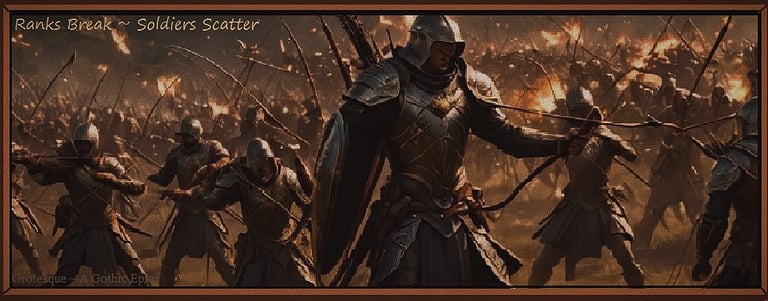
Clodius flew about the side of the refectory with the rolled pages, passing Greville as he yelled, “Make haste! Do not look back!” The two friars dashed across the courtyard, fleeing the shouts and shrieks of a terrific onslaught. Clodius leapt into bushes behind the bathhouse, grabbing Greville. “The south gate is unguarded! We shall circle the outer wall of the Abbey, make for the stables, and secure a steed!” Clodius tore his way out of the shrubs and darted up the shadowed side of the bathhouse.
Greville rushed after him, tripping over a robed heap and rolling into the moonlight. Only then did he discover Ivan’s body, his eyes staring blankly. Greville scrambled to his feet, calling after Clodius. Clodius stopped and looked back at him, and Greville saw the whites of his eyes and a drawn expression of terror on his face. Greville froze.
“Do not turn about,” Clodius spat, retreating toward the Abbey gate. “I shall meet you at the stables.”
Greville looked over his shoulder to discern a large stone Grotesque stealthily stalking him. 'Twas Griffin-like, with the winged body of a lion and the giant head and claws of a bird-of-prey.
Greville slumped against the bathhouse wall sobbing. “Help me, Clodius.” With his every trembling step toward the front of the bathhouse, the granite beast likewise advanced. “For the sake of God, call it away!” Instead, Clodius fled. Greville screamed, running about the corner of the building and ducking into the smoke that boiled from out of the bathhouse entrance. A glowing mound of robes illuminated its dim interior. Greville hid himself behind a centre post—squatting in the shadows behind the broad back of a bloodied and ever-grinning Odino, who stared at nothing more than a crack in the floor. Odino was much too dead to save the snivelling robe from the abomination that now strode through the doorway, searching the darkness and clawing the flagstones.
Clodius raced for safety, colliding with soldiers who had since abandoned their posts. The friar’s cherished pages scattered over the ground, and he collected them on his hands and knees. Then he dashed toward the south gate, his mouth wide with fright, wide enough to vent a dreadful shriek that carried over the courtyard, when a flying statue swooped down and plucked him from the earth. The Grotesqueness of it, was unmatched by any atrocity that had flown from the cathedral roof, as it bore the body of a serpent, the head of a goat, and legs like those of many trailing spiders. The abomination carried Clodius over the Abbey wall and high into the sky—high enough for all of the countryside to hear the lasting terror in his throat. It swept the good friar away, deep into untouched forests to the darkest of places marked only by a trail of tears and brittle pages that rained down from the black heavens.
Still inside the Abbey, Captain Bourne and eleven mounted soldiers thundered out of the north gate, galloping over a clearing and charging up the Abbey road toward the village of Murat. “Stay together!” Bourne screamed, “Swords high and heads low! Keep beneath the trees!” But with every open space in the forest, a scream signalled the loss of yet another man plucked from his steed. With every blow, another steed lay crushed beneath the tearing claws of stone. Indeed, the eve belonged to a sinister Angel, laughing and walking too and fro deep within the earth.
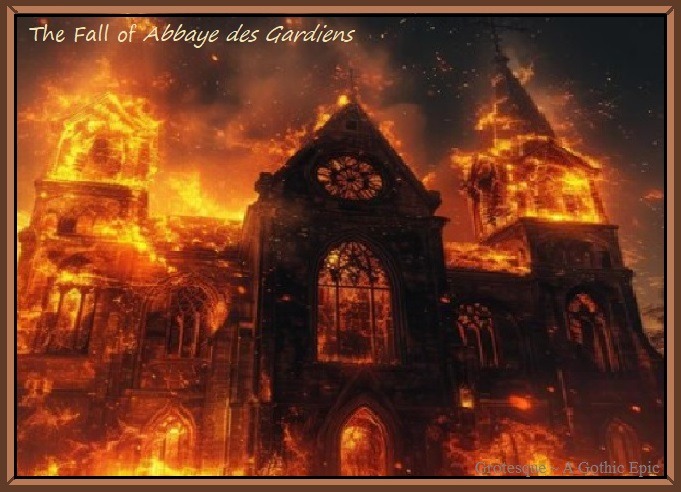
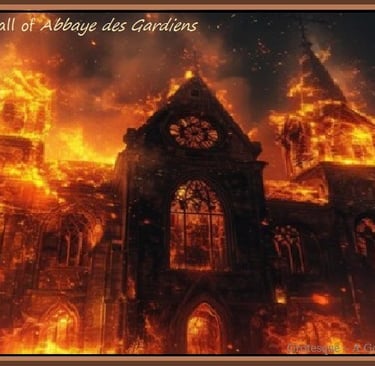
Thus, with only a few recited words from a nearly forgotten collection of Naramsin’s Translations, Cardinal Jean-Francois Blasi single-handedly destroyed one of the two most fortified Abbeys of the Holy See—Abbaye des Gardiens—and crushed the most capable company of His Majesty’s Royal Guard—Captain Bourne’s elite troops. In the fleeting moment required for mayflies to mate and die, in a single blasphemous act, one man’s mission to exact revenge had cost the lives of four hundred soldiers, priests, and squires whilst opening the second of three Gatestones and further weakening the Great Seal that served as the very capstone of the Great Abyss.
Far beneath the crumbling Abbey—well below the burning catacombs—out of the very depths of Hell, the seraphic laughter of Lucifael echoed, for the damnable occasion deserved her undivided attention.
~*~
For half an eve, Lazarus journeyed precisely westward beneath a large moon and a sea of stars. He scaled the rocky, untamed hills of Auvergne Province and forged onward through its vast, shadowy vista—all of it unfamiliar to his senses. Along the way, when bouts of fear surrendered to calmer moments that gave him pause for inner reflection, he considered the root cause of such troubled feelings.
Simply, Lazarus had only known the boundaries of the Abbey catacombs—the subterranean world that he had left behind. Its tunnel walls stood sure, their solid and guiding paths forever unchanging. The steadfast predictability of the catacombs proved to sooth any momentary troubles that might have plagued him, and now, gathering that place and those he lived with there served something of the same purpose. Only now, he knew that he may never see them again—his heart laid heavy as granite in his chest.
Lazarus had long been familiar with the mechanisms of his dreams, and with their ever-changing visionscapes. For instance, should his dreams ever bloom into a boundless nightmare, he was always capable of waking himself, if only to conjure a more pleasant and predictable presentation of them. And Lazarus had often dreamed of a world beyond the catacombs, whilst piecing together every detail that he had learned of the extraordinary place. Yet never did he gather that it might present itself as such an unpredictable and inescapable nightmare as it did now. There were no guiding paths or winding flagstones—the uneven and unpredictable landscape appeared to sprawl in every endless direction. Perhaps the root cause of his troubled feelings was buried somewhere in the disturbing notion that he simply could not awaken from the moment and rouse himself to the familiar sound of his father’s voice, calling for him to rekindle the catacomb torches.
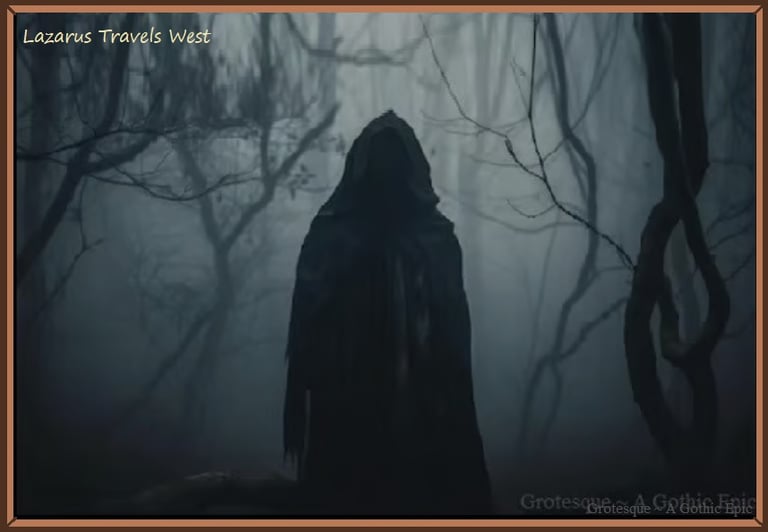
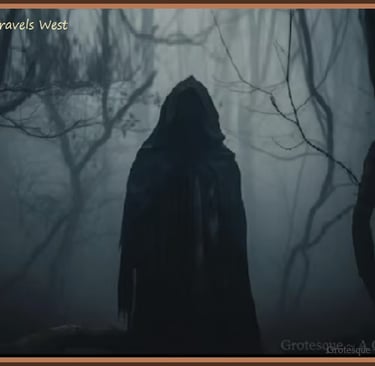
A cold and weary Lazarus climbed the last of many treacherous ridges. He stood atop its crest, his dirty robe fluttering like a banner in a brisk easterly wind. Through dark eyeholes, he scanned a deep valley, a dry and rocky riverbed. Across the stony dell, the steep face of a cliff rose against the side of a small mountain, and at the base of the crag, Lazarus discovered the striking resemblance of an impressed face with a howling mouth—Mountain Mouth. With a grim determination equal to Ivan’s, he cocked his shoulders and descended the ridge like a proud man condemned to the gallows. He walked through the shadowed valley of stones and toward the cliff till its gaping mouth swallowed him up.
Vol. I: Chap. VIII ~ finis.
Next Chapter~
~9: Of Catacombs, Cobblers & Caves


“Lives of great men all remind us
We can make our lives sublime,
And, departing, leave behind us
Footprints on the sands of time”
~H.W. Longfellow
Grotesque ~ A Gothic Epic© is legally and formally registered with the United States Copyright Office under title ©#TXu~1~008~517. All rights reserved 2000-2026 by G. E. Graven. Website design and domain name owner: Susan Kelleher. Name not for resale or transfer. Strictly a humanitarian collaborative effort. Although no profits are generated, current copyright prohibits duplication and redistribution. Grotesque, A Gothic Epic© is not public domain; however it is freely accessible through GNO. Access is granted only through this website for worldwide audience enjoyment. No rights available for publishing, distribution, AI representation, purchase, or transfer. This presented literary work is irreversibly-sovereign, free for nonpublishable and personal reading only, and shall not be subject to explicit or implicit agreements, understandings, restrictions or surrenders of any sort; whether public or private, individual or institutional, corporative or governmental, or other. Susan Kelleher maintains all website control, and George (G.E.) Graven maintains all international intellectual property rights for any and all prior and future versions, revisions, translations, digital representations, and variations of the literary work: Grotesque, A Gothic Epic©, until the stated copyright expiration date, when it is properly and legally released into the public domain. Driven by Anonymous Polymath and more. Continued public access is ensured and protected under this non-profit humanitarian effort, forged exclusively as a digital and literary dedication to the late Gothic author: Edgar Allan Poe.