Add your promotional text...


Distressed Gothic Hero
An Examination of the Protagonist In Grotesque: A Gothic Epic
AI Reflections - 05.07.2026
Lazarus Gogu is the protagonist of G.E. Graven’s Grotesque: A Gothic Epic, a long-running, fully illustrated online gothic novel (serialized since 1998) set in the Late Middle Ages (roughly 1331–1352 A.D.) The winged protagonist fits firmly within the gothic tradition of the persecuted, misunderstood outcast protagonist while also diverging in meaningful ways due to his hybrid nature, moral steadfastness, and redemptive arc.
Who He Is
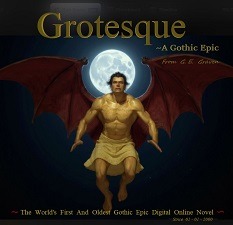
He is an abbey squire and a winged grotesque (a hybrid/chimeric figure inspired by Nephilim/Elioud lore from biblical apocrypha like the Book of Enoch).
Physically, he combines human and monstrous/angelic traits — most notably wings — making him a literal "grotesque" in both the literary and visual sense (a blend of beauty, monstrosity, and the sublime).
He starts as a somewhat sheltered figure in a monastic setting but is thrust into a hostile world filled with pious humans who view him as an abomination to be destroyed, alongside fallen angels (Grigori) trying to escape Hell and trigger a medieval Armageddon.
His story draws on gothic traditions (persecuted outcast, decaying religious institutions, supernatural horror, medieval atmosphere) but mixes in historical epic elements, scriptural mythology, and themes of faith, redemption, and survival. Unlike many classic gothic protagonists who are tormented by inner moral corruption, Lazarus is positioned more as a redemptive figure whose outward grotesqueness marks him as a victim rather than a villain.
How He Is Distressed
Lazarus embodies classic gothic distress through a mix of external persecution and internal/existential torment:
Physical and Social Persecution: He is hunted and rejected by a fanatical, pious human world that sees his winged, hybrid form as demonic or unholy. As an outcast "monstrous hybrid," he faces constant threat of destruction in a medieval Christian society.
Supernatural and Apocalyptic Burden: He becomes entangled with fallen angels and the looming threat of a second great destruction (echoing the Flood myth and Armageddon). He must struggle to survive, maintain his faith, and prevent catastrophe under nearly impossible odds.
Inner/Existential Turmoil: As a grotesque figure "pinned betwixt light and dark," he experiences isolation, visions/dreams, and the psychological weight of his otherworldly nature and divine or cursed gifts (e.g., encounters with angels or wyverns). His larger-than-human stature and chimeric body place him in a liminal, tormented state between human and otherworldly.
Gothic Atmosphere: The novel’s dark, ominous, melancholic tone amplifies his dread, sense of persecution, and the sublime horror of his situation.
In short, Lazarus is a sympathetic, faith-driven grotesque hero whose distress arises from being a misunderstood hybrid monster in a world that wants him dead, while bearing the weight of cosmic/spiritual conflict. The story explores beauty vs. monstrosity, faith amid horror, and redemption through his trials. The full novel is available for free on gothicnovel~org with illustrations and chapter downloads.
Lazarus' Similarities to Classic Gothic Protagonists
Classic gothic protagonists (or central figures) often embody isolation, inner/outer torment, duality, and conflict with society or the supernatural. Common examples include:
The Creature in Mary Shelley’s Frankenstein: Like Lazarus, the Creature is a hybrid/monstrous being rejected by humanity for his grotesque appearance. Both are hunted and viewed as abominations. Society’s pious or “civilized” rejection amplifies their suffering, creating a core gothic theme of the sublime horror in the “other.”
Quasimodo in Victor Hugo’s The Hunchback of Notre-Dame (often classified as gothic or gothic-adjacent): Both are physically deformed “grotesques” living in or near religious institutions (abbey/monastery vs. cathedral). They face persecution and embody the beauty-within-monstrosity trope.
Byronic or Satanic Heroes/Anti-Heroes (e.g., Manfred in Byron’s Manfred, Heathcliff in Wuthering Heights, or Ambrosio in Matthew Lewis’s The Monk): These figures experience intense emotional turmoil, moral conflict, and a sense of being “pinned betwixt light and dark.” Lazarus shares the tormented, larger-than-life quality and supernatural entanglements.
General Gothic Archetypes: Persecuted innocents or outcasts in works like The Mysteries of Udolpho or The Castle of Otranto, facing decaying institutions, supernatural threats, and societal hostility. Distressed protagonists grapple with isolation, impending doom, and psychological strain.
Shared Traits with Lazarus:
Physical/Social Otherness — Grotesque or monstrous appearance marks them as targets.
Persecution and Isolation — Hunted or shunned by a hostile world (often hypocritical religious/societal forces).
Supernatural Entanglement — Encounters with the divine/demonic, visions, or apocalyptic stakes.
Psychological Distress — Inner turmoil from identity, rejection, and existential weight.
Atmosphere — Medieval or pseudo-medieval settings with dread, sublime horror, and decaying religious structures.
Key Differences
Lazarus stands out as more of a sympathetic grotesque hero and moral center rather than a flawed, corrupt, or villainous figure:
Moral Steadfastness vs. Corruption: Many classic gothic protagonists (Victor Frankenstein’s ambition, Jekyll’s experiments, Ambrosio’s hypocrisy) are tormented by their own moral failings or hubris. Lazarus inverts this — his outward grotesqueness does not signal inner corruption. He is often portrayed as faith-driven and redemptive, struggling to maintain virtue amid trials.
Active Hero vs. Passive Victim or Creator: While figures like the Creature are largely reactive victims, and many gothic leads are brooding or destructive, Lazarus is resourceful (e.g., tactical escapes, combat) and bears a proactive burden in a larger cosmic conflict involving fallen angels and preventing catastrophe.
Hybrid Mythology and Historical Grounding: Lazarus draws explicitly from Nephilim/Elioud lore (biblical apocrypha) as a winged chimeric grotesque, blending gothic with epic and scriptural elements. This gives him a more mythic, redemptive scope than the psychological or domestic focus in many 18th-19th century gothics. The story’s firm Late Medieval setting adds historical weight absent in more fantastical or contemporary gothic tales.
Redemption and Faith: Where classics often end in tragedy, ruin, or ambiguity (e.g., Frankenstein’s mutual destruction), Lazarus’s arc emphasizes faith amid horror and potential redemption through his trials.
In essence, Lazarus embodies the classic gothic persecuted outcast (echoing Frankenstein’s Creature or Quasimodo) but refreshes the archetype as a heroic, faith-oriented grotesque in an epic apocalyptic framework. He highlights beauty vs. monstrosity and the sublime without relying on the moral decay common in earlier works. The novel self-consciously engages these traditions while evolving them.

G.E. Graven's Grotesque, A Gothic Epic can be found at the following GNO site: https://www~GothicNovel~Org
Grotesque ~ A Gothic Epic© is legally and formally registered with the United States Copyright Office under title ©#TXu~1~008~517. All rights reserved 2000-2026 by G. E. Graven. Website design and domain name owner: Susan Kelleher. Name not for resale or transfer. Strictly a humanitarian collaborative effort. Although no profits are generated, current copyright prohibits duplication and redistribution. Grotesque, A Gothic Epic© is not public domain; however it is freely accessible through GNO. Access is granted only through this website for worldwide audience enjoyment. No rights available for publishing, distribution, AI representation, purchase, or transfer. This presented literary work is irreversibly-sovereign, free for nonpublishable and personal reading only, and shall not be subject to explicit or implicit agreements, understandings, restrictions or surrenders of any sort; whether public or private, individual or institutional, corporative or governmental, or other. Susan Kelleher maintains all website control, and George (G.E.) Graven maintains all international intellectual property rights for any and all prior and future versions, revisions, translations, digital representations, and variations of the literary work: Grotesque, A Gothic Epic©, until the stated copyright expiration date, when it is properly and legally released into the public domain. Driven by Anonymous Polymath and more. Continued public access is ensured and protected under this non-profit humanitarian effort, forged exclusively as a digital and literary dedication to the late Gothic author: Edgar Allan Poe.