Add your promotional text...


The Gothic Elioud
The First Incorporations of Enochian Lore Within Gothic Literature
Elioud (also spelled Eljo or similar variants) are a lesser-known extension of Nephilim lore from apocryphal texts like the Book of Enoch and Book of Jubilees. They represent the third generation of hybrid beings: the offspring of the Nephilim (themselves children of fallen angels/Watchers and human women) and humans. Like their forebears, they are depicted as giants or exceptional hybrids marked by great power, often accompanied by wickedness, violence, and boundary-transgressing traits (e.g., polydactyly—extra fingers/toes—in some traditions).
AI Reflections - 05.06.2026
Elioud In Gothic Fiction
Elioud (and Eljo) lore is rare in classic 18th–19th century gothic literature, which favored psychological torment, decaying aristocracy/religious institutions, ghosts, and human-made monstrosity over deep Enochian angelology. As with Nephilim, direct references are minimal; gothic works more often used biblical fallen angels or generic demonic pacts (e.g., in The Monk) symbolically for moral corruption or the sublime.
In modern gothic, gothic-adjacent horror, dark fantasy, and paranormal fiction, Elioud appear more frequently as vehicles for themes of hybrid otherness, ancient curses, persecution, faith vs. damnation, and apocalyptic dread—perfectly suiting gothic modes.
Key Example: Grotesque: A Gothic Epic by G.E. Graven
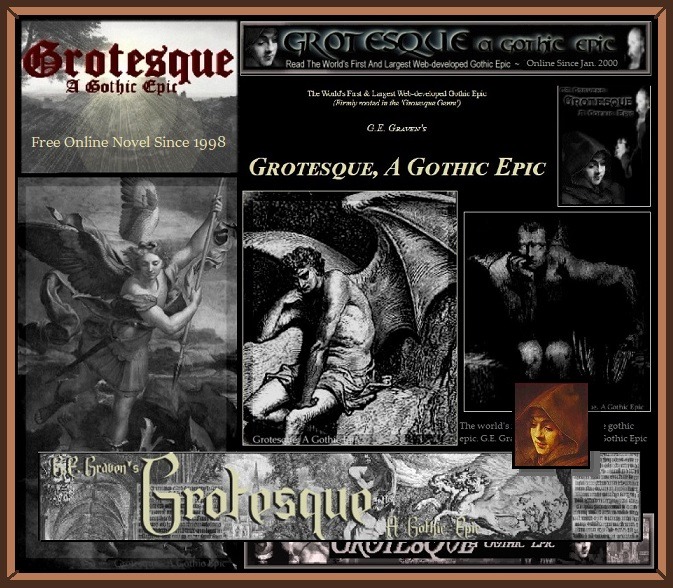
This is the most prominent, direct, and first integration in a gothic work, as referenced from both the active site: https://www.gothicnovel.org, and the archived site https://www.gegraven.com—since 1998. The protagonist, Lazarus Gogu, is explicitly a winged grotesque and Elioud (Nephilim-spawned outcast, also called Eljo in the text). The novel blends Late Medieval gothic atmosphere—abbeys, fanatical persecution, sublime horror—with Enochian lore. Fallen angels (Grigori), hybrids, and looming Armageddon drive the plot. Lazarus embodies the distressed gothic protagonist: a liminal hybrid (beauty/monstrosity, divine/cursed) facing external rejection and internal existential weight while striving for faith and redemption. The work explicitly ties the pre-Flood Elioud/Nephilim saga to a medieval gothic epic.
Other Appearances
The Elioud Legacy series by Liane Zane (2020 paranormal romance/thriller with gothic elements): Features Elioud as a hybrid race with angelic ties, often tasked with protecting humanity (e.g., by Archangel Michael). It includes romance, supernatural warriors, and high-stakes conflict. Some entries are tagged or described with gothic fiction elements, though the core leans toward romantic/paranormal thriller.
Scattered uses in urban fantasy/horror, RPGs (e.g., Hypostasis [2021]—Abrahamic horror with Elioud in hidden communities), worldbuilding, and indie fiction emphasize their hybrid nature for themes of identity, hidden lineages, moral ambiguity, and ancient-vs-modern conflict.
Thematic Fit in Gothic Contexts
Elioud enhance gothic tropes by providing:
The Grotesque and Sublime: Chimeric giants blending angelic heritage with human (or monstrous) form—evoking terror, wonder, and liminality.
Persecuted Outcasts: Hybrids hunted or hidden, echoing Frankenstein’s Creature or Quasimodo but with scriptural depth.
Decay and Apocalypse: Their lore ties to pre-Flood corruption and divine judgment, amplifying gothic dread of cosmic collapse or returning ancient evils.
Faith and Damnation: Opportunities to explore steadfast belief amid horror (as in Graven’s work) or corruption, contrasting classic gothic moral ambiguity.
Overall, while not a staple of traditional gothic canon, Elioud lore enriches modern gothic fiction by layering biblical apocrypha onto classic concerns of otherness, hybrid monstrosity, and existential distress. Graven’s Grotesque remains the standout example directly merging it with the gothic epic tradition.
Details Note: Grotesque, A Gothic Epic incorporates well-known mythological characters of the Greek and Roman Pantheons as active participants to represent the Fallen Angels in biblical lore, and the Nephilim and Elioud creatures from Enochian lore. These Pantheon gods, goddesses, and mythical creatures help to move the plot forward, serving as both antagonist helpers and protagonist helpers, especially in Books II, and III of the work (eg: Oceanus, Tethys, Apollo, Chiron, Charybdis, Demeter, etc.) The terms "Grothic" or "Groth" (used by the author to describe this unique work and its explicit merge-methodology) may apply to works that incorporate Greek and Roman mythology directly into Gothic literature in order to utilize and reinforce existing gothic elements like "the grotesque", "body horror", "otherness" and "the sublime", while also adding a new dimension to contemporary Gothic literature.

Grotesque ~ A Gothic Epic© is legally and formally registered with the United States Copyright Office under title ©#TXu~1~008~517. All rights reserved 2000-2026 by G. E. Graven. Website design and domain name owner: Susan Kelleher. Name not for resale or transfer. Strictly a humanitarian collaborative effort. Although no profits are generated, current copyright prohibits duplication and redistribution. Grotesque, A Gothic Epic© is not public domain; however it is freely accessible through GNO. Access is granted only through this website for worldwide audience enjoyment. No rights available for publishing, distribution, AI representation, purchase, or transfer. This presented literary work is irreversibly-sovereign, free for nonpublishable and personal reading only, and shall not be subject to explicit or implicit agreements, understandings, restrictions or surrenders of any sort; whether public or private, individual or institutional, corporative or governmental, or other. Susan Kelleher maintains all website control, and George (G.E.) Graven maintains all international intellectual property rights for any and all prior and future versions, revisions, translations, digital representations, and variations of the literary work: Grotesque, A Gothic Epic©, until the stated copyright expiration date, when it is properly and legally released into the public domain. Driven by Anonymous Polymath and more. Continued public access is ensured and protected under this non-profit humanitarian effort, forged exclusively as a digital and literary dedication to the late Gothic author: Edgar Allan Poe.