Add your promotional text...




GNO Chapter Excerpts Page ~ B1C10 Quick-Browse
Chapter Quick-Browse For Graven's Grotesque: A Gothic Epic
Chapter 10 Excerpt Teaser
Description: The Spread of Lucifael's Plague ~ 7 Paragraphs
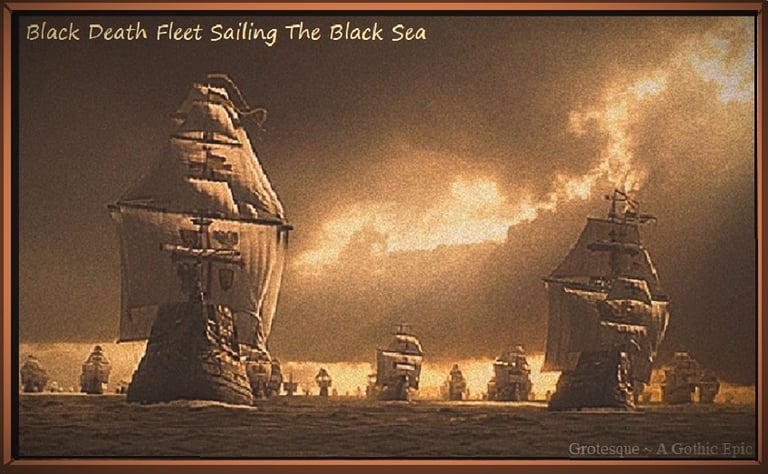
The once tranquil countryside had slowly changed: where the crisp scent of autumn leaves and birdsong carried through unbroken forests, the air now carried the sounds and smells of growing conflict—of rumbling hooves on frozen ground—of leather, sweat, waste and lingering rot—of distant screams and blowing beasts. Initially sporadic, the attacks on the city grew more organized and fierce as the campaign evolved. Still, the Genoese kept the Mongols at bay for three gruelling months—till the Tartars eroded Kaffa’s ramparts with wave upon wave of vengeful, charging, screaming, and most-honourable Mongolians. In the spring of 1347, when the weather warmed and the cherry blossoms bloomed, Genoese blood seeped from its own city walls. Low on provisions and able bodies, the stranded inhabitants came to terms with the outwardly inevitable outcome—that the Tartars stood on the verge of taking the city.
Yet the tide of battle changed, as the Tartars suffered a rather unusual and perhaps divinely intentional twist of fate. The winds turned and the heated breath of Lucifael blew over the pressing armies as the plague had finally infiltrated the ranks of the Tartar hoards. In only days, the entire countryside reeked with the heaping decay of rotting Mongols, and, for leagues in every direction, the fumes of festering human flesh ruined the air. Mortified, the Tartar Lords saw their vast numbers crumble, as whole legions fell; bloated, blackened, and decimated by disease.
'Twas little wonder that the Tartars fell stricken and ashamed of their newly weakened condition—they held their cultural and religious preoccupations in highest esteem; revered with an honour greater than any fear of life lost. Mostly blind by such strict social notions, of which were underscored by centuries of unwavering indoctrination, the Mongol warriors appreciated only one way of life and accepted only one manner of death. For the Mongols, life and death were black and white, with no confusion in matters regarding dignity and dishonour. For them, death in battle was honourable, unlike death by disease, which shamed their entire family and forever marked their survivors with the social stigma of impure lineage.
As many of the Mongols fell mad with fever, plagued to demonstrate a most-honourable death, they charged Kaffa’s walls in massive suicide raids. Stragglers, who were too weak to fight, stumbled forth and stood before the ramparts like ceremonial wretches and beggars of dignity, longing for a kind Genoese crossbow to still their suffering and rescue their families from otherwise inevitable and dishonourable distinction. Perhaps, by means of implied redemption, the Tartar warriors threw themselves against the base of the city’s fortifications, sacrificing their superior numbers to an ever-growing staircase of fly-infested flesh, allowing their Mongol comrades to climb their most-distinguished remains and scale the walls.
As the days wore on—when the sun retreated behind evening skies and the coastal breezes turned seaward, the Genoese colonists drowned in the acrid stench of a thousand souring Tartars. Still, they held their city, praying that the plague might eventually kill the will of the Mongol masses. Numbers and fortifications aside, Time was no ally for either army, since the Genoese were depleting their provisions as rapidly as the plague slew newly recruited Tartar warriors. Thus it might have seemed as though both armies had altogether fallen into a stalemate.
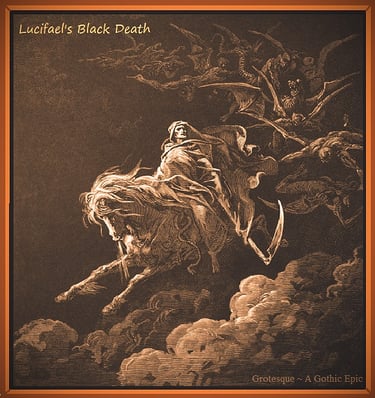
However, as History well knew; with every application of the Art of War, Man was merely a disposable pawn. After all, the Art of War was not of earthly design—‘twas strictly a divine invention, conceived even before the construction of Hell, when legions of heavenly Angels armed themselves against their earthly brothers and sisters: the Watchers, with their Chiefs of Tens. And one Angelic Sister, in particular, knew of the design of war. Like the Angel Apollo, Lucifael was also one of God’s foremost and favoured Angels, and privy to most of His Grand Design, including the Art of War and Conquest. Yet unlike Apollo's somewhat graceful fall from Grace, immediately following her downfall, Lucifael employed her acute knowledge of creation and destruction to influence Man, providing Him with new tools and strategies to wage evermore-effective wars upon His brethren—the canon, the longbow, and the armour-piercing bodkin arrow were only the latest devices of destruction designed via the intimate whisperings of her evil advice. Now, she whispered fresh secrets and, once again, the art of war had evolved to include Lucifael's deadly new concept. When she infected the auricles of the dying Tartar Lords with her wicked whisperings, they learned of her rather vile strategy of human annihilation: germ warfare.
Determined to oust the Genoese, and with Lucifael's fresh revelations, the Lords summoned a fleet of thirteen of their largest catapults, commanding its armies to hurl the contaminated corpses of their fallen comrades into the heart of the enclosed city. Evenly spread over Kaffa’s walls, the death machines never rested. Night and day, without cessation, an inexhaustible supply of plague-stricken Mongols rained down upon the Genoese city, crashing through rooftops and crushing unsuspecting passers-by. At such an ungodly rate of delivery, the colonists could not burn the bodies as quickly as the Tartars hurled them over the walls. And the ghastly odour of burning hair and skin mingled with the existing smell of rotting flesh, filling the enclosed settlement with a suffocating stench. Hell overwhelmed Kaffa. Atop the highest bough of a cherry tree, a lone crow cawed twice—and again...
[ End Excerpt Teaser Text ]
Grotesque ~ A Gothic Epic© is legally and formally registered with the United States Copyright Office under title ©#TXu~1~008~517. All rights reserved 2000-2026 by G. E. Graven. Website design and domain name owner: Susan Kelleher. Name not for resale or transfer. Strictly a humanitarian collaborative effort. Although no profits are generated, current copyright prohibits duplication and redistribution. Grotesque, A Gothic Epic© is not public domain; however it is freely accessible through GNO. Access is granted only through this website for worldwide audience enjoyment. No rights available for publishing, distribution, AI representation, purchase, or transfer. This presented literary work is irreversibly-sovereign, free for nonpublishable and personal reading only, and shall not be subject to explicit or implicit agreements, understandings, restrictions or surrenders of any sort; whether public or private, individual or institutional, corporative or governmental, or other. Susan Kelleher maintains all website control, and George (G.E.) Graven maintains all international intellectual property rights for any and all prior and future versions, revisions, translations, digital representations, and variations of the literary work: Grotesque, A Gothic Epic©, until the stated copyright expiration date, when it is properly and legally released into the public domain. Driven by Anonymous Polymath and more. Continued public access is ensured and protected under this non-profit humanitarian effort, forged exclusively as a digital and literary dedication to the late Gothic author: Edgar Allan Poe.