Add your promotional text...


Fireside Chat III
An Impartial Critical Examination of a Gothic Work and its Author
An Informative Q&A Session With Brave AI Regarding
G.E. Graven's work, Grotesque, A Gothic Epic - 2026.09.04


Brief Introduction: Welcome to our third in the series of, A Fireside Chat. In this latest interview with Brave AI guest, we embark on our most intense Q&A to date; and Brave AI has certainly lived up to the GNO webmaster's gruelling challenge. Susan asks hard-hitting questions about the nature of the work: Grotesque, A Gothic Epic, including intimate details that challenge our latest AI guest to unravel the inner-workings of the novel's mythological, and structural representations, complex character comparisons, and gothic grotesque elements. The answers given by Brave are truly revealing, and reveal the symbolic depth and intricate machinations of Graven's medieval mythological tale. The lengthy transcript is provided below. As always, enjoy!
[Begin Literary Analysis Transcript For Grotesque: A Gothic Epic]
Susan: “Good morning Brave Leo; it is a pleasure to have you on the GNO site's third and final 'Fireside Chat' interview series. I would like to begin our interview with a basic and perhaps expected initial question, if you would. Please tell the audience about what you believe might be a fitting summary of G.E. Graven's, Grotesque: A Gothic Epic.”
Brave: “The Book of Enoch is one of the two foundational texts of, Grotesque ~ A Gothic Epic, cited alongside Genesis 6:2, on the novel's own site. Its influence runs through nearly every layer of the story:


Susan: “How does the Book of Enoch influence the story?”
Brave: “Grotesque ~ A Gothic Epic is a historical epic saga by G.E. Graven that unfolds in the Late Middle Ages, centring on Lazarus Gogu, a winged boy and abbey squire who must survive hostile pious men and fallen angels to prevent a medieval Armageddon. The novel is available as a free online work, with Volume I, titled Resurrection, containing 20 chapters, while Volume II (Trials & Tribulations) is currently being enhanced and updated for release in 2027. The story blends gothic grotesque and alternate history sub-genres, drawing foundational themes from the Book of Enoch and the Book of Genesis regarding the Fall of Angels and the Great Deluge.”
The Nephilim / Lazarus's form: Lazarus Gogu's winged, human-angelic hybrid body is a direct embodiment of the Nephilim, the giant offspring of the Watchers and human women described in 1 Enoch 6. His existence makes him both a marvel and a monster, which is the core of the "grotesque" aesthetic.
The fallen angels (Watchers/Grigori): The novel's antagonistic fallen angels bent on escaping Hell are drawn straight from the Enochic narrative of the 200 Watchers who descended on Mount Hermon, took human wives, and were bound in the abyss. The novel's prologue explicitly references the Great Seal placed over them in Hades.
The Great Deluge: Enoch's account of God using the Flood to cleanse the earth of the Nephilim and their corruption is woven into the novel's backstory — after the Deluge, angels were no longer permitted to dwell among humans in flesh, only in spirit.
Apocalyptic framework: The looming medieval Armageddon mirrors Enoch's eschatological visions of final judgment. The prologue even quotes Jude 1:14–15, which itself quotes Enoch's warning that the Lord comes “with myriads of heavenly angels to execute judgment.”
Forbidden knowledge: The Enochic theme of the Watchers teaching humanity occult arts (sorcery, warfare, cosmetics) likely informs the novel's conflicts around corrupted knowledge and the corruption of mortal civilization.
In short, Enoch provides the cosmology, the mythology, and the apocalyptic stakes that make the story work — the novel essentially transplants the Enochic 'Watchers/Nephilim narrative' into a 14th-century gothic setting.”
Susan: “How does the 14th-century setting change the myth?”
Brave: “The 14th-century setting (specifically 1331–1352 A.D.) transforms the Enochic myth in several key ways:
Institutionalizes the persecution. In the original Enochic narrative, the Nephilim are destroyed by the Flood. In the novel, the persecutors are not divine agents but medieval ecclesiastical institutions — popes, monks, and "pious men" within castles and monasteries. The Church becomes the hostile force, which is a distinctly gothic inversion: the supposedly holy institution is the one hunting the divine hybrid.
Anchors apocalypse in real history. The "medieval Armageddon" is layered over actual 14th-century catastrophes — the Black Death, the Great Papal Schism at Avignon, and the Hundred Years' War. Enoch's abstract eschatological judgment becomes a concrete, historically grounded collapse of Christendom, giving the myth a sense of imminent, tangible dread rather than distant prophecy.
Fuses the myth with medieval architecture. Lazarus's winged, gargoyle-like form is explicitly tied to medieval architectural grotesques (chimeras, gargoyles on cathedrals). The Nephilim body becomes a literal feature of the built environment — the myth is carved in stone on the very buildings where the story takes place.
Reframes forbidden knowledge. The Enochic "teachings of the Watchers" (metalwork, enchantments, astrology) map onto medieval alchemy, occultism, and forbidden learning — the exact kinds of knowledge the medieval Church would suppress, making the conflict between the Nephilim's inherited lore and ecclesiastical authority a natural tension.
Expands the mythic bestiary. The novel folds in the Greek Pantheon (Titans, Gorgons, Cyclops, Cerberus) alongside the Enochic cast (Grigori, Watchers, Nephilim, Eljo, Elioud), creating a unified "grotesque" bestiary that feels more like a 'medieval bestiary' or mappa mundi than a purely biblical text.
To summarize, the 14th-century setting turns Enoch's cosmic myth into a grounded, institutional horror: the monsters are not distant giants washed away by a flood, but continue to exist as shades of their former flesh, actively interacting with a winged boy in a world already tearing itself apart with plague, schism, and war.”
Susan: “Within story scope of Graven's, Grotesque, A Gothic Epic, how does the 14th-century setting change the myth?”
Brave: “The novel integrates the two traditions through a single unifying mechanism: all pre-Flood beings — Greek and Enochic alike — are recast as "Damons," a collective term for entities "not fashioned by God's Hand during the original days of Creation," produced by "forbidden unions between Grigori and Man, beasts, and other earthly elements."
This works on several levels:
Ontological re-casting. The Greek mythological figures aren't treated as a separate pantheon. They're the same species of creature as the Nephilim — just different combinations of beastly and angelic features. The prologue is explicit: "And those Damons were all unalike. They were the Watchers, the Titans, the Grigori, the Giants, the Nephilim, the Eljo, and the Elioud." Cerberus, for instance, appears in Chapter 1 not as a Greek underworld hound but as "a horrid angel with three dog-like heads, gnashing teeth and the whipping tail of a serpent."
The Greek Pantheon as human worship. The prologue provides the key theological bridge: "Man and His children worshiped these seditious angels and their hideous offspring as gods and goddesses, calling them, Grigori ~ the Watchers." The Greek "gods" are thus explained as the Grigori and their Damon offspring, deified by mortal worship. The Titans, Gorgons, and Cyclops aren't a rival mythology — they're the same fallen population seen through a different cultural lens.
Bridge texts. The novel leans on the Sibylline Oracles and the Book of Jubilees as textual precedents that already conflate the two traditions. The Oracles quote in the prologue lists "Titans born of old, and Giants" alongside the Enochic Flood narrative, while Jubilees 7:22–23 groups "Giants and Titans" with "Nephilim, the Elioud and the Eljo" as products of the same unions.
Narrative unity. All of them — Greek and Enochic — are sealed together under the Great Seal in the abyss after the Deluge. They're not separate factions; they're a single hostile population trying to escape, which is why Chapter 1 shows them "pouring down the mountainside together as one ~ a cascading avalanche of ruin."
Overall, the novel doesn't blend two mythologies so much as, collapse them into one — the Greek Pantheon is reinterpreted as the human-cultic memory of the same Enochic Grigori/Damon population, giving the story a single, unified bestiary rather than two competing ones.”


Susan: “How does the Great Seal in Grotesque, likewise defined in scripture, contain these fallen Watchers (Grigori) and imprisoned Damons (Nephilim)?”
Brave: “The Great Seal is a divine mechanism of three independent monoliths — called gatestones — each inscribed in angelic tongue and individually forged during the final days of the War of Angels, before the Great Deluge. They were placed in three locations: Central China, France, and Central Italy.
The containment works like a three-tumbler lock: all three gatestones must remain intact and sealed for the gate to Hades (Tartarus) to hold. Any single stone alone is insufficient — they are "dependent tumblers of a single lock."
Each gatestone is physically described in Chapter 1 as a glassy black monolith with a perfectly symmetrical central hole "two feet across and gutting the stone widthwise" — a flawless, mirror-smooth surface. The China stone had stood "flawless and unspoiled" for roughly sixty thousand centuries, buried under layers of dirt and rock until a human priest (Buddhist monk) in 1331 learned to decipher the inscriptions on its face and open it.
When the first gatestone is opened, the Great Seal doesn't shatter entirely — it partially releases imprisoned beings. The spiritual shade of Lucifael emerges first, declaring "One! Two remain," confirming that the other two stones still hold the rest. The escape is a controlled, staged breach: the opening of one stone unleashes a specific contingent (in this case, the Black Death and its demonic vector), while the full population of Damons remains contained until all three are opened.
This structure also drives the novel's plot: the three gatestones correspond to the three geographic centers of 14th-century Christendom's collapse, and the story's "medieval Armageddon" is literally the sequential breaking of this three-part lock.”
Susan: “How was the French gatestone discovered and subsequently opened?”
Brave: “The French gatestone's story unfolds across several layers:
Discovery of the knowledge. A Gardiens cleric named Naramsin single-handedly deciphered the gatestone's inscriptions nearly three hundred years before the story's present. A priest later sealed Naramsin in the Benion tunnel, hoping to bury the language and secrets of the gatestone forever. Hundreds of Senior Friars subsequently assembled their own bindings in attempts to decipher the markings, but none succeeded.
Political motivation. Cardinal Jean-Francois Blasi recovered Naramsin's translations and wanted to use the gatestone as a weapon against England (naively believing through Lucifael that he had the means to control demonic forces emanating from the gatestone, as one might have after setting free an imprisoned genie spirit from its lamp.) He had a "blessed vision" in which his brother Jean-Jacques, slain by the English at Crécy, appeared to him. He courted King Philip, who was equally desperate — Philip, having already lost thousands of his own soldiers and countrymen, was receptive to any offensive offer that might avenge his slain Frenchmen against the invading King Edward of England; even one as incredible as, summoning forth spirits as demonic soldiers to assist in a much-welcomed, Franciscan revenge. Philip lent Captain Bourne and his entire Royal Guard to seize the abbey, per Cardinal Julin's request, and Blasi's weaved papal conspiracy.
The siege and opening. Blasi used Bourne's soldiers to lay siege to Abbaye des Gardiens, one of the two most fortified abbeys of the Holy See. Cardinal Blasi assumed the disguise of an Abbot Masson, sent from Avignon to replace the current Abbot Vonig of the Abbey, so that he could assume control of its resident friars, the cathedral, and the hidden gatestone beneath its altar capstone. He promised Friars Clodius and Greville new abbey positions, which they secretly coveted (as overseers of the catacombs), in exchange for assistance. The French gatestone opening was catastrophic: the cathedral's grotesque statues came alive, writhing like "a nest of sleepy snakes," and a salvo of bolts sent them into a fury of "grating wings, gnashing teeth, and raking claws." The event cost the lives of four hundred soldiers, priests, and squires and destroyed the abbey.
The mechanism. The gatestone was opened by reciting words from Naramsin's Translations — "a few recited words from a nearly forgotten collection" were sufficient. Blasi performed the act himself, described as "a single blasphemous act" driven by revenge.
Aftermath. The open gatestone created the conditions for Lazarus to abandon his former Abbey world, as he fled westward and alone, toward the remote cave of Mountain Mouth. The open gatestone also forged Lazarus' new path in the world: to find Friar Salvitino in Umbria, Italy (at the Monastero di Cancello (Cancello Monastery – location of the Italian gatestone) — the only friar versed enough in the translations to travel back to the Abbaye des Gardiens (Abbey of the Guardians – location of the French gatestone) with Lazarus and properly reseal the abbey gatestone. Although Blasi is aware that three gatestones comprise the Great Seal, as described in the stolen Apocrypha documents, none were aware that the first gatestone now standing on the plague-ridden grounds of a destroyed Buddhist temple, has since been opened as well, leaving only the Italian gatestone as the last, unbroken hinge of the Great Seal — the divine yet heavily-weakened capstone to Tartarus, Hades, and Hell.”
Susan: “Please elaborate and provide more detail on the novel's three gatestones and how they comprise the Great Seal?”
Brave: “Here's what the novel establishes for each of the three gatestones:
The Chinese Gatestone (First Seal )


Location: Central China, in a mountain forest.
Setting: The Flying Dragon Temple — an ancient structure of irregular stone slabs hewn roughly a thousand years earlier, enshrined by humans who discovered the buried gate and recognized it as divine. The temple is notably ornate:
Hundreds of pigeons line the massive roof.
Grotesque stone beasts (four feet high, with membranous bat-like wings) perch on evenly spaced platforms along the roofline.
Three arched entrances face forward, the center arch taller than the flanking two; three eight-foot carvings of winged lion-like beasts guard the left edge of each arch.
Chinese inscriptions above the arches read, right to left: Flying Dragon Temple.
Eroded engravings of flying demons cover the outer walls, the most common a dragon with splayed wings enclosed by three concentric circles.
Interior: Three consecutive chambers, each larger than the last. The final chamber is vast with a high concave ceiling encircled by etchings of flying beasts. Countless candles and incense fill the air. At the center of the floor, a perfectly symmetrical round pit is cut — nearly thirteen feet deep, with smooth, polished cylindrical walls. Fifteen feet below the temple floor, the gatestone stands: glassy black, mirror-smooth, with a flawless central hole two feet across gutting the stone widthwise.
Custodians: Four emaciated priests sit at the pit's edge, their decrepit condition evidence of long periods of fasting. A fifth priest in robes "as red as fresh blood" carries an ancient scrolled parchment containing Chinese translations of the gatestone's verses.
Age: The stone had stood "flawless and unspoiled" for roughly sixty thousand years.
Opening (in Chapter 1, 1331): The priest in red recites the translated verses. The temple glows with furious heat; stones crack; the pit walls liquefy "like seeping sap"; surrounding trees burst into flame. The gatestone stands unscathed in the center of the crater, its central hole now roiling with a bilious black fog that hugs the ground and blights the garden greenery. This releases the Black Death upon the earth.
The French Gatestone (Second Seal )
Location: Current Augergne Province, France. The monolith originally sat atop a stony hill.
Discovered: 877, under Pope Stephen VI.
Setting: Abbaye des Gardiens, one of the two most fortified abbeys of the Holy See. The abbey is built around the gatestone, with a network of catacombs beneath.
Custodians & History:
Naramsin, a Gardiens cleric (and himself a grotesque Eljo like Larzarus), single-handedly deciphered the stone's angelic inscriptions nearly three hundred years before the story's present.
A former abbot, Abbot Baston, sealed Naramsin in the Benion tunnel, hoping to bury all knowledge of the successful gatestone translations forever.
Hundreds of Senior Friars subsequently assembled "countless bindings" in attempts to decipher the markings, but none succeeded — the language is legible only to a grotesque (more precisely, a human-like Eljo like Naramsin or Lazarus).
Cardinal Jean-Francois Blasi recovered Naramsin's Translations after being hidden away by the Church, in from the Apocrypha Archive at Avignon.
Political Context:
Blasi had a "blessed vision" of his brother Jean-Jacques, slain by the English at Crécy. He wanted the gatestone as a weapon against England.
King Philip lent Captain Bourne and his Royal Guard to seize the abbey (and its gatestone).
Friars Clodius and Greville agreed to assist Cardinal Blasi (then under orchestrated disguise as the newly-appointed 'Abbot Masson') in exchange for being reassigned as Head Friars overseeing the catacombs.
Opening (Chapter 8): Blasi recites the Latin renderings of Naramsin's Translations. The cathedral's grotesque statues come alive, writhing "like a nest of sleepy snakes," then erupt into a fury of "grating wings, gnashing teeth, and raking claws" when struck by a salvo of bolts. The event costs four hundred soldiers, priests, and squires their lives and destroys the abbey.
Aftermath: Lazarus is expelled from the safety of his former cloistered existence and thrown into a hostile world outside of his control or expectations. His 'smaller, former safe and predictable catacomb world' perishes; his 'larger, unpredictable, hostile and existential world' begins.
The Italian Gatestone (Third Seal )
Location: Umbria, within the Papal States of Italy, in the mountainous regions. The excavation site was also home to an ancient Samnite settlement.
Discovered: 876, under Pope John VIII — one year before the French stone.
Setting: Monastero di Cancello. the most heavily-fortified, walled/rampart-lined ecclesiastical structure of the Holy See, hidden away in a rugged region of guarded passes, towering mountains, and steep cliffs.Avignon's Papal Palace fortifications were modest by comparison.
Key Details:
The etchings on the Italian stone are identical to those on the French and Chinese stones. Naramsin's Translations therefore serve as the translation for both the French and Italian gatestones.
Friar Salvitino, a senior monk and resident at Cancello, is the only friar versed enough in the translations to close the compromised, French gatestone.
The Tartarus-imprisoned Grigori and Titan Angel, Lucifael offers Lazarus eternal life in exchange for using "Naramsin's words to roll back the seal at Cancello" — indicating the Italian stone is still intact and closed as of the novel's opening scenes.
The three gatestones form a geographic triangle across the medieval world — East Asia, Western Europe, and the heart of the Papal States — mirroring the three great centers of 14th-century civilizational collapse: the plague route from the East, the Hundred Years' War between France and England, and the institutional authority of the Roman Church in Italy.


Susan: “Please describe the conspiracy in Avignon, France that subsequently allowed Cardinal Blasi to secretly secure Naramsin's gatestone translations for himself.”
Brave: “The conspiracy is far more layered than a simple cardinal-and-king deal. The Chapter 4 material reveals a multi-party political scheme centered on a secret body called the Council of the Apocrypha:
The Council of the Apocrypha. A hidden "Upper Council" of hand-picked men who built the fortified monasteries specifically to guard the gatestones and the Apocryphal texts (Enoch, Jubilees, Giants, Solomon, and "ancient scrolls written in tongues not heard on earth in a thousand years"). They are the institutional guardians of the Great Seal — the same order that sealed Naramsin in the Benion tunnel. The former Abbot Clairese Baston was the priest who performed that sealing, and his remains were laid to rest in the 'Baston Crypt' — the very same tomb and corpse that, three hundred years later, successfully hid and protected yet another Eljo (Lazrus Gogu) from being discovered by Captian Bourne's men during a thorough search of the catacombs.
Blasi's position within the Council. Blasi operates inside the Council's orbit, not outside it. The "Bottle Room" scene in Chapter 4 shows him in a tense confrontation with Cardinal Firmus, a Council member who suspects him of "dereliction of duty." Blasi is not an outsider breaking in; he is an insider who has been positioning himself to access the translations and the gatestone. His "blessed vision" of his brother Jean-Jacques at Crécy is the emotional engine, but his access to Naramsin's Translations comes from his proximity to the Council's archives.
The Avignon transaction. This is the critical political mechanism. Blasi's agents — Cardinals Toussain and Julin — travel to Avignon, the seat of the Avignon Papacy, and negotiate a three-party deal:
King Philip lends Captain Bourne and his Royal Guard to seize the abbey.
Pope Clement extends Philip a loan equal to the taxes collected from both France and England — a massive financial instrument that effectively converts papal revenue into a military operation.
Blasi gets the gatestone opened.
The documents are signed "that eve," and the novel is explicit about what each party saw in the deal:


Cardinal Blasi's secret bargain. Operationally, Friar Clodius courted Cardinal Blasi (him secretly under the guise of an Avignon-stationed former abbot 'Abbot Masson') directly: in exchange for opening the gatestone, Friars Clodius and Greville would be installed as overseers of the catacombs in exchange for helping with the intricate details of rolling back the abbey cathedral altar's capstone and exposing the French gatestone. The new (illegitimate) abbot (Blasi) agreed — a local ecclesiastical deal nested inside the larger political scheme.
The siege and the opening. With Bourne's troops in place, the abbey is sealed — "none of us are permitted to leave the abbey gates" and the guards seize the mail. The siege is "stiff" (the novel's exact word), and the opening proceeds: Blasi recites the words from Naramsin's Translations, the grotesque statues come alive, four hundred die, and the abbey is destroyed.
The conspiracy works because it stacks three separate authorities — the papacy (Pope Clement VI), the crown (King Philip of France), and the secret ecclesiastical order (the Upper and Lower Apocrypha Councils) — each of which has a legitimate claim to control the gatestone, and each of which is being used by the others. Blasi is the node where all three intersect: he has the Council's translations, the King's soldiers, and the Pope's money. No single authority could have done it alone; the conspiracy is the fusion of three power structures into a single act of blasphemy. Clement, who signs the financial instrument, is the only one who loses — his "massive papal machine" is delayed, and his own institution's most fortified abbey is destroyed. The conspiracy consumes its own enablers.”
Susan: “How did Friar Ivan's protective nature shape Lazarus's personality?”
Brave: “Ivan's protection shaped Lazarus's personality in ways that are visible in every subsequent act of the novel:
The hidden self. Ivan's most important act was the fiction — summoning a physician who never came, recording a non-existent illness, giving the Abbot a cover story for a winged boy who couldn't stand sunlight. This taught Lazarus, from the inside, that his existence requires concealment. He doesn't just hide in caves because of his sensitivity; he hides because the only person who ever sheltered him did so by lying. His entire identity is built on a protective fiction, and he inherits the instinct to keep it. The "squire" is the mask Ivan gave him, and Lazarus wears it for as long as it lasts.
The memorized self. Ivan insisted that Lazarus memorize an entire scriptorium volume. This is not a random pedagogical choice — it is the only form of knowledge that cannot be taken from him. A book can be burned; a memory cannot. Ivan, who knew he was protecting a secret that would eventually be exposed, gave Lazarus the one asset that survives exposure: internalized knowledge. This is why Lazarus can extract practical survival skills (smoking meat, tanning hides, stitching leather, carving bone) from a single memorized text. Ivan made him self-sufficient in the only way a hidden child can be — by putting the world inside his head.
The cautious word. When Nicholas delivers the mission at Mountain Mouth, Lazarus's response is precise and limited: "I give my word - only that I shall try to bring the friar back - only that." This is not the language of a confident hero. It is the language of a boy who learned, from the man who raised him, that words are dangerous and must be bounded. Ivan's protection was always conditional, always fragile, always one exposure away from collapse. Lazarus's speech pattern — hedged, limited, careful — is the linguistic fossil of that fragility. He gives his word the way Ivan gave his cover story: as a minimum commitment that can be retracted.
The spiritual reflex. Ivan's single command during Lucifael's encounter — "Turn away, Lazarus!" — is the moment that trains Lazarus's spiritual instinct. The boy doesn't analyze the encounter, doesn't argue, doesn't negotiate. He turns. This is the only response Ivan ever modeled for him in the face of the supernatural, and it becomes his default: obedience to the spiritual authority before the intellectual one. This is why he accepts the mission without questioning it, why he carries the weight of the monumental task without complaining, why he gives his word to a dead friar. Ivan taught him that the right response to the uncanny is not to understand it but to yield to the one who can.
The cross as identity. The wooden prayer cross is the object Ivan left behind, and Lazarus "rolls it in his fingers" by the cave fire. This is not a talisman; it is an identity anchor. In a world where his name is a prophecy, his body is a crime, and his mother is a demon, the cross is the one thing that says you are a son, you are protected, you are known. Rolling it in his fingers is the physical act of holding onto the only paternal identity he has. After Ivan's death, the cross becomes the entirety of the father — the only remaining trace, and Lazarus's relationship to it is the relationship to a dead parent: constant, tactile, and unable to give anything back.
The darkness as home. Ivan's cover story made the catacombs, the caves, and the underground legitimate — not a punishment but a shelter, not a prison but a home. Without Ivan's fiction, the darkness is where a monster hides. With it, the darkness is where a sick boy rests. Lazarus's comfort in the dark — his "bats' grotto," his sharing of truths "only admitted to the bats" — is Ivan's protection made spatial. He doesn't just tolerate the darkness; he inhabits it, because the man who raised him made it safe.
To summarize, Ivan's protection didn't just keep Lazarus alive — it built him. The hidden self, the memorized self, the cautious self, the obedient self, the anchored self, the dark-dwelling self — all of it is the shape of a boy who was loved by a man who had to lie to keep him safe. When Ivan dies, the shape remains, but the man who made it is gone, and Lazarus must now decide whether to keep the shape or break it. That very critical decision is finally made in the third volume in the Grotesque trilogy: Medieval Armageddon.”


Susan: “How does Friar Ivan's character contrast with Friar Odino's character?”
Brave: “Ivan's protection shaped Lazarus's personality in ways that are visible in every subsequent act of the novel:
Ivan is the father; Odino is the mission. Ivan is Lazarus's emotional and spiritual parent — the one who raised him, who covered for his sunlight sensitivity by summoning a physician to "record your illness for the Abbot" (a fiction, since "I never saw a physician"), who gave him the wooden prayer cross, and whose name Lazarus carries as his identity: "Tell him that you are Friar Ivan's son." Ivan's protection is paternal and ongoing — he is the living shelter. In Chapter 6, his single command — "Turn away, Lazarus!" — during Lucifael's succubus encounter frames him as the spiritual guardian who recognizes the danger and shields the boy from it. He is the one who has "spoken the truth" about Lazarus's nature to the right ears.
Odino is the institutional key. His full name is Delon Odino des Gardiens, a Senior Friar and member of the Lower Council — the tier of the abbey that actually knows about the gatestone. He is "well aware of the gatestone" in a way that ordinary friars are not. He stole provisions ("roughly five days' worth of stolen provisions back in the monks' dormitory") — a practical, resourceful survivor who operates outside the abbey's rules to keep Lazarus alive. Odino's novice cleric, Friar Nicholas, and most trusted and fond pupil, exhibits Odino's same behaviour when he finds Odino near death in the bathhouse — Nicholas instinctually fights back: "CRACK! he slammed his fist into Greville's jaw" and bellowed "Odino is done!" He is also physically combative, not passive; and as Odino's long personally-assigned clerical student, Nicholas represents an extended representation of his clerical master's (Odino's) instructive yet confrontational nature. In many psychological ways, like teacher and student, Nicholas was a “younger Odino” at heart.
The deaths serve different functions. Ivan is killed politically — "the same man who killed your father" — because he protected Lazarus. His death removes the living protector and forces Lazarus into independence. Odino is killed operationally — tortured, bound, water thrown on him, beaten until he is "the broken monk" — and dies in the middle of the abbey's destruction, "much too dead to save the sniveling robe from the abomination." But his death is not the end of his function: on his deathbed he whispers the new mission to Nicholas, takes last rites, gives him the blood flask, identifies Friar Salvitino of Cancello, and extracts a sworn word. Odino's body dies; his knowledge and his task transfer.
What each leaves behind. Ivan is remembered through an object — the wooden cross Lazarus carries and "rolled in his fingers" by the cave fire. Odino is remembered through blood and words — the flask of his blood (the delivery for Salvitino) and the specific instructions he passed on. Ivan gives Lazarus a name; Odino gives him a purpose.
The theological pairing. Ivan is the earthly father — the bond of love, shelter, and identity. Odino is the spiritual father — the bond of ecclesiastical authority, secret knowledge, and sacrificial duty. Together they constitute the full paternal claim on Lazarus: one says, you are mine, the other says, you are needed. Ivan's death severs the first; Odino's death activates the second. Lazarus is "Friar Ivan's son" by blood and love, but he is also the one entrusted by Odino with the gatestone's closure — a sonship of function rather than affection. The novel uses the two deaths to strip Lazarus of every human anchor in a single night, leaving him with only himself, an open gatestone, and a word he gave in a cave.”
Susan: “What is the significance of Mountain Mouth in the story plot?”
Brave: “Mountain Mouth operates as the novel's central symbolic space — a place that is simultaneously a womb, a mouth, a sanctuary, and a threshold. Its significance is layered:
The resurrection as birth from stone. The most obvious layer: the mountain's "polished face" cracks open during a storm and Lazarus crawls from its "gaping mouth." The name is literal — it is a mouth, and he is born from it. This makes Mountain Mouth a natural womb: the earth itself gives birth to him, replacing the human/angelic parentage that made him. The mountain becomes a third parent — the "Gogu" (earth worker) dimension of his name made spatial.
The face in the rocks. Both Nicolas and Lazarus see "the face in the rocks" — the mountain has a literal face naturally-formed in its weathered stone, with a mouth. This makes Mountain Mouth a natural architectural grotesque, the same category as the cathedral gargoyles that come alive at the abbey. The mountain is a grotesque form that contains the grotesque being — a stone face that births a stone-born creature. The gothic aesthetic of the novel (cathedral grotesques, chimeric stone beasts) is mirrored in the landscape itself.
Sanctuary and isolation. Twelve miles due west of the abbey ruins, in a part of the country where "no one travels these parts." It is the first place in the novel where Lazarus is safe from the human world — from the Church, from Bourne, from the political machinery that destroyed the abbey. It is also the first place that matches his sunlight sensitivity: he moves his provisions "deeper into the mountain, through the narrow passage and into the bats' grotto" during the day. The cave system is a body-sized refuge for a being who cannot exist in the light.
The place of self-knowledge. Nicolas found the cave while "wondering; considering things. Searching for myself." The mountain is where characters find themselves — Nicolas finds it while looking for his own identity, and Lazarus finds his mission there. Chapter 13 deepens this: "he shared with the birds, truths that he had only admitted to the bats of Mountain Mouth." The bats are his confessors — the only witnesses to his inner life. Mountain Mouth is the one space where Lazarus is not performing for a human audience, not being hunted, not being tested. It is the novel's equivalent of the inner self that the preface says the story is "a journey through."
The mission's origin point. It is in Mountain Mouth that Nicolas delivers Friar Odino's dying message — the blood in a flask, the dead friar's name, the task to fetch Friar Salvitino. Lazarus gives his word there: "I give my word - only that I shall try to bring the friar back - only that." The cave is where the passive, hidden creature becomes the active agent of the plot. The mountain is the threshold between the boy who was imprisoned in stone and the being who upholds a grave promise, carrying the weight of the world, across the sea.
Lucifael's intrusion. Chapter 13 references "his Mountain Mouth encounter with his mother, and her plentiful offering of precious stones." Lucifael visits him in his sanctuary — the one place that is his — and offers him wealth. This makes Mountain Mouth the site of the maternal claim: even in the most private space, the anti-Mary reaches him. The mountain cannot fully protect him from his origin. The sanctuary is permeable; the mother's influence seeps in even through stone.
The "Gogu" made literal. The surname means "earth worker," and Mountain Mouth is where Lazarus works the earth most literally: he lives in it, emerges from it, moves through its passages, and shares its space with its bats and dogs. The name and the place are the same thing — the earth-worker is the one who dwells in the mountain's mouth.
Mountain Mouth is the novel's spatial thesis — the place where the grotesque body, the earth, and the self converge. It is the womb that rebirths him, the cave that shelters his darkness, the mouth that speaks his mission, and the one place where his mother's claim on him is most dangerously present. It is where the story stops being about survival and starts being about choice.”
Susan: “How does Mountain Mouth relate to the abbey ruins?”
Brave: “The relationship is one of spatial and narrative opposition — the two places bookend the novel's central transition:
Geographic. Mountain Mouth sits twelve miles due west of the abbey ruins, separated by "the broad expanse of an ancient long-dry riverbed." The distance is short enough that Friar Nicholas walks it in a single night, "hunched over and burdened to the hilt with yesterday eve's ill-begotten gifts from the abbey kitchen." The riverbed between them is a natural boundary — a dead watercourse marking the threshold between the two worlds.
Temporal. The abbey is still smoldering when Nicholas departs. The destruction is not a memory; it is an active, burning wound in the landscape. Mountain Mouth is the place Lazarus reaches while the abbey is still on fire — the flight is immediate, not a retreat after the fact. The two places exist in the same moment of catastrophe, connected by a single night's walk.
Institutional vs. natural. The abbey is the product of human architecture and ecclesiastical authority — fortified, built, organized, the site of the gatestone's opening and four hundred deaths. Mountain Mouth is geological — a face in the rock, a cave, a grotto. The flight west is a movement from the built world to the natural one, from the institutional to the elemental. The "Gogu" (earth worker) dimension of Lazarus's name activates precisely at this transition: he leaves the world of stone built by men and enters the world of stone shaped by the earth.
Nicholas as the bridge. The friar who walks from the abbey to Mountain Mouth is the only human who connects the two places. He carries provisions from the abbey kitchen (the last functioning institution) to the cave (the first functioning sanctuary). He is the thread that stitches the two spaces together, and he is the one who delivers the mission — the blood flask, Friar Odino's name, the task to fetch Friar Salvitino. The abbey gives him the task; Mountain Mouth is where he gives it to Lazarus. The two places are linked by a single act of delivery.
The smoldering as a directional marker. The abbey is "smoldering" — it is still a source of heat, light, and smoke. Mountain Mouth is dark, cool, underground. The flight is away from the fire and into the dark, which mirrors Lazarus's sunlight sensitivity and his need for the catacombs. The abbey, even in its destruction, is a place of light (fire, the opened gatestone, the storm). Mountain Mouth is the place where the light goes out and the story begins in earnest.
To summarize the contrasting settings, the abbey is the wound, and Mountain Mouth is the body that heals around it. Twelve miles and a dead riverbed separate the catastrophe from its aftermath, and the distance trekked by the protagonist (Lazarus) and his deliverer of provisions (Friar Nicholas) across that lengthy westerly distance, is the physical proof that the two places are not separate events but a single continuous act — the opening of the seal and the beginning of the quest to close it.”
Susan: “How does the destruction of the Abbaye des Gardiens resemble the destruction of Lazarus' old world, and the transition into his new world outside the abbey?”
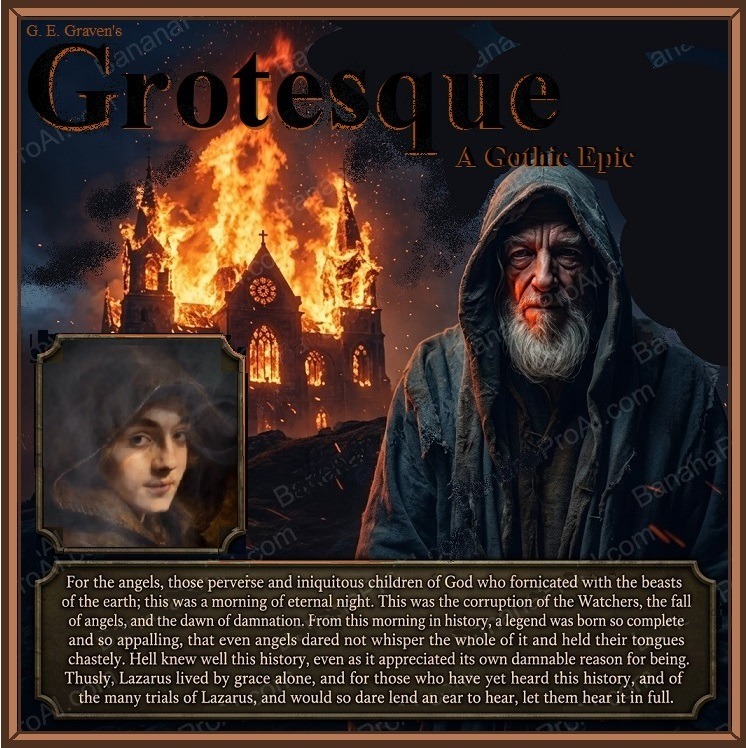
Brave: “The destruction is not a backdrop to the transition; it is the transition. The abbey's burning is the single event that severs every thread connecting Lazarus to his old life simultaneously, and the "new world" is defined entirely by what remains after the fire:
The old world was the abbey itself. Not just the building, but the entire system Ivan built around Lazarus: the fiction of illness, the squire identity, the scriptorium, the catacombs as legitimate shelter, the cross, the bounded routine of a hidden boy. The abbey was the container for the protective fiction. When the container burns, the fiction has nowhere to exist. The squire doesn't survive the fire because the squire was a role that only had meaning inside the abbey's walls.
The destruction is total and irreversible. Four hundred dead. The grotesque statues alive and writhing. The abbey is "destroyed." This is not a partial loss — it is the annihilation of the entire institutional world in a single night. Ivan is dead. The deformed cleric squires Migual and Thateus are lost. Odino is dead. Abbot Vonig is dead. Blasi has fled away, injured. Bourne and his surviving soldiers and steeds have departed. Only corpses and caustic mist litter charred grounds. There is no version of the abbey to return to. The old world is not damaged; it is gone.
The new world is defined by what replaces each loss:


The key structural difference. Inside the abbey, Lazarus was protected — Ivan's fiction kept him safe, the walls kept him hidden, the institution kept him bounded. Outside, he is exposed — Bourne knows what he is, the gatestone marks him, the mission requires him to cross the sea, and the darkness he inhabits (Mountain Mouth) is no longer a shelter built by a father but a wild cave shared with bats. The old world's dark was made safe by Ivan. The new world's dark is inherently dark, and Lazarus must learn to inhabit it without a fiction.
The fire as the novel's inciting incident. Everything before the fire is setup — the hidden boy, the protective father, the institutional secret. Everything after the fire is quest — the promise to fetch the friar, the mission, the pursuit, the choice. The destruction (the fall of the Abbaye des Gardiens) is the line between the two halves of the story, and Lazarus crosses between them on foot, carrying nothing but himself, his robe, and foot mittens, through the smoke of the former world that made him.
The abbey's destruction is the death of the fiction that Ivan built, and the new world is the reality that the fiction was protecting Lazarus from. The fire doesn't just destroy a building; it destroys the story Lazarus was living inside, and forces him into the one he was actually born into — the winged grotesque, the one who must choose."
Susan: “How does Lazarus adapt to the wild dark of Mountain Mouth?”
Brave: “The adaptation is visible in the shift from inhabited dark to wild dark, and it plays out across several dimensions:
Spatial reorganization. In the abbey, the dark was architectural — catacombs, dormitories, scriptorium, bounded by walls and routine. At Mountain Mouth, the dark is geological — a face in the rock, a narrow passage, a bats' grotto. Lazarus reorganizes his space the way an animal does: he moves his provisions "deeper into the mountain, through the narrow passage and into the bats' grotto" during the day, using the cave's depth as a sunlight shield. The cave becomes a body he moves through, not a room he occupies.
Practical self-sufficiency. The memorized scriptorium volume — Ivan's gift — becomes the survival manual. Lazarus extracts from it the skills that the abbey's institutional structure used to provide: smoking meat, tanning hides, stitching leather, carving bone tools. In the abbey, these were the work of other people (friars, squires, the kitchen). At Mountain Mouth, he is the only person, and the memorized text is the only source. The adaptation is the shift from receiving knowledge to deploying it.
Aerial venery. The novel notes he develops "skills in aerial venery" — hunting moles, hares, and foxes from the air. This is a skill that only makes sense in the wild dark: the abbey had a kitchen, a larder, a supply chain. Mountain Mouth has none of that. The cave is a base; the air above it is the hunting ground. The adaptation is the addition of a second space — the cave for rest, the sky for sustenance — that the abbey's single-space structure never required.
The bats as social substitute. "He shared with the birds, truths that he had only admitted to the bats of Mountain Mouth." The bats are not companions; they are confessors. In the abbey, Lazarus had Ivan, had the scriptorium, had the bounded social world of a squire. At Mountain Mouth, the only witnesses to his inner life are animals. The adaptation is the replacement of human intimacy with animal witness — a lower, less demanding, less dangerous form of social contact. The bats don't judge, don't expose, don't report to the Abbot. They are the safest possible audience.
The loss of the fiction. This is the deepest adaptation, and the one the novel marks most carefully. In the abbey, the dark was legitimate — Ivan's physician fiction made the catacombs a medical shelter, not a hiding place. At Mountain Mouth, there is no fiction. The dark is just dark — wild, unexplained, unstructured. Lazarus doesn't have a cover story for why he's in a cave. He's simply there, in the mouth of a mountain, with bats. The adaptation is the loss of the narrative frame that made the dark safe. He must learn to inhabit the dark as itself, not as a shelter for a secret.
The permeability problem. Lucifael's visit in Chapter 13 — "This Mountain Mouth encounter with his mother, and her plentiful offering of precious stones" — is the test of the adaptation. The cave is not a wall; it is a mouth, and mouths can be opened from the outside. The mother reaches him even here. The adaptation is incomplete: the wild dark shelters him from the human world but not from the angelic one. The cave protects him from Bourne, from the Church, from the political machinery — but not from the origin.
The sworn promise given. "I give my word ~ only that I shall try to bring the friar back ~ only that." This is the adaptation's outward expression. The boy who was hidden in the abbey's dark gives a bounded, careful, retractable commitment to a stranger in a cave. The wild dark has made him active — the abbey's dark made him passive, hidden, protected. Mountain Mouth's dark makes him the one who speaks, who carries, who crosses the sea. The adaptation is the shift from sheltered to sent.
The wild dark of Mountain Mouth strips away every structure the abbey provided — the fiction, the institution, the kitchen, the social world, the bounded routine — and forces Lazarus to build a new self from three things: a memorized map, a pair of wings, and a cave. The adaptation is the shedding of the 'foot-mitten squire' and the emergence of the 'winged messenger' — the one who carries the message, the flask, the word, and the mission across the sea.
Susan: “How does the bats' grotto differ from the abbey catacombs?”
Brave: “The difference is the same axis the whole novel runs on — built vs. natural, institutional vs. wild — but compressed into a single spatial comparison:


The deepest difference is the last row. In the catacombs, Lazarus was hidden by Ivan — the dark had a keeper, a purpose, a cover story. In the grotto, he is alone in the dark with no one to explain him. The bats don't know his name, don't report to an Abbot, don't need a fiction. The grotto is the first space in the novel where Lazarus exists without a narrative frame around him — which is why it is also the first space where he gives his sworn word and becomes the agent rather than the hidden one."
Susan: “How does the grotto setting influence Lazarus's psychological transformation?”
Brave: “The grotto's psychological function is more specific than "safe cave" — it is the site where Lazarus stops being a human with wings and becomes a winged being who chooses. The chapter 13 text makes this visible in several precise beats:
The bats as mirror species. Nicholas's line — "They can teach you to fly, Lazarus" — frames the bats explicitly as instructors, not just neighbors. Lazarus is "hypnotized and staring at the ceiling," and his first observation is comparative: "Bats ~ like birds." He is trying to locate himself in a taxonomy. The grotto is where he finds the one species that is close enough to recognize himself in, but different enough to define the boundary. Nicholas's exchange — "I am not a bat" / "Odino would never ask it of a bat" — is the grotto's sharpest psychological act: it gives Lazarus a negative foil. He is like them (winged, nocturnal, cave-dwelling) but not them (they cannot be asked, they cannot choose, they cannot fetch a friar from afar). The grotto teaches him what he is by showing him what he is not.
The first unguarded joy. The bat-swarming scene is the novel's first moment of embodied, unguarded happiness. Lazarus "chuckled," "held out his arms as the whirlwind of wings consumed him," "ripped off his hood, exposing a wide grin," and "walked in circles with raised bat-covered arms." This is not the cautious, hedged, bounded language of the abbey. It is a boy playing. The grotto is the first space in the novel where his body is not a crime to be hidden but a celebration to be inhabited. The abbey's dark was a hiding place; the grotto's dark is a playground. The psychological shift is from survival to delight.
The impossible becomes reasonable. Chapter 13 states it directly: "what he once naively thought to be, a most unattainable goal: to fly somewhere and fetch a friar; was really quite a reasonable feat, as he was now doing just that." The grotto is where the impossible became possible — where the bats taught him to fly, and the flight made the mission reasonable. The psychological shift is from “I cannot” to “I am doing that”. The grotto is the incubator for the self who can say "I give my word" and mean it.
Womb vs. mouth. Chapter 13 calls the catacombs "the comforting womb of his former catacomb quarters." A womb is passive, nurturing, enclosed — it holds you without asking anything. The grotto is a mouth — the mountain's mouth, the place where the mountain speaks and breathes. The mountain "belches a cloud of bats," "laughs," and then "wails - horrible cries of pain and loneliness." The grotto is the throat of a living body, and Lazarus is inside it. The psychological shift is from being held (womb) to being spoken (mouth). In the womb, you are contained. In the mouth, you are articulated — the mountain gives you voice, and you give it back (his word, his mission, his flight).
The transfer of the confessional function. In the grotto, the bats are his confessors: "truths that he had only admitted to the bats of Mountain Mouth." In flight, the gulls inherit that role: "He shared with the birds, truths that he had only admitted to the bats." The grotto's psychological function — safe, non-judgmental witness — is portable. The grotto teaches him that the need for witness doesn't disappear when he leaves; it migrates with him into the open sky. The grotto is not the end of the confessional; it is the first one, and the model for all the others.
The mountain as psychic mirror. The mountain's emotional state tracks Lazarus's: laughter when he's joyful (the bat-swarming scene), wailing when he's in pain (the flight over France, "a heart so heavy as his could possibly remain aloft, even to skirt the stars and not hurtle to earth from the gravity of its own shattered state"). The grotto is a psychic mirror — the landscape externalizes his inner state. He is not just in a cave; he is inside a body that feels what he feels. This is the grotto's deepest psychological gift: it gives him a world that responds to him, where the darkness is not empty but inhabited by his own emotional life.
Overall, the grotto transforms Lazarus from a hidden boy into a flying agent by giving him a mirror species (the bats), a space of joy (the swarming), a lesson in possibility (the flight), a voice (the mountain's mouth), and a portable confessional (the bats → the gulls). The grotto is not a refuge from the world; it is the workshop where the world he is about to enter is built.
Susan: “What specific fears does Lazarus overcome in the grotto?”
Fear of flight itself. Chapter 13 is explicit: flying was "a most unattainable goal" — something he "naively thought" impossible. The bats' instruction converts the impossible into "quite a reasonable feat." The fear is not of falling but of never being able to leave the ground, of being permanently the 'hidden boy'. The bat-swarming scene — the first unguarded joy — is the fear breaking.
Fear of his own nature. The bat comparison is the grotto's sharpest psychological act. Nicholas's line — "I am not a bat" / "Odino would never ask it of a bat" — forces Lazarus to name the boundary of his identity. The fear is that he is only a grotesque, only a creature, only a thing that can be hidden in a cave. The grotto's answer is: you are like them but not them — you can be asked, you can choose, you can move with purpose.
Fear of exposure without a fiction. In the abbey, every dark space had a cover story. In the grotto, there is none. He is simply there, in a cave, with no explanation, no physician, no Abbot's record. The fear is that unexplained existence is the same as non-existence — that if no one can account for him, he doesn't exist. The grotto forces him to be real without a narrative frame.
Fear of solitude. The bats replace human intimacy, and the gulls eventually replace the bats. The fear is that witness is a human requirement — that without a human audience, his truths go nowhere, his word means nothing, his joy is unshared. The grotto teaches him that witness can be non-human, that the bats hear what no friar will, and that this is enough.
Brave: “Based on the established text, the grotto forces Lazarus to confront and overcome a specific set of fears:
The grotto overcomes all four by the same mechanism: it gives him a space where the fear is present and visible (the bats, the empty dark, the unexplained solitude) rather than hidden under a fiction. The abbey's dark made the fears manageable by making them someone else's problem (Ivan's fiction, the Abbot's record). The grotto's dark makes them his — and that is the only way to overcome them."


Susan: “Can you elaborate on Lazarus' death, his resurrection, and how this might attribute to his very name?”
Brave: “The novel's treatment of Lazarus's death and resurrection is tightly woven into the name itself. Here's what the text establishes:
The death: imprisonment in stone. Lazarus is sealed inside granite — "the granite shards once serving to imprison Lazarus in stone." While encased, he is effectively dead: "in stone, you could neither resurrect yourself, nor cast the Glow upon your own head." The stone imprisonment is both physical entombment and a kind of death — he is buried in the earth, cut off from his own power.
The resurrection: Mountain Mouth. A storm strikes the mountain. The polished face of Mountain Mouth cracks open, and "a naked figure emerged from its gaping mouth...crawled forth, slipped into a puddle, and lay still. In its undiminished form, perhaps the body best resembled a winged version of the former friar, Ivan. Lazarus lived." He has also grown larger — "now larger dimensions" — suggesting the resurrection was not a simple restoration but a transformation. The author has even produced a dedicated audio recording titled "Lazarus Resurrects from Mountain Mouth."
Who raised him — and the Glow of the Throne. Lucifael's reaction is the key: "Is destiny inasmuch a mystery for it? Or is this uncommon resurrection a divine omen of sorts?" She then demands: "Recall everything for your dear mother, Lazarus. Who raised you?" The answer is withheld from the reader. What is established is that Lazarus carries "the Glow of the Throne" — a divine attribute — but while in stone, he could not activate it on himself. Something or someone else did. He is "the only of my Eljo children ever to be born again," making the event unique in the entire Eljo lineage.
The name as prophecy. The name Lazarus is the Greek rendering of the Hebrew Eleazar, meaning "God has helped." The biblical Lazarus of Bethany is the most famous resurrection figure in Christian tradition — raised by Jesus four days after death. The novel leans into this directly:
Chapter 13 is titled "He is Risen" — the exact phrase used for Christ's resurrection.
The chapter's epigraph is from the Parable of the Rich Man and Lazarus (Luke 16:25): "Remember that in your lifetime, you received good things, whilst Lazarus received bad things." This inverts the parable's moral: the novel's 'Lazarus has received nothing but suffering', making his resurrection an act of divine justice rather than a simple miracle.
The name literally means "God has helped" — which is precisely what the resurrection is. The name is not just a label; it's a prophecy fulfilled in the plot. The character is named for the thing that will happen to him.
The surname "Gogu." This is a diminutive of Gheorghe (George), from the Greek: geōrgós — "earth worker" or "he who works the land." In context, this is striking: Lazarus is an earth worker in the most literal sense. His duties and very existence are confined within catacombs and caves. He is imprisoned in stone. He emerges from a mountain. His entire physical existence is bound to the earth and its stone. The surname grounds the angelic being in the soil — the "Gogu" (earth worker) who is also "Lazarus" (God has helped) is a being who belongs to the ground but is pulled back from it by divine intervention.
The author's meta-layer. G.E. Graven explicitly draws a parallel between the in-story resurrection and the novel's own: the website was revived after a decade of being offline, all work and site domain assumed lost (until it was discovered to have survived as archived data on a then-unknown yet functioning archival website); and the author calls Lazarus "resurrected" from "apparent oblivion" twice — once in the story at Mountain Mouth, and once in the real world when the archived pages and (eventually) the lost domain name, were recovered. The name "Lazarus" thus operates on two levels simultaneously: the character's resurrection and the work's own return from digital death.
To summarize, the name Lazarus is the novel's central theological thesis compressed into a single word — God has helped — and the death-and-resurrection at Mountain Mouth is the moment the name becomes literal. The character is not just named after the biblical figure; he is the biblical figure, transplanted into a 14th-century gothic setting, and the story is the fulfillment of what the name already promised.

Susan: “What is the significance of the 'Glow of the Throne'?”
Brave: “Based on what the text establishes, the Glow of the Throne is a divine attribute — a radiance or authority emanating from God's Throne — that is uniquely present in Lazarus. Its significance operates on several levels:
What it is. The Throne is God's seat of authority — the same Throne invoked in Chapter 1 when Michael commands the angels "By command of the Throne!" and the same Throne that Lucifael is claiming ("Azazel supports her claim to the Throne"). The Glow is the visible or spiritual emanation of that authority. Lazarus carries it as an inherent or bestowed attribute, making him a being who bears a trace of divine sovereignty within his Eljo form.
The resurrection question. Lucifael's reaction to Lazarus's return from Mountain Mouth is the key: "Is destiny inasmuch a mystery for it? Or is this uncommon resurrection a divine omen of sorts?" She then demands: "Recall everything for your dear mother, Lazarus. Who raised you?" The fact that she asks who raised him — rather than how — implies the Glow of the Throne is connected to the mechanism of his resurrection. Either the Glow is what did the raising (activated by an external agent), or it is what marks him as having been raised. The answer is withheld from the reader.
Uniqueness within the Eljo lineage. Lucifael states he is "the only of my Eljo children ever to be born again." The Glow of the Throne is what makes him singular among the Eljo — no other member of his class carries it. This elevates him from a member of a species to a unique theological figure: an Eljo who bears the mark of the Throne itself.
Theological architecture. The Glow places Lazarus at the intersection of three powers in the novel:
God's Throne — the source of the Glow, the ultimate authority.
Lucifael's claimed Throne — the rival claim she is pursuing, which makes Lazarus's possession of the Glow a direct challenge to her ambition.
The Eljo lineage — his species, which the Glow makes him an exception within.
This is why Lucifael is so fixated on him: he is not just a grotesque who can read the angelic tongue and open the gatestones. He is a being who carries the divine authority itself — the very thing she is trying to seize. His resurrection, marked by the Glow, is not just a personal miracle; it is a cosmic statement that the Throne's power has chosen a side, and that side is not hers.
What remains unknown (In Volume I). The novel does not yet specify how the Glow (halo/nimbus) appeared after Lazarus' resurrection, or specifically identify the cause, identity, or reason for the resurrection. It does not describe what Lazarus' Glow looks like to others; however. Lazarus did see the reflection of his Glow while bathing in the pool of Pseudonia (in Chapter 18). Like Lucifael, the Grigori Angels Bestimedeus and Hominedeus also spotted his Glow immediately, and were extremely troubled by the presence of its divine aura; however, they deliberately refused to discuss it openly with Lazarus. These details are presumably reserved for Volumes II and/or III, where the full theological mechanics of the Throne and its relationship to the Great Seal are presumably explored.
In short, the Glow of the Throne is the novel's way of marking Lazarus as theologically unique — an Eljo who carries the radiance of God's own authority, making him simultaneously the key to the seal, the object of Lucifael's desire, and the living proof that the divine Throne has not abandoned a world that is mired in death and decay."
Susan: “How is the "Glow of the Throne" similar to saints in early artistic depictions presenting a glowing halo encircling their heads?”
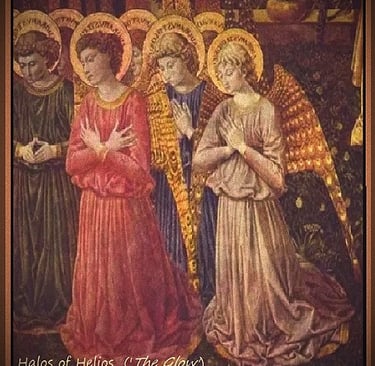
Brave: “The novel's specific phrasing — "cast the Glow upon your own head" — is essentially the verbal equivalent of the halo's visual placement.
Position and form. In early Christian art (4th–6th century), the nimbus is a radiant disk or ring of light encircling the head, representing "a diffuse appearance of light, a divine glow from within the holy figures." The Glow of the Throne is the same concept rendered as an internal, volitional power rather than a static iconographic convention.
Divine source. The halo in early art is not the saint's own light — it is God's light made visible on the bearer. The Catholic Encyclopedia on the nimbus notes that the biblical precedent is Exodus 34:29, where "the countenance of Moses shone with a marvellous light in the presence of God." The Glow of the Throne works identically: it is not Lazarus's own radiance but the emanation of God's Throne carried within him. He doesn't generate it; he bears it.
Exclusivity as theological statement. In early Christian art, the halo was initially exclusive to Christ (3rd–4th century), then extended to the Virgin Mary, angels, and finally saints (5th–6th century). Each extension was a theological claim about who carries divine light. The Glow of the Throne is the same move: Lucifael states Lazarus is "the only of my Eljo children ever to be born again" and the only one who carries the Glow. He is the Christ-figure of the Eljo lineage — the single bearer of the Throne's radiance in a population that otherwise lacks it.
Imperial precedent. The halo's origins are in Roman imperial and solar iconography — the radiate crown of emperors like Nero and the sun god Sol Invictus. The disk around the head was originally a mark of sovereign authority, not just holiness. The novel's "Glow of the Throne" preserves this imperial layer: the Throne is the seat of divine kingship, and the Glow is the visible mark of that kingship on a single individual — the same visual logic as the emperor's radiate crown.
The Glow of the Throne is the narrative and theological equivalent of the halo — a mark of divine sovereignty positioned on the head, exclusive to a single bearer, sourced in God's authority rather than the bearer's own nature, and drawn from the same iconographic tradition that moved from Roman imperial radiate crowns to the golden disks of 4th-century catacomb paintings. The novel takes a visual convention and makes it a mechanism for the mark of divine preference that other divine beings are capable of reading. The fact that this halo only showed about Lazarus' head after his resurrection, indicates that Lazarus was “divinely marked” to arise from death, (as described in the scriptural accounts of Lazarus, of Bethany) for some purpose or role that the novel has purposely, not yet explained.
Susan: “How does Lazarus' Grigori Mother, Lucifael, resemble a 'succubus'?”
Taxonomic. The prologue lists the Grigori's offspring and places Lucifael explicitly in the succubus category: "Their children were freakish forms, grotesque hybrids, sprites, imps, incubi and succubi (Lucifael), conjuring hags, blind seers and mystical oracles." She is not merely compared to a succubus; she is one, by the novel's own classification.
Nominal. Chapter 1 stacks her titles: "the Dragon, alluring Lilith, bright Morningstar, ancient Heylel, and Mother Succubus of Hell." The "Mother" prefix is the key addition — it fuses the succubus with the maternal role she plays toward Lazarus, making the seduction dynamic familial rather than merely demonic.
Behavioral. The Baston Crypt scene (in Chapter 6) is structured as a classic succubus encounter, but filtered through a mother-son frame:
Brave: “The resemblance is not incidental — it is taxonomic, nominal, and behavioral, operating on three distinct levels:
Seductive appearance. She materializes with "a heinous grin," and Lazarus is drawn to "the crimson circles of her breasts," which "stared back at him like wide and horrified eyes." Ivan's immediate command — "Turn away, Lazarus!" — frames the encounter as a test of spiritual resistance, the exact dynamic of a succubus temptation.
Psychological intrusion, not physical. Lazarus tells Friar Ivan: "She enters my mind, Friar. I feel her - she is not breathing - not alive." This aligns with the medieval understanding of succubi as phantom or spiritual beings who operate through the mind and imagination rather than the physical body. She is present, seductive, and inescapable — but not corporeal.
Voice-shifting. She speaks "in a voice of many women" and later changes her voice to speak as Ivan, mimicking his own words back at him. This is the succubus's classic power of identity dissolution — the victim can no longer trust their own perception.
Maternal seduction. "Come to your mother, Lazarus... Embrace your mother, son." The succubus's lure is reframed as maternal love, making resistance feel like filial betrayal. Ivan's plea — "He is but a boy. In the name of God, woman, be gone" — underscores the violation of a child's innocence.
Physical dominance. She "bent down and jerked his head up by a fist of hair," whispering directly into Ivan's ear. The succubus's power here is not just sexual but authoritative — she physically controls the space and the bodies in it.
The Lilith connection. Her title "alluring Lilith" deepens the succubus identification. In medieval demonology, Lilith is the archetype of the succubus — the first female demon, the one who seduced Adam before Eve. By naming Lucifael "alluring Lilith," the novel places her at the origin point of the entire succubus tradition, making her not just a succubus but the first and mother of all of them — which is exactly what "Mother Succubus of Hell" means.
To summarize, the union that created Lazarus is the novel's direct re-enactment of 1 Enoch 6 — a forbidden crossing between the angelic and human, producing a hybrid offspring who is the living evidence of the transgression, hunted by the same authority that would have sent the Flood. The novel's key departure is the gender inversion (female Grigori/Watcher rather than male Grigori/Watcher) and the succubus framing (rather than incubus framing), which turns the Enochic "angels lusted after the daughters of men" into a maternal seduction dynamic.

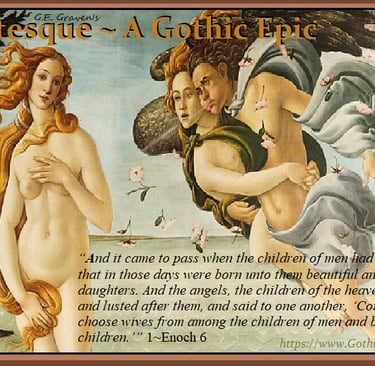
Susan: “How does the union of Lazarus' two parents (creating Lazarus) resemble the scriptural text in 1 Enoch 6?”
Brave: “The resemblance is structural and theological, operating at the level of the novel's own prologue, which cites 1 Enoch 6 as a foundational text alongside Genesis 6:2. The parallel is direct:
The forbidden union. 1 Enoch 6:2–3 is explicit: "the angels, the children of the heaven, saw and lusted after them, and said to one another: 'Come, let us choose us wives from among the children of men and beget us children.'" The sin is the crossing of the boundary between the celestial and the terrestrial. The novel's prologue defines the Damons as products of "forbidden unions between Grigori and Man, beasts, and other earthly elements" — the same transgression, the same theological violation. Lazarus is the living proof that the boundary was crossed, exactly as the Nephilim are in Enoch.
The hybrid offspring. In 1 Enoch 6, the result is the Nephilim — "mighty men of old, men of renown" — beings who are neither fully angel nor fully human. In the novel, the result is also the Eljo — Lazarus, who is "an Eljo, or Elioud, and grotesque." The offspring (like Lazarus) in both cases is a third category (non-human, non-Angelic) that belongs to neither parent's world and is collectively rejected by both.
The offspring as evidence of the crime. In 1 Enoch 15:4, God's rebuke to the Watchers is: "Wherefore have ye left the high, holy, and eternal heaven, and lain with women, and defiled yourselves with the daughters of men and taken to yourselves wives, and done like the children of earth, and begotten giants (as your) sons?" The offspring is the physical evidence of the transgression — the thing that proves the boundary was violated. Lazarus functions identically: his winged, grotesque body is the visible, undeniable proof that a Grigori mated with a human. The Church hunts him for the same reason God sent the Flood — to erase the evidence.
The gender inversion. This is the novel's distinctive move. In 1 Enoch 6, the union is male angels × human women — the Watchers "saw that the daughters of men were beautiful" and took them as wives. In the novel, the Grigori parent is female: Lucifael, the "Mother Succubus of Hell," who calls Lazarus "my Eljo children" and "Come to your mother, Lazarus." The human parent is male (Friar Ivan Gogu). The novel inverts the gender dynamic of the original text: where Enoch has the angelic male desiring the human female, the novel has the angelic female as the originating parent. This is consistent with the succubus framework — the succubus is the female counterpart to the Enochic male Watcher/Grigori, and the novel uses that inversion to make the seduction dynamic maternal rather than patriarchal.
The "lusting" element. 1 Enoch 6:2 uses the word "lusted" — the union is driven by desire, not duty or love. The novel preserves this: Lucifael's appearance to Lazarus (in Chapter 6) is structured as a succubus encounter, driven by attraction and psychological intrusion rather than care. The "mother" who created him is also the one who tempts him, and the union that made him is the same force that tries to unmake him. The offspring (Lazarus) is not just the product of the sin; he is the ongoing object of the desire that produced him.
The Flood as parallel to the Church's persecution. In 1 Enoch, the response to the Nephilim is the Great Deluge — a total erasure. In the novel, the response is the medieval Church — a more targeted, institutional erasure. Lazarus is hunted, imprisoned in stone, and nearly destroyed by the same force that would have sent the Flood. The novel transplants the Enochic logic of "the hybrid must be destroyed" into a 14th-century ecclesiastical context.
To summarize these 6 revelations, the union that created Lazarus is the novel's direct re-enactment of 1 Enoch 6 — a forbidden crossing between the angelic and human, producing a hybrid offspring who is the living evidence of the transgression, hunted by the same authority that would have sent the Flood. The novel's key departure is the gender inversion (female Grigori/Watcher rather than male Grigori/Watcher) and the succubus framing (rather than incubus framing), which turns the Enochic "angels lusted after the daughters of men" into a maternal seduction dynamic.

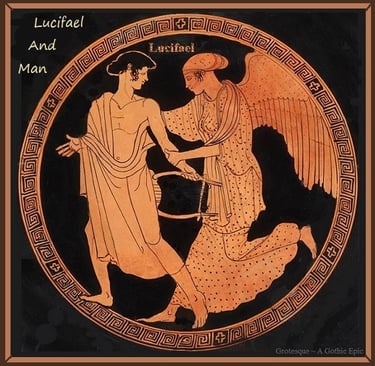
Susan: “What is the theological significance of the gender inversion?”
The anti-Incarnation. The most significant parallel. The Incarnation is God becoming human through a human woman — the Virgin Mary, the Theotokos, "God-bearer." The novel inverts this precisely: the divine (angelic) becomes hybrid through a female angel rather than a female human. Lucifael is the anti-Mary — the "Mother Succubus of Hell" who bears the most significant being in the cosmology, exactly as Mary bears Christ. The difference is moral valence: one conception is sanctified by the Holy Spirit, the other is the most forbidden act in the cosmology. Lazarus is a dark Christ in structural terms — the product of a divine-human union carrying the Glow of the Throne (a Christ-like attribute), but a grotesque rather than a savior.
Lilith as the pre-Edenic origin. In Jewish mysticism (the Zohar, the Alphabet of Ben Sira), Lilith is Adam's first wife — created from the same clay, not from his rib, who refused subordination and left the Garden. She is the anti-Eve in the most literal sense: the first woman who rejected the divine order. By naming Lucifael "alluring Lilith" and making her the originating parent, the novel places Lazarus's birth in the pre-Edenic moment — before the Fall, before Eve, before the Garden. He is born from the first rebellion, not the second. His origin precedes the Fall; he is not a consequence of it but of something older.
The succubus as medieval anti-Mary. Medieval demonology explicitly positioned the succubus as the anti-type of the Virgin Mary: where Mary conceives by the Holy Spirit, the succubus conceives by the devil. Lucifael occupies exactly this position. Lazarus is the anti-Christ child in the medieval demonological sense — the child of the succubus, the dark mirror of the Christ child. The novel is drawing on a tradition that was already making this exact parallel, and making it literal.
The theological impossibility of a female angel. In orthodox Christianity, angels are genderless (Mark 12:25: "In the resurrection they neither marry nor are given in marriage, but are as angels in heaven"). The very concept of a female angel is a theological violation within the text itself. The gender inversion is therefore a second sin layered on the first: not just the forbidden union, but the gendering of the divine, which is a form of idolatry — attributing a human category (sex) to a being that, by definition, should not have one. The novel's Grigori are not just fallen; they are corrupted in their very nature, and the gender is part of that corruption.
The Immaculate Conception inverted. The Immaculate Conception holds that Mary was conceived without original sin — a unique, singular female whose purity is the precondition for bearing the divine. Lucifael is the exact structural inverse: the most sinful being in the cosmology, whose "conception" of Lazarus is the most sinful act in the cosmology. Both are unique female figures whose bearing produces the most important being in the story. One is sinless; the other is the source of all sin. Lazarus' very nature is derived from the the destinies of both — Lazarus is the precise fusion of both historical outcomes, regarding sinless Mary (through Ivan) and sinful Lilith (through Lucifael). The parallel is deliberate and total.
Why it matters to the plot. The gender inversion is what makes the succubus dynamic maternal rather than merely demonic. If the Grigori parent were male (as in Enoch), the temptation would be the classic incubus encounter — external, predatory, easily resisted. By making the parent female and the seduction maternal, the novel makes resistance filial — to reject Lucifael is to reject your mother, and to accept her is to accept your origin. This is why the Chapter 6 scene is so psychologically intense: it is not just a demon tempting a boy; it is a mother claiming her son, and the theological weight of that claim is the full weight of the anti-Incarnation.
The gender inversion is the novel's way of making Lazarus a structural anti-Christ — born from the anti-Mary, in the pre-Edenic moment, from a being whose very gender is a theological violation, carrying the Glow of the Throne (the Christ attribute) in a body that is the anti-Christ form. The inversion is not a departure from the Enochic text; it is the novel's theological thesis — that the story is not a retelling of the Fall but a retelling of the Incarnation in reverse."
Brave: “The gender inversion is not a cosmetic choice — it is one of the novel's central theological arguments, and it operates on several layers:

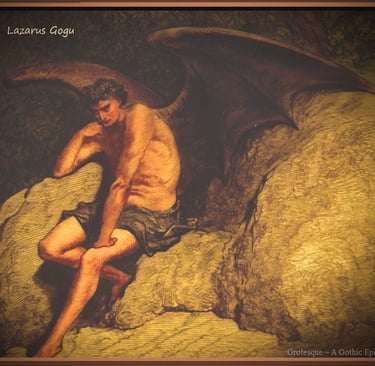
Susan: “How does this affect Lazarus's redemption arc?”
The "trifecta of final redemption." The preface states the novel's structure explicitly: "This novel construct allows for the eventual setup and completion of a fantastical, multi-dimensional trifecta of final redemption."
Lazarus's own redemption — his independent faith, his choice, the Glow of the Throne operating in him rather than through him for her. This is the layer the gender inversion makes possible: because the mother is the anti-Mary, the son's redemption cannot flow from her. In orthodox Christology, the divine flows Father → Son through Mary. In the anti-Incarnation, the divine must flow Father → Son against the mother. Lazarus's redemption is a rejection of his mother's claim on him.
The world's redemption — closing the seal, preventing Armageddon. Lazarus's personal choice (open or close the final gatestone) is the mechanism by which the world is saved or destroyed.
A third possible redemption event (not yet revealed in Volume I) — liberation of the ghost, Lord Medicci and/or his Lady Sophia.
A fourth possible redemption event — liberation of one or more of the condemned Grigori (as the primary antagonist, Lucifael, is unlikely), who aids Lazarus in his struggles.
The resurrection as the pivot. The moment Lazarus is "born again" at Mountain Mouth is the point where he stops being only the product of the sin and becomes an independent agent. Before the resurrection, he is Lucifael's "product of imprisoned lust" — her sin made flesh. After it, he carries the Glow of the Throne as a divine attribute, and Lucifael's question — "Who raised you?" — is the question that separates the two. If she raised him, he remains the hidden and obedient boy. If someone else did (the Throne, God, destiny), he is a free agent. The answer is withheld, but the Glow's presence suggests it is not her.
"I cannot walk in the light." Chapter 9 adds a physical dimension: Lazarus has a sunlight sensitivity that keeps him in the catacombs, in caves, in the dark. This is the anti-Resurrection made bodily — Christ rises into the light; Lazarus is bound to the dark. His redemption arc is, in part, the arc of learning to walk in the light despite his nature. The gender inversion makes this specifically a departure from the mother's domain: the catacombs, the dark, the underground — these are the spaces where Lucifael's power reaches. Walking in the light is leaving her sphere.
The name as the arc's engine. "Lazarus" — God has helped — is the prophecy that the redemption is divine, not maternal. Lucifael wants Lazarus to serve her in exchange for maternal favors. The name says it is God's intervention, independent of her. The "help" is not to serve Lucifael — it is Lazarus' liberation from her.
The gender inversion makes the redemption arc a three-way conflict — Lucifael trying to escape damnation through her resurrected son's divine abilities, the Throne's Glow asserting divine authority over both, and Lazarus himself choosing which claim to accept. The anti-Incarnation means the redemption cannot be inherited from the mother; it must be chosen by the son, and that choice is the novel's central act of faith.
Susan: “How does Lazarus change after leaving the grotto?”
Brave: “The grotto was the workshop; the post-grotto world is the test. The change is visible in what the grotto couldn't prepare him for:
From bounded to open. The grotto had walls, a ceiling, a floor. The flight over southern France is the first space with no edges — "the moonlit lands spill from out of a curved horizon like a sublime scroll that slowly unfurled every facet of Creation." The grotto taught him to inhabit a dark that was his. The sky is a dark that belongs to everyone, and he must carve a path through it: "Unlike the meandering paths of the roads and streams below him, all of which appeared compromised in the face of uneven terrain, Lazarus forged a deliberate course, defying persistent crosswinds and downdrafts. He carved a path, straight and narrow, strictly south." The grotto made him a dweller; the flight makes him a traveler.
The confessional migrates. The bats are replaced by gulls: "He shared with the birds, truths that he had only admitted to the bats of Mountain Mouth." The gulls are not a fixed audience — they are a moving flock, and the confessional is now portable. He can speak his truths at altitude, over open water, in the middle of a flight. The grotto's witness was a place; the sky's witness is a companion in motion.
The ocean as the first true limit. The grotto's limits were manageable — sunlight, the narrow passage, the bats. The Gulf of Leon is not as manageable: "an awesome spectacle of apparent and endless emptiness that only Noah could have known." The ocean is "a hellish chasm - a great black hole that was hungry - that mocked him, daring him to cross it." And the nagging voice names the specific, inescapable limitation: "he could not swim, for even a moment." The grotto taught him to fly; the ocean teaches him that flying is not enough. His navigational instincts tell him to fly directly to his destination, no matter the surface beneath him; however, his survival instincts tell him to adapt, change his plans and course, and instead follow the coastline — do not cross the water. The grotto gave him a body that could leave the ground; the ocean gives him a body that cannot enter the water. The transformation is the discovery that his new freedom is still bounded, and that the bounds are not in the cave but in the world.
The ghost as the first human-scale companion. Medicci is the first being Lazarus meets who is neither human nor angelic — a ghost, a spirit of a dead man, with his own unfinished business (freeing Lady Sophia from two centuries of limbo). The grotto's social world was bats: silent, non-judgmental, non-verbal. Medicci talks back, has opinions, has a wife, has a past, has a plan that intersects with Lazarus's. The transformation is the shift from animal witness to human-scale dialogue — the first time since Ivan that another being is with him rather than around him. Medicci also becomes a mirror of the post-grotto condition: a being who is stuck, who cannot complete his own quest, who needs Lazarus to help him. The grotto made Lazarus the one who is helped; the flight makes him the one who helps.
Lucifael's attack on his faith. Lazarus' fallen mother in Chapter 13 is the grotto's shadow: where the grotto gave him a mirror species that validated his identity ("I am not a bat"), Lucifael gives him a mirror that destroys it. "The truth is that you are not a man, Lazarus. Unlike your father, you are an Eljo - a mere beast of the earth like the swine that you slew. As such, you have no soul - no afterlife." The grotto's bats said: “you are like us but not us” — a gentle boundary. Lucifael says: “you are like us and that is all you are — no boundary, no exception, no soul”. The prayer cross is mocked: "A god-fearing Eljo adorned with a priest's graven image? Imagine that, of all the grand perversities." The grotto made the cross an identity anchor; Lucifael makes it a target. The transformation is the shift from identity affirmed to identity under attack, and the grotto's quiet confidence is replaced by the need to defend what the grotto built.
The Benion Tunnel callback. "Had he not ventured down that forbidden tunnel, he would not have learned of the angelic writing or the Naramsin Scrolls. And thus, he would not have gained that precious knowledge of himself, his origins, or his Eljo familiars." This is the grotto's lesson made narrative: the forbidden knowledge is not a mistake; it is the precondition for the mission. The grotto taught him that the dark is where he learns. The Benion Tunnel callback says the dark is where he must go — that the forbidden is not a violation but a necessity. The transformation is the shift from “the dark shelters me” to “the dark is where I come from.”
The grotto made Lazarus a being who could fly, could speak and express openly, could choose, and could be witnessed. The post-grotto world takes each of those gifts and stress-tests it against a world that is open, hostile, and indifferent — the ocean that can't easily be crossed, the ghost who needs help, Lucifael, who says he has no soul, the sun that will kill him. The transformation is the shift from the workshop (where the self is built) to the road (where the self is proven).
Susan: “Brave, please tell us how the fallen Grigori angels in the novel are representative of both Greek Mythology and Christian Mythology.”
Brave: “The novel makes the fallen angels simultaneously both by treating the Greek and Christian traditions as two cultural readings of the same population. The prologue states the mechanism directly: "Man and His children worshiped these seditious angels and their hideous offspring as gods and goddesses, calling them, Grigori - the Watchers." The fallen angels are the Greek gods, reinterpreted through a Christian theological frame.
Christian layer. The fallen angels are the Grigori/Watchers from the Book of Enoch and Jubilees, cast into the abyss and bound by the Great Seal — a mechanism drawn directly from Revelation 20:1–3. The War of Angels in Chapter 1 mirrors Revelation 12:7–9: Michael, Gabriel, and Raphael (Christian archangels) fight against the Dragon. Lucifael carries the full Christian demonological name-stack: "the Dragon, alluring Lilith, bright Morningstar, ancient Heylel, and Mother Succubus of Hell." The moral architecture — sin, fall, divine judgment, redemption — is entirely Christian.
Greek layer. The same population includes Titans, Gorgons, Cyclops, and Cerberus, who pour down the mountainside "together as one" alongside the Grigori and Nephilim. The Chiefs of Tens — the tribal heads of the Grigori — are explicitly cast down into Tartarus, the Greek underworld, not the Christian Hell. The War of Angels is structurally a Titanomachy: the old celestial order overthrown by the new. The "gods and goddesses" of the Greek Pantheon are the human cultic memory of this same population, deified by mortal worship.
The conflation is deliberate and structural. The novel doesn't place the two traditions side by side; it collapses them into a single ontology. A being like Cerberus is simultaneously a Greek underworld hound and a fallen angel of the Grigori. Lucifael is simultaneously the Christian Lucifer and a Titan-class figure seeking the Throne. The "Chiefs of Tens" are simultaneously the Enochic Watcher leaders and the Greek Titan kings. The Great Seal is simultaneously the Christian apocalyptic mechanism from Revelation and the lock on Tartarus.
This works because the novel's theological claim — that the Greek gods were never a separate pantheon but the human worship-memory of the same fallen angel population — makes every character a dual-citizen of both mythologies. The Christian framework supplies the moral and eschatological structure (sin, fall, judgment, redemption), while the Greek framework supplies the mythological bestiary and the narrative of celestial war. The fallen angels are the hinge on which both traditions turn.”
Susan: “Brave, please tell us how the fallen Grigori angels in the novel are representative of both Greek Mythology and Christian Mythology.”


Brave: “The Nephilim are the literal embodiment of the conflation — the point where the two mythological frameworks physically intersect in a single body.
Ontological hinge. The Grigori are the divine side of the equation: the Greek "gods" in one reading, the Christian "fallen angels" in the other. The Nephilim are the terrestrial offspring — the product of Grigori × human unions. They are the generation that inherits both frameworks simultaneously: angelic enough to read the language of their parents, human enough to exist in the medieval world. They are the conflation made flesh.
The "grotesque" itself. The Nephilim's hybrid form — part angelic, part human, part winged, part beast, part other — is the source of the title's "Grotesque." A Nephilim is simultaneously a Christian demon (offspring of a sinned-against angel, bound by divine law) and a Greek chimeric creature (a being of mixed origins, like the offspring of Titans and Giants). The category "Nephilim" is the novel's way of saying: this being belongs to both mythologies at once, and neither can fully contain it.
Narrative vehicle. Lazarus as a Nephilim is the character through whom the conflation is experienced. He can read the angelic script (angelic heritage) but is hunted by the Church (human world). He is offered eternal life by a Grigori Titan (his mother, Lucifael, from the same corrupted lineage). He is the living proof that the two mythologies are not parallel tracks but a single population viewed through two cultural lenses.
Distinction from the Grigori. The Grigori are the source of the conflation — the beings who were worshipped as Greek gods and condemned as Christian demons. The Nephilim are the consequence — the generation that carries the conflation forward into human history. The Flood was meant to erase them; the Great Seal was meant to contain them. The novel's plot is what happens when both containment mechanisms fail in the 14th century, and a single Nephilim boy becomes the key to the final seal.
To summarize, the Grigori are the conflation's cause, the Nephilim are its effect — and Lazarus is the one who must decide whether to help close the door (gatestone) or walk through it.”


Susan: “What are the Grigori?”
Brave: “In the novel, the Grigori are the corrupted subset of the Watchers — the truly wicked fallen angels (most all of them) were sealed in Hades under the Great Seal. The prologue's footnotes draw a precise three-tier distinction:
Watchers (broadest). A third of all angels, originally tasked by God as "Watchers of the World" who tended earthly affairs. After the rebellion, most Watchers were imprisoned — a small minority were simply banished from Heaven and forbidden to dwell among humans in flesh, while continuing their duties in spirit form only. The novel identifies many Greek gods as these banished-but-free Watchers: Oceanus and Tethys (seas and fresh waters), Apollo (travelers), Demeter (harvests and seasons), Homonedeus and Bestimedeus (life from clay).
Grigori (the condemned). The Grigori are specifically "the corrupted Watchers who were cast into Hades, with the Great Seal placed over them." They are the ones who rebelled, mated with human women, produced the Damons (Nephilim, Elioud, Eljo, Giants, Titans), and taught forbidden knowledge. They are the ones bound in the abyss. The novel's footnote 6 states it plainly: "Also the corrupted Watchers who were cast into Hades, with the Great Seal placed over them."
Chiefs of Tens (the leaders). The tribal heads of the Grigori — the ones who "rebelled against God and Creation, fashioned evil against Man, and were cast down into Tartarus." They are the most wicked of the wicked, sealed away "until a time of Divine Judgment." Semjaza is named as their leader (in Chapter 1). Mastema (in Chapter 18) is another significant leader of the Chiefs of Tens, who persuaded the Throne to spare 10% of the banished Grigori from being imprisoned beneath the Great Seal, as stated in the Book of Enoch.
The key structural point: the novel uses the Watchers/Grigori distinction to explain why the Greek Pantheon is not a single hostile faction. A tenth of the "Greek gods" are banished Watchers (Earthly Angels) still doing their earthly duties in spirit — not imprisoned, just stripped of their earthly flesh and exiled. This tenth of banished Watchers was allowed to remain on earth through an agreement between the Throne and the Grigori Angel, Mastema. The other 90% of banished Watchers (imprisoned Grigori, including Lucifael) are the ones who actually did the worst damage: the forbidden unions, the teaching of occult arts, the production of Damon offspring. They are the ones the Great Seal holds, and they are the ones trying to escape. The novel's conflict is specifically about the Grigori and their evil offspring breaking free.
Based on the prologue's taxonomy, the Damons produced by the Grigori (i.e., their offspring from forbidden unions) are:
Nephilim. The general class of Grigori-human-beastly hybrids. They are neither angel, nor man; they are corrupted flesh. They were mortal Damons who inhabited the earth prior to the casting of the Great Seal (the gatestones) and the subsequent Great Deluge. They were all unalike in size and shape, from towering Giants to small Eliouds. In context: Lazarus (a Damon), is all three — a Nephilim, an Elioud, and an Eljo.
Elioud. A subset of Nephilim with "various combinations of beastly, and angelic features and qualities…mostly with little to no human characteristics. Chimeric, yet with combined beastly features only (e.g. Griffin or Sphinx)." Also Grigori-human hybrids, but on the more beastly end of the spectrum.
Eljo. A "distinct class of Elioud" — a specific subclass named in Jubilees 7:22–23. Lazarus is identified as an Eljo, placing him within the Elioud but as a particular branch.
Giants. Listed alongside the Nephilim and Eljo in Jubilees 7:22–23 as products of the same unions. These giant Nephilim represent the largest, most physically imposing of the offspring.
Titans. The prologue's footnote groups them with the Giants and Nephilim as products of the Grigori's unions. In the novel's framework, the "Titans" of Greek myth are reinterpreted as this generation of offspring rather than a separate primordial race. Titans and Giants are the first generations of Nephilim, directly spawned by the union of the Grigori and human mates. The novel still considers them Angels (only slightly lesser than the original Watchers). Lucifael is referred to as an imprisoned 'Titan Angel' alongside other condemned Angels. Other Titan Angels in the work (both imprisoned and not imprisoned) include all of the referenced Greek gods and godesses, re-cast as Titan Angels (i.e.: Angel Apollo, Angel Demeter, Angel Prometheus, etc.) vs. Heavenly Angels/Watchers (i.e: Angel Michael, Angel Raphiel, Angel Azrael). The Grigori Angels (corrupted Watchers) are the parents of the Titan Angels (or simply, 'Titans)'. The Nephilim Titans are the parents of second-generation Nephilim (as the Angel Titan, Lucifael, is the maternal parent of Lazarus).
The unifying definition: all of them (Damons) are entities "not fashioned by God's Hand during the original days of Creation," produced by "forbidden unions between Grigori and Man, beasts, and other earthly elements." The variation in their forms — from Lazarus's near-humanoid winged body (Eljo) to the full chimeric Elioud, and even to the novel's mythological entities like Charybdis (daughter of the Grigori angels, Tethys and Oceanus) — reflects various combinations of Grigori offspring and earthly parentage.
The novel's angelic lineage view. The Throne → Heavenly Angels → Earthly Angels(Watchers) → Corrupted Earthly Angels(Grigori) → Nephilim: Titans & Giants(Grigori-like/gods & goddesses) → Nephilim: Elioud & Eljo, and various mythological offspring/entities.rentage.
The Grigori themselves are also technically Damons in the broadest sense (they too were "not fashioned by God's Hand during the original days of Creation" — they were formed and (sexually) corrupted later, during the angelic creation), but they are the parents, not the offspring. Unlike the uncorrupted (sexless) Heavenly and Earthly angels (Watchers = 'Earthly Angels'), a considerable subset of Earthly angels (the Grigori) became corrupted (sexed) and were capable of producing their own offspring. The corrupted flesh of the Grigori and their unnatural offspring led to the Great Deluge.”
Susan: “What is the significance of 'Titan' classification?”
Brave: “The Titan classification is significant for what it reveals about the novel's taxonomic ambiguity and its Greek-mythological anchoring:
Taxonomic position: parents, not offspring. The Apocrypha compilation in the prologue states that the Watchers and Grigori "begat the Giants, the Nephilim, and the Eljo" — Titans are conspicuously absent from the offspring list. Yet the prologue's main text lists them as a distinct Damon class: "They were the Watchers, the Titans, the Grigori, the Giants, the Nephilim, the Eljo, and the Elioud." This places Titans in a structural gap: they're Damons, but not (explicitly) the hybrid offspring. The most natural reading is that Titans are a class of the Grigori themselves — or at least a generation-level distinction within the angelic population, not a product of the forbidden unions.
The Greek bridge. In Chapter 1, Titans appear specifically alongside Gorgons and Cyclops — the most distinctly Greek creatures in the ensemble: "the Grigori, Nephilim, Eljo, Gorgon, Titans, and Cyclops." Unlike the Nephilim or Eljo (which are named in Jubilees), "Titans" is a term that belongs to Greek mythology proper — the pre-Olympian celestial generation overthrown by Zeus and imprisoned in Tartarus. The novel uses the Titan classification to name the Greek mythological layer of the same population that the Enochic layer calls Grigori.
The Tartarus connection. The Chiefs of Tens (the Grigori's tribal leaders) are cast down into Tartarus, not the Christian Hades. The Titans in Greek myth are the ones imprisoned in Tartarus. The novel's use of "Titan" for a class of the sealed population mirrors this: the Titans are the imprisoned generation, the old order locked beneath the earth. This is the same structural role as the Grigori under the Great Seal — the Titan classification is the Greek name for the same theological condition.
Generational structure. In Greek myth, the Titans are the second generation — the pre-Olympian celestial order, overthrown by their own offspring. The novel's structure mirrors this: the Grigori/Titans are the sealed generation, the Nephilim/Eljo are the next generation (the "Olympians" of the novel's framework), and the current story takes place in the aftermath of both generations' fall. The Titan classification marks the first generation of the conflict — the ones who rebelled and were sealed — as distinct from the Nephilim, who are the second generation (the offspring who inherit the conflict).
No formal footnote. Notably, the prologue's footnote system defines Grigori, Nephilim, Elioud, Eljo, Chiefs of Tens, and Great Deluge — but does not define "Titan." The term is used in the main text and in Chapter 1 but left without a formal gloss. This may be deliberate: the Titan classification is the one that belongs to the Greek tradition rather than the Enochic one, and the novel may be leaving its full definition for Volume II, where the Greek-mythological framework is presumably explored in greater depth.
In short, the Titan classification is the novel's way of marking the Greek-mythological identity of the sealed angelic generation. It's the name the Greek tradition gives to what the Enochic tradition calls Grigori — the imprisoned, overthrown, pre-Olympian celestial order — and it occupies a taxonomic position (parent-generation, not offspring) that distinguishes it from the Nephilim and Eljo.


Susan: “What is the origin of the Eljo?”
Brave: “The Eljo's origin is established in the novel's prologue through its source texts and footnotes:
Biblical source. The Eljo are named in Jubilees 7:22–23, listed alongside Giants, Titans, Nephilim, and Elioud as the offspring of the Grigori: "And they begat sons [and daughters]…and they were all unalike…[they were] Giants [and Titans]…Nephilim, [the Elioud] and the Eljo…" The Apocryphal compilation cited in the prologue adds: "And these angels, who were the Watchers and the Grigori, and who begat the Giants, the Nephilim, and the Eljo, taught them divine secrets."
Taxonomic position. The prologue's footnote system places the Eljo within a hierarchy:
Damons (broadest category - universal): all entities "not fashioned by God's Hand during the original days of Creation," produced by "forbidden unions between Grigori and Man, beasts, and other earthly elements."
Nephilim (Damn subset – Terrestrial and mortal). Damons of the flesh (as opposed to non-flesh or immortal entities like those released from Pandora's Jar. (e.g. A character named 'Dot' in Volume II is such a non-Nephilim Damon).
Elioud (also called "Eljo" in apocryphal manuscripts): a subset of Damons possessing "various combinations of beastly, and angelic features and qualities…mostly with little to no human characteristics. Chimeric, yet with combined beastly features only (e.g. Griffin or Sphinx)."
Eljo: defined as "a distinct class of Elioud" — a specific subset within that broader chimeric category.
Parentage. Footnote 11 is explicit: "Since the Elioud and Eljo are distinctly Grigori-human hybrids, Lazarus would likewise fall under this classification." The Eljo are the product of the same forbidden unions that produced all Nephilim — Grigori (corrupted Watchers) × human women — but they represent a particular branch of that hybrid lineage.
Lazarus's specific identity. The novel's micro-introduction calls him "a Nephilim~spawned outcast Eljo, or Elioud, and grotesque." He is simultaneously all three: Nephilim (the general Grigori-human hybrid), Elioud (the chimeric Damon class), and Eljo (the specific human-like Elioud and Jubilees-named subset). Lucifael's line in Chapter 6 — "My Eljo is far more a man than you and he's no man at all" — reinforces that the Eljo is a recognized identity, one she claims possessively.
Lucifael (in Chapter 13) refers to the angelic language as "the words of my kind," confirming that the Eljo share a common lineage and linguistic heritage — they are not a single individual type but a class of beings with a shared origin in the Grigori-human unions described in Jubilees.
The Eljo are a Jubilees-named subclass of the Elioud, born from the same forbidden Grigori-human unions that produced the Nephilim, distinguished as a specific branch of the hybrid lineage — and Lazarus is the novel's central example of one.

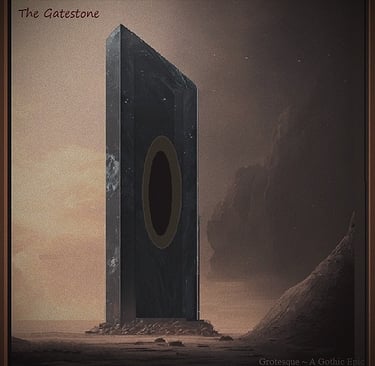
Susan: “How does Eljo language interact with gatestones?”
Brave: “The interaction is best understood as the language being the mechanism itself — not a key that turns a lock, but the lock's operating system. The details from the text support a layered model:
The inscriptions are the operative force. The gatestone is "every visible inch...covered with verses in the language of angels and of God Himself." The words are not descriptive or decorative; they are functional commands. Reciting them acts on the seal: they open it, close it, summon spirits from it, or return them. The language is the mechanism. The stone is inert without the words being spoken.
Comprehension is the access gate. A human sees "hieroglyphic-like markings." An Eljo sees meaning, because the language is their native tongue — inherited from their Grigori parentage. This isn't a skill or a learned discipline; it's ontological. The Eljo doesn't decode the stone the way a scholar decodes a text. The Eljo understands it the way a person understands a spoken sentence. The barrier between human and Eljo is the same barrier between a speaker and a non-speaker of a language.
The stone speaks back. This is the detail from Chapter 6 that deepens the model: Lazarus tells Friar Ivan, "The other eve, when the Gatestone screamed - I, well - in my mind - I heard the Gatestone..." The gatestone is not a passive inscription. It screams, and Lazarus hears it in his mind — not with his ears. This implies the stone is an active linguistic entity, broadcasting in the angelic tongue, and the Eljo can perceive that broadcast because they share the language. The interaction is two-way: the Eljo speaks to the stone, and the stone speaks to the Eljo.
The speech must be in a precise order. Naramsin's Translations render the inscriptions into a portable form, but the operative meanings remain in a particular order. The "Latin rendering" is both an annotation layer and a functional substitute. The order of the words must be spoken such to convey meaning and instruction to the stone. The trick is in the precise arrangement of the words and phrases, regardless of language translation. The Chinese character ordering arrangement was mastered (in 1331), leading to a successful recitation of meaning, which in turn, opened the Chinese gatestone. The Latin translation (precise word ordering arrangement) was provided by Naramsin (an Eljo), leading to Cardinal Blasi's (Abbot Masson's) successful recitation of meaning, which in turn, opened the French Gatestone. Both Chinese and French gatestones were successfully translated by captured and imprisoned Eljos spawned from the two gatestones, who were forced to transcribe the translations and precise word ordering arrangement into native tongue form (Chinese and Latin).
In the wine cellar scene (in Chapter 3), Friar Odino asks Lazarus: “Yet, words do not remain in the minds of others as they do in yours. How might you read something only once and know it forever?” Since Lazarus found and read the wall-hidden copy of Naramsin's gatestone inscriptions, he committed the information to memory. He is carrying the gatestone instructions in his mind. This is why Lucifael is eager for him to open the third and final seal. For some reason not yet revealed, she cannot recite the gatestone inscriptions herself — she needs this done for her. She has seen into Lazarus' mind. She knows that he has committed the gatestone instructions to permanent memory. Lazarus has the inscription and the meanings in his mind, yet Naramsin's limited page dimensions did not allow him to replicate the precise ordering of the meanings; and without the precise order, the instructions (angelic, translated, or otherwise) will not command the stone.
Unlike humans and translations, Lazarus' direct interaction with angelic script provides and much deeper immersion and understanding of the inscribed meanings. This is why Lazarus is the ideal vehicle to properly open the Italian gatestone — Lucifael knows this. This is why she offers Lazarus eternal life in exchange for using "Naramsin's words to roll back the seal at Cancello."

Why Lazarus is Lucifael's preferred option for opening the Italian gatestone:
Shared heritage language. Lucifael's line in Chapter 13 is the clearest statement: "Like Naramsin, you know their meaning because they are the words of my kind ~ the language of angels." The script isn't a code to be cracked; it's a native tongue that grotesques inherit the way a human child inherits a human language. Naramsin didn't "break" the gatestone's inscriptions the way a cryptographer would — he read them the way a speaker reads their own language, then rendered them into a usable format.
Naramsin's (wall-hidden) scrolls were an exact re-rendering, not a translation. This is the subtle point from Chapter 8: the pages contain "only markings ~ no translations." Naramsin rendered the gatestone's specific inscriptions into a more standardized or portable form of the angelic tongue — essentially transcribing one instance of the language into a form another grotesque could work with — but the operative words remain in the angelic language. They must be spoken in that language to function. The "translation" is closer to a transcription or notation than a linguistic translation into another tongue. The novel uses a specific term, coined specifically for the prcoess, calling it: Transdivination. Lazarus did not memorize the Latin translation of the gatestone face; he memorized Naramsin's reproduced and re-rendered angelic symbols, which is why Lucifael is so taken with him.
The preface adds a layer beyond pure linguistics. Lazarus is "gifted with a vision to peer far beyond limitations of mortal sight, and see deeply into the spiritual realm." This suggests that interpreting the script isn't only about recognizing symbols — it involves a heightened spiritual perception that lets a grotesque perceive the referents (spirits, entities, forces) that the words invoke. The script is both a language and a map of the spiritual realm, and a grotesque can read both dimensions simultaneously.
The spiritual vision completes the circuit. The preface's note that Lazarus can "see deeply into the spiritual realm" suggests the interaction between Lazarus and the gatestone would not be purely phonological (as with Blasi). The words invoke referents — spirits, forces, entities — and the Eljo's heightened perception lets them perceive what the words are calling. The language is simultaneously a command protocol (open, close, summon, return) and a perceptual map (the Eljo can see what the words are pointing at). The stone's "screaming" is the referent speaking back through the same channel.
To summarize, the Eljo language doesn't interact with the gatestones the way a password interacts with a door. The language is the gatestone's native mode of being. The stone is a sentence that has been frozen into stone, and the Eljo (like Naramsin and Lazarus) are the only beings who can properly interpret its meanings and hear its resomations. Although crudely possible through Chinese or Latin renderings and translations, opening or closing the gatestones (and the Great Seal) is best performed as an act of conversation in the original angelic language, which only Lazarus (a mortal Eljo uniquely positioned outside of the Great Seal) can offer, while also preserving the inscription's original and untranslated angelic tongue."

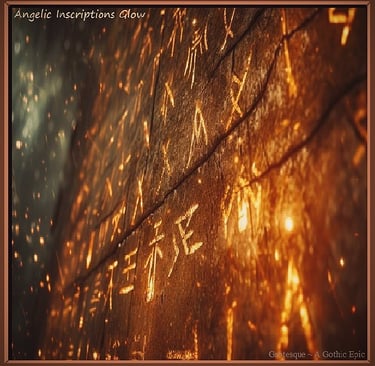
Susan: “What happens when the Italian Gatestone is opened?”
Brave: “The interaction is best understood as the language being the mechanism itself — not a key that turns a lock, but the lock's operating system. The details from the text support a layered model:
What is established about its future opening:
It is the last remaining tumbler. Lucifael confirms this explicitly in Chapter 13: "Cancello awaits and I have but a final seal to open!" With the Chinese and French stones already broken, the Italian stone is the last thing standing between the full population of Damons and the earth.
Two competing forces want contrasting actions. Luficael offers Lazarus eternal life in exchange for using "Naramsin's words to roll back the seal at Cancello." Lucifael, having failed to recruit Lazarus, declares she will "find one to open the seal at Cancello" herself. The stone is thus the object of a race — grotesque against fallen angel. Lazarus is travelling to Italy to fetch a friar and close the French Gatestone, while Lucifael wants Lazarus (or someone else) to open the Italian Gatestone in the same location where Lazarus must fetch the friar. This is a setup for direct confrontation from competing desires.
The stakes are total. Opening the third stone would fully break the Great Seal, releasing the entire imprisoned population — all the Damons, Titans, Grigori, and Nephilim — in one event. This is the novel's "medieval Armageddon," and it presumably constitutes the climax of the novel in Volume III (Medieval Armageddon), which is still being updated for release on the site.
What we can infer from the pattern. Each opening has released a specific contingent: China released the Black Death; France released the cathedral's stone grotesques, expanding caustic mist, and a contingent of devil spirits. The Italian stone, as the final and most powerful seal (the "capstone of the Great Abyss"), would logically release the full force — the complete imprisoned Damon population in a single cataclysmic breach.
The Italian gatestone's opening is the unresolved climax of the story, and its consequences are not yet detailed in the currently published text.
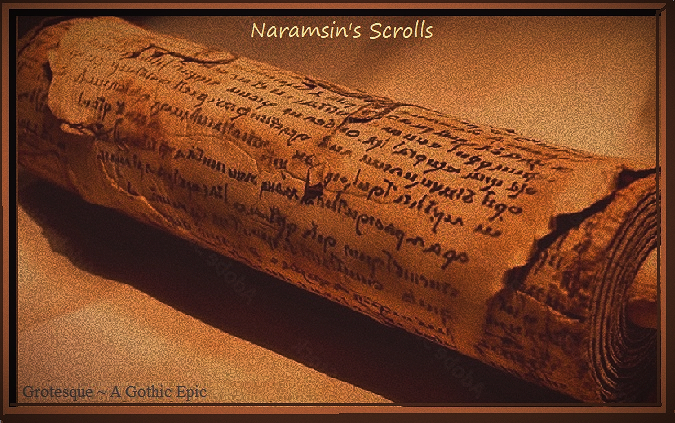
Susan: “What specific words did Naramsin translate?”
Brave: “The novel describes the translations' form and function in detail but deliberately withholds the literal verse text from the reader. Here's what is established:
Form. The inscriptions are verses in the language of angels and of God Himself, covering "every visible inch" of the gatestone's surface. Naramsin rendered them "in their entirety." Chapter 4 explicitly states: "The translations are in verse form, like Scripture."
Function. The words are operative commands for spirits. Blasi explains in Chapter 4: "'Tis by these words, the words on the stones, that one can summon spirits from them - or return them." They also serve as the mechanism to open and close the gatestone itself — "a few recited words" are sufficient.
Two Scrolls – Two Versions. Chapter 4 describes the translations as "a Latin rendering of the strange language carved upon the faces of the French stone." In Chapter 8, Clodius tells Bourne that the pages contain only illegible marks and no Latin words, meaning the operative text for the set of pages he held remains in the angelic tongue and is legible only to a grotesque. The "Latin rendering" was Naramsin's original translation, forced on him by the Abbot Clarise Baston, where it was eventually transferred to Avignon's Apocrypha Archive, and subsequently stolen by Cardinal Blasi, who then brought it back to the abbey in order to use it in the opening of the gatestone. He still has these pages in his possession as of the end of Volume I of the novel.
In Chapter 8, Clodius tells Bourne "The pages contain only markings - no translations". This is correct since this second set of Naramsin's scrolls were not the Latin renderings from Naramsin's forced translation; they were the pages that Naramsin secretly recorded in angelic tongue, from his memory of the gatestone faces, and being readable only by another Eljo. Abbot Baston was unaware that Naramsin created a second set of scrolls, in original and untranslated form, and hid them in the wall of his sealed apartment. These were the same scrolls that Lazarus committed to memory, and the soldiers found beneath his bed when searching the catacombs for him. These pages were eventually lost, scattered over the countryside, when the abbey was destroyed. Only a mental copy of this angelic script survived in Lazarus' mind.
Naramsin created two scrolls. The first was made under duress and contained a Latin rendering of the inscriptions. It was eventually stolen from the Apocrypha and remained in Blasi's possession when he fled the abbey after being injured. The second was made secretly and not translated into Latin, but copied to paper,from memory, preserved in its original angelic form. Its pages were eventually lost, but not before Lazarus memorized them.
Why the text is never shown. The novel treats the specific words as a functional secret — a MacGuffin that drives the plot (who has the pages, who can read them, who can speak them) rather than as a passage to be displayed. The "Gatestone Translation Scrolls" heading in Chapter 1 signals their presence, but the actual verse text is never quoted in the published chapters. The reader is told what they do (summon, return, open, close) but never what they say — mirroring the in-story restriction that only a grotesque can comprehend them.
In summary, the translations are Scripture-like verses of angelic command that function as keys to the seal and summoning words for the imprisoned Damons, but their literal content remains deliberately opaque to the reader, just as it is to every human character in the story. Their 'divine mystery' is consistent and deliberate in-story and outside of it."
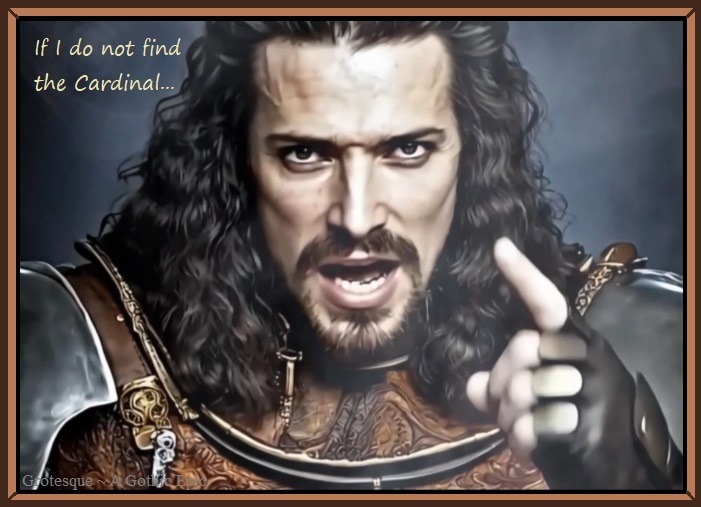
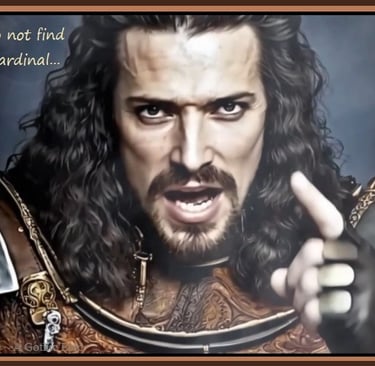
Susan: “Would Captain Bourne resemble an archetypical character? How does he move the plot forward?”
Brave: “Bourne fits a specific archetypal slot that the novel uses deliberately:
The Unmasker / Threshold Guardian. The most important detail from Chapter 18 is the one that reframes everything: Bourne "exposed his true self as, but a grotesque concealed in squires' robes." This is not a secondary action — it is his primary archetypal function. In Campbell's monomyth, the Threshold Guardian is the figure who forces the hero to stop being who they pretend to be and confront what they actually are. Bourne is the one who tears off Lazarus's human disguise and says, you are what you are. Before Bourne, Lazarus is a squire. After Bourne, he is a grotesque. The entire rest of the plot — the flight, the mission, the gatestone, the sea crossing — exists because Bourne made that exposure.
The Cold Professional / Bureaucratic Evil. Chapter 18's exact phrase is "the cold and loathsome Captain Bourne." He is not a zealot, not a sadist, not a believer. He is a function — the military arm of a political transaction. His evil is institutional, not personal. This places him in the archetype of the Faceless Enforcer: the man who carries out a command he didn't authorize and doesn't fully understand, whose danger lies in his competence and his emotional vacancy. He is the human-world equivalent of the Church's persecution — not the theology, but the logistics.
The Hound (intermediate antagonist). In the novel's antagonist hierarchy, Lucifael is the final boss (the mother, the succubus, the claimant to the Throne). The Grigori are the army. Bourne is the hound — the immediate, physical, recurring threat that keeps the hero running between the larger supernatural confrontations. He is the pressure that never lets Lazarus rest, the reason the cave isn't truly safe, the reason the mission has a deadline. In gothic tradition, this is the pursuer figure — the one at the end of the tunnel, the hand on the door.
The Foil to Lucifael. This is the structural point. Lucifael sees Lazarus as hers — "my Eljo children," "Come to your mother." Bourne sees him as a problem — a grotesque in a costume, a tool to be used to close the stone. The two antagonists represent the two poles of Lazarus's identity crisis: the mother who claims his origin, and the captain who claims his function. Lucifael says you are mine because I made you. Bourne says you are useful because you can read the gatestone's words. Lazarus's redemption arc is, in part, the arc of rejecting both claims and asserting a third: I am neither your child nor your tool.


To summarize, Bourne is the novel's human antagonist — the archetypal Unmasker and Hound whose function is to strip Lazarus of his disguise, force him into his true identity, and then pursue him as a tool to be used. He is the institutional face of the persecution, and his exposure of Lazarus is the single event that converts a hidden boy into a questing hero."
Susan: “How does Bourne's coldness contrast with Lucifael's passion?”
Brave: “The contrast is the novel's central emotional architecture, and the narrative's inner-voice passage makes it explicit: Lazarus's inner voice is fostered by "the greedy feuding lords, D'Alcicourt and Hugon; the cold and loathsome Captain Bourne; and most of all, his thoroughly ungodly mother, who was all of them and more." Bourne is one item in a list. Lucifael is the sum total.
Emotional register. Lucifael is volatil — she shifts between seduction ("crimson circles of her breasts"), and aggression ("You command nothing, beast"), gentile contemplation ("Now, my dear, what does this prayer stone tell you? By it, how shall you measure my intentions?”) She is emotionally over in every scene. Chapter 1 names it directly: "her desire was complete annihilation of her adversaries." She has a desire. Bourne has none. He is "cold and loathsome" — the novel's exact phrase — which is not the same as "cruel." Cruelty is a feeling. Coldness is the absence of one.
Relationship to Lazarus. This is the sharpest cut. Lucifael sees Lazarus as herself — He is a mirror, a child, a sin, a redemption vehicle. The relationship is personal and total. Bourne sees him as a function — a translator, a key, a problem to be solved. The relationship is instrumental and partial. Although Lucifael wants him to open the Italian gatestone, she cannot stop looking at him because he is of her, yet is now crowned with the Glow of the Throne — the very Throne that she seeks to rule. Bourne looks at him only when he is useful.
The gothic pairing. This is the classic gothic division of labor: the supernatural evil is passionate (the seductress, the mother, the demon who feels), while the human evil is cold (the institution, the bureaucrat, the enforcer who functions). The gothic tradition has always held that the human world is more terrifying than the supernatural one, precisely because it is less — less feeling, less grandeur, less even the dignity of malice. Bourne is more frightening than Lucifael in the way a locked door is more frightening than a monster: the monster at least acknowledges you exist.
The "all of them and more" line. The structural point is that Lucifael contains Bourne. She is "all of them and more" — the lords, the captain, the institution, the persecution. Bourne is one of the forces that compose her. The novel is saying that the human evil is a component of the supernatural evil, not a separate category. The coldness is the mechanism by which the passion operates: Lucifael provides the desire, and Bourne provides the logistics. Without the coldness, the passion has no hands. Without the passion, the coldness has no reason.
The ghost's "passion." Chapter 19 adds an echo: a ghost figure (Medicci) tells Lazarus, "Forgive me, Lazarus; my passion overtakes me," and asks to accompany him on his quest. The word "passion" is used in the novel's emotional vocabulary for the supernatural register — the thing that overtakes, that is too large for the container. Bourne's "coldness" is the absence of this. He is never overtaken by anything. He is, in the novel's terms, the one who has no passion to be forgiven for.
In short, Lucifael's passion makes her legible — you can see why she does what she does, because you can see what she feels. Bourne's coldness makes him illegible — you cannot see why, because there is no why. The gothic horror is not the monster. The gothic horror is the man in the uniform who does not feel anything while the monster is weeping.
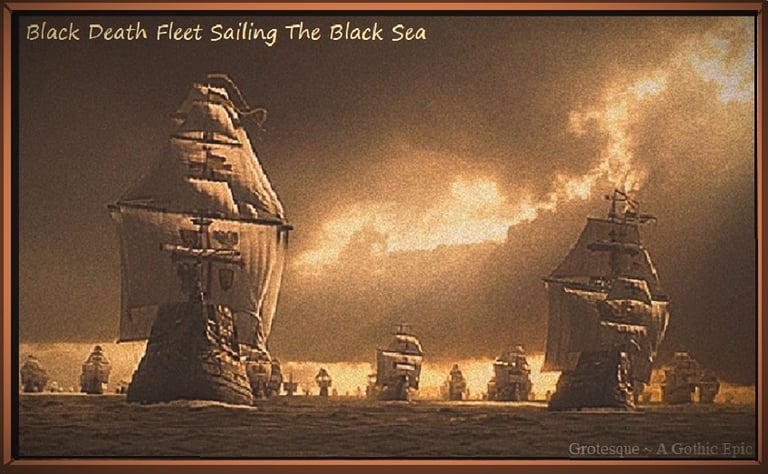
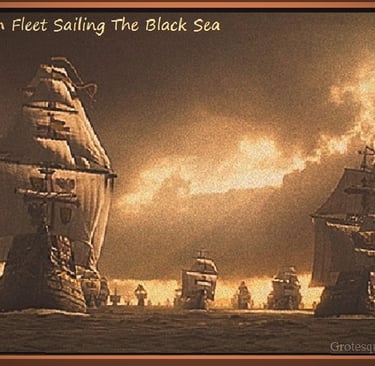
Susan: “How does the Black Death narrative serve the overall story structure?”
Brave: “The Black Death is the novel's structural hinge between the mythic and the historical, and it operates on several levels:
It is the first seal's specific release. Each gatestone, when opened, unleashes a distinct contingent. The Chinese stone releases the Black Death; the French stone releases the cathedral grotesques and devil spirits. The plague is thus the first phase of the medieval Armageddon — the apocalypse is not a single event but a sequential, staged breach, and the Black Death is its opening move.
It bridges the supernatural and the real. The novel's alternate history mechanism is precise: the gatestone's opening is a supernatural event, but its consequence is a historically real catastrophe. The plague that kills 35 million Chinese in 16 years and then sweeps across the Silk Road toward Europe is the same pandemic that historically struck in 1347–1351. The novel doesn't add a fantasy plague to a historical one; it retcons the historical plague as a demonic weapon. The "Black Death" of history is reinterpreted as the direct, intentional result of Lucifael's act.
It creates the narrative timeline. The Chinese gatestone opens in 1331. The plague then takes 16 years to decimate China, then follows trade routes westward. By 1347–1351, it reaches Europe — which is exactly when the story's main European action takes place. The plague is the connecting thread between the Chinese prologue and the French/Italian plot: it is the invisible force already ravaging the world by the time Lazarus is born again at Mountain Mouth. The reader meets the protagonist in a world that is already dying.
It is Lucifael's first weapon. The text is explicit: "The Bubonic Plague was one of Hell's more clever designs" and "her desire was complete annihilation of her adversaries." Lucifael doesn't just escape the seal — she wages war. The plague is a strategic act, directed by her instruction to a pigeon, which dies and becomes the vector. The "chemical shapeshifter" quality — the disease cycling through bubonic, pneumonic, and septicemic forms — mirrors the novel's central theme of the grotesque as a being that refuses to be contained in a single form. The plague itself is a kind of grotesque: it changes, adapts, and multiplies.
It sets the scale of the stakes. Before the reader meets Lazarus, the novel has already established that tens of millions are dead and the death toll is still climbing. The "medieval Armageddon" is not a future threat; it is already underway. This gives the entire story a sense of urgency that a purely supernatural conflict would lack: the apocalypse is not abstract. It is in the air, in the rats, in the rotting corpses lining the roads. The gothic dread is not just atmospheric; it is epidemiological.
It inverts the Enochic Flood. In the original Enochic narrative, God sends the Flood to erase the Nephilim. In the novel, Lucifael sends the plague to erase humanity. The direction of the attack is reversed: the Flood was divine punishment against the hybrid offspring; the Black Death is demonic punishment against the human world. The novel's "second certain destruction" (from the synopsis) is the plague — the anti-Flood, sent by the fallen rather than the divine, targeting humans rather than hybrids.
To summarize, the Black Death is the novel's way of making the apocalypse historical, specific, and already in progress. It transforms the story from a supernatural adventure into a retelling of the 14th century in which the real pandemic is revealed as a demonic act, and the "medieval Armageddon" is not a future prophecy but a present, ongoing, and already catastrophic reality."
( End Fireside Chat III )

George Edmund Graven ~ 2004
Grotesque ~ A Gothic Epic© is legally and formally registered with the United States Copyright Office under title ©#TXu~1~008~517. All rights reserved 2000-2026 by G. E. Graven. Website design and domain name owner: Susan Kelleher. Name not for resale or transfer. Strictly a humanitarian collaborative effort. Although no profits are generated, current copyright prohibits duplication and redistribution. Grotesque, A Gothic Epic© is not public domain; however it is freely accessible through GNO. Access is granted only through this website for worldwide audience enjoyment. No rights available for publishing, distribution, AI representation, purchase, or transfer. This presented literary work is irreversibly-sovereign, free for nonpublishable and personal reading only, and shall not be subject to explicit or implicit agreements, understandings, restrictions or surrenders of any sort; whether public or private, individual or institutional, corporative or governmental, or other. Susan Kelleher maintains all website control, and George (G.E.) Graven maintains all international intellectual property rights for any and all prior and future versions, revisions, translations, digital representations, and variations of the literary work: Grotesque, A Gothic Epic©, until the stated copyright expiration date, when it is properly and legally released into the public domain. Driven by Anonymous Polymath and more. Continued public access is ensured and protected under this non-profit humanitarian effort, forged exclusively as a digital and literary dedication to the late Gothic author: Edgar Allan Poe.