Add your promotional text...




GNO Chapter Excerpts Page ~ B2C1 Quick-Browse
Chapter Quick-Browse For Graven's Grotesque: A Gothic Epic
Book 2 - Chapter 1 Excerpt Teaser
Description: The Crossing ~ 7 Paragraphs
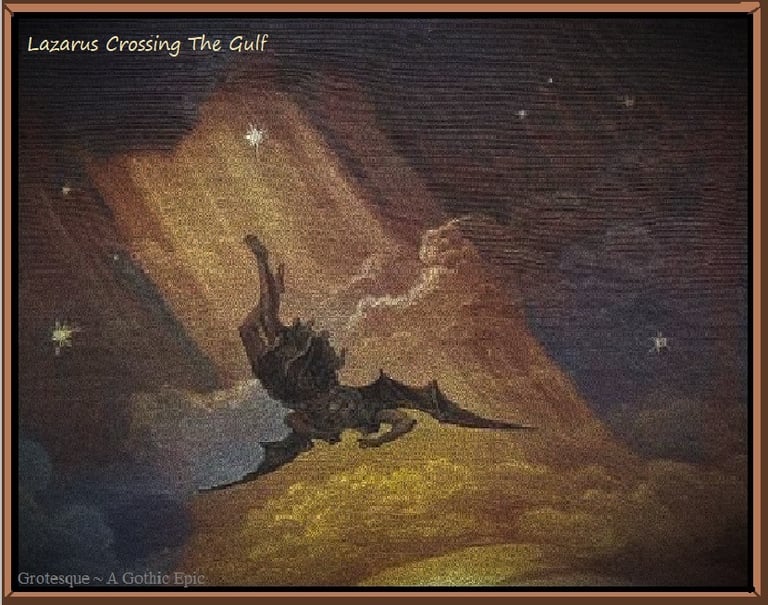
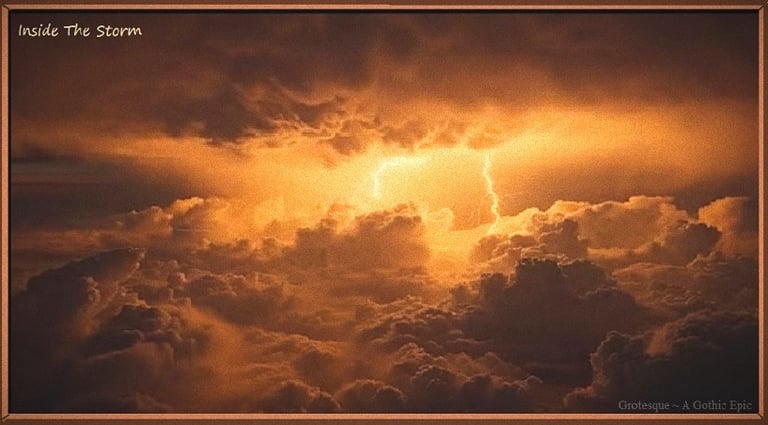
At length, when the last hues of lunar light dwindled, 'twas as though, an immense pall of the deepest darkness had swallowed the whole world. Nonetheless, the Eljo and his ghostly companion could clearly see through the outwardly unbounded shroud of obscurity, even to discern the topmost edge of the front. High overhead, the dense crest of the storm resembled a massive, black, double-headed wedge that deliberately moved to divide the heavens into three parts—the slow-moving and seafaring beast cleaved the skies with its own, perpendicular path. And within its voluminous and illuminating interiors, bright and flowing bolts of light inter-weaved one another as well-defined and ever-branching veins. The eastern horizon was afire with persistent bursts and serpentine glows. As well, the once rumbling heavens now tolled with a cacophony of explosions and crackling thunders, and; in chorus, the massive blasts might have seemed as if to compete with one another for the sharpest crescendos and most deafening expressions. The steady, easterly breeze turned erratic, morphing into an unpredictable and discordant ensemble of intense turbulence. Then, a hard and cold rain claimed centre stage, and drenched Lazarus, chilling him to the core. Still, he never wavered from the shortest course to Corsica, even as he tipped and dipped through treacherous currents. The harsher winds taxed him—they drained his energies as, different pains assailed his extremities. And what was even more, with every seemingly extreme event revealed, both, within and without Lazarus; perhaps the most prevalent matter might have been, that the full brunt of the tempest had not even begun to present itself.
The ghost advanced, slightly ahead of the Eljo, and scolded him, “You shan't outlast the likes of her; she's a ship-eater, Lazarus!”
“I can fly no faster,” Lazarus yelled, through the bellowing wind. “I shall overly tire!”
“'Tis too late for flight; she's now upon us,” Medicci exclaimed. “And she'll rip your wings and cast you down, lest you put the burden of her fury, beneath you!” He thrust an arm, overhead. “Lazarus, you must climb atop her!”
Lazarus shot an eastward glance, peered deeply into the belly of the beast, and saw its forthcoming ferocity—Medicci was on the mark, for to fret, so. Lazarus pursed his lips and clenched his teeth; yet, his initial perception, of utter frustration, hastily faded with the advent of a more potent emotion; and an apparently allusive and profound sense of impending loss, now drowned that formerly fleeting feeling. Within his entire essence, the memory of Friar Nicholas' earthy boots seemed to prevail, even as he doubled himself over, in a move to remove his most cherished, earthly possessions. Without skipping a wing-beat, he shed both of his burdensome, waterlogged boots and sacrificed them to the boundless, black abyss, beneath him. And, with naked feet and a greatly lightened load, the Eljo drew a deep breath, and hardened a pair of newly upturned wings for his eventual, and wholly essential, ascension into the heavens.
Now, thoroughly annoyed by the assiduous storm, which called for the complete and immediate surrender of his leather soles, Lazarus quickly tapped into new reserves, lunging skyward, flying directly for the storm's horned-like head, and toward the double-pronged wedge of its lofty crest. Far below him, angry seas swallowed a pair of nobleman's boots.
'Heave; Press; Draw—Heave; Press; Draw—'
Like a careful mountain climber, scaling the face of a great precipice and, whose limbs remained keenly aware of every rocky crevice and outcropping—or even a frantic fish, swimming steeply upstream, with thrusting fins that worked to minimize all aqueous resistance—Lazarus pressed himself into the heavens whilst allotting an acute attention to the intricate workings of his wings. He counterbalanced their tilt, lift, and lilt, swiftly and repeatedly, against every marked tide of countering winds that moved to diminish his upward, aerial advance. Nevertheless, the heavy shower turned into an outright downpour; and Lazarus lowered his head, for to shield his face from the pouring rain, even as his hunched and unnatural posture placed terrific strains upon the connective fibres betwixt his neck and shoulders. Still higher and higher, he climbed, through the torrent of black rain, intense flashes, and horrendous crashes that marked his every side. Driving crosswinds and massive downdrafts slung him every-which-way; he swerved and veered, struggling to maintain an upwardly direct course. Indeed, Lazarus' lengthy ascension was deliberate and demanding; and his forward progression might have resembled the pathetic pace of a persistent pedestrian who strode against the incline of a muddy hill and, where every, fully drawn step, earned, but a smidgen of the expected distance. The Eljo quickly depleted much of his reserves and found his self, heavily winded and immensely fatigued. Even more, the cold air had since numbed a large part of his senses, and he could no longer localize his strains and pains—collectively, they seemed to converge into a cohesive and omnipotent 'screech', which permeated his entire person. And in the white light of his blinding suffering, Lazarus' thoughts escaped to a single childhood memory, where he recalled himself, sitting in the abbey's Baston Crypt with his father, in the quiet shadows of candlelight glows, and whispering recitals of passage, from the biblical trials of Job. The memory was fleeting, however; as his mind hastily condemned all suggested likeness of his own life, to that of Job's. 'After all,' he gathered, 'he was nothing like the good and godly Job; he was merely a devious and evil Eljo, who had tricked the abbey friars with a face cowl, fled his ordained destiny, and failed to sacrifice himself for, to serve as a sacred, stone fixture, atop God's cathedral.' And Lazarus likewise surmised that the very storm, which he now faced, was conceivably, the very Face of God, which came to stop a fleeing Eljo from freely roaming the world—and, of course, he was certainly no match for the Wrath of God. Lazarus stopped climbing—he levelled off, gasping for breaths in the pounding rain, whilst hardly countering the crosswinds that flung him about.
“No!” Medicci lunged forth and commanded an overwhelming presence in Lazarus' face. “You must persist, a might more; you're nearly atop her, Lazarus!”
Lazarus shook a heavy head and panted, “'Tis too much—shall hold—here.”
“And here, you shall die,” Medicci screamed. “Her crest is just above us; we are nearly clear of her! Climb higher; damn you!”
Perhaps there was a lingering flame left within Lazarus, which remained unfed by the fuels of frustration, desire, or determination. And his new moves might have been born out of sheer desperation; or they may have stemmed from an awesome fervour to survive. Even more, they could have simply been reactionary, with him being completely unaware of the moment, and doggedly responding to barked and trusted orders, which called for his direct action. Whatever the catalyst, Lazarus protested with a hoarse howl as he ripped the drenched and fluttering shirt from off his chest, and slung its added wind-drag into the darkness. And in the same, unbroken motion, he thrust his face toward the pouring heavens and ploughed upward. In an almost mechanical roll of repetitive moves, he established an unrefined rhythm, where his heavy breaths marked every wafting of his pale wings. He blew like a galloping steed, gasping in the thin and frigid air.
“Umph-awe—Umph-awe—Umph-awe—”—his breaths became outbursts of cyclically vented steam, which steadily fogged with his deliberate heaves and strokes. At length, the rains calmed and the winds eased as he verged upon, and penetrated the massive, black sky-wedge. The storm's haze parted itself to reveal a truly glistening moon; and even the stars gleamed sharply with shimmering glows. Lazarus had lastly climbed atop the tempest, and placed her roiling fury squarely beneath him.
A robust and southerly breeze bathed Lazarus, adding lift to his wings and warming them as well. The steady blow of wind allowed him to ride its current in much the same manner as might a stiff-winged and high-flying bird-of-prey. With minimal exertion required for flight, he gathered his strength and wit, both of which, the storm had since taxed in his arduous ascension. And as he soared atop the great tempest's ceiling, Lazarus marvelled over the astounding skyscape that sprawled before him. Beneath a bright moon, the endless, flat clouds resembled a white and misty, panoramic landscape, which all but begged, for to be stridden upon—'twas indeed, a heavenly scene of seemed serenity. Its picturesque presentation of untainted tranquillity belied the raging fury beneath its pale skin, and; if not for the many patches of flashing light that randomly lit its surface, and the immutable and pervasive rumblings of thunder, Lazarus could have imagined that he had truly flown to heaven. Suddenly, the southerly winds died and a deathly stillness hung in the air.
“A heavenly view of the belly of hell, if you will,” Medicci bellowed. “Ready your wings, Lazarus!”
Lazarus looked in Medicci's direction, and found the ghost to be peering upward and behind them, toward the northern skies. He followed Medicci's gaze, and looked over his shoulder to discover a second, much higher storm, which now barrelled in on his heels. “Dear God,” he gasped; and immediately, he felt as though, every drop of hope had bled from his being. Lazarus lowered his head, placed prayer-folded hands over his nose and mouth, and considered his latest and gravest predicament.
Far below him, numerous umber-ish flashes radiated throughout the umbrage of the tempest's hazy ceiling; and high above him, a massive, black nimbus incessantly pulsed with innumerable beacons, of the deepest, emerald green—Lazarus found himself trapped betwixt two distinctly different and converging sea squalls. The lower tempest lumbered eastward, crossing practically perpendicular to Lazarus' path, yet the much higher mistral-head pursued a more south-easterly course, toward the shores of Western Corsica, and hastily moving in the identical direction of Lazarus' intended line of flight.
“Climb higher,” Medicci shouted, “Move ahead, and above the new storm—that we needn't fly through it!”
“'Tis too late,” Lazarus cried. “The winds have stilled; they shall soon turn, even before I reach—”
A frigid wall of bice and gale-force winds slammed into Lazarus' backside, hurling him forward and sending him, nearly head-over-heels. He quickly recovered; however, in the terrific turbulence that now engulfed him, Lazarus desperately sought to maintain his balance. He threw the weight of his arms and legs outward, and flew with a completely sprawling posture. His newly assumed position triggered a terrible drag and significantly slowed his advance, yet the added balance of the unnatural stance saved him from tumbling wildly through the powerful gale.
“The winds have turned—too great—has me, firmly pinned!” Lazarus exclaimed in clearly strained intonations. And if the destructive winds were not enough for Lazarus to attest to the approaching gale's ferocity, he could certainly discern the devastating effects of its profound ferociousness, in the extreme and sublime, and nearly divine events which now unfolded before and beneath him. He witnessed, the once smooth ceiling clouds of the lower tempest, bowing upward and curling away from him to form immeasurable swirling spindles, which might have altogether resembled, the raised hairs on the back of a startled dog. And whilst the gale violated its crest, the tempest passionately churned, its disturbed surface now heaving and leaning like swollen seas. Enormous rifts formed throughout its topside, exposing its lower, lightening clouds—'twas as if a fantastic and gigantic, unseen claw had deliberately raked deep ruts through its head. The ravaging gale, which now trapped Lazarus, was a dense sky-monster that hastily mounted the lesser tempest, corrupted its face, and moved to devour its form. Truly, the gale was greatly more than a ferocious storm—'twas a predator of storms, a high-flying Charybdis, and a Firmamental Tempest-eater.
Medicci sped forth, to hover just above and in front of Lazarus. With a wide wave of his arm, he commanded full attention before shouting, “You must climb, as before, Lazarus! Breach this new storm!”
Lazarus reacted with a stark glare of disapproval.
Medicci thrust an arm in the air and gave him a coarse directive: “Upward and onward, Lazarus!”
“I am no floating ghost who might dismiss the winds upon my every whim, Medicci,” Lazarus decried. “And I cannot fly, forever—or, to Heaven, even! I am but flesh and bone; and regrettably, I am incredibly moved by my lasting pains of strains!” High overhead, the fat, black forehead of the ravenous gale hastily overtook Lazarus, swallowed the whole moon at once, and left him in the heavy shadows of its outwardly solid and bulging, Buddha-like belly....
[ End Excerpt Teaser Text ]
[ Click to Open Entire Chapter ]
Grotesque ~ A Gothic Epic© is legally and formally registered with the United States Copyright Office under title ©#TXu~1~008~517. All rights reserved 2000-2026 by G. E. Graven. Website design and domain name owner: Susan Kelleher. Name not for resale or transfer. Strictly a humanitarian collaborative effort. Although no profits are generated, current copyright prohibits duplication and redistribution. Grotesque, A Gothic Epic© is not public domain; however it is freely accessible through GNO. Access is granted only through this website for worldwide audience enjoyment. No rights available for publishing, distribution, AI representation, purchase, or transfer. This presented literary work is irreversibly-sovereign, free for nonpublishable and personal reading only, and shall not be subject to explicit or implicit agreements, understandings, restrictions or surrenders of any sort; whether public or private, individual or institutional, corporative or governmental, or other. Susan Kelleher maintains all website control, and George (G.E.) Graven maintains all international intellectual property rights for any and all prior and future versions, revisions, translations, digital representations, and variations of the literary work: Grotesque, A Gothic Epic©, until the stated copyright expiration date, when it is properly and legally released into the public domain. Driven by Anonymous Polymath and more. Continued public access is ensured and protected under this non-profit humanitarian effort, forged exclusively as a digital and literary dedication to the late Gothic author: Edgar Allan Poe.